
Triage first: who to call in Pembroke Pines
If anyone is in danger, call 911 before anything else. That means fire, heavy smoke, a person shocked and hurt, anyone unresponsive, or chest pain, confusion or trouble breathing after contact with electricity. Give the address, say it is an electrical emergency and follow the dispatcher's instructions. In a large community with winding streets and gates, tell the dispatcher the community name, the gate entrance to use and any entry number a responder would need, because that detail saves confusion at the worst moment.
If a utility line is down, sagging, sparking or lying across a fence or a car, stay well back and keep others away. Call 911 and the power company. Do not touch anything that may be in contact with the line, and do not walk through puddles near it. After storms, a line can be energized even when nothing seems to be happening.
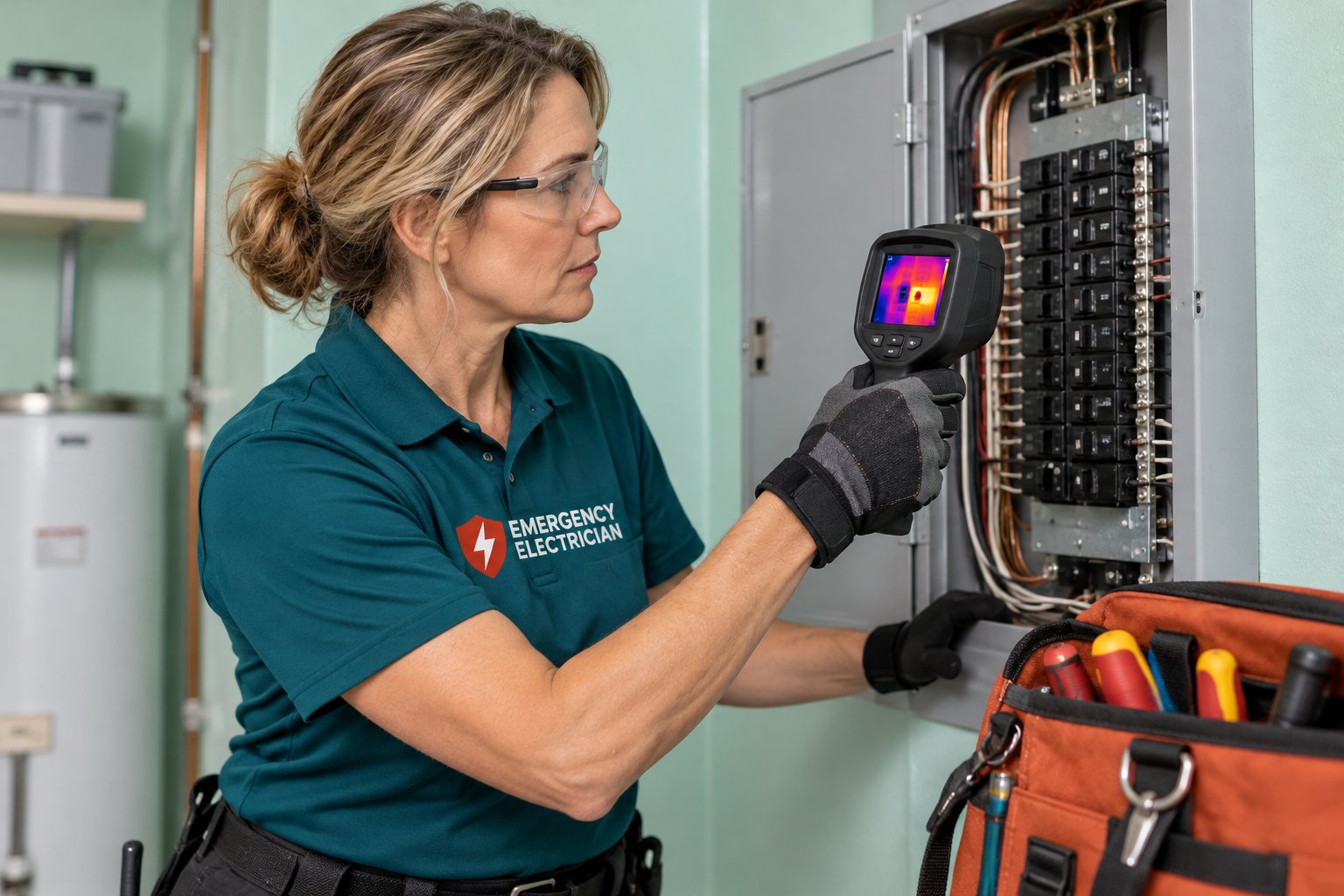
If nobody is in danger but something is wrong, such as a hot or buzzing panel, a burning smell, a breaker that will not reset or a section of the house with no power, call an emergency electrician. The dispatcher will ask safety questions, explain how the visit works and tell you what to leave alone while you wait.
- Fire, heavy smoke, injury or unresponsive person: 911 first.
- Downed or sparking utility line: stay back, call 911 and the power company.
- Smoke, heat or buzzing from the panel: stay clear, call 911 if there is smoke, then an emergency electrician.
- Dead outlets, tripping breakers or a partial outage: call an emergency electrician.
Planned communities and newer wiring
Much of Pembroke Pines was developed as master-planned neighborhoods, with homes built in groups by the same builders to similar plans. Newer construction has real advantages: grounded outlets, modern panels, arc fault and ground fault protection in required locations and wiring sized for typical loads. That does not make it immune. Homes built in groups share their weaknesses too, so a problem found in one house often shows up in its neighbors.
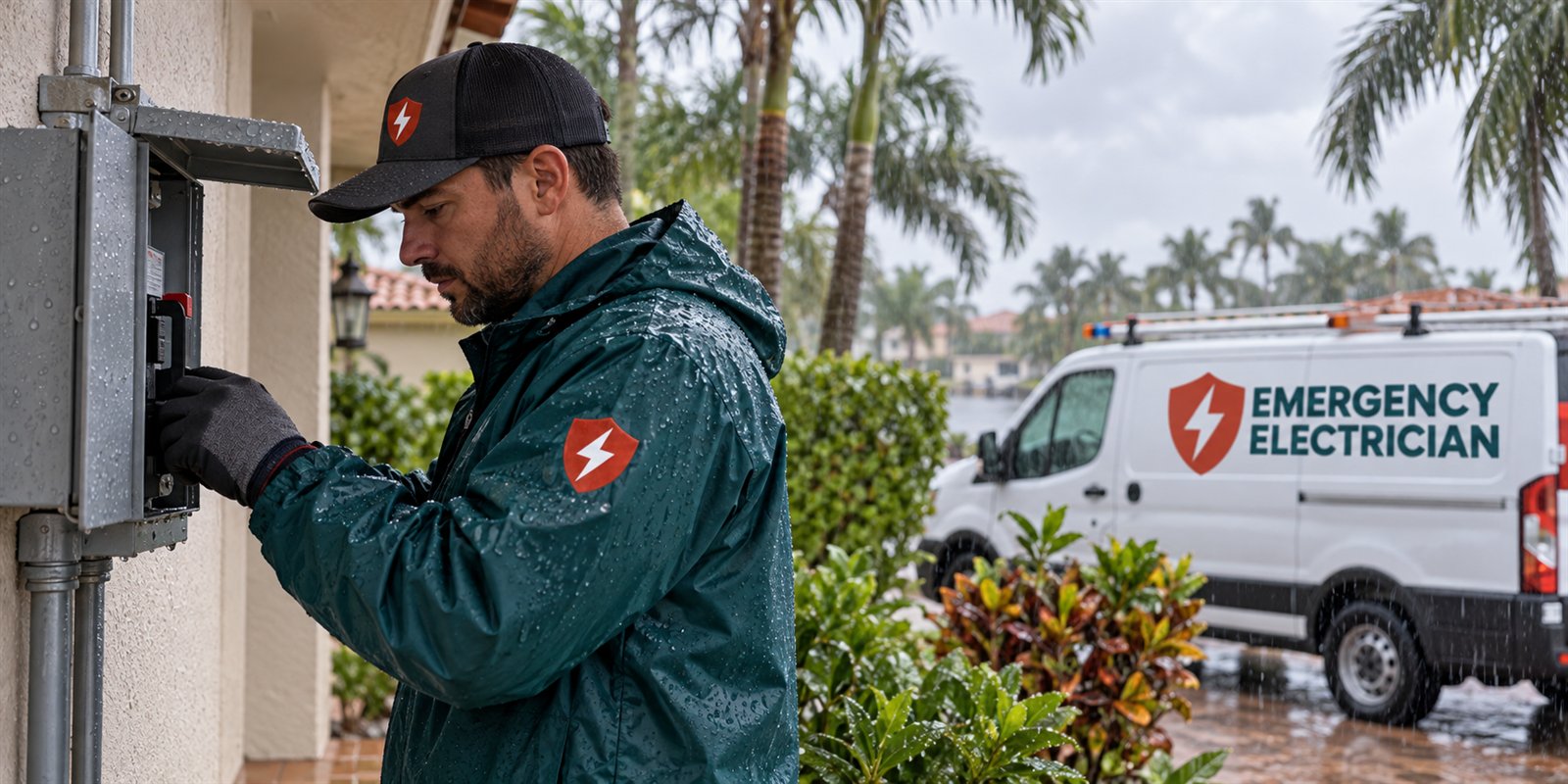
Common faults in newer homes are usually not the brittle-insulation problems of old houses. They are loose connections at devices and breakers, damage from other trades working in the walls and attic, poorly seated receptacles, water entering exterior boxes and equipment that failed early. A loose connection can run hot and scorch a receptacle even in a house that is only a few years old. A warm outlet is a warning in any building, whatever its age.
Because newer homes feel trustworthy, owners sometimes dismiss warning signs. A breaker that trips repeatedly, a switch that crackles or a light that flickers when the air conditioner starts is worth a call. Our page on warning signs that come before an outage lists what to notice, and how electrical fires start explains why a small heat problem deserves respect.
Homeowner associations, gates and who may do what
Association rules touch electrical emergencies in practical ways. Gated entrances need to admit a technician. Some communities require notice before work that affects exterior walls, meters or common lighting. Townhome and villa communities may share walls, roofs and utility connections, which raises the question of whether a given piece of equipment belongs to the owner or the association.
As a rule, the equipment inside and on your own lot belongs to you, while common area lighting, entry gates, shared pumps and community equipment belong to the association. When a gate operator fails or a community light pole goes dark, the report goes to management, not to the owner next door. Our page on HOA and community gate power failure covers that side in detail.
In an emergency, safety comes before paperwork, but a short call to management saves delay. Tell them an electrician is coming, ask whether the gate list needs updating and ask whether any approval is needed for visible work such as a replaced meter base or exterior conduit. Keep any approval in writing. If the problem is a hazard, a good association will want it fixed quickly, and a technician's findings report helps everyone agree on what happened.
Attic air handlers and the faults that start there
In many South Florida homes, the air handler sits in the attic or in a closet beside the garage, with a disconnect nearby and a condensing unit outside. The attic runs hot, the equipment runs for long hours and condensation is a constant companion. Those conditions produce a recognizable group of electrical faults: a blower that hums and does not start, a breaker that trips when the system tries to cycle, a disconnect that is discolored, and water from a clogged drain line that finds its way into electrical parts.
A burning smell from the air handler, a scorched disconnect, a breaker that will not stay on or any sign of smoke should be treated as urgent. Switch the thermostat off to stop the system calling for power. Do not open the disconnect or touch the unit if there is any sign of water, heat or burning. Call, and describe what you saw and smelled. Our page on air handler and outdoor disconnect failure goes through the symptoms and what a technician checks.
Water is a particular concern. A drain pan that overflows can drip onto wiring, a switch or a control board. If you see water near the air handler and the unit is electrical, shut off the thermostat, avoid the area and call. The fix is often two parts: stopping the water and repairing the damage it caused. A technician will look at both.
Lightning, surges and the open sky
Summer afternoons in South Florida bring frequent thunderstorms, and Pembroke Pines, with its wide streets and open lots, has no shortage of exposure. Lightning does not need to hit a house to damage it. A strike on a nearby pole, a tree or the ground can send a surge along power lines, cable lines and even underground pipes. The usual victims are televisions, routers, air handler control boards, garage door openers, smart devices and pool equipment.
After a nearby strike, walk through the house. Check whether breakers have tripped, whether any outlets are dead, whether electronics have failed and whether there is a smell of burning. Do not reset a breaker repeatedly if it keeps tripping. Do not touch a device that is hot, scorched or smoking. Our pages on lightning strike house damage and lightning near misses and electronics explain what can be hidden after a strike.
Protection is worth understanding. A surge protective device at the panel can reduce the risk from surges that arrive through the service, and plug-in protectors add a second layer at sensitive equipment. Neither is a promise against a direct strike. The page on when to add a surge device or generator explains how technicians think about the choice.
| Pembroke Pines situation | Likely electrical cause | First move |
|---|---|---|
| Air handler hums, breaker trips | Failed capacitor, motor or short | Thermostat off, call |
| Burning smell near attic unit | Overheated connection or control board | Thermostat off, stay clear, call |
| Several devices dead after storm | Surge through the service | Check breakers, call |
| Gate or community light dark | Common equipment failure | Report to management |
| Warm outlet in a newer home | Loose connection at the device | Stop using it, call |
GFCI and AFCI devices that will not stay on
Newer homes have more protective devices, and those devices do their job by tripping. A ground fault circuit interrupter protects against current leaking to ground and is required in places such as bathrooms, kitchens, garages and outdoors. An arc fault circuit interrupter watches for the signature of a dangerous arc and is common on bedroom and living circuits. When either one trips repeatedly, it is telling you something about what is on the circuit.
Sometimes the cause is mundane, such as a damaged appliance cord or a vacuum with a failing motor. Sometimes it is moisture in an outdoor box, a nail through a cable behind a wall, a failed device or a shared neutral. The right response is not to replace the breaker with something less sensitive. The right response is to find the cause. Our page on what GFCI and AFCI devices protect against explains the difference, and urgent GFCI and AFCI repair covers what a technician does.
If one trips the moment you plug in a particular appliance, unplug it and leave it unplugged. If it trips with nothing connected, leave it off and call. If you see scorching, smell burning or feel heat, do not keep resetting it. Resetting a device that is protecting you from a fault only repeats the fault.
Garages, EV chargers and added loads
Many Pembroke Pines homes have attached garages, and many owners have added to them: a second refrigerator, a deep chest chiller, a workbench, tools, a compressor and increasingly an electric vehicle charger. Each addition places more demand on circuits that were sized for lighter use. A charger that runs for hours is a continuous load, and it will reveal a loose connection or an undersized circuit by running hot.
A charger, plug or outlet that is warm, discolored or smells of hot plastic should be switched off at the breaker and left alone. A charger that trips its breaker repeatedly or displays a fault should not be bypassed. Our page on urgent EV charger fault explains what usually goes wrong and what the inspection covers.
Garage outlets also face moisture, heat and physical damage. Water from a leaking door, a flooded floor or a storm can reach low outlets. If the garage has taken on water, keep out of it, leave the circuits off and call. Our page on garage and EV after flood covers the extra care that a flooded garage needs.
Who fixes what: utility, association or electrician
In a planned community, the question of responsibility has three possible answers. The utility is responsible for its lines and equipment up to the connection to your building, which usually includes the meter. The association is responsible for common elements. The owner is responsible for the building-side equipment, including the meter base, the panel, the wiring and the fixtures.
If the whole neighborhood is out, it is a utility matter. If only your home is out, check your breakers first, then look at the meter. A burned meter base or a damaged service mast is generally the owner's repair, but the utility must disconnect and reconnect so the work can be done safely. A dead streetlight or a dark community entrance is the association's. Our page on utility or electrician, who fixes what sets out the split.
If you are renting, the question has a fourth answer: the landlord. Report the problem in writing as well as by phone, and read our page on home or rental, which repair is yours. Do not attempt electrical repairs yourself in a rental, and do not let that discourage you from reporting a hazard.
Permits, inspections and records
Some emergency repairs require a permit and inspection through the city's building department. Replacing a device is generally minor. Replacing a panel, a meter base or a service mast, adding circuits or installing a charger usually involves a permit and an inspection. Utility reconnection after a major repair may depend on that inspection, so the schedule can affect when power returns.
A technician on an emergency call should tell you whether a permit is needed and how it will be handled. They may make the situation safe first and arrange the permit and inspection afterward. In a community with an association, check whether the association needs a copy of the permit or approval for visible exterior changes.
Keep everything: the permit, the inspection result, the findings report and photographs of the damage before and after repair. These records matter for insurance, for resale and for the association. Our guides on permits for emergency electrical work and photographing damage before repairs explain what to gather.
What to tell the dispatcher and how to prepare
Give the dispatcher the address, the community name and the gate instructions. Say what happened, what you saw, heard and smelled, and what you have already done. Mention whether the area is wet, whether a breaker is tripped and whether anyone has felt a shock. Say whether anyone in the home relies on medical equipment, and whether children, older adults or pets are present. Our page on what to tell the electrician dispatcher offers a short script.
You will be asked safety questions and told how the visit works, including the service call charge, which is explained on the phone before anyone is dispatched. Quotes are given by phone, and more complicated jobs need an on-site visit first.
Preparation helps. Know where your main breaker is, label the panel, keep flashlights and a charged power bank handy, and keep the gate details and management contact in your phone. Do not ignore small signs: a warm outlet, a flicker or a breaker that trips now and then is the earliest warning you will get. If something looks or smells wrong, call.
Questions people ask
Who do I call first for an electrical emergency in Pembroke Pines?
For fire, heavy smoke, a person shocked and hurt or anyone unresponsive, call 911 first. For a downed or sparking utility line, stay back and call 911 and the power company. For trouble at your property without immediate danger, such as a hot panel, a burning smell or a breaker that will not reset, call an emergency electrician.
My home is fairly new. Can it still have a dangerous electrical fault?
Yes. Newer homes avoid many age-related problems, but loose connections, damage from other trades, water entering exterior boxes and early equipment failures still happen. A warm outlet, a crackling switch or a breaker that trips repeatedly is a warning in any building and deserves an inspection.
What should I do if my attic air handler smells like it is burning?
Switch the thermostat off so the system stops calling for power. Do not open the disconnect or touch the unit if you see water, heat, scorching or smoke, and call 911 if there is smoke or fire. Then call an emergency electrician and describe the smell and what you saw.
Why does my GFCI or AFCI keep tripping?
These devices trip when they detect leakage to ground or a dangerous arc. Causes include damaged appliance cords, moisture in outdoor boxes, a damaged cable in a wall or a failed device. Unplug whatever was connected, do not keep resetting it, and call if it trips with nothing plugged in.
Do I need to tell my homeowner association before an electrician comes?
In an emergency, safety comes first, but a quick call to management helps with gate access and any rules about exterior work. Ask whether visible changes need approval and keep any approval in writing. Common area problems, such as community lighting or gates, are reported to the association rather than fixed by an owner.
How are quotes given for emergency electrical work?
Quotes are given by phone after you describe the problem, and more involved jobs need an on-site visit first. There is a service call charge, explained on the phone before dispatch. The technician explains findings and options in plain terms before any work begins, so you decide at each step.
About "Emergency Electrical Help in Pembroke Pines": call and give us the details, and we will explain what is safe to do while you wait and what the visit would cover. Jobs that cannot be quoted blind need a look on site.
Related pages
- AC Disconnect Burn: A melted or scorched AC disconnect box outside your home is an electrical hazard. See what to do now, who handles which part, and what to tell the dispatcher.
- GFCI and AFCI Explained: A plain explanation of ground-fault and arc-fault protection, where each is used, what each catches, and the limits that still call for caution.
- Gate Power: Community gate, pool pump, or clubhouse lost power? Managers learn the safety steps, what to check first, and what an electrician and a gate vendor each do.
- Miramar: Emergency electrical triage for Miramar: newer suburban builds, open-sky lightning exposure and surge damage. Learn who to call first and what to check.
- Hollywood: Emergency electrical triage for Hollywood, Florida: mid-century block homes, beachside salt corrosion and condo corridors. Learn who to call first and why.
- Plantation: Emergency electrical triage for Plantation: established ranch homes, aging panels and decades of added room loads. Learn who to call first and what to expect.