
Why a repeatable trip is useful information
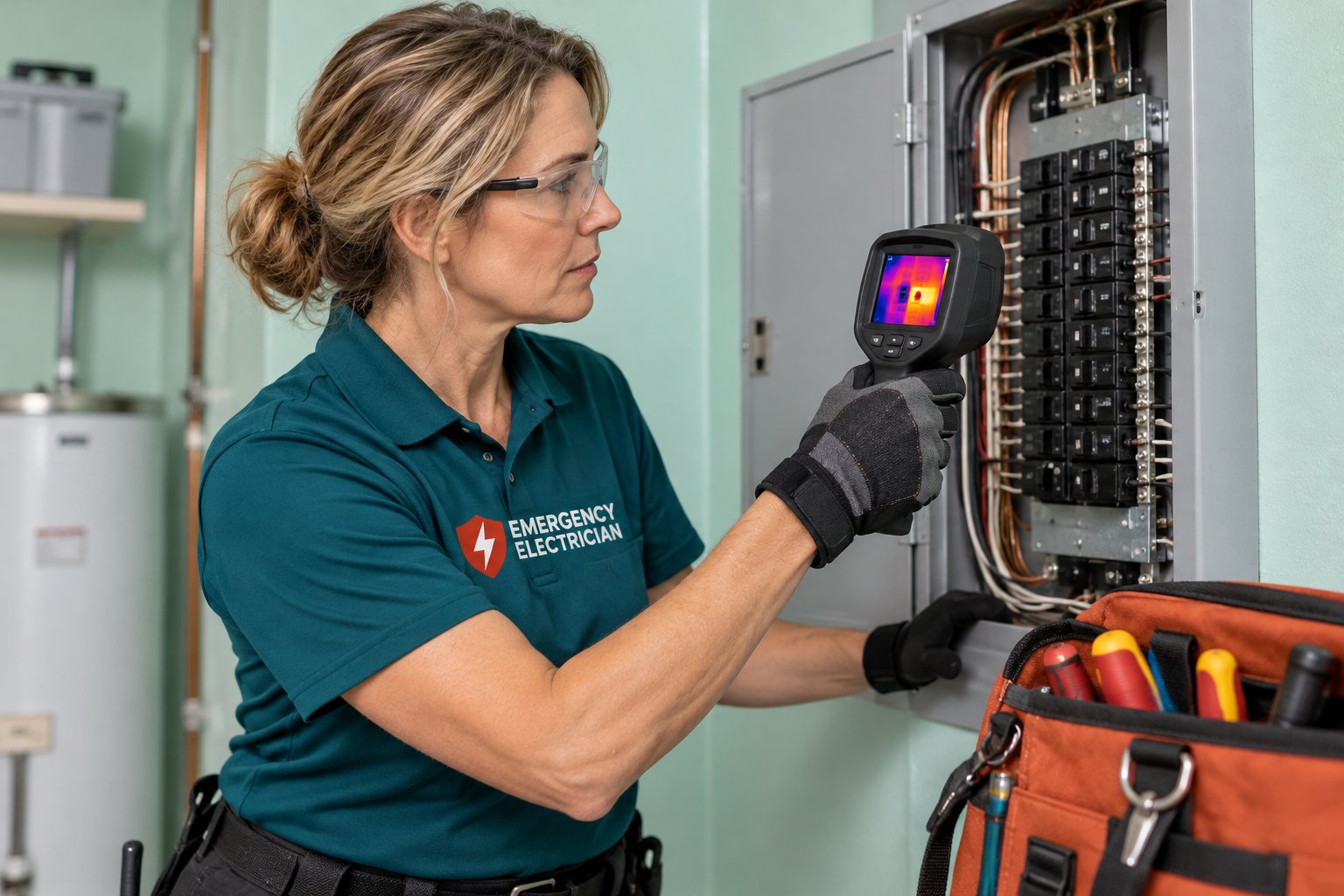
Random breaker trips are hard to diagnose because nothing connects one event to the next. A trip that happens every time the microwave starts, or every time the hair dryer goes on high, is different. The repeat tells you that the trouble is linked to a particular load and a particular circuit, and that narrows the search considerably. A technician can often form a short list of likely causes from that single sentence on the phone.
It also tells you something about urgency. A breaker that trips is doing its job, which is to open the circuit before wiring overheats. If the trip is clean, the breaker is not hot, and nothing smells of burning, the situation is usually an urgent repair rather than a life-safety emergency. If the trip comes with a bang, a flash, a hot breaker or a smell, the situation changes, and the page on the breaker that will not reset and the page on a hot breaker or panel door apply.
Most homeowners notice this problem with kitchen and laundry appliances, window air conditioners in older homes, space heaters in winter, and hair dryers on bathroom circuits. The names change but the question is the same: is the circuit simply being asked to carry more than it can, or is there something wrong that happens to show itself when that appliance draws power?
The two broad causes: overload and fault
A standard breaker trips for two reasons. An overload means the total current on the circuit is higher than the breaker rating for long enough that the thermal part of the breaker heats up and opens. A short circuit or ground fault means a sudden surge of current, far above the rating, because current is taking a path it should not, and the magnetic part of the breaker opens almost at once. Some breakers also trip on arc faults or ground faults, which are separate protections built into the device.
An overload trip usually takes a little time. The appliance runs for a short while, and then the breaker clicks off. A short or a ground fault trip is immediate: the moment the appliance starts, or the moment you plug it in, the breaker goes. Telling these apart is the most useful thing you can note for the technician. Did it trip right away or after running for a while?
The pattern tells you where to look. Overload points toward how many things share the circuit and how much the appliance draws. An immediate trip points toward the appliance, its cord and plug, or the outlet and wiring. Neither is something to solve by swapping in a bigger breaker, which is a dangerous shortcut covered later on this page.
Overload: when the circuit is simply carrying too much
Many older homes in South Florida have kitchens and bedrooms wired with a small number of general circuits that were planned long before microwaves, air fryers, space heaters and window air conditioners were common. When a high-draw appliance shares a circuit with lights, a television and a refrigerator, the total can exceed what the circuit is built to carry. The breaker trips at the moment the new load pushes the total over the line.
Typical examples are a microwave and a toaster on the same kitchen run, a hair dryer in a bathroom shared with lights and a fan, a window air conditioner in a bedroom that also feeds outlets in the hallway, and a space heater in a room on a lighting circuit. Some of these appliances are meant to be on a dedicated circuit, and plugging them into a general one is a mismatch between the appliance and the house.
A true overload is not harmless just because the breaker handled it. A circuit that is repeatedly pushed to its limit stresses every connection on the way, and loose or aging connections get hot. If the trip is accompanied by warm plugs or cords, a warm outlet or a faint smell of hot plastic, it moves from nuisance to urgent. See the page on outlets that feel warm or look discolored for what to watch for.
- Trip happens after the appliance has run for a short time
- Other devices on the same circuit were running at the same time
- The appliance is a heater, microwave, toaster, dryer or air conditioner
- The trip stops if you unplug other things from the circuit
- Plugs, cords or outlet covers feel warm
Fault: when the appliance or the wiring is the problem
A fault trip is immediate and often accompanied by a loud click or a brief flash at the outlet or the appliance. The appliance may have a failed heating element, a cracked cord, a damaged motor winding or water inside it, any of which can send current to ground. A window unit with a failing compressor, a microwave with a failing high-voltage part or a hair dryer with a frayed cord are typical examples.
The wiring can be the cause too. A damaged cable in a wall, a loose neutral at an outlet, a nail through a wire or an outlet box filled with moisture can all produce an immediate trip, but only when the load is large enough to expose the fault. A circuit with a hidden fault may seem fine with a lamp plugged in and trip at once with a hair dryer, because the higher current drives the leak. This is why a circuit that tests fine with small loads can still be defective.
To tell the appliance from the circuit, the simplest safe observation is whether the same appliance trips a different circuit and whether other appliances trip this one. Moving a window air conditioner to another room's outlet, for example, can show whether the unit is the culprit. Do this only with a dry, undamaged cord and plug, in a dry location, and stop immediately if anything smells hot or sparks. If you are unsure, leave it for the technician.
A simple safe way to gather the pattern
You can collect useful information without taking any risks. Write down which appliance is involved, which room, and which breaker trips, if the panel is labeled. Note whether the trip is immediate or delayed, whether it happens every time or only sometimes, and whether other devices were running. Note the time of day and the weather, since humidity and heat can affect motors and moisture-prone outlets.
Look at the appliance and its cord without touching anything that has been warm. A cord with a cracked jacket, a plug with discolored prongs or a smell of hot plastic around the plug are all worth reporting. Check that the appliance is dry and that nothing was spilled on it. Do not open the appliance, do not open the outlet and do not remove the cover of the panel. The technician will do those steps with the right instruments.
If the breaker resets and holds with the appliance unplugged, that points toward the appliance or the load. If it still trips with nothing plugged in, the fault is in the circuit, and the circuit should stay off. That second case is a different kind of call, closer to the one described on the page about a breaker that will not reset.
The dangerous shortcut: a bigger breaker
Some people, or some handymen, respond to a nuisance trip by replacing the breaker with a larger one. The trips stop, and the problem seems solved. It is one of the most dangerous things you can do to a house, because the wire in the wall is sized for the original breaker. A larger breaker lets more current flow before it opens, and the wire can overheat long before that happens. The breaker no longer protects the wire, and the trip you wanted to stop was the warning.
Taping a breaker handle in the on position, holding a breaker with a clip or resetting it repeatedly by force are equally dangerous. A breaker that will not stay on is telling you something. Overriding it hides the signal and leaves the heat.
If you suspect that a previous owner or a previous repair put in a larger breaker, tell the technician. They will check the wire size against the breaker size and correct any mismatch. A mismatched breaker is a hazard in its own right, even if nothing has tripped lately, and it is the kind of thing that a visit can find. The page on older home electrical red flags lists others to look for.
When it stops being a nuisance and becomes an emergency
Call 911 first if you see flame, smoke, a glowing outlet or a melting plug, or if anyone has been shocked. Treat these exactly as you would the signs on the pages about smoke from a panel or sparks at an outlet. A trip that comes with any of those signs is not a nuisance trip.
Call an electrician promptly, even at night, if the breaker feels hot to the touch, if the panel makes a buzzing or crackling sound, if a trip repeats several times in a row, if lights flicker when the appliance runs, or if more than one breaker is affected. These are signs that the problem may be at the panel, at a main connection or in a shared neutral, rather than at the appliance.
A next-day visit may be reasonable when the trip is clean, the appliance is the only thing involved, nothing is warm and the circuit stays off when you unplug the appliance. In that case, leave the appliance unplugged, leave the breaker off or avoid using that outlet, and book a visit. If you cannot tell which case you are in, call and describe it. The dispatcher can help you decide.
Common household examples and what they suggest
A microwave that trips the kitchen breaker as soon as it starts may have a failed internal part, or it may share a circuit with other heavy loads. A repeat of the trip with the microwave alone on the circuit points toward the unit. A repeat only when the toaster is also on points toward overload. In a rental, report it to the landlord as well, since kitchen circuits are usually part of the property.
A hair dryer that trips the bathroom GFCI or breaker may be tripping a ground fault device because of moisture in the dryer, the cord or the outlet. Bathrooms in humid climates are tough on outlets, and a GFCI that is aging can trip too easily. The page on a GFCI that will not reset covers the device side of that story.
A window air conditioner that trips the bedroom circuit on a hot afternoon is a classic South Florida call. Compressors draw a surge when they start, and a circuit with several outlets already in use may not manage it. A window unit that trips immediately and repeatedly may also be failing internally. In either case, the unit should not be run on an extension cord, and the space heater and the air conditioner should never share an outlet strip.
- Microwave trips as it starts: unit fault or crowded kitchen circuit
- Hair dryer trips a bathroom outlet: moisture, cord damage or an aging GFCI
- Window air conditioner trips on start: surge on a shared circuit or failing compressor
- Space heater trips after a short run: overload, often on an extension cord
- Dryer or oven trips a double breaker: heating element, cord or terminal fault
What the technician will do and what to prepare
The technician will start by asking about the pattern you noted, then look at the panel, the breaker involved and the wire connected to it. They will check that the breaker and wire are matched, test the circuit with and without the appliance, and measure current draw where useful. If a shared neutral or a loose connection is suspected, they will open the relevant outlets or the panel with the power off and inspect the connections.
Repairs range from replacing a worn outlet or a tired breaker, to splitting a crowded circuit, to running a dedicated line for a big appliance. Some solutions are quick and some need planning. Complicated jobs need an on-site visit before a quote can be given, and the service call charge is explained on the phone before dispatch. Quotes for simple work are given by phone.
To prepare, leave the appliance unplugged, clear the area around the panel and the outlet, and have the make and model of the appliance on hand. If the appliance is in a rental, tell your landlord or manager. Call now with the pattern you noted, and the dispatcher will help you decide how quickly the visit should happen.
Questions people ask
Why does my breaker only trip when I use one appliance?
The appliance may draw more current than the circuit can carry with everything else on it, or the appliance or its cord may have a fault that only shows when it runs. A trip after a short run suggests overload. An immediate trip suggests a fault in the appliance, cord, outlet or wiring. Noting which one you see helps the technician.
Is it safe to keep resetting the breaker?
One reset to see whether the trip was a one-time event is understandable. Repeated resets are not. Each reset puts current back into whatever caused the trip, and a fault can heat wiring or an outlet. If the breaker trips again, leave it off, unplug the appliance and call. Never hold or tape a breaker on.
Can I replace the breaker with a larger one to stop the trips?
No. The wire in the wall is sized for the breaker that protects it. A larger breaker lets more current flow before opening, which can overheat the wire inside the wall. The trips stop but the danger rises. Only a qualified technician should decide on breaker size, based on the wire.
The appliance works fine in another outlet. Does that mean the appliance is okay?
It suggests the appliance is not the main problem, but it does not clear everything. The first circuit may be overloaded, or its wiring or outlet may have a fault. A technician can test the circuit with the right instruments. Leave the first outlet unused until it has been checked.
Is this an emergency or can it wait until tomorrow?
It is an emergency if there is smoke, flame, a melting plug, a hot breaker, a buzzing panel or a shock. If the trip is clean, nothing is warm and the circuit stays off when the appliance is unplugged, a next-day visit may be reasonable. If you are unsure, call and describe what you see. The dispatcher can advise on timing.
What does a visit for a repeating trip usually involve?
The technician checks the breaker and wire match, tests the circuit with and without the appliance, inspects outlets and connections, and may measure the current drawn. The fix may be a worn outlet, a tired breaker, a split circuit or a dedicated line. Simple work is quoted by phone. Complicated jobs need an on-site look first, and the service call charge is explained before dispatch.
About "The Breaker Trips Every Time One Appliance Turns On": call and give us the details, and we will explain what is safe to do while you wait and what the visit would cover. Jobs that cannot be quoted blind need a look on site.
Related pages
- Breaker Re-Trips: A breaker that trips again right after you reset it points to a hard fault. Learn why repeated resetting is risky and what to do and tell the electrician.
- Hot Panel: A hot breaker or panel cover can mean a loose connection or overload. Learn what warmth is normal, when to call 911, and what to do before an electrician.
- Warm Outlet: A warm, browned or melted outlet is a heat warning. Learn how to read the damage, what to unplug, when it is a same-day call, and what a technician checks.
- GFCI Won't Reset: A GFCI that will not reset means a fault or a failed device. Learn what safe checks you can do, what to avoid, and how to describe the problem by phone.
- Reading a Tripped Breaker: What breaker handle positions mean, what a tripped breaker is telling you, and which details to pass along by phone, all without opening the panel.
- Burning Smell: A burning smell with no flames is still a warning. Learn how to choose between 911 and an urgent electrician call, and what to do while you wait.