

Triage first: who to call in Deerfield Beach
In any life-threatening electrical situation, call 911 first. That covers visible fire, heavy smoke, a person shocked and hurt, anyone unresponsive and anyone with chest pain, confusion or trouble breathing after contact with electricity. Give the address, the building and unit, say it is an electrical emergency and follow the dispatcher's instructions. Do not wait to see whether a shocked person recovers.
If a utility line is down, sagging or sparking, stay far back and keep people and pets away. Call 911 and the power company. Do not touch a fence, a vehicle, a metal railing or a puddle near the line. Near the coast, wet ground and salt spray make any contact more dangerous.
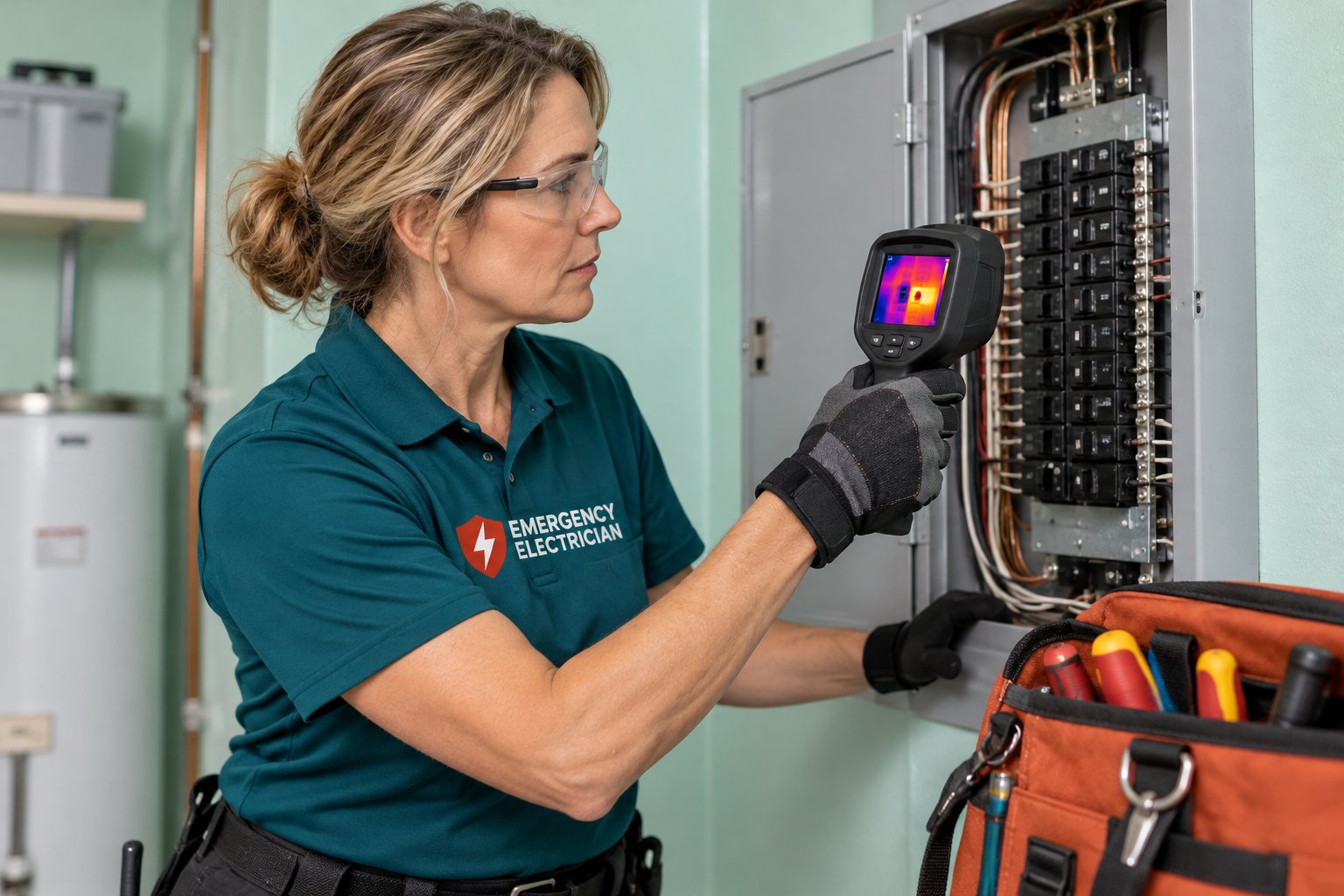
If nobody is in danger but something is clearly wrong, such as a hot or buzzing panel, a burning smell, a plug melted into an outlet, a breaker that will not reset or a unit that has lost power, call an emergency electrician. The dispatcher will ask safety questions first, explain how the visit works and tell you what to leave alone while you wait.
- Fire, smoke in the building, injury or unresponsive person: 911 first.
- Downed or sparking utility line: stay back, call 911 and the power company.
- Smoke, heat or buzzing from a panel: stay clear, 911 if there is smoke, then an emergency electrician.
- Dead unit, tripping breaker or warm outlet: call an emergency electrician and tell building management if you live in a condo.
Retirement-era condominiums and their original wiring
Deerfield Beach has many condominium buildings and garden-style communities built decades ago for retirees. Many have been loved and maintained, and many still carry the original electrical systems: the same risers, the same meter rooms, the same unit panels and much of the same branch wiring behind the walls. Systems that old have a history of small repairs, and the people who made them are often gone.
Common findings in units of that age include small panels with limited breaker spaces, wiring with insulation that has dried or cracked, ungrounded outlets, aluminum branch wiring in some buildings from a certain period and splices made long ago by someone who has since moved on. The units themselves have been renovated at different times by different owners, so adjacent units may have very different wiring.
None of this means a unit is unsafe. It means the unit deserves an inspection if anything seems off. Our page on older home electrical red flags lists the signs, and urgent aluminum wiring failure explains one of the specific hazards of that era.
Condo ownership lines and who handles what
In a condominium, the unit owner is generally responsible for the panel inside the unit and everything it feeds. The association is responsible for the common elements: meter rooms, risers, feeders, hallway lighting, pumps, elevators and the building's main equipment. The exact boundary is set by each building's documents and often falls at the unit's panel or its meter.
That split matters in an emergency. A tripped breaker in your unit is yours to handle. A failed feeder or a burned connection in the meter room belongs to the association. A neighbor's experience helps: if others on your floor are dark too, the building side is the likely source and management should be called at once. If only you are dark, check your own panel first.
Our pages on condo unit power loss and who to call and condo common area outage go through the cases, and condo electrical room fire risk explains the hazards in shared rooms.
| Deerfield Beach setting | Common electrical problem | First move |
|---|---|---|
| Older condo unit | Overloaded small panel, warm outlets | Reduce load, call |
| Condo meter room | Heat, corrosion, burning smell | Leave, 911, management |
| Balcony or lanai outlet | Corroded, water in box | Stop using, call |
| Older single-family home | Aged wiring, added loads | Breaker off if tripping, call |
| Beachside exterior equipment | Salt corrosion at disconnect or meter | Stay clear if wet, call |
Window units, space heaters and added loads in older apartments
Older condominium units were wired when residents expected few electrical conveniences. Today, residents may run a window or wall air conditioner, a dehumidifier, a space heater on a cool night, a microwave, an air fryer, a portable oven and a television, and plug several of them into the same outlet through a power strip. Circuits that were never meant to carry that much run warm, and weak connections get weaker.
Heat is the sign. A plug, a cord or an outlet that is warm, a power strip that smells of hot plastic or a wall plate that is discolored is telling you the circuit is overloaded or a connection is loose. Unplug everything on that outlet, stop using it and call. Do not keep resetting a breaker that trips under load.
Our pages on extension cord and power strip limits and space heater and window air conditioner circuit safety explain the limits, and a plug melted into an outlet tells you what to do if it has already happened.
Salt air, humidity and slow corrosion near the water
Deerfield Beach sits on the Atlantic, and salt air is part of the environment for a large share of its buildings. Salt settles on meter bases, disconnects, exterior panels, balcony outlets, light fixtures, gate operators and pool equipment. With humidity, it corrodes terminals and rusts enclosures. A connection that corrodes runs hot, and heat damages the insulation around it long before a breaker trips.
Corrosion also hides. A rusted panel cover can conceal water inside. A corroded neutral can produce voltage imbalances, so some lights run bright while others dim. A balcony outlet that works only on dry days is telling you that moisture is getting in. Look at your exterior equipment now and then. White or green crust, rust trails, water marks, covers that no longer close and disconnects that stick are reasons to call.
Our guide on warning signs that come before an outage lists the signs, and urgent exterior lighting repair covers what a technician checks on fixtures that live in the weather.
- White or green crust on terminals or breakers.
- Rust trails beneath panels, meter bases or disconnects.
- Water marks or dampness inside enclosures.
- Outdoor outlet covers that are cracked, missing or ill-fitting.
- Lights that flicker or breakers that trip when it rains.
Older single-family homes and mid-century additions
Away from the high-rises and the garden condos, Deerfield Beach has neighborhoods of single-family homes built across several decades. Many have been remodeled, with additions, screened rooms, converted garages and pools. A remodel tends to add circuits to an existing service without replacing the panel, so the home carries more load than it was designed for.
The usual symptoms are familiar: a panel with no room, double-tapped breakers, handles that do not match the wire, outlets that spark, switches that crackle and lights that dim when the air conditioner starts. Hidden problems include splices in attics, wiring that was extended with tape and cable chewed by rodents. A fault in a hidden box can arc without tripping a breaker.
A technician can inspect the panel, test major circuits and tell you what is safe and what is not. Our pages on panel repair versus panel replacement and urgent attic wiring repair explain what repair can mean and when replacement is the better choice.
Power loss in a unit: a calm sequence of checks
If your unit or house loses power, start by finding out whether the loss is yours alone. Look outside, check the hallway lights and ask a neighbor. If others are dark too, call management or check the utility's outage information. If only you are dark, check your panel with dry hands from a dry floor using a flashlight. Look for a tripped breaker, including the main. A tripped breaker sits between on and off.
If a single breaker has tripped, switch it fully off and then on once. If it trips again, leave it off and unplug what is on that circuit. If the main has tripped and will not stay on, leave it off. If nothing is tripped and the unit is dark, the cause may be a failed main, a loose connection or a loss of supply, and that is a call to an electrician and, in a condo, to management.
Do not use candles. Do not run a generator in a unit, on a balcony or in a garage. If anyone depends on powered medical equipment, tell the dispatcher and call the supplier. Our page on household emergency plan for power loss helps you prepare before it happens.
Storm season on the coast
Hurricane season brings predictable electrical hazards to a coastal city. Wind drives debris and limbs into overhead lines. Storm surge and heavy rain flood ground-level equipment, including meter rooms, garages and parking-level panels. Lightning damages electronics and air handlers. Salt-laden water leaves corrosion that continues to attack equipment after the water recedes.
Before a storm, learn where your main breaker is and how to shut it off. Photograph the panel and the meter. Raise valuable electronics off the floor. In a condo, ask management how the building handles electrical rooms before and after flooding. Our before-hurricane electrical checklist explains more.
After a storm, do not enter standing water near electrical equipment, stay away from downed lines and do not switch on any system that was wet, above all after saltwater contact. Our pages on saltwater surge electrical damage and flooded home electrical first steps explain why equipment that seems fine may fail later.
Smoke alarms, carbon monoxide alarms and emergency lighting in older buildings
Life-safety equipment in an older building needs the same electrical attention as everything else. Hardwired smoke alarms with battery backup, carbon monoxide alarms, exit signs and emergency lights all depend on a working supply and a good battery. As buildings age, alarms reach the end of their service life, batteries weaken and connections loosen.
A chirp is a message. It can mean a weak battery, an alarm that has expired or a power problem on the circuit. Do not silence an alarm and forget it. If an alarm sounds with smoke, a burning smell or any sign of fire, leave and call 911. If it sounds for carbon monoxide, get everyone into fresh air and call 911 as well.
Our page on smoke alarm chirping and power issues explains the electrical causes, and urgent smoke and CO alarm wiring explains what a technician checks when interconnected alarms fail. In a condo, tell management about stairwell and corridor emergency lights that are out or flickering. They are building equipment and need prompt repair.
Permits, inspections and paperwork in older buildings
Work on panels, feeders, meter bases and service equipment usually needs a permit and an inspection through the city, and a condo may also require association approval and proof of insurance. An older building may have conditions that must be addressed when a permit is opened, such as old wiring that is not up to current standards. A technician should explain what applies and how it will be handled.
In an emergency, safety comes first. The technician may make the situation safe and arrange the permit and inspection afterward. After a major repair, the utility may wait for the inspection before reconnecting service.
Keep records: a written findings report, the permit, the inspection result and photographs of the damage before repairs. Send a copy to management when the problem involved common equipment. Our guides on permits for emergency electrical work and getting a written findings report explain what to ask for.
What to tell the dispatcher and how to prepare
Give the dispatcher the address, the building and the unit and floor. Say what happened, what you saw, heard and smelled and what you did. Mention whether the area is wet, whether a breaker is tripped, whether anyone has felt a shock and whether anyone relies on medical equipment. Give the manager's name and number if you live in a condominium. Our page on what to tell the electrician dispatcher offers a short script.
You will be asked safety questions and told how the visit works, including the service call charge, which is explained on the phone before anyone is dispatched. Quotes are given by phone, and more complicated jobs need an on-site visit first.
To prepare, learn where your panel is, label it, keep a flashlight and a charged power bank near the door and keep management's number in your phone. Do not ignore small signs. A warm outlet, a flicker or a breaker that trips again and again is the earliest warning you get. If something looks or smells wrong, call.
Questions people ask
Who do I call first for an electrical emergency in Deerfield Beach?
For fire, heavy smoke, a person shocked and hurt or anyone unresponsive, call 911 first. For a downed or sparking utility line, stay back and call 911 and the power company. For trouble at your property without immediate danger, such as a hot panel, a burning smell or a breaker that will not reset, call an emergency electrician.
Is wiring in an older Deerfield Beach condo unsafe?
Not necessarily. Many older units work for years after careful repairs, but insulation dries, connections loosen and loads have grown. Warm outlets, frequent trips, flickering lights and a crowded small panel are signs worth inspecting. A technician can explain what is safe, what is urgent and what can wait.
My plug and outlet feel warm when I run a space heater. What should I do?
Unplug the heater and anything else on that outlet and stop using it. Heat means the circuit is overloaded or a connection is loose. Do not keep resetting a breaker that trips, and do not use a power strip for a heater. Call an electrician to inspect the outlet and circuit.
Who is responsible for a problem in the building's electrical room?
Generally the association is responsible for common elements, including meter rooms, risers and feeders, while the owner is responsible for the unit panel and wiring. The exact line is set by the building's documents. Report any problem in a shared room to management, and call 911 if there is smoke or fire.
Why do outdoor and balcony outlets fail so often near the coast?
Salt air and humidity corrode terminals and let moisture into boxes and covers. Corrosion raises resistance, which creates heat, and moisture can trip ground fault devices or cause shorts. Cracked covers, rust trails and outlets that work only on dry days are signs to call for an inspection.
How are quotes given for emergency electrical work?
Quotes are given by phone after you describe the problem, and more involved jobs need an on-site visit first. There is a service call charge, explained on the phone before dispatch. The technician explains findings and options in plain terms before any work begins, so you decide at each step.
About "Emergency Electrical Help in Deerfield Beach": call and give us the details, and we will explain what is safe to do while you wait and what the visit would cover. Jobs that cannot be quoted blind need a look on site.
Related pages
- Unit vs Building: Your condo unit lost power. Sort a unit panel problem from a building fault, know who to call first, and what to tell the manager and the electrician.
- Old Home Red Flags: Cloth wiring, two-prong outlets, fuse panels and other red flags in older homes: what each one means, how urgent it is, and what to do about it.
- Saltwater Damage: Why storm surge saltwater damages electrical equipment differently than rain: salt residue, hidden corrosion in panels and how damage spreads over time.
- Pompano Beach: Emergency electrical triage for Pompano Beach: beachfront condos, Intracoastal homes, marine exposure and older panels inland. Learn who to call first and why.
- Boca Raton: Emergency electrical triage for Boca Raton: high-rise condos, gated communities and homes with extensive landscape and pool lighting. Learn who to call first.