
Triage first: when to call 911 and the utility
If you see flames, smoke, or sparking from the panel, the meter, or the charger, or smell burning, call 911 and keep everyone away. If a person has been shocked, call 911 first. If water is flowing or standing in the garage and the panel is within it, do not enter. A person standing in water while touching a panel or a metal object connected to the electrical system can be seriously injured.
If the garage is flooded and the meter is there, or if the meter or service wires are under water, the utility may need to disconnect service before anyone enters. In many parts of the area the utility is FPL, and some cities have their own municipal systems. Call the utility's emergency line, and tell them that water has reached the meter or the panel. Our page on the power company disconnect and reconnect process explains how that typically goes.
If there is no fire and nobody is hurt, the garage is still a hazard zone. Do not wade in to check the damage. Do not go in to move the car if water is around the panel or if the charger is submerged. A vehicle is replaceable, and a person is not. Stay out until the power to the garage is confirmed off by the utility or by a qualified technician, and until the standing water has gone.
Why garages are the weak point in a flood
Garages are built close to grade and often sit slightly lower than the house, with a sloped floor and a door at the street side. When water rises, the garage takes it first. Because garages are treated as utility spaces, builders often place electrical equipment there to save interior room: the main panel or a sub-panel, the water heater, a washer and dryer, a freezer, and increasingly an EV charger.
Equipment placed low on the wall is the most exposed. A panel mounted at a convenient height may have its bottom edge only a foot or two above the floor, and the conduits entering from below, or the wires entering at the bottom, can draw water in. A charger wall unit placed at knee height, or a charging cable laid across the floor, can be submerged by even a modest flood. The panel, the charger, and the outlets near the floor each have different vulnerabilities, and each needs a different kind of check.
In coastal and canal-front areas the water may be salty or brackish. Saltwater is much more corrosive and conductive than fresh water, and the damage continues after the water leaves. See saltwater surge electrical damage for what that means for panels and wiring.
The panel in a flooded garage
A panel that has been touched by floodwater is a serious concern. Water that reaches the breakers, the bus bars, or the neutral and ground bars leaves a conductive film. Minerals, salt, and dirt dry on the metal, and corrosion starts. The panel may look fine after drying, but it can fail days or weeks later, with arcing, overheating, or breakers that fail to trip. Our page on water in the electrical panel describes what happens in more detail.
Even a panel that did not get wet can be at risk. Water that enters the conduits can travel into the panel enclosure from the wiring side, and humidity inside a flooded garage can condense on cool metal. A panel that sat in a closed, humid garage for days after a flood can show corrosion without ever being touched by standing water.
Because of this, the common outcome after a panel is wet is replacement rather than cleaning, though that decision belongs to the technician after inspection. Do not open the panel yourself to look. Do not switch the main breaker if the panel is wet or the floor is wet. Our guide on when it is safe to use the main breaker sets out the conditions. For the replacement process, see emergency panel replacement.
EV chargers and flood: a modern problem
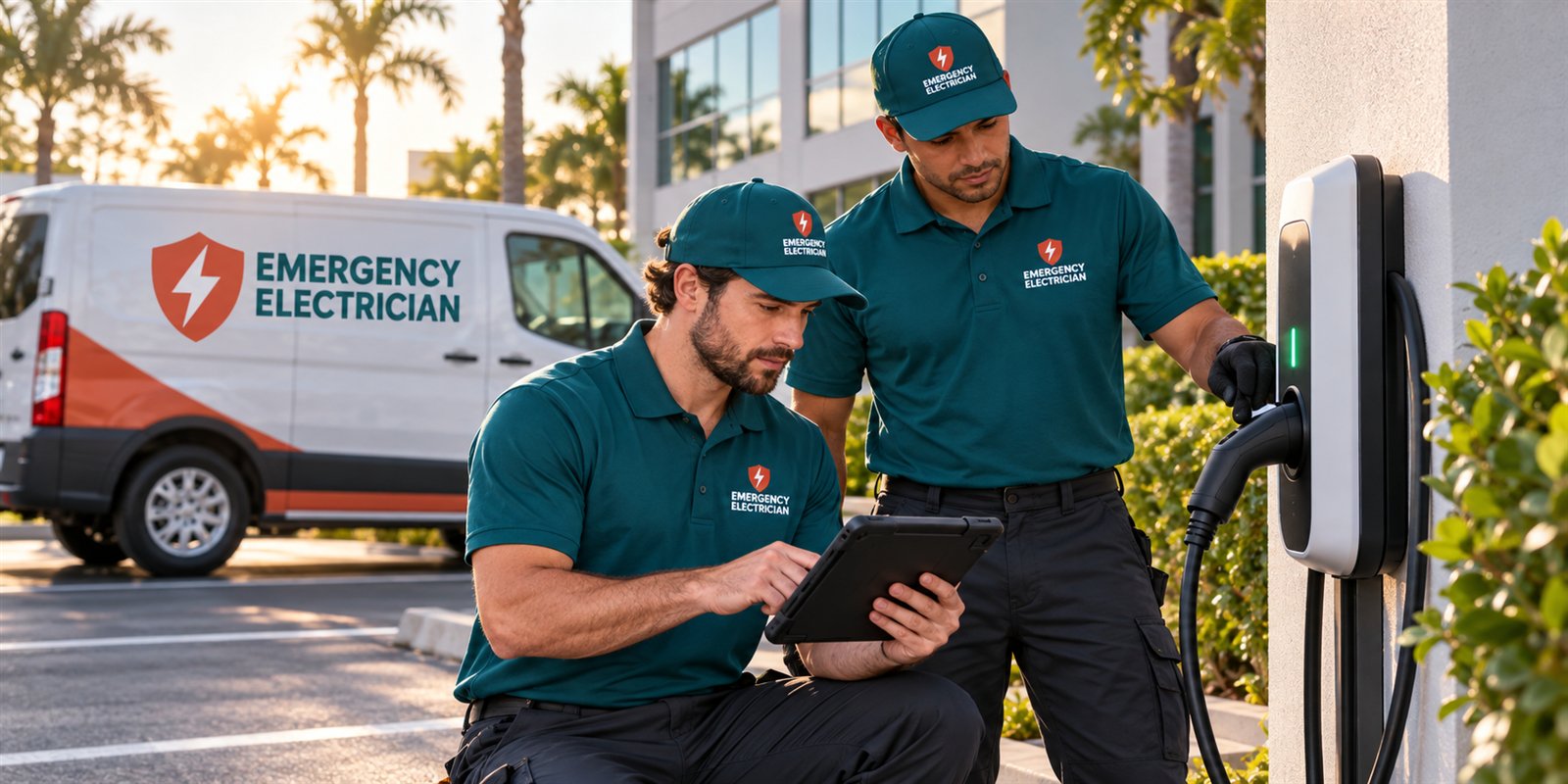
EV chargers have changed the garage. A wall-mounted unit connected to a dedicated 240 volt circuit carries a heavy load and includes electronics, a charging cable, and safety monitoring. Manufacturers design chargers to handle some moisture, but a flood is outside what most are meant for. If water reached the charger body, the cable connector, or the plug and receptacle, the unit should be considered unsafe until it has been inspected.
The vehicle is part of the equation. A car that has been in floodwater may have damaged high-voltage systems, and a vehicle that was connected to the charger during the flood presents a different risk. Do not plug a flooded vehicle into any charger, and do not try to charge it. Consult the vehicle manufacturer or a dealer about flood-damaged vehicles. Our page on urgent EV charger faults explains the electrical side of charger problems.
A technician checks the supply circuit, the breaker, the wiring, and the receptacle or hardwired connection. They look for corrosion, water in the conduit, and burned or discolored terminals. They test the ground fault protection that is often built into the charger or the circuit. A charger whose electronics have been wet is usually replaced, since the manufacturer's safety systems cannot be trusted after water exposure. The circuit may be reusable, but it must be tested first.
Other garage electrical items at risk
The water heater, if electric, has a high-wattage element and a supply circuit. If the lower part of the heater and its wiring were underwater, the heating elements, thermostat, and connections may be damaged. A water heater with a gas burner still has a control and ignition system. Do not turn it back on until a technician has checked the electrical side and the gas side. See urgent water heater electrical for more.
Washers, dryers, and freezers carry wiring at low heights. A dryer outlet, with its large 240 volt connection, is often near the floor. A chest freezer plugged into a floor-level outlet may be a hazard if the outlet got wet, and the food inside is also an issue. The outlets themselves, particularly the ones with ground fault protection, may have failed. Replace rather than reset when water has been inside.
Garage door openers, overhead lighting, and receptacles on the walls also deserve a check. Openers run on household power and include electronics. A flooded opener motor, even one mounted high, can be affected by moisture in the garage air. Overhead lights are less often damaged, but the switches and wiring at low heights may be. A thorough re-check covers everything that is powered in the space, not only the largest items.
Safe steps while you wait for help
If the power to the garage is still on and you can safely reach the panel without entering water, you may be able to switch off the garage circuits, but only if the panel is dry, the floor is dry, and nothing is smoking or buzzing. If you cannot reach it without stepping into water, do not try. A dispatcher can talk you through alternatives, including contacting the utility to disconnect service.
Keep everyone out of the garage. That means children, pets, and neighbors who want to help. If the garage is attached to the house, close the door between them to reduce the chance that someone walks in. Do not try to pump out water using an electric pump plugged into a garage outlet. Do not run extension cords through the water.
Document the damage from a safe place with your phone. Photograph the water line, the panel, the charger, the appliances, and any visible debris. Write down the time the water entered and the time it receded. This helps with the insurance claim and with the technician's assessment. See photographing damage before repairs and electrical damage and insurance documents.
What the technician's re-check involves
The re-check begins with safety: confirming that power to the garage and the affected circuits is off and verified off with a meter. Then comes a visual survey. The technician looks at the water line, the condition of the panel and its enclosure, the conduits, the receptacles, and the appliances. They look for signs of corrosion, mineral deposits, burned connections, and moisture in places it should not be.
Testing follows. The technician checks circuits for insulation resistance, continuity, and ground faults. They test protective devices, including ground fault and arc fault breakers and receptacles. They open the panel, with the power off, and inspect the breakers, the bus bars, and the terminals. Anything that shows corrosion or moisture damage is a candidate for replacement. Parts that cannot be tested with confidence are replaced rather than reused.
The outcome is a clear list of what is safe, what needs repair, and what must be replaced. The technician explains the order of work, which parts need a permit and inspection, and what must be done before service can be restored. Our page on storm rebuild permits and inspections describes how the process works in general terms, and getting a written findings report explains what to ask for.
Different garages, different risks
A newer home in a flood zone may have the panel mounted higher than older homes, but the charger and appliances are still low. An older home may have a panel mounted near the floor in a corner of the garage, with wiring that predates modern protection. In an older home, flood damage may reveal other issues, such as aging wiring, so the technician may recommend repairs beyond the flood damage. See older home electrical red flags.
A townhouse or condo garage may share walls, ceilings, or electrical rooms with neighbors. A flood that affects one garage may affect others, and the association may have rules about repairs and access. If your garage is part of a shared electrical system, contact the association or management as well as an electrician. Our page on condo electrical room fire risk covers related issues.
A detached garage or workshop is fed by a sub-panel and a feeder circuit from the main house. Water in the garage can damage the sub-panel, but it can also affect the feeder, particularly if the conduit runs underground. A technician will test the feeder as well as the equipment. See subpanel failure in a detached building for how those failures present.
Planning ahead and what to have ready when you call
When you call, describe the situation clearly. Say how high the water rose, whether it has receded, where the panel is and whether it was touched by water, and whether an EV charger or vehicle was involved. Tell the dispatcher whether the power is on or off at the garage and whether you have noticed any smell, sound, or sparks. Say whether the utility has been contacted. Provide any gate or access instructions if relevant.
For the longer term, consider how to reduce exposure the next time. Raising equipment, relocating a panel, and choosing weather-rated equipment are subjects to discuss with a technician. No one can promise that a garage will not flood again, and those changes depend on the home and local rules. But the repair is a good time to ask. See hurricane season electrical readiness for a season-long approach.
Above all, resist shortcuts. Do not restore power to a flooded garage on your own, do not plug a flooded vehicle into a charger, and do not assume that a panel that looks dry is safe. When you are ready, call, describe what you see, and let a technician decide the safest next step. Quotes are given only by phone, a job like this needs an on-site visit, and the service call charge is explained before dispatch.
Questions people ask
Is it safe to enter a garage that flooded if the power seems off?
Not until power is confirmed off. A garage panel may still be energized even if some lights are out, and water can carry current. Do not wade in water near a panel, outlet, or charger. Have the utility or a qualified technician disconnect and verify the power first, then wait for the water to recede before anyone goes in.
Can a wet panel be dried and used again?
Often it cannot be trusted. Water leaves conductive residue and starts corrosion that can cause arcing or overheating later, even after the panel dries. A technician inspects and tests it, and replacement is a common result. Do not open the panel or switch breakers yourself when the panel or floor is wet.
Should I keep charging my EV after the garage flooded?
No. Do not use a charger that may have been exposed to water, and do not charge a vehicle that was in floodwater. Moisture in the charger electronics or connector can create shock and fire hazards. Have the circuit and charger inspected, and ask the vehicle manufacturer or a dealer about the vehicle itself.
What about the washer, dryer, and freezer outlets?
Low outlets that got wet should be treated as damaged. Do not plug appliances back in or reset tripped ground fault devices. A technician tests the circuits, replaces damaged receptacles, and checks the protective devices. Chest freezers and food inside raise a separate food safety question you will need to handle with your own judgment and local guidance.
Does flood damage to the garage need a permit?
It can. Replacing a panel, a service component, or running new circuits often requires a permit and inspection through the local building department, while simple repairs may not. Rules differ by city and county. The technician can explain what applies to your job, and permitting is usually part of the plan for larger repairs.
How are the quote and service call charge handled?
Quotes are given only by phone. Flood damage in a garage is the kind of job that needs an on-site visit, and there is a service call charge that is explained on the phone before dispatch. Call, describe the water level and equipment involved, and the dispatcher will explain the process before anyone is sent.
If "Garage Electrical After Flooding" matches what is happening, call and describe it plainly: the room, the breaker, any burning smell or tripped circuit. We explain what the repair would involve before a visit is set.
Related pages
- Water in Panel: Water reaching an electrical panel is serious. Learn when to shut the main, when to stay out, what causes intrusion, and what an electrician checks first.
- EV Charger Fault: An EV charger that trips breakers, runs hot, or smells of burning needs to be stopped. Learn triage steps, the likely causes, and what a technician will check.
- Flood First Steps: What to do about electricity in a flooded home: stay out of water near power, how the utility disconnect works and why inspection comes before power returns.
- Saltwater Damage: Why storm surge saltwater damages electrical equipment differently than rain: salt residue, hidden corrosion in panels and how damage spreads over time.
- After-Storm Power: What to check before the utility re-energizes your service after a storm, what to leave off, and how to bring a house back online without damage or hazards.
- Pre-Storm Checklist: A calm, practical electrical checklist for the days before a hurricane: what to check, what to charge, what to leave alone and when to call a professional.