
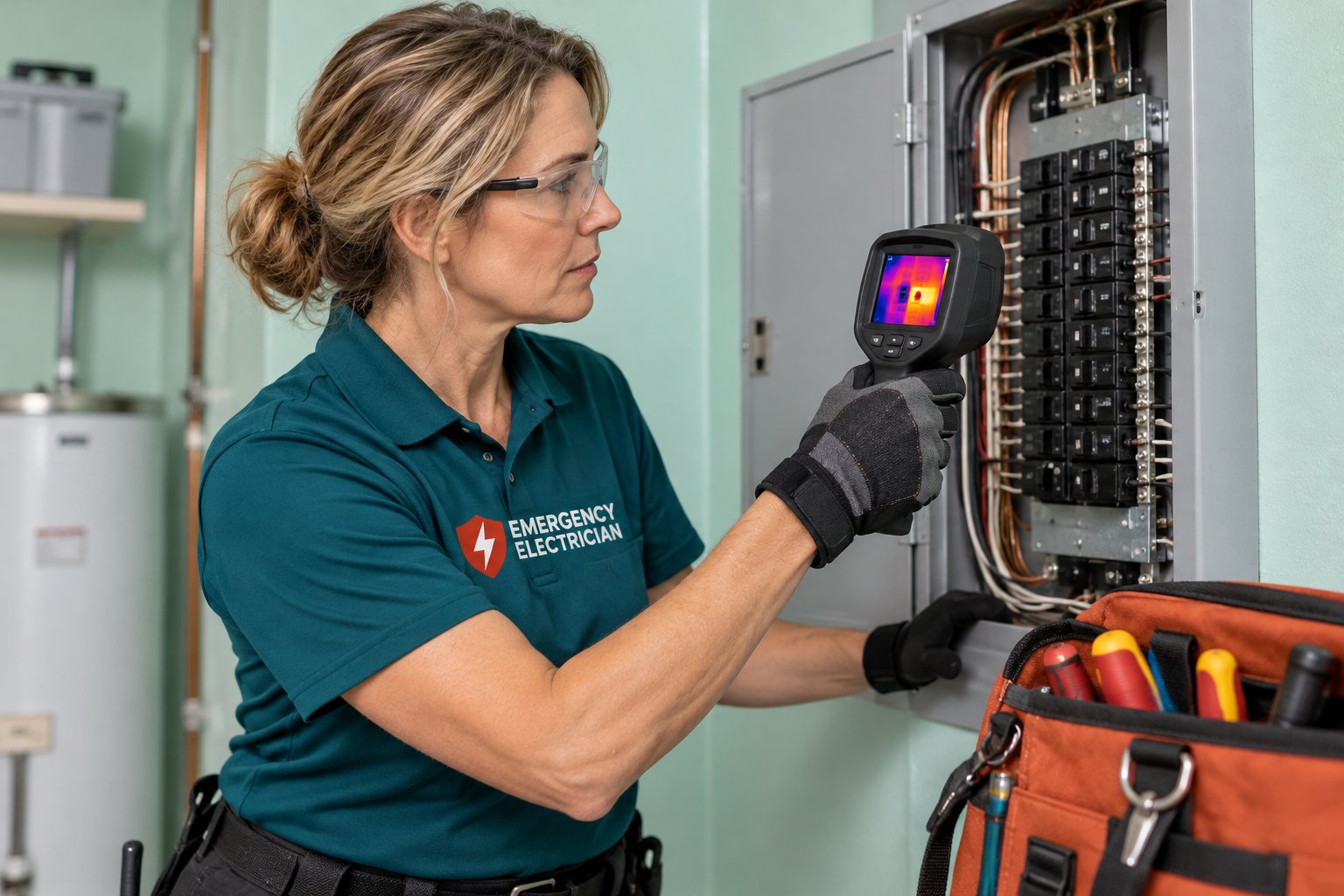
Start with safety: when this is a 911 and utility call
Before anything else, decide whether you are looking at an emergency that belongs to the fire department or the power company. If you see flames, smell hot plastic, see smoke coming from the outbuilding, or notice scorch marks on the panel, call 911 first and stay clear of the building. Do not go inside to investigate. If a wire between the buildings is down, sagging, arcing, or lying in the yard, treat it as live, keep people and pets away, and report it to the utility and to 911 if anyone is at risk.
A dead subpanel without any of those signs is still urgent, but it is a different kind of urgent. Nobody is in immediate danger from a circuit that is simply off. The risk is that the cause is a damaged feeder or a failed connection, and those can overheat or become shock hazards if someone keeps pushing power into them. That is why the first rule is to stop experimenting. Do not keep resetting breakers, do not bridge anything with an extension cord from the house, and do not open the panel cover.
Extension cords deserve a particular warning here. A very common reaction to a dead garage is to run a long cord from a house outlet to keep the freezer or a tool running. That can be reasonable for a short time if the cord is rated for the load, is not damaged, is kept out of water, and is not run under a door where it can be crushed. But a freezer is about the only item that justifies it, and the cord should never feed a space heater, a welder, a compressor or a window air conditioner.
How a detached building gets its power
A detached garage, workshop or guest unit is normally fed by a set of conductors that run from the main house panel to a smaller panel in the outbuilding. That smaller panel is the subpanel. The run between them is called the feeder. It may be buried underground in conduit, run overhead on a pole or messenger, or sometimes surface-mounted along a wall or fence. Each of those arrangements fails in its own way.
Underground feeders can fail where a conduit takes on water, where a shovel or root has damaged the cable, or where a splice was made inside a junction that later corroded. In South Florida, a high water table, heavy summer rain and salt air make buried connections and conduit ends especially vulnerable. Overhead feeders can be pulled down by tree limbs, loosened by wind, or damaged where they attach to the buildings. Surface runs can be cut by landscaping tools or chewed by animals.
At the main house, the feeder starts at a breaker that is usually a two-pole device. When that breaker trips, everything in the outbuilding goes dark at once. At the outbuilding, the feeder lands on a main lug or a main breaker in the subpanel. Any connection along that path can burn, loosen or corrode. Knowing this layout helps you describe the situation on the phone, because the technician will want to know which of these arrangements you have.
What you can safely observe without touching anything
There is a useful amount of information you can collect with your eyes and without opening a cover. Start at the main house panel. Look at the door and the breakers from where you stand. Is there a two-pole breaker labeled for the garage, workshop, shed or subpanel, and is its handle in the middle position, which indicates a trip, or fully off? Note what you see. If the breaker is hot to the back of your hand, buzzing, discolored, or smells of burning, do not touch it and call 911.
Next, look at the outbuilding from the outside. Is the feeder visible, and does it look intact? Is a conduit cracked, pulled away from a wall, or full of water? Is there standing water near the panel location? Are there signs that a tree limb, a vehicle or a pressure washer hit the line? Photographs taken from a safe distance help the technician plan and are useful later for insurance paperwork.
Finally, think about what changed. Did power go out during a storm, a lightning strike, a heavy downpour, or after someone plugged in a new tool or a window air conditioner? Did lights flicker or dim before it died? Did a neighbor have an outage at the same time? Was there a pop or a bang? These clues separate a tripped feeder breaker from a burned connection or a damaged underground run, and they shorten the diagnosis considerably.
- Which building has no power: garage, workshop, guest unit, shed, pool house or barn
- Whether the feeder is buried, overhead or surface-mounted, if you know
- What the two-pole breaker in the main house panel looks like (do not touch if hot)
- Whether the outbuilding has any partial power, such as some lights but no outlets
- Whether anything was plugged in or started just before the outage
Describing a split service to the dispatcher
Many properties in Broward County and the cities from Boca Raton to North Miami have what people loosely call a split service: the main house has one electrical setup and the outbuilding has another, sometimes with its own meter, sometimes fed from the house. The distinction matters because it changes who is responsible for fixing what, and what the utility has to do. If the outbuilding has its own meter, a dead building may be a utility-side problem or a customer-side one. If it is fed from the house, the problem is almost always on the customer side.
When you call, say clearly whether the main house has power, whether the outbuilding has its own electric meter, and whether the two buildings share a single service. If you are not sure, walk outside and look for a second meter on or near the outbuilding. A second meter is a strong clue. Also say whether the outbuilding is occupied as living space, such as a rented garage apartment or a guest suite, because a dead subpanel with people living behind it raises the priority.
Also tell the dispatcher about any equipment that is time sensitive. A chest freezer full of food, a sump pump, a well pump, medical equipment, a home office, or a workshop with a running project are all legitimate reasons to explain urgency. The dispatcher cannot promise an arrival time, but accurate details help them decide how to schedule and what to bring to the visit, including testing tools and possible repair parts.
Likely causes behind a feeder or subpanel failure
The most common causes fall into a handful of groups. The simplest is a tripped two-pole breaker at the house panel, which can be caused by an overload, a short circuit in the outbuilding, or a ground fault. If it trips again as soon as it is reset, there is a hard fault somewhere, and the right response is to stop resetting and call.
The second group is a burned or loose connection. Feeder lugs at either end can loosen from thermal cycling, and aluminum feeder conductors, which are common in older detached buildings, are particularly sensitive to loose terminations. A loose connection creates resistance, resistance creates heat, and heat degrades the insulation and the lug itself. You may see partial power, flickering lights, or a smell before the connection finally fails.
The third group is physical damage and water. Water in a conduit run, a broken junction box, a cut cable from digging, or a feeder pulled loose by a falling limb can all open the circuit or create a ground fault. The fourth group is a failed subpanel main breaker, which is less common but does happen after a surge or after years of heat. The last group is a utility-side problem, if the outbuilding has its own service, and that is for the power company to fix once your side is shown to be intact.
What a technician tests, and in what order
A qualified electrician approaches a dead subpanel in a sequence that protects them and you. They begin with a visual inspection of the house panel, the feeder breaker and the visible path of the feeder. They confirm whether the breaker is tripped, damaged or showing heat marks. Then they de-energize the feeder properly before opening anything on the outbuilding side.
With power off and locked out, they inspect the subpanel interior for burn marks, loose lugs, corrosion, moisture and signs of rodents or insects. They test insulation resistance on the feeder conductors where appropriate, which reveals a cable that has been damaged by water or soil. They check that neutrals and grounds are separated correctly in the subpanel, which is a rule specific to feeders to detached buildings and a frequent source of hidden problems in older work.
If the feeder tests sound, they re-energize it step by step, measure voltage at the subpanel, and bring branch circuits back one at a time to find a short or a faulty load. If the feeder is damaged, the job becomes a repair or replacement, which may need trenching, new conduit and a permit. That is the point where a visit on site is required for a proper quote, because underground runs, distances and conditions vary too much to price over the phone.
Temporary power versus a proper repair
After the first visit, you may have a choice between restoring partial power quickly and completing a full repair on a later visit. A technician may be able to isolate a damaged circuit and restore the rest of the subpanel, or run a temporary arrangement to keep critical loads going. Those steps can make sense when a freezer, a pump or a living space depends on the building.
A temporary arrangement should still be done to a safe standard. That means correctly sized conductors, proper connections, protection at the source, and a plan for the permanent fix. It does not mean a bridged cord, a doubled-up breaker or a splice taped inside a wet box. Ask the technician to explain what is temporary, what is permanent, what is protected, and what you should not plug in until the permanent work is done.
Permanent repairs to a feeder usually involve a permit and an inspection by the local building department. The permit process differs from city to city, and some jurisdictions treat a replaced feeder differently from a repaired connection. The electrician will tell you what applies. Keep the paperwork, because it matters for insurance and for any future sale of the property.
Property types and local conditions that affect this problem
South Florida has a wide mix of properties where this scenario shows up. Older single-story homes in cities such as Hollywood, Pompano Beach and parts of North Miami often have detached garages or workshops fed by decades-old runs, sometimes with aluminum conductors and mixed hardware. Newer homes in western Broward neighborhoods may have garages attached by a breezeway, pool houses, or guest casitas fed by buried conduit that has only seen a few summers of heavy rain.
Waterfront and canal-side properties add salt air and a high water table, which accelerate corrosion on lugs, conduit fittings and underground splices. Properties with pools often have a pool equipment area that is wired like a small outbuilding, and a failure there can resemble a dead subpanel. Hurricane season brings felled limbs, flooded trenches and surge events that damage buried and overhead runs alike.
Rental properties and multi-structure lots bring another wrinkle: who owns the feeder and who is responsible for fixing it. If you rent a garage apartment or a unit behind a main house, tell the landlord promptly in writing, and do not attempt to move the problem to a neighbor's circuit. The electrician will want to know who authorizes the work and who can grant access to the main panel.
What to have ready before the visit, and how to prepare the site
A little preparation speeds up the visit and reduces repeat trips. Clear a path to the main panel and to the subpanel, move vehicles or stored items that block the outbuilding's electrical wall, and keep pets and children away from the work area. If the outbuilding is locked, make sure someone can open it. If there are gates, pass the access instructions on the phone.
Have a note of the symptoms ready: when it failed, what you heard or smelled, what was running, and what you observed in the house panel. If you took photographs, keep them handy. Know where the shutoff for the whole house is, in case the technician wants everything off. Keep anything fragile, such as computers or a tool with an unfinished job, unplugged and safe.
Ask about the service call charge during the first phone call. Quotes are given by phone only, and a complicated feeder problem needs an on-site look before a firm figure can be given. The charge for the call is explained before dispatch, so there are no surprises. When you are ready to get a qualified electrician looking at the subpanel, call, describe what you see, and let the dispatcher guide the next step.
- Make sure everyone is safe and away from any damaged lines or burning smells.
- Photograph the house panel, the outbuilding and any visible feeder damage from a safe distance.
- Leave tripped breakers alone if they trip again after one reset.
- Move stored items away from both panels so the technician can reach them.
- Call and describe the situation, including whether the outbuilding has its own meter.
Questions people ask
Can I just reset the breaker in the house panel to bring the garage back?
You may try one reset of a feeder breaker that has clearly tripped, provided you see no burning smell, heat, discoloration or water near the panel and you can reach it safely. If it trips again at once or will not stay on, stop. A repeated trip means a hard fault in the feeder or subpanel, and further resetting can worsen damage. At that point, leave it off and call for an electrician.
Is it safe to run an extension cord from the house to the garage freezer?
For a short time, a heavy-duty outdoor cord rated for the load can keep a freezer cold while you wait for repairs. Keep it undamaged, off wet ground, not pinched in a door, and plugged into a protected outlet. Do not use it for heaters, compressors, welders or air conditioners. If the cord feels warm, unplug it. A technician can advise on safer temporary options.
Why does the garage have no power when nothing else in the house is wrong?
Because the outbuilding sits at the end of its own feeder and subpanel. A tripped two-pole breaker, a burned lug, water in a conduit, a damaged buried cable or a failed subpanel main can cut power to the whole outbuilding without affecting the main house. The feeder path and the subpanel are what a technician tests first, using proper lockout steps.
Does the electrician or the power company fix a dead outbuilding?
If the outbuilding is fed from the house panel, the problem is on the customer side and an electrician handles it. If the outbuilding has its own utility meter, the utility may need to check its side up to the meter, while the electrician handles everything after it. A technician can tell which is which once the equipment is inspected. Tell the dispatcher whether there is a second meter.
Will the repair need a permit?
Replacing or altering a feeder, a subpanel or its grounding commonly requires a permit and an inspection through the local building department, while a simple connection repair may be treated differently depending on the city. The electrician will explain what applies where you live. Keep copies of any permit and inspection records, since insurers and future buyers sometimes ask for them.
How is the cost decided for a feeder problem?
Quotes are given only by phone, and a complicated job such as a damaged underground feeder needs an on-site visit before a firm figure can be given. A service call charge applies and is explained on the phone before anyone is dispatched. Distance, trenching, conduit condition and permit needs all affect the work, which is why the visit comes first.
Reading about "Subpanel in the Garage or Shed Went Dead"? Tell us what stopped working and when. We will say what an electrician would check first, and quotes are given by phone when the job can be described.
Related pages
- Half-House Outage: Half your home lost power while the rest works. Learn why a split outage can mean a lost leg, what you can check safely, and why to call an electrician.
- Water in Panel: Water reaching an electrical panel is serious. Learn when to shut the main, when to stay out, what causes intrusion, and what an electrician checks first.
- Breaker Re-Trips: A breaker that trips again right after you reset it points to a hard fault. Learn why repeated resetting is risky and what to do and tell the electrician.
- Downed Wire: A wire on the ground may be live even if it is silent. Learn how to keep a safe distance, call 911 and the utility, and what never to do near a fallen line.
- Electrician Dispatch: Calling an electrician about a problem? Learn which symptoms, timing details and photos to describe so the right technician and tools are sent the first time.
- Warm Outlet: A warm, browned or melted outlet is a heat warning. Learn how to read the damage, what to unplug, when it is a same-day call, and what a technician checks.