
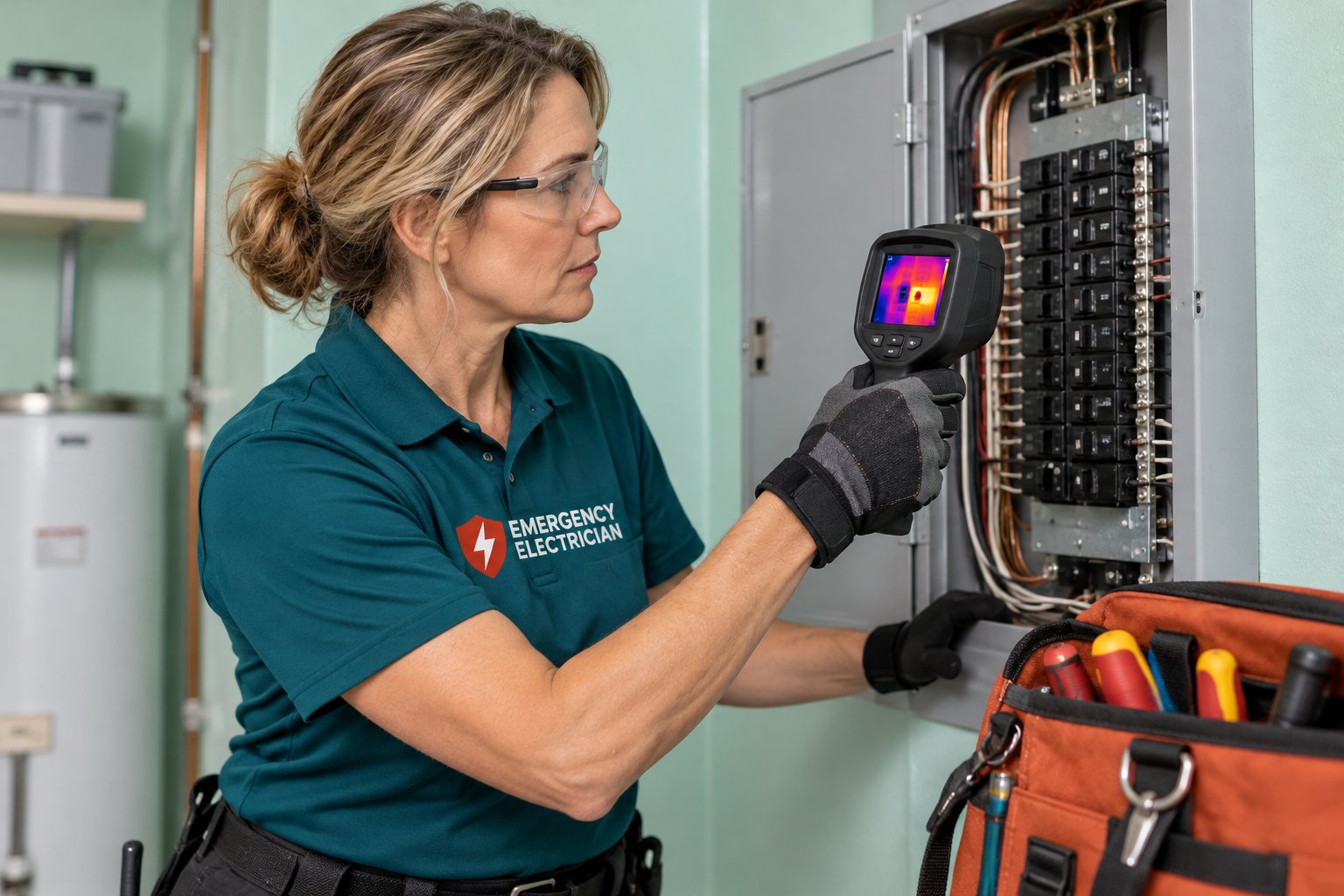
What the bus bar is and why scorching matters
Inside an electrical panel, the bus bars are the flat metal strips that carry power from the main breaker to every individual breaker. Each breaker clips or bolts onto a bus bar, and that connection has to stay tight and clean so that current passes without resistance. When the connection loosens, corrodes or gets overloaded, resistance rises, and resistance makes heat.
Heat at a connection tends to feed itself. A slightly loose breaker heats the metal, the metal expands and loosens further, oxidation builds on the hot surface, and the resistance climbs again. Over weeks or months that cycle can discolor the bar, soften the plastic around it, and eventually carbonize the surrounding material. A burned bus bar is the visible result of a connection that has been running hot for a long time.
Most homeowners never see the inside of a panel, so scorching is usually discovered when a technician removes the cover, or when a smell, a buzzing sound or a tripped main finally forces a look. If you notice a smell of hot plastic or burned metal near the panel, treat that as a warning on its own, even without visible damage.
What scorch marks and burned slots look like
A technician describes the damage in several ways. Brown or blue tinted metal on a bus bar is heat discoloration. Black soot around a breaker slot is carbon from arcing or overheating. A breaker with a bubbled, warped or melted case suggests prolonged heat at that position. Pitting on the bar, where the metal looks eaten away, is evidence of arcing, small electrical sparks that jump across a poor connection.
Sometimes the wire itself shows the damage. Insulation that has turned brittle, brown or crumbled near the breaker terminal suggests a long period of overheating at that point. Copper that has turned a dull dark color or aluminum that has pitted and whitened near the lug points the same way.
You may also notice a pattern: the damage clusters around one breaker, or around the main breaker, or along one side of the panel. A single hot spot suggests a loose or failing breaker or a single overloaded circuit. A broader pattern suggests a panel that is aging, a moisture issue, or sustained heavy load across many circuits. Describe what you saw to the dispatcher in plain words, and do not remove the panel cover yourself to look.
Why you should not open the panel cover
The dead front, the cover over the breakers, can usually be removed with screws, but the bus bars behind it are energized whenever the service is on, even with the main breaker off in many cases, because the main breaker only protects the load side. The lugs at the top of the main breaker remain live all the time. Touching or tools slipping near them can cause severe injury.
Scorching also tells you that the equipment has been under stress. Heat-damaged insulation may be brittle and conductors may be partly exposed. A screwdriver tip that bumps a damaged bar can cause an arc flash, a sudden burst of heat and light that can burn skin and eyes.
If you have already seen the scorch marks, for example during a prior inspection or a photograph, do not poke at them, clean them or try to tighten anything. If the panel door is warm, if you smell burning, or if you hear buzzing, leave the area around the panel and treat it as an emergency. Our page on smoke from a panel covers what to do if smoke or fire is involved.
Immediate steps while waiting for help
If you see smoke, flames or a strong burning smell, call 911 first, leave the building, and call the electrician afterward. If there is no smoke and the situation appears stable but you suspect panel damage, call the number on this page and describe what you saw.
While waiting, you can reduce load on the panel by turning off large appliances at their own controls, such as the oven, dryer, water heater thermostat or air conditioner thermostat. Do not flip the breakers in the damaged panel to do this unless the dispatcher tells you it is safe. Switching a breaker under load puts stress on a connection that may already be failing.
Keep the area in front of the panel clear, keep children and pets away, and keep anything flammable, such as boxes, rags or paint, at a distance. If the panel is in a garage, keep vehicles and stored items from being stacked against it. Write down what you noticed and when, and take photographs of the outside of the panel and any melted or discolored items without opening it.
Why the panel is often replaced instead of patched
People reasonably ask whether a burned bus bar can be cleaned and the breaker swapped. In most cases the answer is no. The bus bar is part of the panel assembly, and in nearly all residential panels it is not a separately replaceable part. Once the bar is pitted, discolored or deformed, a new breaker will not seat properly, and the poor contact will return.
Scorched insulation inside the enclosure also cannot be restored. Heat leaves plastic brittle and carbonized, and carbon is conductive, which can create tracking paths for current to travel where it should not. Cleaning one visible spot does not address hidden damage behind or below it.
There are exceptions. If only a single breaker and its immediate terminal show minor heating and the bar is clean and intact, a technician may be able to replace that breaker and the damaged wire end, then re-inspect. That is a judgment call made on site, with the cover off and the power controlled. When damage is on the bar itself, replacing the panel is the safer path. Our page on panel repair versus replacement lays out the reasoning in more detail.
What a technician checks beyond the visible damage
A technician who finds a burned bus bar treats it as a symptom, not just a defect. They will ask what caused the heat. The checklist usually includes the tightness of every terminal, the condition of the main lugs, the size of the wire on each breaker, the connected load on the circuit that cooked the position, and signs of moisture.
Moisture is a frequent cause in South Florida. Panels on exterior walls, in garages and in utility rooms collect humidity, and any intrusion through a wall penetration or a conduit can allow corrosion. Salt air near the coast speeds oxidation of metal contacts. Our page on water in an electrical panel explains how moisture damages panels.
The technician also looks at the breaker brand and type, whether the breakers are the right ones for that panel, and whether any have been swapped for substitutes that do not fit snugly. A mismatched breaker can look seated yet make poor contact on the bar. Any evidence that wires were doubled up under a single terminal, or that aluminum and copper were mixed without proper connectors, is documented for the report.
Common causes worth knowing about
No single item on this list tells a technician which one applies to your panel. They look at the pattern of the damage and the history of the house. If you know of earlier electrical work, new appliances or a recent water issue, mention it. Even small details can help the technician avoid a repeat of the failure.
- A loose breaker or loose wire terminal that was never re-tightened after earlier work
- A circuit loaded beyond what its wire and breaker were designed to carry, such as a space heater or a window air conditioner on a shared line
- Corrosion from moisture, salt air or a roof or wall leak that reaches the panel
- Age and repeated thermal cycling, where metal and plastic expand and contract for decades
- Poor-fitting or mismatched breakers that do not seat firmly on the bar
- Aluminum conductors connected without suitable connectors or antioxidant treatment
- A damaged main breaker or main lug that overheats and radiates heat into the bars below it
- Pest intrusion, such as insects, rodents or lizards, that bridges parts or leaves debris inside
Three scenarios that end in a burned panel
Consider a 1980s townhouse in Pembroke Pines where the garage panel sits on an exterior wall. Years of humid air and the occasional wind-driven rain have left a faint rust bloom inside the enclosure. One summer afternoon the air conditioner breaker begins to hum. The terminal had been slowly oxidizing, and by the time the owner notices a hot-plastic smell, the bar beneath it is blackened. Here moisture and age were the drivers, and replacing the panel is the sensible fix.
Now consider a house in Plantation where a homeowner added a window air conditioner and a space heater workshop to the back room over a couple of years, all on the same breaker. The breaker never tripped because the load was just under its rating, but the sustained current heated the terminal for many hours at a time. The lug loosened, arcing began and the slot discolored. The panel itself was fine for decades; the load on one circuit was not. A technician would redistribute loads and may add circuits.
Finally, picture a condo in Hallandale Beach where an earlier repair swapped in a breaker that looked the same but was not the type listed for that panel. It clipped on loosely and made poor contact. Months later the neighbor in the next unit mentions a faint smell in the electrical closet. Mismatched breakers are one of the quieter causes of burned bars, and a technician will check the labels on the panel and the breakers to confirm they belong together.
Questions to answer before you call
A short set of facts helps the dispatcher decide how urgent your situation is and what kind of visit to arrange. You do not need to know the technical answers; a plain description is enough. Try to note what you saw or smelled, where in the building the panel is, and how long you have noticed it.
It also helps to know whether the building is a single-family house, a townhouse, a condo unit or a commercial space, because the person who controls access to the electrical room may be an association or a landlord. In multifamily buildings, the unit panel is often yours to repair while the main distribution equipment belongs to the building. Our page on condo electrical room fire risk explains how those responsibilities divide.
Have the following ready if you can: the street address, whether power is on, off or partly on, which appliances or rooms are affected, whether you have heard buzzing or seen flickering, whether anyone has opened the panel recently, and whether you have photographs of the outside of the panel. Do not delay the call to collect any of this. If the smell is strong or the panel is hot, call first and gather details afterward.
What not to do
Each item on this list is tempting because it feels like action. The better action is distance, reduced load and a call. Our guide on what never to do in an electrical emergency collects these points in one place.
- Do not remove the panel cover to look, to clean, or to tighten screws
- Do not spray electrical cleaner, water or lubricant on a burned area
- Do not repeatedly switch a hot or humming breaker off and on
- Do not push a replacement breaker into a damaged slot to see if it works
- Do not cover the panel with tape, boxes or fabric to hide the damage
- Do not keep using a circuit that smells hot because it seems to work
What the aftermath documentation should include
Burned electrical equipment is often tied to an insurance claim, a landlord conversation or a home sale, and good records make each of those smoother. Before the old panel is removed, photograph the outside, the area around it and any visible damage from a safe distance. If the technician opens it and offers to show you, ask permission to photograph the inside.
Ask for a written description of what was found: which positions were damaged, whether the bar or the breaker was the main failure, what condition the wiring was in, and what was replaced. Keep the permit number, the invoice and the inspection result. Ask whether the old panel will be kept for the insurer to examine, since some insurers want to see failed equipment before it is discarded.
If you rent, give your landlord the written findings and keep a copy. If you own, store the documents with your other home records. Call when you are ready to talk it through, and the dispatcher will help you with the next step.
What the repair or replacement process involves
Replacing a panel is a planned procedure. The technician will need power to the building shut off, which typically means the utility removes the meter or disconnects service, because the lugs ahead of the main breaker cannot be de-energized by the homeowner. The old panel is removed, the new one is mounted, the conductors are terminated, labeled and torqued, and the grounding and bonding are checked and corrected where needed.
This kind of work often needs a permit and inspection in South Florida jurisdictions, and the utility will usually require an approval before it reconnects. The permit office and the utility both keep their own schedules, so the time without power can be longer than the physical work. Ask the dispatcher about what to expect, especially if someone in your home depends on medical equipment or if food storage is a concern.
A panel replacement is also a chance to address related issues, such as unlabeled circuits, a lack of surge protection, or a panel that is full and has no room for additions. Our page on urgent panel replacement describes how those decisions are usually handled.
Getting power back and avoiding a repeat
Once the new panel is in service, a technician should test the circuits, confirm the voltage, check for balanced load and show you the labels. Ask for a written note of what was found and what was done, particularly if an insurance claim or a landlord report is part of your situation. Our guide on getting a written findings report explains what to ask for.
Prevention is partly about load and partly about maintenance. Avoid running space heaters and similar high-load devices on shared circuits, and watch for warm breakers, buzzing or recurring trips. Report those early rather than waiting for visible damage. A technician can check terminal tightness and look at the panel with a thermal camera, which shows hot spots without removing the bars from service.
If you are in a rental, tell the landlord or property manager as soon as you notice a smell or discoloration, and keep a record of the date. If you own the property, keep the photographs and invoices. When you are ready to talk it through, call the number on this page and describe what you saw, and the dispatcher will explain the next steps.
Questions people ask
Is it dangerous to stay in the house with a scorched panel?
It can be. Scorching means there has been heat at a connection, and that heat can return at any time. If you smell burning, hear buzzing, or the panel door feels warm, leave the area and call. If you see smoke or flames, call 911 and get out. If the panel looks stable and there is no smell, reduce load, keep clear of it and call the number on this page promptly.
Can an electrician just replace the burned breaker?
Sometimes, if the damage is limited to one breaker and its terminal and the bus bar itself is clean and intact. When the bar is pitted, discolored or deformed, a new breaker will not seat properly and the problem returns. The technician decides on site with the cover off and the power controlled. Do not try to swap a breaker yourself.
Why does the utility have to be involved in a panel replacement?
The conductors feeding the main breaker are on the supply side and remain energized even when the main is off. To work safely, the technician usually needs the utility to remove the meter or disconnect service. The utility also typically requires inspection approval before reconnecting. That coordination can extend the time without power beyond the hands-on work.
What caused the scorching in my panel?
Common causes are loose terminals, overloaded circuits, corrosion from moisture or salt air, age, mismatched breakers and aluminum wiring that was connected poorly. A technician looks at the pattern of damage and the history of the house to narrow it down. Mention any recent appliance additions, water leaks or earlier electrical work when you call.
Should I turn off the main breaker if I smell burning?
If there is smoke or fire, leave and call 911 first. If the situation is calm and you can reach the panel dry and safely, the dispatcher may advise switching off the main. Be aware that the main only de-energizes the wiring behind it. The lugs above it stay live, so do not open the panel cover under any circumstances.
How do I find out what this will cost?
Quotes are given only by phone. There is a service call charge, which the dispatcher explains before anyone is dispatched. A panel replacement is usually a complicated job that needs an on-site visit before a quote can be given. Have the symptoms, the age of the home and any photographs of the outside of the panel ready when you call.
If "Scorch Marks and Burned Breaker Slots" matches what is happening, call and describe it plainly: the room, the breaker, any burning smell or tripped circuit. We explain what the repair would involve before a visit is set.
Related pages
- Panel Smoke: Smoke from a breaker panel is a 911 event. Learn what to do while waiting, what the fire crew does, and how the electrician visit follows afterward.
- Hot Panel: A hot breaker or panel cover can mean a loose connection or overload. Learn what warmth is normal, when to call 911, and what to do before an electrician.
- Panel Buzzing: Some panel hum is normal, but loud buzzing can signal arcing or a loose connection. Learn to sort the sounds and what to tell the dispatcher about them.
- Panel Replace: Fire, flood or failure can force a panel swap. See when replacement is needed, how permits, utility disconnect and inspection work, and how to prepare.
- Repair vs Replace Panel: Inspection findings that push an electrical panel toward repair or replacement, including heat damage, corrosion, and obsolete designs, with no figures given.
- Burning Smell: A burning smell with no flames is still a warning. Learn how to choose between 911 and an urgent electrician call, and what to do while you wait.