
Why panels make noise at all
A breaker panel is mostly metal bars, switches and wire. When alternating current flows through magnetic parts, such as the small coils inside certain breakers and the transformers installed near panels, the parts vibrate slightly at the frequency of the supply. That can produce a faint, steady hum. Many homeowners hear it only in a quiet house at night, and in many cases it has been there since the panel was installed.
Noise also comes from other sources near the panel. A doorbell transformer mounted on the panel or on a nearby wall hums. A whole-house surge protector may have small internal components that make a quiet sound. A nearby water heater, a thermostat transformer or a refrigerator on the other side of the wall can send sounds through the structure that seem to come from the panel. Part of the work of triage is finding out whether the sound is really from the panel.
Where noise becomes a concern is when it changes character. A hum that gets louder, a buzz with a rough or sputtering quality, a crackle, a sizzle or a sound that comes and goes with load is not the same as a steady hum. Those sounds can come from electricity jumping across a gap, which is the physical meaning of arcing.
Sounds that suggest a problem
Learn to describe the sound in words. A steady, low, even hum that has been present for a long time and has not changed is the least worrying. A buzz that is louder than it used to be, or that you only began to notice recently, deserves attention. A rough, rasping or sputtering buzz, like frying or static, is more concerning, and a sharp crackle or snap that repeats is more concerning still.
The sound can tell you something about the cause. A loose connection often produces an intermittent buzz or sizzle, because the contact makes and breaks as the metal vibrates. A failing breaker can produce a buzz that seems to come from one spot in the panel. An overloaded circuit can make a louder hum as the breaker and wire carry heavy current. A sound that rises and falls with the air conditioner or another large appliance cycling on points to a load-related issue.
If you can describe whether the sound is steady or intermittent, where in the panel it seems to come from, and what is running when it is loudest, you have given the dispatcher useful information. Do not put your ear against the panel, and do not open it.
- Steady low hum, unchanged for a long time: lowest concern, still mention it
- Hum that has grown louder or only recently appeared: call and report it
- Rough, rasping or sputtering buzz: treat as possible arcing
- Crackle, snap or sizzle: leave the area and consider 911
- Sound that changes when a large appliance starts: load-related fault likely
- Sound accompanied by heat, smell or discoloration: treat as a panel fire risk
When a buzz means leave and call 911
Call 911 if the buzzing comes with any of the following: a burning or hot plastic smell, visible smoke or haze, heat from the panel cover, sparks or flashes, discolored or melted plastic, or a crackling or snapping noise. The combination of sound and any of those signs suggests active arcing or overheating, which can start a fire inside the panel or the wall behind it.
In that case, leave the house, call from outside, and tell the dispatcher that the sound and the smell or heat are coming from the electrical panel. Do not return to check. Do not try to switch off the main breaker if the panel is already smoking or if you hear arcing, because operating a main breaker on a failing panel can cause an arc flash. The steps are the same as on our page about smoke at the electrical panel.
If the sound alone is the only sign, and it is not a crackle, call an electrician urgently. If you cannot tell whether a sound is serious, a dispatcher can ask you a few questions and help you decide. It is a perfectly reasonable use of an emergency line to ask whether a sound is a problem.
Common causes technicians find behind a buzzing panel
A loose terminal is the cause that comes up most often. Over time, the vibration of current and the expansion and contraction of metal as it heats and cools can loosen screws. Once a connection is loose, current jumps across tiny gaps, producing buzz and heat. A related cause is a wire that has been double-tapped, with two conductors under a terminal made for one, which holds poorly and loosens.
Another cause is a breaker that is not seated properly on the bus bar or is worn. Breakers clip onto the bus, and if the clip has weakened, the connection buzzes and heats. A breaker with a manufacturing defect or damage from earlier trips can also produce noise. In some homes, particular brands of breakers and panels have a history of problems, which a technician will recognize on inspection.
Corrosion, insect intrusion and moisture are also factors in this part of Florida. Humid air, a panel in a garage that sees condensation, or a panel on an exterior wall with a failed seal can lead to damp or corroded parts that arc. See water in an electrical panel for the case where moisture is visible. Finally, sound can come from an upstream cause at the meter or service, in which case the utility has to be involved.
What you can safely do
From a safe distance, listen briefly, and write down what you hear and when. Do not stand in front of the panel for long. If the sound is faint and steady, with no heat, smell or other sign, you can reduce the load by switching off large appliances at their own controls and see whether the sound changes. If it quiets when a particular appliance is off, note which one.
Keep people and pets away from the panel, and clear anything stored in front of it. Do not open the panel door. Do not touch breakers. Do not spray anything near the panel. If the panel is in a garage, avoid working or parking right in front of it.
If the noise seems to come from somewhere else, such as a transformer, an appliance or a light fixture, say so. A buzzing dimmer, a buzzing fluorescent ballast or a failing LED driver can also be mistaken for panel noise, and they can be a hazard in their own right. Our page on a hot or crackling light switch describes a related symptom.
What to tell the dispatcher about the sound
A good description is the most useful tool you have. Start with the address and a callback number. Then say where the sound is, in the panel, near the meter, from a specific breaker or from a room. Describe the sound in plain words: hum, buzz, sizzle, crackle, snap, or like frying. Say whether it is steady or on and off, and whether it is louder than before.
Then say what changes it. Does it get louder when the air conditioner starts? Does it stop if you switch off a certain appliance? Say how long you have noticed it, and whether it began after a storm, a power outage, a flicker or a repair. Mention any smell, heat or discoloration, and whether any breaker has tripped.
Say whether you have left the house, and whether you have called 911. If a dispatcher asks you to check something, ask whether it is safe to do so. Our guide on what to tell the electrician dispatcher lists the usual points, and warning signs that come before an outage explains why early sounds matter.
What the technician will do
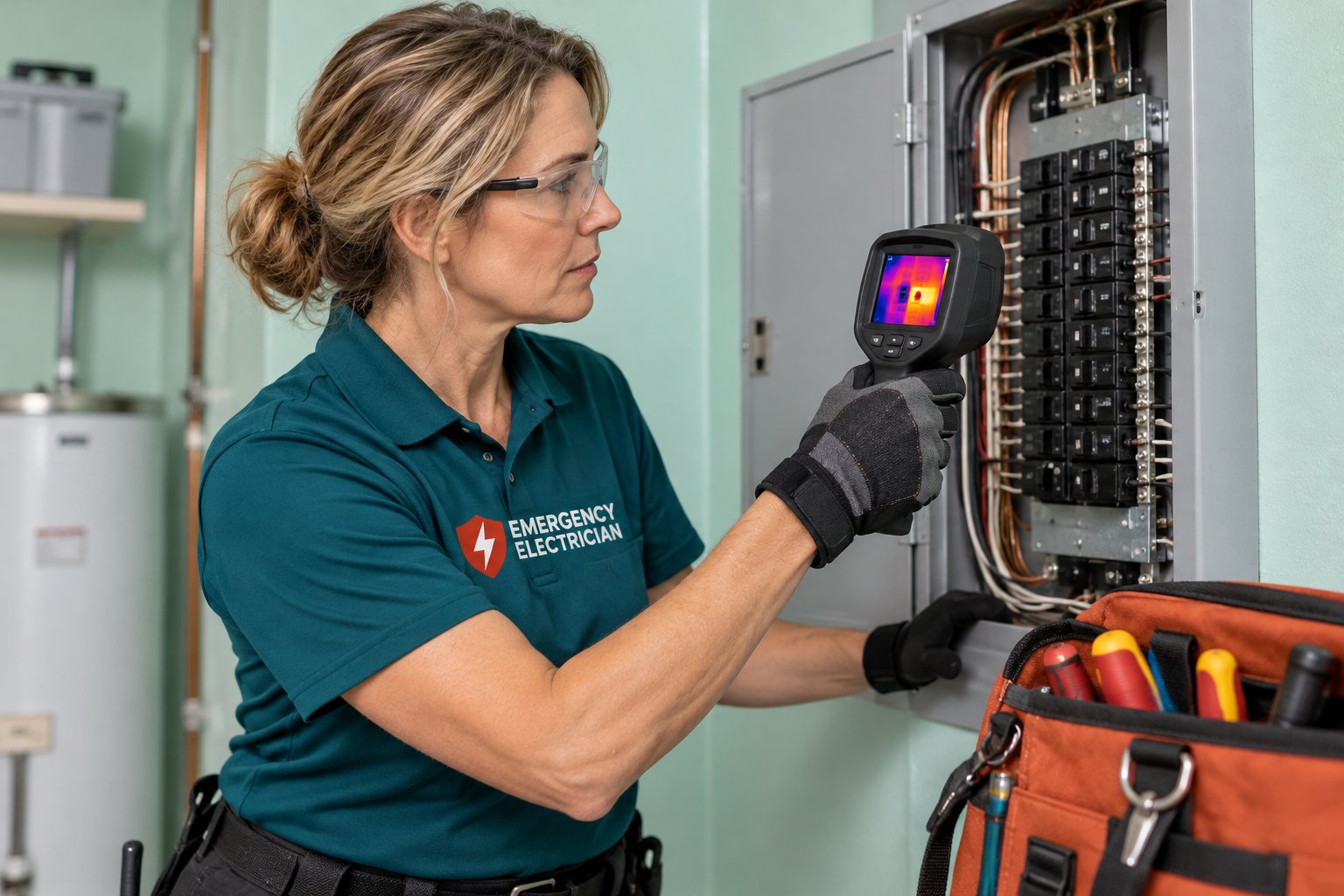
On arrival, a qualified technician will usually listen first, then scan the panel with a thermal camera under normal load to see whether a connection is hot. A buzzing connection is often hotter than its neighbours. Next, they will turn off power and confirm it is dead, then remove the cover and look at the breakers, the bus and the terminals.
They will check the torque of terminals where appropriate, look for discolored copper, melted insulation and signs of arcing, and check that each breaker is firmly seated. They will test breakers, check the main lugs and look at the connection to the meter if it is accessible. If a breaker is worn or damaged, it will be replaced. If the bus is damaged, the repair is larger.
In some cases the buzzing is traced to a loose neutral or a problem on the utility side, which has to be coordinated with the utility. Our page on loose neutral symptoms describes what that looks like in a house. Quotes are given by phone for straightforward items, and complicated jobs need an on-site visit. There is a service call charge, which is explained on the phone before dispatch.
When the buzz is not a fault
After inspection, it is possible that the sound is a normal property of the equipment. Some panel designs, some breakers and some transformers hum audibly, especially in a quiet house or in a closet that amplifies sound. A technician can compare the sound with what is expected and may be able to reduce it, for example by securing a loose cover or isolating a transformer that is vibrating against a wall.
If the technician finds nothing wrong, ask them to tell you what normal sounds like for your panel, so that you can notice a change. Ask them to note the date of the inspection. If the sound later changes, you have a baseline. A sound that is not a fault today may become a fault later, and early notice is useful.
It is also worth asking whether the panel's age or type is a factor. Some older panels and certain brands have a track record, and a technician may recommend monitoring or replacement. See recalled breaker brand failure for the broader concern.
Different houses, different panel sounds
The kind of home you live in changes what you hear. In a concrete block house, common across South Florida, the panel is often in a garage or on an exterior wall, where heat and humidity affect it more, and where the sound of a loose connection can carry into a quiet garage. In a high-rise condo, each unit has its own small panel, and a buzz there may involve the unit's panel or something in the shared electrical room. Older homes in neighborhoods built decades ago may have panels that have been added to several times, with extra breakers and tapped connections that loosen with age.
Newer homes are not immune. A recently built panel can buzz because a terminal was not tightened fully during installation, and the vibration of normal load can show it within months. Homes that have had solar panels, an electric vehicle charger or a hot tub added in recent years may be carrying more load than the panel was first laid out for, which brings heat and sound together.
Whatever the house, the advice is the same: note what you hear, keep the load down, keep the area clear and call. A technician will bring a thermal camera and the right tools and will be able to say whether the sound is part of the equipment's normal behavior or a sign of a connection that needs attention. If you have a panel that has always hummed and you simply want reassurance, say so on the call. That is a fair reason to ask for a check, and it is better to ask than to wonder.
Next steps
If you are standing in a quiet house listening to a panel and wondering whether the sound is normal, the safest course is to call. Describe what you hear, and let the dispatcher decide whether it needs urgent attention. A sound that is a fault now will not fix itself, and a sound that is harmless costs you only a short conversation.
While you wait for the visit, keep the area around the panel clear, keep the load down, and stay alert for changes. If the sound turns to a crackle, if you smell burning or if you see smoke, leave and call 911. After the visit, keep notes of what was found and done.
When you are ready, call, tell the dispatcher what you hear and where, and arrange for a qualified technician to look at it.
Questions people ask
Is a humming breaker panel normal?
A faint, steady hum can be normal, especially in a quiet house or near a transformer. A hum that has become louder, a rough or sputtering buzz, a sizzle, or any crackle is not normal. If the sound is new or has changed, or comes with heat or smell, call an electrician. If there is smoke or crackling, leave and call 911.
What does arcing sound like?
Arcing often sounds like frying, sizzling, rasping static, or a series of small snaps or crackles, and it may come and go. It happens when current jumps across a gap, for example at a loose terminal. If you hear it from the panel, especially with a smell or heat, leave the building and call 911.
Can I open the panel to find out where the buzz comes from?
No. Opening a panel exposes live parts that can cause shock or an arc flash, and the service wires inside stay energized even with the main breaker off. Describe the sound from a safe distance and let a qualified technician inspect it with proper equipment, including a thermal camera.
Why does the buzz get louder when the air conditioner runs?
A heavy load increases the current through the breaker, the bus and the connections. A loose or worn connection can then buzz or heat more. Tell the dispatcher exactly what is running when the sound grows. It is useful evidence for the technician and suggests a load-related fault that should be checked soon.
Could the noise be coming from something other than the panel?
Yes. Doorbell and thermostat transformers, surge protectors, dimmers, fluorescent ballasts and appliances on the other side of a wall can all hum or buzz and seem to come from the panel. Note where the sound is loudest and whether it changes when a device is switched off, and tell the technician, who can trace it.
How urgent is a buzzing panel with no smell or heat?
It should be treated as urgent but not necessarily a 911 matter. Call an electrician the same day and describe the sound. Reduce the load, keep people away from the panel and watch for changes. If the buzz turns to crackling, or smoke, heat or a burning smell appears, leave and call 911.
Reading about "Buzzing From the Electrical Panel"? Tell us what stopped working and when. We will say what an electrician would check first, and quotes are given by phone when the job can be described.
Related pages
- Hot Panel: A hot breaker or panel cover can mean a loose connection or overload. Learn what warmth is normal, when to call 911, and what to do before an electrician.
- Loose Neutral: Lights that get brighter in one room and dimmer in another, buzzing and failing electronics can mean a loose neutral. Learn the signs and why it is urgent.
- Panel Smoke: Smoke from a breaker panel is a 911 event. Learn what to do while waiting, what the fire crew does, and how the electrician visit follows afterward.
- Early Warning Signs: Subtle clues like flickering lights, warm plates, odd smells and buzzing sounds can come before an electrical failure. Learn which ones deserve a call.
- Small Fire: Small flames at an outlet, cord or appliance still mean get out and call 911. Learn why water is wrong, when an extinguisher is an option and what follows.
- Flooded Outlets: Outlets that were underwater or soaked should stay off until inspected. Learn what to leave alone, what a technician checks first, and how to describe it.