
Smoke at the panel means 911, not a service call
If you see smoke, haze or a visible glow at the breaker panel, or smell a strong burning odor that is coming from the panel, the first call is 911. This is not a situation to handle by phoning an electrician and waiting for a callback. The panel is the point where all of the power in the house is distributed. A fire at that point can spread quickly into the wall, the attic or the garage, and it can disable the breakers that would normally protect the rest of the wiring.
Say clearly to the dispatcher that the smoke is coming from the electrical panel. That wording matters because it tells the fire crew to expect an energized electrical fire, which calls for different tactics than a kitchen fire. They will approach with equipment suited to electrical hazards and, in many cases, ask the utility to disconnect power at the meter or service line.
Do not delay your call to take photographs, collect valuables or try to put anything out. Your priority is getting everyone out and calling. Once you are outside and the call is made, you can think about next steps, but while you are inside the house with smoke at the panel, every moment spent on anything else is a moment of risk.
Getting out safely
Leave the building by the route that takes you farthest from the panel. If the panel is in a garage, hallway or utility closet that sits on the way to the front door, use another exit, such as a patio door or a window on the ground floor. Do not walk past the panel if you can avoid it. Take children and pets with you, help anyone who cannot move quickly, and close doors behind you if that can be done without delay, since closed doors slow the spread of smoke and heat.
Once outside, move well away from the house, and stay clear of windows and the area near the meter. Gather in a place where responders can find you, such as the front of the property, and count heads. If someone is missing, tell the first responder right away. Never re-enter the home for any reason, including to get a pet, a wallet or a phone charger.
If you live in a condo or apartment building and the panel in your unit is smoking, pull the building fire alarm if one is reachable on your way out, and let neighbours know as you leave. Electrical rooms in multi-unit buildings are covered in condo electrical room fire risk, and the same principle applies: smoke at electrical equipment is an evacuation event.
- Call 911 and say the smoke is at the electrical panel
- Leave by the exit farthest from the panel
- Take everyone, close doors behind you if it costs no time
- Meet outside in a visible place and count everyone
- Do not go back in for any reason
- Keep neighbours informed in shared buildings
What not to do near a smoking panel
Do not open the panel door, do not touch the breakers and do not try to switch off the main breaker if smoke is already present. A smoking panel may have failed internally, and the main breaker is part of the same assembly. Operating a main breaker that is on a failing bus can cause an arc flash, which is a violent release of heat and light that can cause serious burns even from a few feet away.
Do not use water. Water on an energized panel can carry current back to you and can spread the fault. A household fire extinguisher is rated for particular types of fire, and only a unit rated for electrical fires should ever be considered. Even then, the guidance for the public is to leave and call, not to fight a panel fire. Trying to fight it exposes you to smoke, which can be toxic from burning insulation and plastics.
Do not stand in front of the panel to see what is happening. Do not photograph it from close range. If it is safe to do so from the doorway, a quick glance is the most you should take before leaving. Our page on what never to do in an electrical emergency lists the common mistakes in more detail.
Why panels smoke
Knowing what causes panel smoke helps you describe it afterward and decide on repairs. The most common cause is a loose or corroded connection where a wire meets a breaker or the bus bar. A loose connection creates resistance, and resistance generates heat, which can melt the insulation on the wire and the plastic of the breaker. In South Florida, humidity and salt air raise the odds of corrosion at these points, particularly in garages and exterior panels.
Other causes include a failed breaker that is overheating, an overloaded circuit that has been running warm for a long time, water intrusion that causes arcing across the bus, insects or pests that enter the panel, and damage from a lightning strike or a surge. Panels that are old, that have been added to many times, or that have double-tapped breakers, where two wires share a single terminal not designed for it, are at higher risk. A bus bar that has burned is covered on the page about a burned panel bus bar.
A recalled or failed breaker brand can also be the cause. If you are in a house with a panel of a type that has drawn public safety concern, tell the technician. You do not have to work out the cause yourself, but you can help by noting how long the panel has been in service and whether any recent work was done on it.
What the fire crew and the utility will do
When the fire crew arrives, they will assess for fire and heat, check air for smoke, and look for ways the fire could be spreading in the walls. For an energized panel, they typically ask for the power to be cut at the source, which means contacting the utility to disconnect at the meter or service drop. In much of South Florida the utility is FPL, though some cities run their own electric utilities, and the fire crew will know which applies to your address.
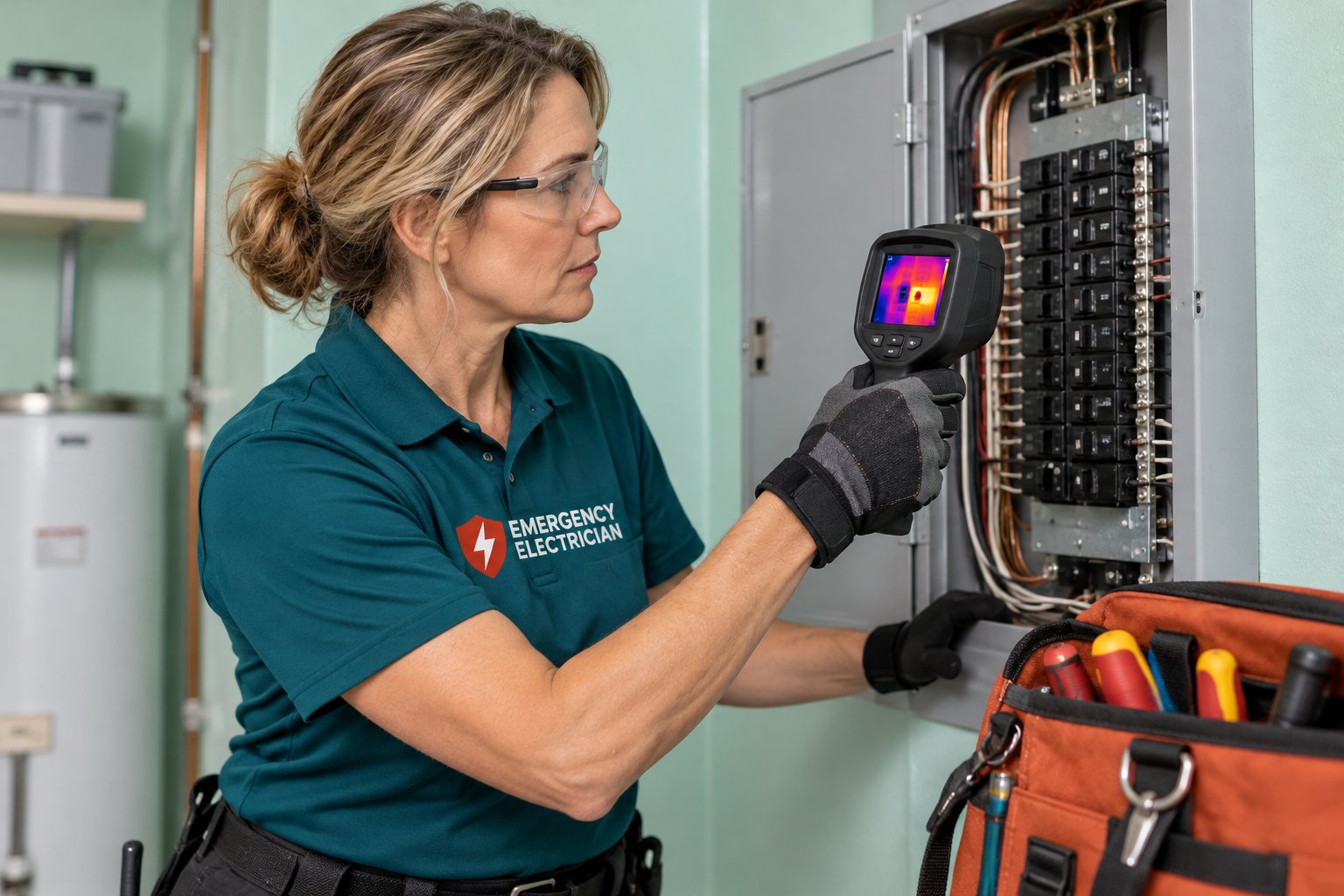
The crew may use a thermal camera to scan the panel and surrounding walls and may open sections of drywall to check for hidden fire. They may leave a tag on the meter or panel indicating that the service has been disconnected for safety, and in some jurisdictions an inspection is required before power is restored. They will often tell you not to turn the main breaker back on yourself, and you should follow that instruction.
After the fire crew clears the scene, they may give you an incident number. Keep it. You will need it if you file an insurance claim and may need to give it to the electrician or to the utility. Our page on the fire department visit and electrical reinspection describes how this step connects to repairs.
Calling an electrician after the all clear
Once the fire crew says it is safe to be in the building, or after they have left with the power off, call an electrician to assess the damage and plan the repair. Say that the panel smoked, that the fire department attended, whether the utility has disconnected the service, and whether anyone has been permitted back into the house. This lets the dispatcher plan the visit and the tools needed.
At the visit, a qualified technician will confirm that the panel is de-energized at the meter before opening it, since even a panel with the main breaker off can carry live parts on the line side. They will inspect the damage, look at the bus bar, breakers, and incoming conductors, and check for heat damage to nearby wiring and the wall. Where a panel has burned, the usual outcome is replacement, not repair, though the scope depends on what they find.
A panel replacement typically involves a permit and an inspection, and coordination with the utility to disconnect and reconnect. Quotes are given by phone for straightforward items, but a smoked panel is a complicated job and needs an on-site visit. There is a service call charge, explained on the phone before dispatch. The differences between a repair and a full swap are discussed in panel repair versus panel replacement.
Staying in the house or leaving for the night
After a panel fire event, the question of whether to stay in the house is real. If the utility has disconnected power and the fire crew has cleared the building, the house may be physically safe but without electricity. You may need to consider refrigeration, medical equipment, and air conditioning in a hot climate, and the practical answer depends on how long repairs will take, which a technician can estimate after seeing the damage.
If there was heavy smoke, the air may be unhealthy to breathe even after the fire is out. Ventilate once responders say it is safe, and consider staying elsewhere until the smell and residue are addressed. People with asthma, young children and older relatives are more vulnerable to smoke residue. Do not run a generator inside the house or the garage, and do not connect one to the house wiring, as explained in generator backfeed risk.
If a medical device depends on power, tell the fire crew and the electrician immediately. They can help plan for temporary power or alternative arrangements. Insurance may cover temporary lodging in some cases, and keeping receipts and notes will be useful if you decide to ask.
Documentation while memories are fresh
Once everyone is safe, write down what happened while it is fresh. Note the time you first noticed smoke or smell, what you saw at the panel, what had been running, whether lights flickered or breakers tripped beforehand, and who responded. If you have photos of the panel taken before the event, such as from a labeling project, keep them.
After the fire crew has cleared the scene and you have permission to be in the house, take photographs of the panel and nearby damage from a safe distance, without touching anything. Capture wide shots first, then close-ups. Keep damaged parts if the electrician removes them, since an insurer or investigator may want to see them. Our guide on electrical damage and insurance documents covers what paperwork helps.
Ask the electrician for a written findings note describing what was found and what was replaced. A short document with the date, address and description is useful for claims and for the next owner of the house.
Reducing the chance of a panel problem in the future
After a panel event, ask the technician what led to it and what else in the house deserves a look. If a loose connection was the cause, they may recommend checking connections at other points, such as the main lugs and the meter base. If corrosion was involved, they may suggest checking for moisture entry at the panel enclosure, the service mast and the weatherhead. If the panel was overloaded, a discussion of circuit layout and upgrading may follow.
Some warning signs show up before a panel failure, such as a panel cover that is warm, breakers that trip without an obvious reason, a faint buzz or a smell near the panel. See warning signs that come before an outage for a list. Keeping the area around the panel clear, with at least a clear walkway, also helps responders and technicians reach it quickly.
If you have been through a smoke event and are thinking about the safety of the rest of the house, call and describe the situation. A qualified technician can explain what is practical to check and arrange a visit when you are ready.
Questions people ask
Should I turn off the main breaker if my panel is smoking?
No. If smoke is coming from the panel, do not open it or touch the breakers, including the main. A failing panel can arc violently when a breaker is switched, causing serious burns. Leave the building, call 911, and let the fire crew and the utility remove power at the meter. Never use water on an energized panel.
Who do I call first, 911 or the electrician?
Call 911 first. Smoke at a panel is a fire emergency, and the fire crew can work with the utility to cut power at the source. After the fire department clears the building, call an electrician to assess damage and plan repairs. Tell the dispatcher that the fire department attended and whether the utility has disconnected service.
Can the panel be repaired, or does it have to be replaced?
It depends on what the technician finds after power is confirmed off. If the bus bar, several breakers, or the enclosure are burned, replacement is the usual outcome. A localized problem such as one failed breaker and a clean bus may be repaired. Quotes are given by phone for simple items, but a smoked panel usually needs an on-site visit.
Will I need a permit and inspection?
Panel replacement generally involves a permit and an inspection through the local building department, and the utility has to disconnect and reconnect service. Requirements differ between municipalities, so the electrician will explain what applies to your address. Do not restore power yourself after the utility or the fire crew has disconnected it.
Is it safe to sleep in the house after a panel smoke event?
Only after the fire crew says the building is clear, and consider air quality and the lack of power. If the utility has disconnected service, you may have no lights, cooling or refrigeration. Heavy smoke residue can affect breathing. Do not run a generator indoors or connect one to the house. Many people choose to stay elsewhere until repairs are made.
What should I tell the dispatcher?
Give your address, say the smoke is coming from the electrical panel, say whether anyone is still inside or hurt, and say whether you have left the building. Stay on the line if asked. Do not go back in to collect belongings. Responders will ask about the panel location, so mention if it is in a garage, closet or exterior wall.
If "Smoke at the Electrical Panel" matches what is happening, call and describe it plainly: the room, the breaker, any burning smell or tripped circuit. We explain what the repair would involve before a visit is set.
Related pages
- Hot Panel: A hot breaker or panel cover can mean a loose connection or overload. Learn what warmth is normal, when to call 911, and what to do before an electrician.
- Burned Bus Bar: Scorch marks, melted plastic or a burned bus bar inside an electrical panel: what it means, why the panel is often replaced and what to do right now.
- 911 Script: Calling 911 about sparks, smoke, a shock or a downed wire? These are the facts that help dispatch most: address, hazard, people at risk and power status.
- Panel Replace: Fire, flood or failure can force a panel swap. See when replacement is needed, how permits, utility disconnect and inspection work, and how to prepare.
- Warm Outlet: A warm, browned or melted outlet is a heat warning. Learn how to read the damage, what to unplug, when it is a same-day call, and what a technician checks.
- Shock Victim: If someone was shocked at home, call 911 first and do not touch them while still energized. Learn the safe order of steps and the electrical check afterward.