
Warm is not the same as hot
Electrical equipment gives off some heat in normal use, and a panel cover that feels faintly warm after a day of heavy air conditioning is not necessarily a sign of trouble. The difference lies in degree, in pattern and in change. A panel that has always felt slightly warm in one spot, with no smell and no recent changes, is different from a cover that has just become too warm to keep a hand on. The second case calls for action.
A rough guide, offered with caution because touching a panel is itself a risk, is that you should be able to rest the back of your hand lightly against a panel cover and not feel an urge to pull away. If you do feel that urge, or if the metal feels hot like a stove top, treat it as serious. Never press your palm on a panel to test it, and never touch a panel with wet hands or while standing on a wet floor.
Remember that what you can feel on the outside is less than what is happening inside. A cover that is warm to the hand may be hiding a connection that is much hotter, because the cover and the air gap insulate the outside from the inside. That is why a modest warmth that is new, localized or growing deserves respect.
What heat in a panel can mean
The most common cause of a hot spot in a panel is a loose or high-resistance connection. Where a wire is fastened to a breaker terminal or to the bus bar, the metal surfaces should be tight against each other. If the screw has loosened, if the wire has corroded, or if two wires have been squeezed into a terminal designed for one, the connection resists the flow of current, and resistance turns into heat. The heat can then loosen the connection further, creating a cycle that gets worse.
Another cause is an overloaded circuit. If a breaker is carrying close to its rated current for long periods, such as a large air conditioner on a hot afternoon or several heaters on one circuit, it will run warm. A third possibility is a failing breaker, where the internal parts have worn and the breaker is generating heat even at modest loads. Finally, a hot panel door can result from the main lugs or the meter connection upstream running hot, which is a utility-side and service-side issue that needs coordination.
In South Florida, heat and humidity add to all of these. A panel in a garage or an outdoor enclosure that sits in direct sun can start out warm before the electrical load adds anything. Corrosion from damp air makes connections worse. For an example of how corrosion shows up elsewhere, see a burned panel bus bar.
The order of calls to make
The right call depends on what accompanies the heat. Call 911 first if you see smoke or haze, smell burning, hear crackling or popping, see discolored paint or melted plastic on the panel, or see any glow or flicker. In those cases, the panel is already in a failure that could become a fire, and the guidance on smoke at the electrical panel applies.
If the heat is the only sign, with no smoke or smell, call an electrician urgently and describe what you found. If you reach a dispatcher who judges the situation as higher risk, they may tell you to call 911. If you can, ask the utility whether a meter-side issue is possible, since the utility handles the equipment up to and including the meter. If the heat seems to come from the meter base or the service lugs, mention it.
A third route applies when the heat is mild, stable, and appears only in heavy-load conditions. In that case, reduce the load and call for a visit the same day. Our guide on the call order for a burning smell gives the same logic in a different context.
- Smoke, smell, crackling or discoloration: leave and call 911
- Hot cover or breaker with no other sign: step away and call an electrician urgently
- Mild warmth only under heavy load: reduce load and call the same day
- Heat at the meter or service lugs: tell the dispatcher, the utility may need to be involved
Immediate steps that are reasonably safe
If there is no smoke, smell or sound, you can reduce the heat by reducing the load. Turn off large appliances that are in use and are on the circuit you suspect, using their own switches or controls and not the panel. Switch off air conditioning at the thermostat if the heat seems related to a large cooling load. Do not open the panel to check.
Keep people away from the panel and keep the area around it clear, including anything that might be stored in front of it. Remove flammable items such as cardboard, cleaning products and paper from near the panel if you can do so without standing in front of it. Keep children and pets away. If the panel is in a garage, avoid parking or working in front of it.
Do not cover the panel with anything, including a cloth, which can trap heat. Do not spray any liquids, including cleaners or lubricants, near the panel. Do not tape the breakers. Leave the panel door closed. If the heat or any other sign increases, move outside and call 911. Our page on what never to do in an electrical emergency expands on the list.
Should you switch off the breaker that feels hot
It is a natural thought to switch off the hot breaker. If the panel is dry, the cover is intact, there is no smoke or smell, and you can reach the breaker without touching the hot metal, switching off a single breaker is usually a reasonable step. Use one hand, stand to the side, and move the handle firmly to off. Doing so removes the load from that breaker and often lets it cool.
However, do not do this if the breaker is too hot to touch, if the handle is discolored, melted or loose, or if you hear arcing. In those cases the act of switching can itself cause an arc. If you are unsure, step away. A hot main breaker needs extra care. Switching it off disconnects all branch circuits but not the wiring from the meter to the main, which stays energized. If the main breaker or its surroundings are hot, treat the panel as a possible service-side problem and call for help without touching it.
Our page on when it is safe to use the main breaker has more detail. If you do switch off a breaker, leave it off, and tell the technician exactly which one and when.
Things that can look like heat but are not
Some warm panels are simply warm for harmless reasons. A panel on an exterior wall that faces the afternoon sun will warm through the day. A panel in an unventilated utility closet behind a water heater can sit in warm air. A panel next to a hot attic space or a garage ceiling may be warmer than the room. These causes affect the whole cover evenly and do not produce a hot spot at one breaker.
The difference with a connection problem is localization and change. A hot spot at one breaker, in a column of breakers, which shifts when you change the load, points to an electrical cause. Heat that is the same everywhere on the cover and tracks the sun probably does not. Still, because you cannot see inside, it is better to have someone check than to decide by guessing.
Other sources of warmth include a buzzing transformer, such as a doorbell transformer mounted at the panel, or a nearby device such as a whole-house surge protector that is installed beside the panel and is working. Page whole-house surge protector failed covers one such device, and the question of sound and heat together appears in buzzing from the panel.
What the technician will check
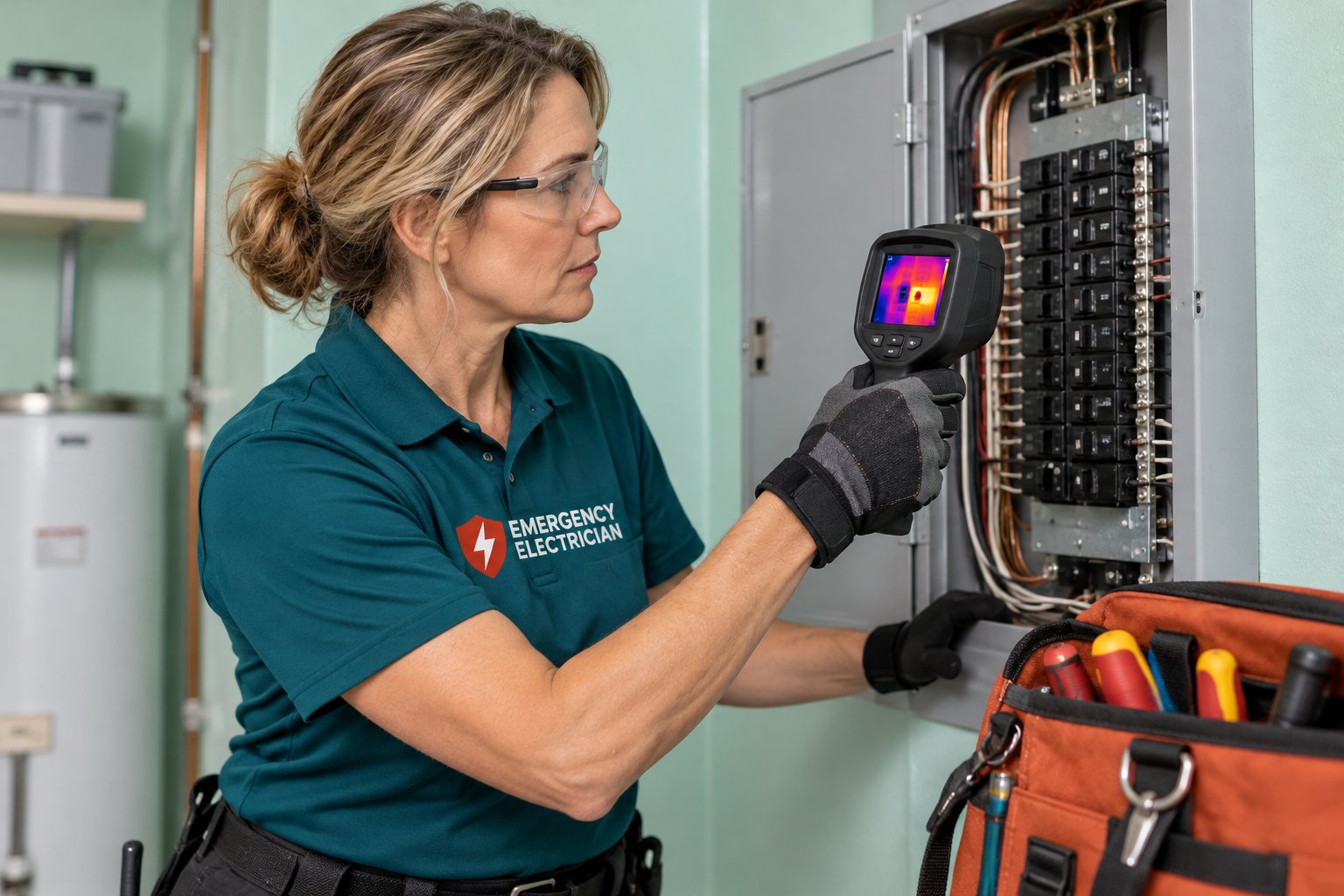
A qualified technician will first confirm the situation from your description and then arrive prepared to work on an energized panel under controlled conditions. They will usually look at the panel with a thermal camera while it is under load, because heat shows up clearly as a bright spot. This lets them find which breaker or connection is hot without opening anything, and it guides the next step.
After that, they will de-energize what they can, remove the panel cover and examine terminals, breakers and the bus. They will look for loose screws, discolored wire ends, melted insulation, signs of arcing and corrosion. They will check whether the wire gauge matches the breaker rating, whether any terminals have two wires where only one is allowed, and whether the breaker itself is damaged.
The repair may be as simple as tightening a terminal and replacing a damaged breaker. If the bus is damaged or the heat has gone on for a long time, the repair may involve a larger section of the panel or a replacement of the panel itself. The options are discussed in panel repair versus panel replacement. Quotes are given by phone for straightforward items, and complicated jobs need an on-site visit. There is a service call charge, which is explained on the phone before dispatch.
What to tell the dispatcher about the heat
Give the address and a callback number first. Then describe where the heat is. Say whether it is the cover, a specific breaker, or the meter. Say how hot it feels in everyday terms, such as warm like a mug, hot enough that you pulled your hand away, or too hot to hold. Avoid guessing at temperatures, and do not use a thermometer on an energized panel.
Say what had been running when you noticed, whether the heat increases when something starts, such as the air conditioner, and whether it has changed over time. Mention any smell, sound or discoloration. Say whether any breaker has tripped. Say whether you switched anything off, and which. Mention whether the panel is in a garage, closet, exterior wall or inside living space, which helps the technician bring the right access tools.
If the home has a medical device on any circuit, say so. A dispatcher can then prioritize accordingly. Our guide on what to tell the electrician dispatcher lists the usual details.
Preventing a repeat
Once the cause is found and corrected, ask the technician what led to the heat. If the cause was a loose connection, ask whether other terminals were checked. If it was an overloaded circuit, discuss how to rebalance the load or add a circuit. If it was corrosion, ask about sealing the enclosure and checking where moisture is entering. Having the explanation in plain words makes it easier to avoid the same trouble.
Some habits help. Keep the area around the panel clear. Do not stack storage against it. Avoid adding large loads such as a space heater or a window air conditioner to circuits that already run warm. Notice changes: a new smell, a buzz, a trip pattern or a warm cover. Early notice is the main defense. See warning signs that come before an outage for more.
If you have a hot breaker or panel cover right now and are unsure what to do, call and describe it. A person on the phone can help you decide whether this is a 911 matter or an urgent visit, and can schedule help.
Questions people ask
Is it normal for a breaker panel to feel warm?
A slight, even warmth, especially on a sun-facing wall or in a closed closet, can be normal. A cover that feels hot, a hot spot at one breaker, or heat that is new or growing is not normal. If you would pull your hand away, treat it as a problem, stay away from the panel and call. Do not press your palm on it.
Should I call 911 or an electrician for a hot panel?
Call 911 if there is smoke, a burning smell, crackling, melted or discolored plastic, or any glow. If the panel is hot with no other sign, call an electrician urgently and describe it. If the dispatcher believes the risk is high, they may tell you to call 911. When unsure, calling 911 is the safer choice.
Can I switch off the hot breaker myself?
Only if the panel is dry and intact, there is no smoke, smell or arcing sound, and the breaker is not too hot to touch. Use one hand and stand to the side. Do not operate a breaker that is melted, discolored or loose, and be careful with the main breaker. When in doubt, step back and call.
What usually causes a breaker to get hot?
Most often a loose or corroded connection, which creates resistance and heat. Other causes include a long overload, a failing breaker, two wires under one terminal, or a hot connection on the service side. Humid South Florida air speeds corrosion. A technician can find the hot point with a thermal camera and then inspect the terminals.
Will the whole panel have to be replaced?
Not always. If the problem is a loose terminal or a single failed breaker, a repair may be enough. If the bus bar or several parts have been damaged by heat, replacement may be the better course. The technician will explain what they find. Quotes are given by phone for simple items, and larger jobs need an on-site visit.
What can I do to cool it down while I wait?
Reduce the load by switching off large appliances and the air conditioner at their own controls, and keep people and flammable items away. Do not cover the panel, spray anything on it, open it, or tape breakers. If smoke, a smell or sounds appear, leave the building and call 911. Do not wait for it to cool by itself.
About "Panel Cover or Breaker Feels Hot": call and give us the details, and we will explain what is safe to do while you wait and what the visit would cover. Jobs that cannot be quoted blind need a look on site.
Related pages
- Panel Smoke: Smoke from a breaker panel is a 911 event. Learn what to do while waiting, what the fire crew does, and how the electrician visit follows afterward.
- Panel Buzzing: Some panel hum is normal, but loud buzzing can signal arcing or a loose connection. Learn to sort the sounds and what to tell the dispatcher about them.
- Breaker Re-Trips: A breaker that trips again right after you reset it points to a hard fault. Learn why repeated resetting is risky and what to do and tell the electrician.
- Breaker Replace: A bad breaker can leave circuits dead or overheat in the panel. Learn when replacement is urgent, what is inspected beyond the breaker, and why testing follows.
- Appliance Trips Breaker: A breaker that trips every time the microwave, hair dryer or window unit runs is giving a clue. Learn overload versus fault and when to call an electrician.
- Burning Smell: A burning smell with no flames is still a warning. Learn how to choose between 911 and an urgent electrician call, and what to do while you wait.