
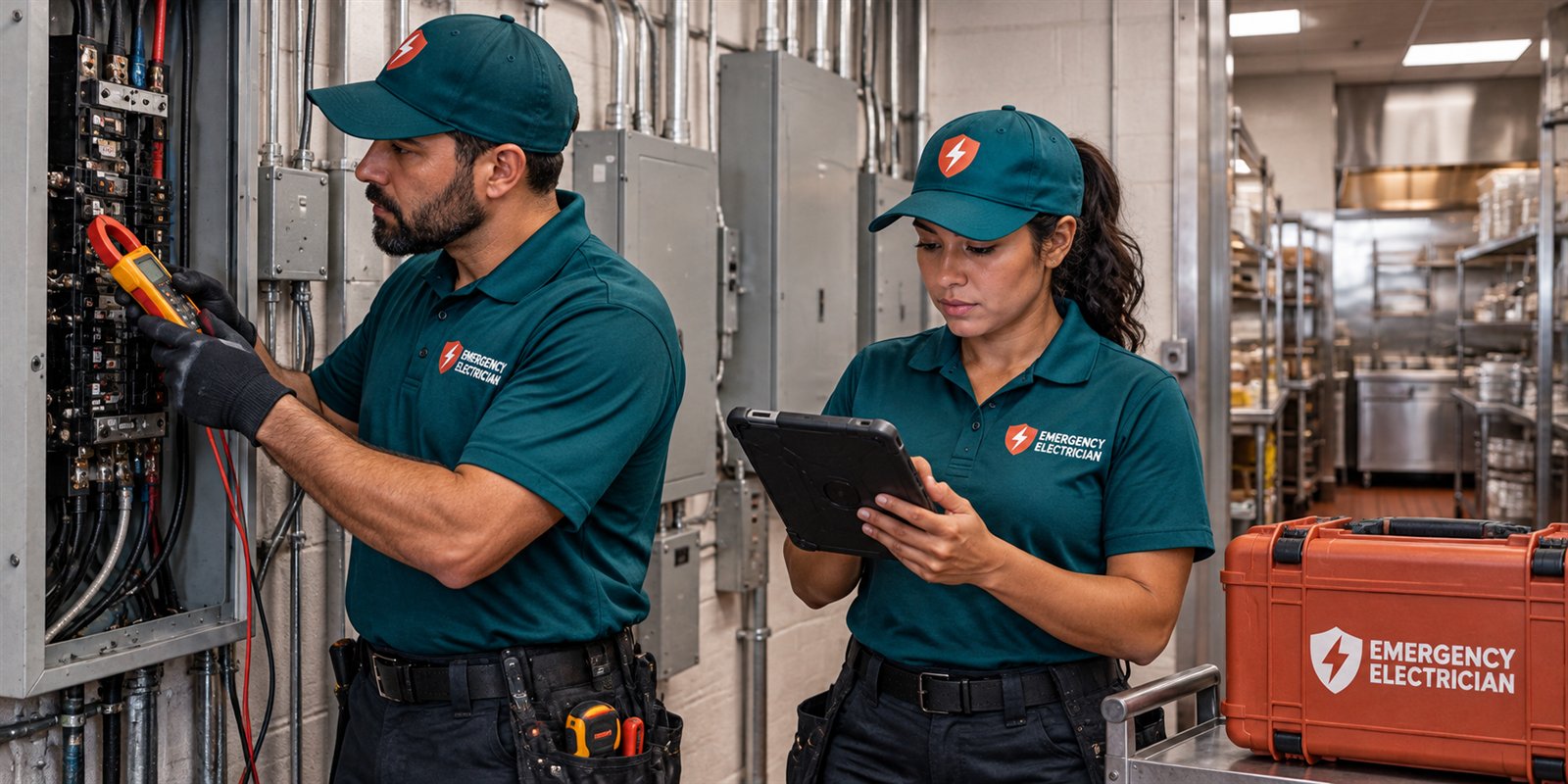
If the power is out right now
This page is about planning, but many readers arrive in the middle of an outage. If anyone is hurt, if you smell burning, see smoke or sparks, or find water around electrical equipment, call 911 first. If a wire is down outside, stay away and call 911 and the power company. Do not start a generator indoors or in a garage, because carbon monoxide can kill without warning. If a carbon monoxide alarm sounds, get everyone outside and call 911.
If the outage is just an outage, and nobody is in danger, your first job is to find out whether it is the utility or your building. Check whether neighbors are dark. If so, call the power company's outage line and ask about restoration. If only your space is dark, look at your panel from the outside without opening it, and call an electrician if breakers will not reset or if anything smells hot.
Never plug a portable generator into a wall outlet or into a building circuit with a homemade cord. This is called backfeeding. It can send electricity back through the utility lines and seriously injure or kill a line worker, and it can start a fire in your building. Our page on generator backfeed risk explains this danger in more detail.
- Hurt, smoke, burning smell, water on live equipment: 911 first.
- Generators run outdoors only, away from doors, windows and vents.
- Never connect a generator to a wall outlet with a double-ended cord.
- Keep fuel stored safely and away from the generator while it runs.
Start with the question: what must keep running?
Backup power planning begins with a list, not with a purchase. A small business rarely needs to power everything. The question is what loses money, creates risk, or stops you from serving customers if it goes dark. For a restaurant, that may be refrigeration and some lighting. For an office, it may be network gear, a few computers and the phone system. For a salon, it may be lighting, a few outlets and water heating. For a medical or dental practice, it may be refrigerated storage and equipment that cannot be interrupted.
Write the list in three tiers. The first tier is life safety and legal necessity, such as emergency lighting and exit signs, alarm systems, and anything required by rules for your type of business. The second tier is what protects inventory and data, such as refrigeration, servers and point of sale. The third tier is comfort and convenience, such as general lighting, air conditioning and break room equipment. Most small businesses can justify backup for the first and second tiers and decide separately about the third.
Next to each item, note whether it runs on a standard outlet, a dedicated circuit, or 240 volts, and whether it runs continuously or in short cycles. Compressors, pumps and motors draw a large surge when they start, which matters for sizing. A technician can help you measure or estimate the real demand. Do not assume the nameplate on a unit tells the whole story.
Generator versus battery: the concepts
A generator makes electricity by burning fuel, usually gasoline, propane, natural gas or diesel. A battery system stores electricity, often charged from the grid or from solar panels, and releases it when needed. The two have different strengths, and neither is better in every case.
A generator can run for as long as it has fuel, which is its main advantage during a long outage. It is noisy, it needs fuel and maintenance, it needs to be placed outdoors and away from openings, and it takes some time to start. A battery system is quiet, has no exhaust, and can switch over quickly, so it suits equipment that dislikes interruption, such as computers. Its limit is capacity: when the stored energy is used up, it is done until it is recharged.
Some businesses combine them, using a battery or uninterruptible power supply for sensitive electronics to ride through the gap, and a generator for longer outages. Whether that makes sense depends on what you need to run and for how long. A technician can explain the tradeoffs for your building. Ask questions about noise, fuel storage, exhaust placement, and local rules for outdoor equipment.
| Question | Generator | Battery system |
|---|---|---|
| Run time | As long as fuel lasts | Limited by stored energy |
| Noise and exhaust | Yes, must be outdoors | Quiet, no exhaust |
| Switchover | Short interruption before it starts | Can be very fast |
| Maintenance | Fuel, oil, periodic running | Mostly monitoring |
| Best fit | Long outages, motors and cooling loads | Electronics and short outages |
The connection matters more than the machine
The most important part of a backup system is not the generator or battery but how it connects to the building. A proper transfer switch separates the building's wiring from the utility when the backup source is running, which prevents backfeed and protects the equipment. Without one, there is no safe way to feed building circuits from a generator.
There are several approaches. A manual transfer switch is thrown by a person, who moves the selected circuits from the utility to the generator. An automatic transfer switch senses the loss of utility power, starts the generator and switches over by itself, which suits businesses that may be unattended. A generator inlet, together with an interlock or transfer switch, lets a portable generator feed chosen circuits through a properly installed connection. These details are covered in generator inlet and transfer switch basics.
Installation involves load calculations, wiring, a permit and an inspection in most places. It is not a do-it-yourself job and not something to improvise during an outage. If you are told a generator can be plugged into a regular outlet, or that a transfer switch is optional, treat that as a warning sign and ask an electrician.
Sizing: why guesses go wrong
A backup source that is too small will trip, stall or shut down when loads start. A source that is too large costs more to buy, fuel and maintain than needed. The goal is a source sized for the loads you chose, with room for starting surges and some growth.
Motors are the big variable. A refrigeration compressor or an air conditioner can draw several times its running power for a moment as it starts. If several motors start at once, the surge adds up. Good planning staggers the load, or uses a transfer switch that shifts loads in a set order, so the source is not hit all at once. Lighting and electronics are comparatively easy to size because their demand is steady.
A technician can read nameplates, measure actual current with a meter, and look at your panel to see how loads are divided. That gives a defensible number. Be wary of rules of thumb that ignore your actual equipment. Quotes and sizing discussions happen by phone after you describe the loads, and bigger projects need an on-site look. Do not buy a generator before you know what it will need to carry.
Critical loads: refrigeration, data and life safety
Refrigeration deserves its own thought. Food businesses and some medical offices depend on cold storage, and a closed cooler holds its temperature for a time, which varies with how full it is and how often it is opened. Keeping doors shut during an outage is the single most useful habit. Whether to discard product after an outage is a food safety question for the business to answer using the rules that apply to it. Our page on walk-in cooler electrical failure covers the electrical side.
Data and point of sale systems are sensitive to sudden loss of power, which can corrupt files or damage hardware. A small uninterruptible power supply on each critical device gives enough time to save work and shut down properly, or to ride through a short blip. It does not replace a generator for a long outage, and it needs periodic battery replacement. For servers and networks see office server room power problems.
Life safety systems such as emergency lights, exit signs and fire alarm panels have their own battery backup requirements. Do not assume a generator takes the place of those, and do not alter them without a qualified professional. If a fire alarm panel shows a trouble signal during an outage, leave it for the alarm company or the electrician. See emergency lighting and exit sign failure.
Fuel, placement and exhaust
Generators make carbon monoxide, an invisible gas that causes illness and death every year after storms. Place a generator outdoors, well away from doors, windows, vents and air intakes, so the exhaust cannot be drawn inside. Never run one in a garage, even with the door open, or in a shed, a carport or a crawl space. Install battery or plug-in carbon monoxide alarms where people work and sleep.
Fuel is a hazard of its own. Gasoline and propane need approved containers and safe storage, away from ignition sources, and never filled while the engine is hot or running. A permanent natural gas or propane unit needs a proper gas connection made by qualified people and checked under the rules that apply. After a hurricane, fuel can be hard to get, which is a reason to think about supply in advance.
Placement also has to account for water, because storm surge and heavy rain can reach equipment on the ground. A generator needs to be accessible for service but protected from flooding. Local rules and the property owner may restrict where equipment can go, especially in condos, plazas and other shared sites. Ask the property manager and the permit office before you plan an installation.
- Outdoors only, far from openings and air intakes.
- Dry location, protected from flooding where possible.
- Fuel stored in approved containers and kept away from heat.
- Carbon monoxide alarms where people spend time.
Leased spaces and shared buildings
If you rent, the landlord may control where a generator can sit, how it connects, and who can touch the building's electrical equipment. A tenant cannot usually install a transfer switch on shared equipment without permission, and some leases forbid fuel storage or outdoor equipment. Start the conversation with the property manager before buying anything. We discuss the landlord and tenant division in who handles the power problem.
In a multi-tenant building the landlord may already have a building generator that supplies emergency lighting or common systems. That does not necessarily supply your suite. Ask what the system carries, what it does not, and what you can connect to it, if anything. Do not assume that the building generator will keep your tenant space powered.
If you cannot install a generator, a battery backup for key electronics, a plan for portable cooling and a plan for relocating perishable stock may be the practical steps. Some landlords allow a connection point for a rental generator during emergencies. Ask, and have the answer in writing.
Maintenance, testing and the plan on paper
A backup system that has not been tested is a hope, not a plan. Generators need to be run periodically under load, with fuel kept fresh, oil and filters checked, and batteries tested. Transfer switches need to be exercised. Battery backup units need their batteries replaced at intervals set by the maker. Ask the installer for a schedule and keep a log of tests.
Write a short plan. List who decides to start the system, who operates it, where the fuel is, how to shut it down, and what loads are connected. Post it near the transfer switch or panel. Train a second person, since the first person is never there on the day it matters. Include whom to call and in what order, and tell staff what is off limits.
A technician can walk through the plan with you, check labeling in your panel and confirm that the connected circuits match your priority list. For ideas on inspections to schedule, see electrical checks that support business continuity. Nothing can promise that a system will never fail, but regular testing finds problems while there is still time to fix them.
Hurricane season and long outages
In South Florida, the main reason to plan is the hurricane season. Storms can leave a district without power for days, and the aftermath can include fuel shortages, closed roads and slow repair queues. If you rely on a generator, buy and store fuel safely early in the season, test the system before storms are in the forecast, and know how to shut off the building main before a storm arrives. See the pre-hurricane electrical checklist.
Think too about what happens when power returns. Restoration can bring surges and brownouts that damage equipment. Turn off or unplug sensitive devices before restoration, and switch loads back in stages. A whole-building surge protective device and good grounding reduce risk but do not eliminate it. After a storm, do not enter flooded areas with live electricity present, and do not use flooded equipment until a qualified person has checked it.
Plan for the staff as well as the machines. Decide when the business will close, how employees will be told, and where critical records and cash will be kept. Backup power buys time, but it does not replace a decision about when to stop and stay safe.
Questions to bring to the electrician
When you call about backup power, the conversation goes better with a short list. Say what business you run, what your priority loads are, and whether you rent or own. Say what your current panel looks like if you know, and whether the building has gas service. Say whether you want a manual or an automatic system and how long an outage you want to ride through.
Ask how connection will be handled, whether a permit is needed, how the load will be calculated, and how the system will be tested. Ask what maintenance is required and who does it. Ask whether the plan keeps working during a flood or high wind. Ask for any recommendation in writing, and do not be pressured into a decision on the spot.
Quotes are given by phone after the situation is described, and a backup power installation usually needs an on-site visit first because the details of the panel and the site matter. A service call charge applies for a visit, and it is explained before anyone is dispatched. When you are ready to talk it through, call.
Questions people ask
Can I plug a generator into a wall outlet to power my shop?
No. Feeding a building through an outlet with a double-ended cord, called backfeeding, can electrocute utility workers, damage the generator, and start fires. The safe method is a properly installed transfer switch or inlet with an interlock, put in under a permit. For small loads, plug devices directly into the generator with outdoor-rated cords.
Is a generator or a battery better for a small business?
It depends on what you need to run and for how long. Generators handle long outages and motor loads but need fuel, maintenance and outdoor placement. Batteries are quiet and switch over quickly, which suits computers and registers, but they run out when the stored energy is used. Many businesses use both. Describe your loads to an electrician.
Where can I safely run a generator?
Only outdoors, in a dry spot, well away from doors, windows, vents and air intakes. Never in a garage, shed, carport or crawl space, even with a door open. Carbon monoxide from the exhaust is invisible and deadly. Put working carbon monoxide alarms indoors, and get everyone outside and call 911 if one sounds.
How do I know what size backup I need?
List the equipment that must keep running, then find its running and starting demand. Motors such as compressors draw a surge at startup, so they drive the size. An electrician can read nameplates and measure real current. Avoid guessing from rules of thumb. Sizing is discussed by phone, and larger projects need a visit to your panel.
Will a backup system protect my refrigeration and data?
A properly sized and connected system can keep chosen loads running, but no system is immune to failure, so test it regularly. A small battery unit on computers and registers lets you shut down cleanly. Keep cooler doors closed during an outage. Food safety decisions after an outage are yours to make using the rules that apply.
I rent my space. Can I install backup power?
Possibly, but you will likely need the landlord's written permission, and some leases restrict fuel storage, outdoor equipment and changes to shared electrical gear. Start with the property manager. If a generator is not possible, plan battery backup for key electronics and a procedure for protecting perishable stock. An electrician can describe what fits your space.
About "Business Backup: What to Know and Do": call and give us the details, and we will explain what is safe to do while you wait and what the visit would cover. Jobs that cannot be quoted blind need a look on site.
Related pages
- Inlet and Transfer: Plain-language guide to generator inlets, interlocks and transfer switches, and why they are safer than backfeed cords. For homeowners planning ahead.
- Pre-Storm Checklist: A calm, practical electrical checklist for the days before a hurricane: what to check, what to charge, what to leave alone and when to call a professional.
- Business Power Loss: Your business just lost power. Follow a safe first-hour sequence for owners and managers: safety, isolating the cause, informing staff, and documenting.
- Backfeed Danger: Plugging a generator into a wall outlet can send power back onto the utility lines. Learn why backfeeding is dangerous and what proper isolation involves.
- Continuity Checks: Inspection-style electrical planning for businesses: what a continuity check looks at, how to prepare, and why it reduces surprises without promising results.
- Condo Emergency: Board members and managers: a call order for condo electrical emergencies, who handles shared rooms, what residents report, and what to document afterward.