
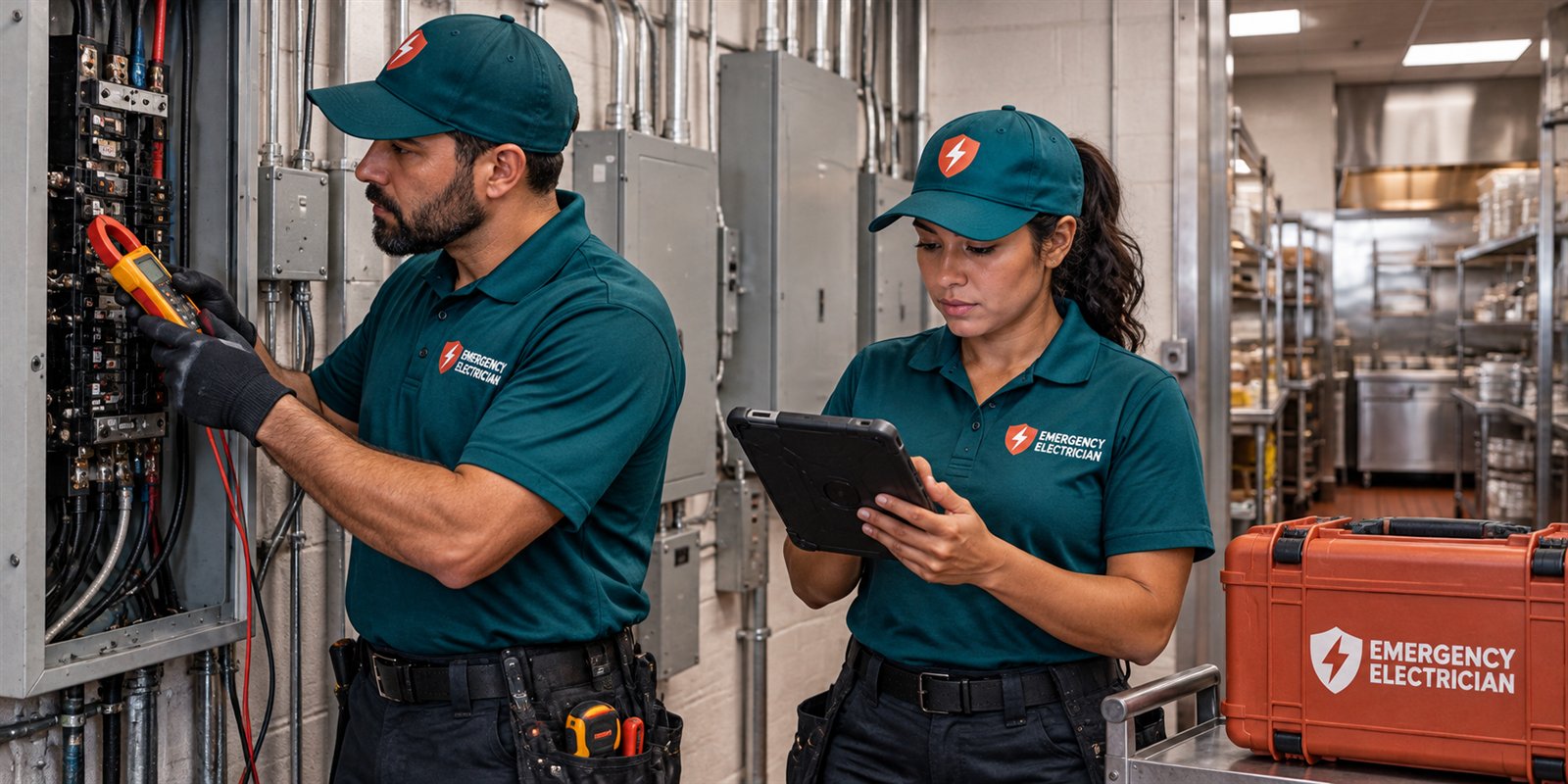
If something is wrong right now, this is not the page
Planning pages are for calm moments. If you smell burning, see smoke or sparks, hear buzzing or crackling from a panel, feel heat on a wall or a breaker, or see water near electrical equipment, treat it as an emergency. Call 911 first if anyone is in danger, if there is fire or smoke, or if a wire is down. Then call an electrician. Do not wait for a scheduled inspection.
If the lights are simply out, find out whether it is the utility or your building. If neighbors are dark, call the power company. If only your space is affected and a breaker will not reset, call. Do not repeatedly reset a breaker that keeps tripping, because it is protecting the circuit from a fault.
When the immediate problem is dealt with, this page can help you ask what could be done to make a repeat less likely. The checks described here are the kind of planning that is done on a normal day, with enough time to think, to ask questions, and to schedule any repair work without the pressure of an outage.

- Burning smell, smoke, sparks, heat, buzzing or water on equipment: urgent, not a planning matter.
- Anyone hurt or a wire down: 911 first.
- Breaker that keeps tripping or will not reset: leave it and call.
- Planning checks are for stable conditions, scheduled in advance.
What a continuity check is, and what it is not
A continuity check, as the term is used here, is a planned review of the electrical equipment your business depends on. A technician looks at the service equipment, the main panel and subpanels, the major circuits, the critical loads, the backup arrangements and the labeling. They note signs of heat, corrosion, loose connections, overloaded circuits, outdated equipment and anything that looks unsafe.
It is not a promise. An inspection looks at conditions at a moment in time. It can find evidence of problems that are developing, and it can show how the system is arranged, but it cannot predict the next storm, the next surge or the next component failure. Electrical equipment can fail without warning, and nothing offered here removes that risk.
It also is not an inspection by a government authority, and it does not replace any inspection required by the rules for your building or business. Think of it as a practical review for the owner or manager, with the aim of reducing surprises and making the next outage shorter and less confusing. The depth of the check varies with the building and what you ask for.
Start with your critical loads
Before the visit, make a list of what your business cannot lose. Refrigeration, point of sale, servers and network equipment, medical or lab equipment, security and fire systems, process machinery, signage and exterior lighting are common examples. Next to each item, note where it is plugged in or which panel feeds it. If you do not know, say so, because finding out is part of the review.
The technician can use that list to focus. A restaurant's priority may be the walk-in cooler circuit, the hood fan and the dedicated outlets for cooking equipment. An office may prioritize the server room, the network closet and the lighting. A warehouse may focus on three-phase equipment, dock doors and lighting. A retail store may care most about registers, display lighting and signage.
Ranking the loads also helps with later decisions, such as which circuits would go on backup power. See backup power planning for a small business. The ranking does not have to be perfect. It only has to give the technician something to work from, and it will probably change after the visit when you learn what is on which circuit.
The service entrance and the main panel
The service entrance is where utility power enters the building. A review here looks at the meter base, the service conductors, the main disconnect and the connections to the main panel. In South Florida, humidity, salt air and storm exposure make corrosion and water entry the usual concerns. A technician will look for rust, discoloration, damaged weatherproofing and signs of earlier water entry.
At the main panel, the technician looks at the condition of breakers, the bus bars and the wiring. They look for signs of overheating, such as darkened insulation or burn marks, and for loose connections, which are a common cause of trouble. They look at whether the panel is crowded, whether the wiring is neat, whether the right sizes of wire and breaker are paired, and whether there is clear working space in front of the panel.
Some tests need the equipment to be shut off, which means planning the visit at a time that suits the business. Some inspections can be done with the covers closed, using an infrared camera or a thermometer to look for hot spots on a loaded panel. Technicians know which steps are safe and which need power off. You should not open panels yourself to prepare. Only a qualified person should remove covers.
Labeling, directories and documentation
A surprising number of outages last longer than they need to because nobody knows what is on which breaker. A good review includes the panel directory. The technician can check that each breaker is labeled, that the labels are accurate, and that spare and unused positions are marked. They can help trace circuits, with the cooperation of whoever knows the space.
Labeling should be clear enough for a stranger to follow at night under a flashlight. Use plain names, such as walk-in cooler compressor or front register, instead of vague words such as misc. Add the location of subpanels and the main disconnect to a simple map. Put a copy of the map where staff can find it, and give one to the property manager.
Ask also about drawings. Some buildings have as-built electrical drawings, a one-line diagram or a panel schedule kept by the landlord. Having them to hand can save time during a fault. If none exist, a technician may offer to sketch a basic diagram of what they see during the visit. For related thoughts see panel labeling before an emergency.
Circuit loading, cords and temporary wiring
Over time, businesses add equipment. A new coffee machine, a space heater, a second refrigerator, extra computers and a string of power strips can overload circuits that were adequate before. A review looks at which circuits carry which loads, whether any are heavily loaded, and whether extension cords and power strips are being used as permanent wiring.
Extension cords and power strips are meant for temporary use and have limits. A technician may point out cords that are warm, damaged, daisy-chained or run under rugs and across walkways. They may suggest adding circuits where equipment is permanently needed. They may also note whether outlets are in good shape, whether ground fault protection is present where wet areas require it, and whether anything is plugged into the wrong type of outlet.
You can help by looking, without touching, for obvious signs: outlets that are discolored, plugs that feel warm, breakers that trip regularly, lights that flicker when equipment starts. Write down what you see and tell the technician. Do not open outlets, remove covers or change wiring yourself. For more on cord limits see extension cords and power strips.
- Warm plugs, discolored outlets or a hot smell: stop using that outlet and report it.
- Breakers that trip regularly: a symptom to report, not to override.
- Lights that dim when equipment starts: may point to loading or connection problems.
- Power strips feeding other power strips: a sign more circuits may be needed.
Surge protection, grounding and storm exposure
South Florida's storms bring lightning, surges and outages. A review can look at what protection is in place. Surge protective devices at the panel and at sensitive equipment can reduce the energy that reaches electronics. They do not make equipment immune, and they wear out after taking surges, so a technician may check whether indicators show they are still working.
Grounding and bonding are the less visible part. They give fault current a safe path and help protective devices operate. A technician can look at the visible parts of the system, such as the connection to the grounding electrode, and note whether anything looks corroded, loose or missing. Some testing needs dedicated instruments and may be a separate item from a general check.
Think about water, too. Look at whether panels and equipment are placed where flooding or roof leaks could reach them, whether outdoor equipment has proper covers, and whether conduit entries are sealed. After a storm, do not enter a flooded space to check equipment. For storm planning see hurricane season electrical readiness and when to add a surge device or generator.
Life safety and emergency systems
Emergency lights, exit signs and fire alarm systems are part of continuity in the sense that they keep people safe when normal power is gone. A review can note whether emergency lights come on when tested, whether exit signs are lit, and whether any show signs of failure. Tests on these systems are often governed by specific rules and need qualified people, so ask what is included and what is not.
A technician may note battery age, loose fittings and damaged units, but fire alarm systems are usually serviced by specialists. If a fire alarm panel shows a trouble signal, do not silence or reset it without a qualified person. Tell the electrician what you see and whom you use for alarm service. See emergency lighting and exit sign failure.
Make sure everyone on staff knows where the exits are and what to do in an outage. A plan that includes who calls whom, how customers are guided out, and when the business closes is as important as equipment. The electrician can describe the system, but the plan is yours.
Preparing for the visit
Schedule the visit for a time that works for the business. Some checks need parts of the system to be turned off, which interrupts operations, so ask about what to expect. Plan for staff to protect sensitive equipment, shut down computers properly and avoid opening refrigeration during any planned interruption.
Clear access to panels, disconnects and equipment. Remove stock, boxes and furniture from the area in front of electrical panels. Make sure keys to electrical rooms are available and that the property manager knows about the visit. If you are leasing, tell the landlord, since some work in shared rooms needs approval. See arranging access for an electrical visit for more.
Have your critical load list, any known problems, any drawings you have, and a history of past issues ready. Tell the technician about trips, flickers, noises, smells and any equipment changes. Be honest about earlier repairs, including any done by people who were not electricians. The more accurate the picture, the more useful the review.
- List your critical equipment and where it is powered from.
- Note any past outages, trips, flickers, smells or repairs.
- Clear access to panels and electrical rooms.
- Arrange keys and notify the landlord or manager.
- Plan for any shutdown, including protecting computers and refrigeration.
Using what the technician finds
After the review, ask for the findings in writing, with items sorted by urgency. Some will be things to fix soon, such as a loose connection or a damaged cord. Some will be things to plan, such as an old panel or a crowded circuit. Some will be observations that need no action. Ask the technician to explain the reasoning behind each recommendation.
Decide what to do and in what order, and ask about permits and cost by phone. Quotes are given by phone, and larger jobs may need an on-site visit. Avoid doing work that has no clear purpose, and avoid putting off work that is clearly urgent. If you rent, share the findings with the landlord where items fall on the building side.
Keep the report with your other continuity records, such as the load list, panel map and insurance contacts. Review it after major changes, such as new equipment or a renovation. A check is a snapshot, and the building changes. Treat it as the start of a habit instead of a one-time project. For a related approach after a failure see preventing a repeat electrical emergency.
Calling to talk it through
If you are thinking about a continuity check, call and describe your business and what worries you. The dispatcher can explain what a visit would involve, whether a technician would need to shut off any power and how long it might take, without making promises about timing. Say whether the space is leased, whether you have backup power and what equipment is critical.
Ask how findings will be reported and what is and is not included in the visit. Ask about the service call charge, which is explained before anyone is dispatched. Quotes for repairs are given by phone, and complicated jobs need an on-site look. A check will not prevent every failure, but it can show you where the weak points are while you still have time to act.
If something is urgent, say so at the start. If anyone is in danger, call 911 first. When you are ready to plan, call and tell us about your building.
Questions people ask
Will a continuity check prevent outages?
No check can promise that. It looks at conditions at one moment and can reveal worn, loose, overloaded or poorly labeled equipment so you can address it, but electrical equipment can still fail, and storms and surges are unpredictable. Think of it as a way to reduce surprises and shorten the next outage, not as protection against every one.
What does a technician look at during the review?
Typically the service entrance and meter base, the main panel and subpanels, breaker and wiring condition, signs of heat or corrosion, circuit loading, cords and power strips, surge protection, grounding where visible, panel labeling, and emergency lighting. The depth depends on your building and what you ask for. Ask what is included when you call.
Will the power need to be shut off?
Some parts of a review can be done with covers closed, while others need parts of the system de-energized. Ask when you schedule. If a shutdown is needed, plan it for a quiet time, shut down computers properly, avoid opening refrigeration, and tell staff and, if you rent, the landlord. Do not open panels yourself.
How often should a business have its electrical system checked?
There is no single schedule that suits every business. Age of the building, climate, equipment changes, past problems and the cost of downtime all matter. Many owners choose to review after major changes, after a storm or surge, and at a regular interval that fits the business. A technician can discuss what makes sense for your situation.
Does this replace a required inspection?
No. A continuity check is a practical review for the owner or manager. It does not replace any inspection required by local rules, your insurer, your landlord or the authority that oversees your business. If you are unsure what inspections apply, ask the property manager and the local permit office.
What should I do after I get the findings?
Ask for them in writing, sorted by urgency, with the reasoning for each item. Fix urgent items soon, plan the others, and share building-side items with your landlord. Quotes come by phone and larger jobs need a visit. Keep the report with your continuity records and review it after major changes.
Reading about "Continuity Checks: What to Know and Do"? Tell us what stopped working and when. We will say what an electrician would check first, and quotes are given by phone when the job can be described.
Related pages
- Business Backup: Planning backup power for a small business: what to keep running first, how generators and batteries differ, and how to stay safe during an outage.
- Business Power Loss: Your business just lost power. Follow a safe first-hour sequence for owners and managers: safety, isolating the cause, informing staff, and documenting.
- Prevent Repeat: Follow-up inspections and everyday habits that lower the chance of another electrical emergency in South Florida, without promising outcomes.
- Panel Labeling: Why an accurate circuit directory matters in a crisis, what a good one looks like, and how labels are updated safely without opening the panel yourself.
- Outage Records: What to record during a business power outage for managers, landlords and insurers: timelines, photos, losses and technician findings, with no coverage claims.
- Exit Lights: Exit signs dark or emergency lights failing in an occupied building? Learn why it is a life-safety issue, safe first steps, and what a technician will check.