

Triage first: the order of calls in Coral Springs
If anyone is in danger, call 911 first. That means fire, heavy smoke, a person shocked and hurt, anyone unresponsive and anyone with chest pain, confusion or trouble breathing after contact with electricity. Give the address, say it is an electrical emergency and follow the dispatcher's instructions. Do not hang up until you are told to.
In a neighborhood with large trees, the other common emergency is a line problem. A branch resting on a wire, a service cable pulled away from the house, a wire touching a fence or a tree that has taken the line down with it are all hazards. Stay well back and keep children and pets away. Call 911 and the power company. Do not try to move a branch that touches a wire, because a wet branch conducts, and do not touch anything that touches the branch.
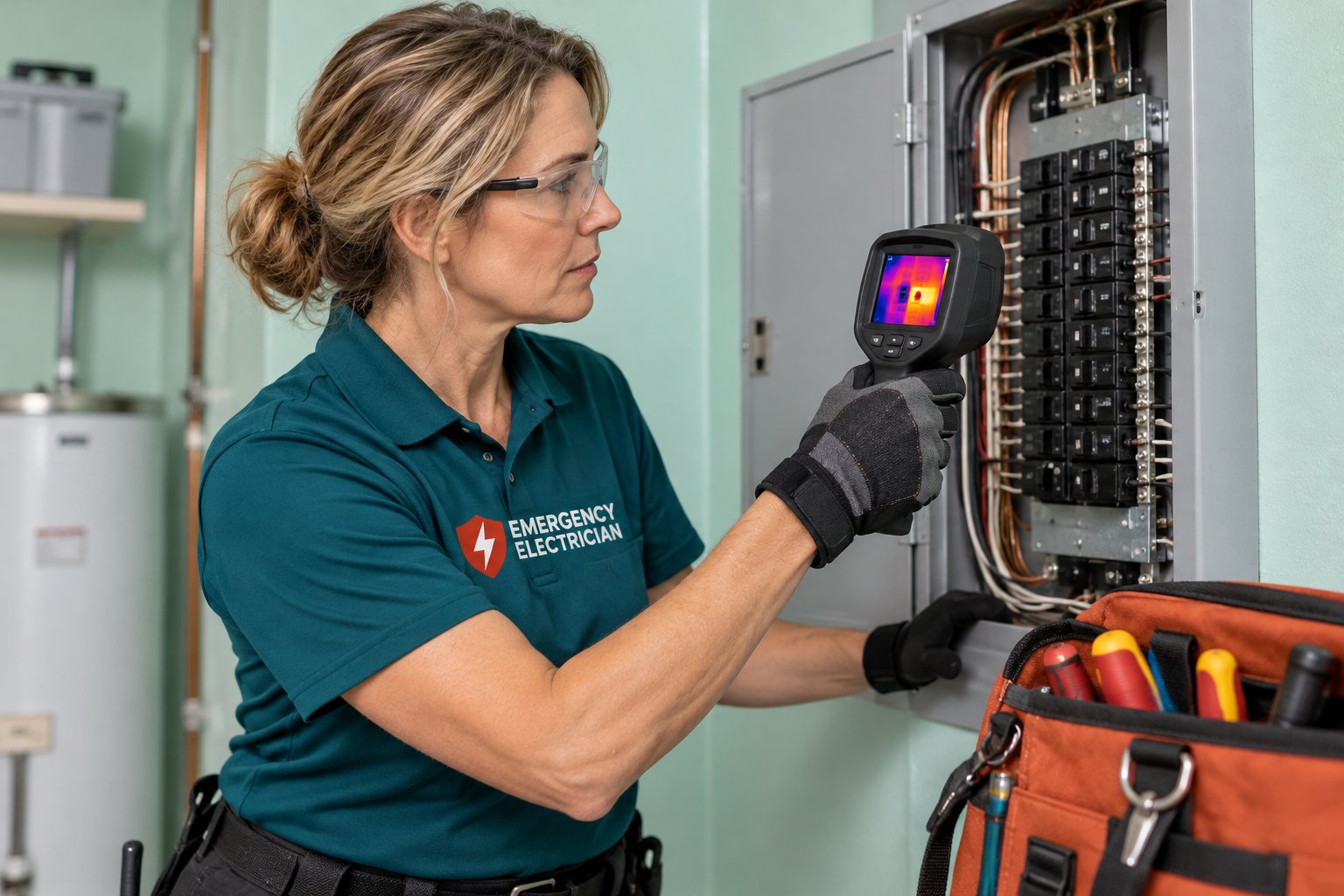
If nobody is in danger but the system is behaving badly, such as a hot or buzzing panel, a burning smell, a breaker that will not reset or a house that has gone half dark, call an emergency electrician. The dispatcher will ask safety questions first, explain how the visit works and tell you what to leave alone in the meantime.
- Fire, heavy smoke, injury or unresponsive person: 911 first.
- Branch on a wire, wire down or cable pulled off the house: stay back, 911 and the power company.
- Smoke, heat or buzzing from the panel: stay clear, 911 if there is smoke, then an emergency electrician.
- Dead outlets, tripping breakers or half the house out: call an emergency electrician.
Trees, branches and overhead service lines
Mature trees are one of the pleasures of living here, and a leading cause of storm-related electrical calls. Overhead service lines run from a pole to a house, often passing through or beside tree canopy. A heavy limb that falls on that line can pull the cable down, pull the mast over, tear the weatherhead from the wall or break the connection at the meter.
Not every case is dramatic. A branch that rubs against a cable for months wears through the insulation, and the cable may arc in the rain. A palm frond that blows onto a line can cause a short. A tree that leans against a mast bends it gradually. Owners notice flickering lights, a hum from the line outside or a smell of burning from the roofline, and assume it will pass. It will not.
If a tree has fallen on or against a service line, treat the whole tree as energized. Our pages on a tree falling on the service line, a wire touching a tree or fence and a frayed or sagging service cable explain what you may see and what to do. In every case, the first step is distance.
Masts, weatherheads and the point where the house is connected
Where the overhead service connects to the building, three pieces matter: the weatherhead at the top of the pipe, the mast or conduit that carries the wires down and the attachment to the structure. If a limb bends the mast, the weatherhead tilts, the seal fails and rain runs down the wires into the meter and panel. If the cable is pulled hard, it may loosen connections inside the weatherhead or tear away from the building.
Signs of trouble include a mast that leans, a weatherhead that is tilted or hanging, wires that sag visibly or a cable that has pulled away from the wall. Inside the house, you may notice lights that dim, flicker or glow brighter than usual, or a hum near the panel. Those are symptoms of a loose or damaged connection and deserve prompt attention.
Responsibility is split. The utility owns the lines up to the connection, and the owner is responsible for the building-side equipment, which in many arrangements includes the mast. The utility must disconnect and reconnect so the work can be done safely. Our pages on leaning or bent service masts, torn weatherheads and water entering the service and urgent service mast repair cover the details.
Roots, underground runs and landscaping hazards
Not every tree problem is overhead. Many neighborhoods have underground service or underground branches to pool equipment, outbuildings, irrigation controls and landscape lighting. Roots grow toward moisture and push on pipes and conduit. Over years, they can crack a conduit, move a junction box or press on a cable until its insulation fails.
Landscaping work is a second hazard. A shovel through a buried cable, a tractor-mounted auger in a yard or a fence post set through a conduit can damage a line that nobody remembered was there. A damaged buried cable may not fail at once. It may leak current to ground for weeks, which shows up as a tripping ground fault device, a tingling feeling from a metal object or a patch of ground that is always wet.
Before any digging, use the public utility locating service that exists for this purpose in Florida, and mark the paths of private lines you know about. If you strike a cable, step away, keep others away and call 911 if there is any sign of arcing or burning. Then call an emergency electrician. Our page on outdoor outlets and yard electrical safety explains how to treat yard circuits with respect.
What storms do to a tree-lined street
Thunderstorms and tropical systems bring wind, and wind moves trees. In a neighborhood with mature canopy, one gust can take down a limb that brings a line with it, and a hurricane can take down dozens along the same street. Outages can last a while, and individual homes may be out even after the street is restored if their own service line was damaged.
After a storm, walk the property carefully and look from a distance. Is the mast straight? Is the weatherhead still attached? Are the wires clear of branches? Is the meter intact and still seated in its base? If anything looks wrong, stay back and call. Do not go up a ladder, do not pull at a cable and do not cut a branch near a wire. Our page on storm-damaged meter and mast goes through the signs.
Before the season, have large limbs trimmed away from service lines by a qualified tree service that knows the rules for working near energized lines, and ask the utility about the line it owns. Our before-hurricane electrical checklist and hurricane season electrical readiness explain other steps that make storm season easier.
| Coral Springs situation | What it means | First move |
|---|---|---|
| Branch resting on a wire | Line may be energized, cable may arc | Stay back, 911 and utility |
| Mast leaning or weatherhead tilted | Water may enter the service | Stay clear, call |
| Cable sagging or pulled off wall | Loose or damaged connection | Stay back, 911 and utility |
| Tripping GFCI after digging | Damaged buried cable | Leave circuit off, call |
| Whole house dark, neighbors lit | Service line or main failure | Check main breaker, call |
Flickering, buzzing and the signs of a damaged connection
A loose or damaged connection at the service rarely announces itself with fireworks. It shows up as lights that flicker or change brightness, appliances that act oddly, a hum or a crackle near the meter or the panel, a warm meter base and sometimes a smell of hot plastic. Those symptoms get worse under load, so they may be noticeable only when the air conditioner starts or the oven is on.
When the neutral connection is the one that has loosened, the voltage can become unbalanced. Some lights run bright, others dim, and sensitive equipment can be damaged. That is a case where lights that seem extra bright are not a good sign. Our pages on loose neutral symptoms and lights extra bright or surging explain why.
If you see these signs, reduce the load by switching off large appliances, and call. If the signs are paired with a burning smell, visible scorching at the meter or panel or smoke, call 911. A hot connection at the service is one of the more serious home electrical problems, because it can heat quietly until something ignites.
Older neighborhoods, newer additions and panels
Coral Springs includes a range of home ages, from earlier neighborhoods to newer developments. Owners in older sections have often remodeled: kitchens, bathrooms, additions, screened rooms and pools. Each project added circuits, and many left the original panel in place. A panel that has grown crowded may have double-tapped breakers, handles that do not match the wire size and spaces that are labeled wrongly or not at all.
Pool and patio additions deserve particular attention. Pumps, heaters, lights and automation are all supplied from the house, often through a subpanel in an outbuilding or on an exterior wall, and a long run from the main panel can lose voltage and run hot if it was not sized well. A pool pump that trips repeatedly or a light that flickers is worth a call.
A technician can inspect the service, the panel and the major circuits and tell you whether a repair, a replacement or a monitoring plan fits your home. Our page on panel repair versus panel replacement explains the thinking, and older home electrical red flags lists what to watch for.
Utility, association or electrician: who handles what
Responsibility depends on where the problem is. The power company handles its lines, poles and transformers and generally the meter. The owner handles the building-side equipment: the meter base, the mast in many arrangements, the panel and the wiring. A homeowner association handles community lighting, entry equipment and common elements.
If the whole street is dark, check the utility's outage information. If only your home is dark, check your breakers and your meter. If a wire is down, call 911 and the utility. If the mast or weatherhead is damaged, the electrician repairs it and the utility must disconnect and reconnect. Our page on utility or electrician, who fixes what sets this out with examples, and the power company disconnect and reconnect process explains the steps.
Plan for the sequence. After a damaged service is repaired, an inspection may be required before the utility reconnects. Your electrician should explain what is needed and in what order, so that you know why the lights are still off after the repair is finished.
Permits, records and insurance after a tree event
Replacing a mast, a weatherhead, a meter base or a panel usually requires a permit and an inspection through the city's building department. A technician on an emergency call will tell you whether a permit is needed and how it will be handled. They may make the situation safe first and arrange the permit and inspection afterward.
Tree damage is a common insurance claim. Before anything is moved or cut, photograph the tree, the wires, the mast, the meter and any damage inside the house. Keep the findings report, the permit and the inspection result. Make a list of damaged equipment. Our guides on photographing damage before repairs and electrical damage and insurance documents explain what to gather.
Be careful about who removes a fallen tree. Tree work near an energized line is dangerous and should be done only after the utility has made the line safe. Our page on a tree falling on house wiring explains the order of work.
Pools, screened enclosures and the electrical work behind them
Many Coral Springs lots hold a pool under a screened enclosure, with equipment tucked beside the house. That equipment takes a steady beating from sun, sprinklers and storms. Pumps, heaters, chlorinators, automation panels and lights all depend on weatherproof connections and ground fault protection that works. Palm fronds, branches and wind-driven rain can damage the wiring that serves them, and moisture finds the weak point in time.
A pump that trips its breaker, a light that flickers, a control panel with water inside or a tingle felt in the water is a hazard. If anyone feels a shock in or near the pool, get everyone out at once and do not go into the water to help. Call 911 if anyone is hurt. Switch off the pool breaker only if you can reach it dry, then call an emergency electrician.
After a storm, the pool equipment pad may be wet or flooded. Do not step into standing water near it, do not switch the equipment on and do not assume that it is safe because it looks fine. Our page on pool and spa electrical after flood explains what to leave to a technician.
What to tell the dispatcher and how to prepare
Give the dispatcher the address and say what happened, what you saw, heard and smelled and what you have already done. Describe where the tree or branch is, whether any wire is down or sagging, whether anything is sparking and whether the area is wet. Say whether a breaker has tripped, whether anyone felt a shock and whether anyone relies on medical equipment. Our page on what to tell the electrician dispatcher gives a short script.
You will be asked safety questions and told how the visit works, including the service call charge, which is explained on the phone before anyone is dispatched. Quotes are given by phone, and more complicated jobs need an on-site visit first.
To prepare, learn where your main breaker is, label the panel, keep flashlights and a charged power bank handy and know which trees are near your service line. Do not ignore small signs, because a flicker or a hum is the earliest warning you get. If something looks or smells wrong, call, and let a technician say whether it is urgent.
Questions people ask
Who do I call first for an electrical emergency in Coral Springs?
For fire, heavy smoke, a person shocked and hurt or anyone unresponsive, call 911 first. For a downed or sparking utility line or a branch on a wire, stay back and call 911 and the power company. For trouble at your property without immediate danger, call an emergency electrician.
A branch is lying on the wire to my house. Can I move it?
No. A branch on a wire can be energized, and wet wood conducts. Stay far back, keep others away and call 911 and the power company. Do not touch the branch, the wire or anything in contact with them, and do not let a tree service work near the line until the utility has made it safe.
My mast is leaning after a storm. Is that urgent?
Yes. A leaning mast can tear the connection at the top, let water into the meter and panel and strain the cable. Stay clear, do not touch it and call. The electrician repairs the mast and the utility has to disconnect and reconnect so the work can be done safely.
Why do my lights flicker or run extra bright?
It can mean a loose or damaged connection in the service, often a neutral, which makes voltage uneven. Some lights run bright and others dim, and equipment can be damaged. Reduce the load by switching off large appliances and call. If you smell burning or see scorching, call 911.
What should I do before digging in my yard?
Use the public utility locating service before any digging, and mark any private lines you know about, such as pool or lighting circuits. If you hit a cable, step back, keep others away, call 911 if there is arcing or burning and then call an emergency electrician. Do not touch the cable or the tool.
How are quotes given for emergency electrical work?
Quotes are given by phone after you describe the problem, and more involved jobs need an on-site visit first. There is a service call charge, explained on the phone before dispatch. The technician explains findings and options in plain terms before any work begins, so you decide at each step.
About "Emergency Electrical Help in Coral Springs": call and give us the details, and we will explain what is safe to do while you wait and what the visit would cover. Jobs that cannot be quoted blind need a look on site.
Related pages
- Tree on Line: A tree pulled down the service line to your house. Learn who handles mast, drop and conduit damage, what to avoid, and how to coordinate the repair.
- Bent Mast: A service mast bent or pulled by a tree, wind or a sagging line is a hazard. Learn what to do, how to work with the utility and what repair and permits involve.
- Line on Tree: A power line resting on a tree, fence or roof can energize it. Learn the hazards, the correct call order, and what to avoid until the utility makes it safe.
- Plantation: Emergency electrical triage for Plantation: established ranch homes, aging panels and decades of added room loads. Learn who to call first and what to expect.
- Miramar: Emergency electrical triage for Miramar: newer suburban builds, open-sky lightning exposure and surge damage. Learn who to call first and what to check.