
Danger first: treat every wire as live
If a tree has pulled wires down or left them sagging, the first step is distance. Stay far back from any wire on the ground, on a fence, on the tree, on the roof, or hanging low over the yard. Keep children, pets, and neighbors away. Do not drive over a wire. Do not touch a tree, a fence, a gutter, a car, or a puddle that is near a downed wire, because the ground and anything touching it can carry current for some distance.
Call 911 and tell them wires are down, with the address and the location of the hazard. Then report the same to the utility. Do not wait for the power to go out as a sign that the wires are dead. A wire can be live while the power in the house is out, and a line can be re-energized automatically or when crews restore a feeder, with no warning.
If the wires are on a vehicle with someone inside, the guidance from emergency services is to stay in the vehicle unless there is fire, and to call for help. That is a situation for the fire department and the utility, not for neighbors. On your own property, the rule is simple: look, stay back, call.
- Stay far back from any wire on the ground, tree, fence or roof.
- Call 911 and the utility. Do not wait for the power to fail.
- Never touch or move a wire, branch or object in contact with it.
- Keep people and pets out of the yard until crews say it is safe.
The anatomy of a service connection
A typical South Florida home with overhead service has a series of parts between the utility pole and the main panel. A service drop is the set of wires from the pole to the house. It attaches to the building at a point on the roofline or at a mast, a vertical pipe rising from the roof or the wall. At the top of the mast is a weatherhead, a curved fitting that lets the wires enter the conduit while keeping rain out. The conduit runs down to a meter socket, and from the meter, wires run to the main panel.
Some houses have underground service, in which cables come from a pad-mounted transformer or a pole through buried conduit to the meter. Trees can damage those too, when roots, falling trunks, or digging crews disturb buried conduit or a pedestal. But the overhead drop is the part most exposed to falling trees.
Understanding these parts makes the phone call easier. When the dispatcher asks what is damaged, you can say whether the drop is down, whether the mast is leaning or broken, whether the weatherhead is pulled off, or whether the meter socket is hanging. That helps sort out who needs to come and in what order.
Who owns what: utility versus customer
The usual dividing line is the point of attachment. The utility owns and repairs the service drop, the wires from the pole to the connection, and the meter. The customer owns the mast, the weatherhead, the conduit, the meter socket, and everything from there into the house. The exact boundary can vary by utility and by the layout of the property, and a technician or the utility can confirm it for your address.
This split matters because each side repairs only its own equipment. The utility will not repair a bent mast or a cracked meter socket, and an electrician will not restring the drop wires from the pole or handle the meter itself. If both sides are damaged, both need to act, and the utility generally will not reconnect until the customer-side equipment has been repaired and, where required, inspected.
In a condominium or a multi-unit building, ownership is different. The service entrance, the meter bank, and the riser may be common elements owned by the association, while the panel inside each unit belongs to the owner. See the page on which repairs belong to the utility and which to an electrician for a fuller breakdown.
What tree damage looks like on the customer side
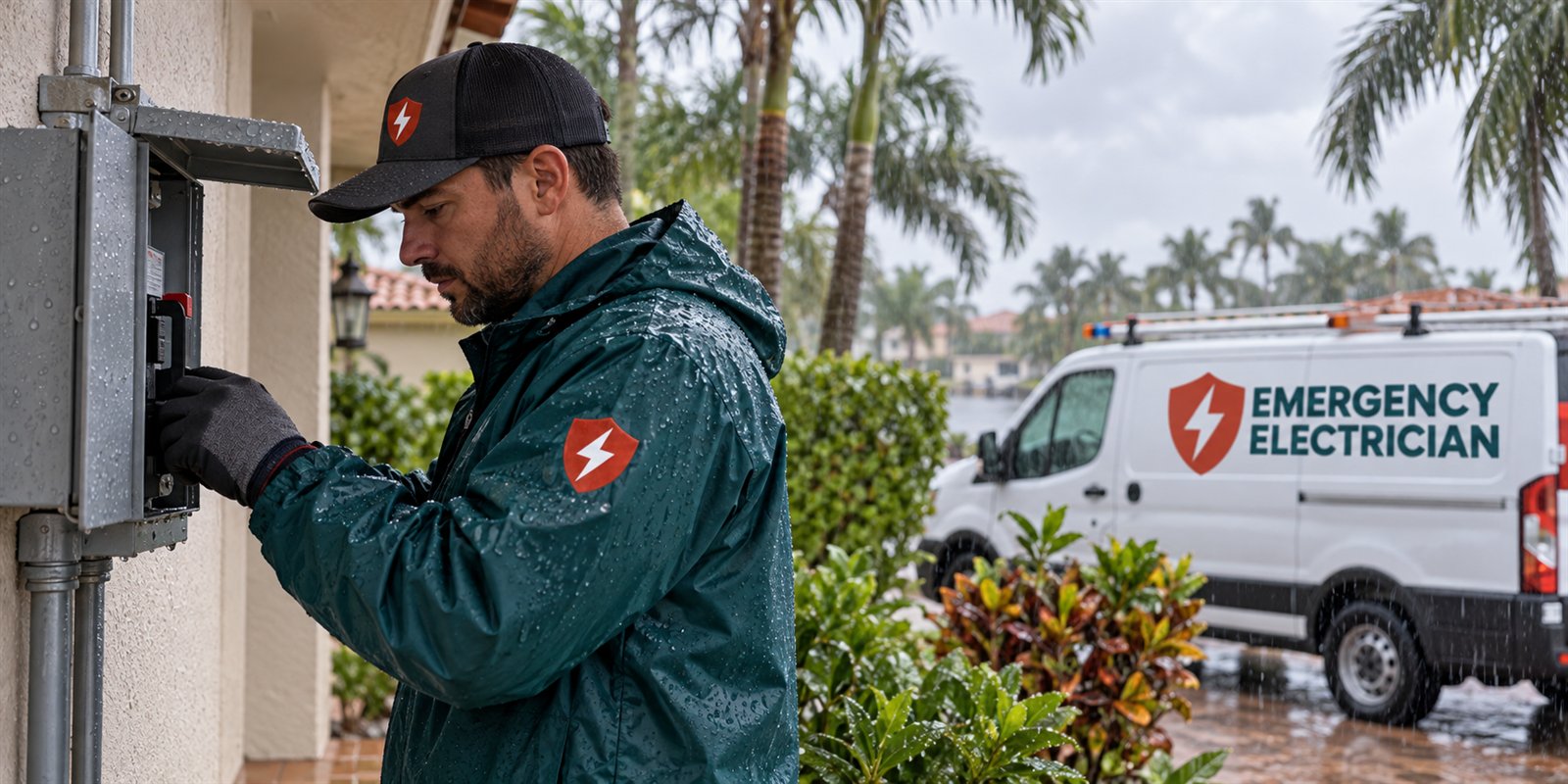
A tree pulling on the service drop transmits that force to the mast. The mast may bend, lean, crack, or tear out of its brackets and the roof flashing. Because the mast is usually conduit with the service conductors inside, a bent mast can pinch or damage the wires and expose conductors. A weatherhead can be pulled off, leaving open conductors and an open pipe that lets rain pour in.
The conduit and the meter socket below are next. Rainwater entering at a torn weatherhead runs down the conduit into the meter socket and may reach the main panel. A meter socket that has been jerked can be loosened from the wall, cracked, or have its internal connections damaged. Signs include a meter that tilts, a socket cover that has popped, burn marks, or a smell of burning plastic.
Roof damage is common at the attachment point. The mast passes through the roof with flashing to keep water out, and a leaning mast can tear the flashing and open the roof to leaks. That water may reach attic wiring and ceilings. A roofer and an electrician usually need to coordinate for this repair.
What to do while you wait
Stay out of the yard near the damage. If the utility or fire crews have asked you to leave the house or stay away from certain areas, follow their instructions. Keep a safe distance and a clear exit path.
Inside the house, if the power is still on and you believe the service has been damaged, you can switch off the main breaker if the panel is dry, easy to reach, and not in a damaged area. This stops power flowing inside, but it does not make the outside wires safe. Do not open the panel, and do not touch the meter or the mast. If the panel is wet, damaged, or near the impact area, do not approach it.
Use flashlights, not candles. Unplug sensitive electronics so a restoration surge does not harm them. Take photographs from a safe distance for the insurance record, and write down the time and who you called. If you plan to use a generator, run it outdoors, far from the damage, and never connect it to the house wiring. See generator backfeed risk for why this is critical to utility crews.
The sequence of repairs
The repair usually follows a logical order. First, the area is made safe, which may mean the fire department and the utility securing downed wires or de-energizing the line at the pole. Second, the tree is removed by a crew that works only after the utility confirms lines are de-energized or clear. Third, the customer-side equipment is inspected and repaired by an electrician, which may include replacing the mast, weatherhead, conduit, meter socket and service conductors as needed.
Fourth, where required, the work is inspected by the local building or electrical authority. Many cities in Broward County and the cities from Boca Raton to North Miami require a permit for service equipment repairs and an inspection before reconnection. Permit offices work in their own ways, so ask your electrician what applies in your city. Fifth, the utility reconnects the service and sets or reinstalls the meter.
The sequence can take time, because each step depends on the one before. A utility crew cannot reconnect until the customer side is ready, and an electrician cannot finish until the utility has restored its drop or confirmed that the mast can be worked on. Good communication between the parties speeds things along. See the page on the power company disconnect and reconnect process.
What an electrician checks and repairs
On arrival, the technician confirms with the utility, or by observation, that the service wires are de-energized before working near them. They assess the mast, weatherhead, conduit, service conductors, meter socket and the grounding conductor. The technician looks for bends, cracks, burn marks, exposed conductors, and water damage.
If the mast and weatherhead are bent or torn, replacement is typically the right approach, since a bent mast can have damaged conductors inside. Conductors that have been stretched or nicked may need to be replaced to the first accessible connection. The meter socket is checked for cracks and burned contacts, and replaced if damaged. The grounding electrode conductor and its connections are checked, since tension on the service can disturb them.
Inside, the panel is examined for water damage and corrosion, and the main breaker is checked. If water entered through the weatherhead, it may have reached the bus bars and breakers, and those parts may need replacement. The technician will explain what is repaired, what is in doubt, and what the utility must do. Quotes for the repair are given by phone, and complicated jobs need an on-site visit before a quote is possible.
Permits, inspection and why they matter
Service equipment repairs usually need a permit because they affect the safety of the connection between the utility and the house. A permit means that an inspector will check the work, and in many places the utility will not reconnect until the inspection has passed or the authority has released the service. This protects you from poor connections that could cause a fire later.
The details differ by city and county. Some places allow an emergency repair with a permit applied for afterward, and others require approval first. Your electrician will know the local process. Do not hire anyone who suggests skipping the permit because it is faster. An uninspected service connection can cause trouble with insurance, with the sale of the house, and with safety.
The page on whether you need a permit for emergency electrical work explains how this usually works and what to ask. Keep copies of the permit and the inspection sign-off with your records.
Hidden damage after the reconnection
Even after the service has been repaired and reconnected, watch the house for several days. A stressed conductor that was missed, a loose connection in the meter socket, or moisture that entered the panel can produce problems later. Signs include flickering lights, a buzzing sound at the meter or panel, a warm meter cover, breakers that trip, and a burning smell.
If you see any of these, call promptly. A loose connection in the service entrance heats under load, and the heat rises on hot afternoons when the air conditioner runs. A problem that does not appear at night may show up in the heat of the day.
It is also worth walking the property after the repair to see if the tree removal has left any damage to underground conduit, landscaping lighting, or pool equipment lines. The page on urgent service mast repair explains what that repair involves.
Insurance, documentation and what to ask
Photograph the damage from a safe distance before anything is moved: the tree, the wires, the mast, the meter, the roof at the attachment. Keep all invoices, permit documents, and written findings. Ask the electrician to describe what was damaged and what was repaired in writing. See electrical damage and insurance documents for what adjusters usually want.
When you call an electrician, say that a tree took down the service line, whether the wires are still on the ground, and whether the utility has been notified. Describe the mast, weatherhead and meter as best you can from the ground. Ask about the service call charge and how scheduling works before dispatch.
Quotes are given by phone and larger jobs need an on-site visit. When you are ready, call, and the dispatcher will help you with the order of the steps. If wires are down, someone is hurt, or there is smoke or fire, call 911 first.
Questions people ask
Who is responsible for the wires that a tree pulled down?
The utility owns and repairs the service drop, which is the wires from the pole to the connection point, and the meter. The customer owns the mast, weatherhead, conduit, meter socket and wiring inside. The exact boundary can vary, so the utility or an electrician can confirm it for your address. Both sides may need to act before service is restored.
Can I move the wire or the branch off my property?
No. Treat every downed or sagging wire as live, even if your power is out. Stay far back, keep people and pets away, and call 911 and the utility. Never touch a wire, a branch contacting it, or anything wet or metal near it. Only trained crews should move a wire or clear a tree from a line.
Why will the utility not reconnect my power right away?
Customer-side equipment must be safe before the utility reconnects. If the mast, weatherhead, conduit or meter socket is damaged, it must be repaired by an electrician, and in many areas inspected, before the utility restores service. This protects your home and the utility crews from a faulty connection.
Do I need a permit for a mast and meter repair?
In many Florida cities, yes. Service equipment repairs affect the connection between the utility and the house, and an inspection may be needed before reconnection. Rules differ by city and county. Your electrician will know the local process. Be cautious of anyone who suggests skipping the permit to save time.
Is it safe to turn off the main breaker inside the house?
If the panel is dry, easy to reach, and away from the damage, switching off the main inside the house reduces risk inside. It does not de-energize the service wires outside or the incoming conductors in the panel. Do not open the panel or touch the meter. If the panel is wet or damaged, stay away and call 911 and the utility.
What should I tell the dispatcher?
Give your address and a callback number. Say that a tree pulled down the service line, whether wires are on the ground, whether the mast or meter looks damaged, whether you have contacted the utility, and whether there is smoke or a burning smell. Ask about the service call charge and scheduling before dispatch.
If "A Tree Pulled Down the Service Line" matches what is happening, call and describe it plainly: the room, the breaker, any burning smell or tripped circuit. We explain what the repair would involve before a visit is set.
Related pages
- Tree on House: A tree on the house can hide damage to attic wiring, fixtures and the service. Learn the hazards, the safe first steps, and what an electrician inspects.
- Mast and Meter: Why damaged meter sockets, masts and weatherheads must be repaired by an electrician before the utility reconnects, and how the process usually works.
- Frayed Service Cable: Frayed, sagging or rubbed-through service cable at your house: how to tell utility lines from your own conductors, what to avoid and who to call first.
- Downed Wire: A wire on the ground may be live even if it is silent. Learn how to keep a safe distance, call 911 and the utility, and what never to do near a fallen line.
- Who Fixes What: Where utility equipment ends and customer equipment begins, in general terms, so you know whether to call the power company, an electrician, or 911 first.
- Wet Attic Lights: A roof leak can send water along wiring into ceiling lights. Learn what is safe to do, what to leave alone, and how an electrician triages a wet ceiling.