
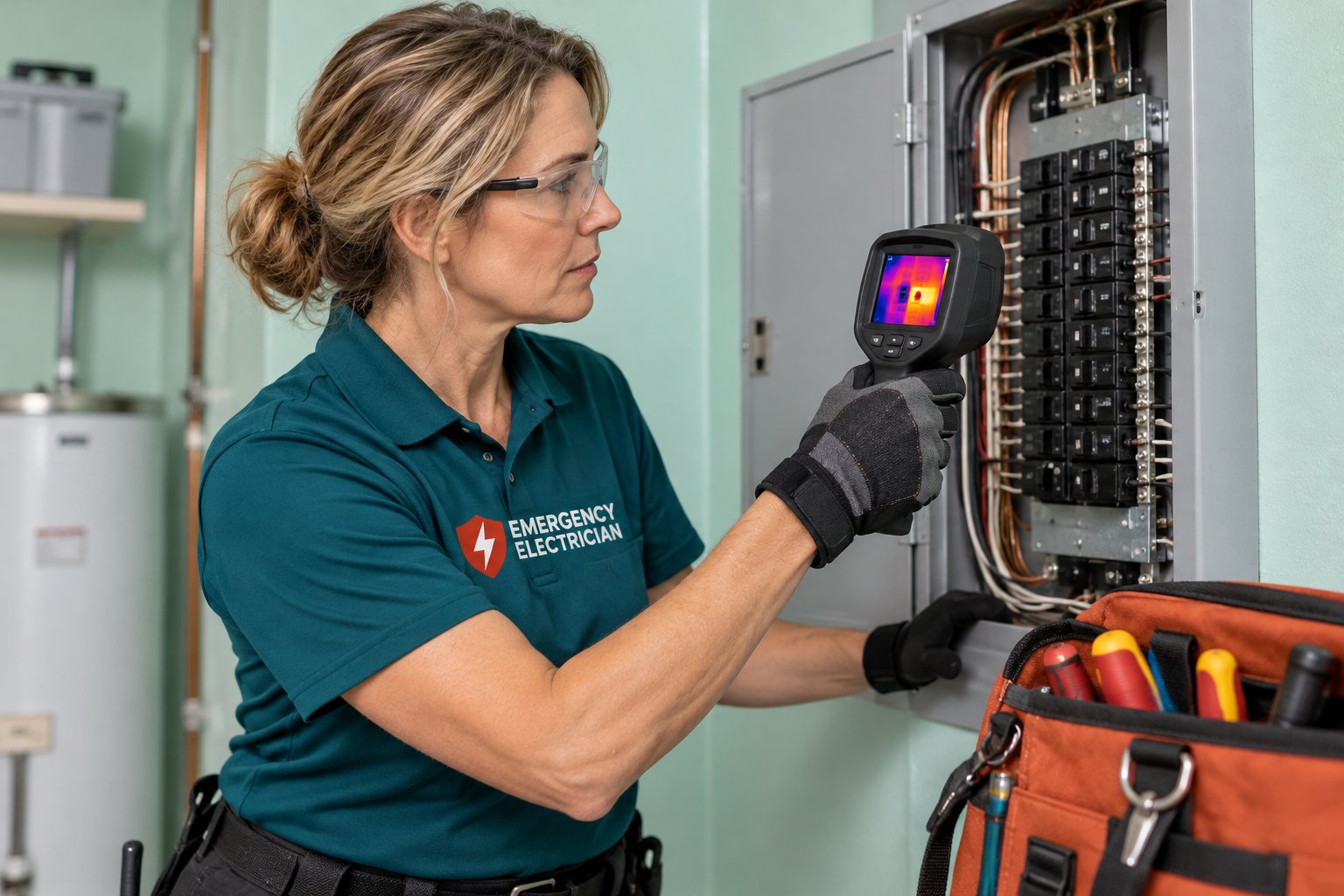
Safety first: what you can see is not the whole danger
If you see sparks, smoke, flames, or a burning smell at the meter or the mast, or if any wire is down or sagging, move away and call 911. Then report it to the utility. Do not approach, do not touch the meter, and do not try to push a leaning mast back into place. The wires entering the top of the mast and the meter socket are energized from the utility side with a voltage that can kill, and they remain so even when your own power is out.
If the meter has been pulled out, the socket cover is hanging open, or the meter is missing, the exposed jaws behind it may be live. Do not reach in, do not poke anything into the opening, and keep children and pets away. A missing meter is not a sign that the circuit is dead.
If there is no immediate hazard, take photographs from a distance and write down what you see. That record helps the electrician plan the repair and helps with insurance. Keep your attention on the ground, not on climbing a ladder to inspect. The best inspection for you is from a safe distance on the ground.
- Sparks, smoke, flames or burning smell at the meter: call 911.
- Never touch a leaning mast, torn weatherhead, or open meter socket.
- A missing or pulled meter does not mean the jaws are dead.
- Photograph from a distance and report what you see.
What the mast, weatherhead and meter socket do
The mast is a rigid pipe, usually steel conduit, rising from the meter area above the roofline. It lifts the utility's wires high enough to keep them clear of the roof and of people. The utility wires attach to a point on the mast, and the service conductors inside the mast run down to the meter. The mast must be strong enough to hold the pull of the wires and braced so that it does not lean.
The weatherhead is the curved cap at the top of the mast. It lets the conductors enter the pipe while shedding rain, and it has small openings through which the wires pass. If it is torn off or cracked, water runs straight down the conduit toward the meter and the panel.
The meter socket is the box on the wall that holds the utility's meter. It has jaws that clamp the meter blades, connections for the incoming conductors, and connections for the outgoing conductors to the main panel. The socket belongs to the customer, while the meter belongs to the utility. The socket takes the stress from the mast above and must remain watertight and firmly mounted.
Why damaged customer-side equipment blocks reconnection
The utility's job ends at the connection point. Past that point, safety depends on the customer's equipment, and the utility has no way to verify its condition by looking from a truck. A leaning mast, an open weatherhead, a cracked socket, or burned connections can cause a fire, a shock hazard, or a fault that endangers crews and the neighbors on the same transformer.
For these reasons, utilities generally require that damaged customer-side equipment be repaired before they restore or keep service on. In many cities in South Florida the repair also requires a permit and an inspection by the local authority before the utility reconnects. The exact requirements differ by utility and city.
This is a frustrating moment for many homeowners. The neighbors have power, the street looks fine, and yet the house is dark. The reason is usually that the house has damage on its side of the line that must be fixed first. Knowing this saves time, because you can call an electrician early rather than waiting for the utility to come.
Typical storm damage patterns
Wind can bend or twist a mast, especially when the utility drop pulls on it or a limb falls on it. A bent mast can crush or abrade the conductors inside. Wind can also pull the weatherhead apart or loosen the clamps that hold the mast to the wall, so that it leans visibly.
Flying debris and falling trees can strike the meter socket, cracking the plastic or bending the metal. Storm surge and flooding can reach a socket mounted low on the wall and corrode its connections. Salt air accelerates that corrosion, particularly near the coast, so a socket that looked fine before the storm can show green or white deposits afterward.
Roof damage is a related issue. The mast passes through the roof with flashing, and a damaged roof around the mast lets water run down the conduit. If a tarp has been placed on the roof, the mast may be hard to reach, and the roofer and the electrician need to coordinate.
What an electrician repairs
The electrician begins by confirming the situation with the utility, which may need to disconnect the drop or pull the meter, so that the work can be done safely. Customer-side technicians do not cut live utility wires. The utility handles that step.
Typical repairs include replacing a bent or damaged mast, installing a new weatherhead, replacing service conductors that have been stretched or damaged, replacing a cracked meter socket, restoring a securely mounted and properly braced mast, and renewing the grounding connections. Where the roof flashing is damaged, the tech seals it or coordinates with a roofer.
Inside, the technician checks the main panel for water and damage. If water has entered through a torn weatherhead, the panel may need cleaning, drying, and replacement of corroded parts. In some cases the panel itself needs replacing. The technician explains the findings and the options, and quotes are given by phone, with larger jobs needing an on-site visit first.
Common scenarios and how they play out
Scenario one: after a hurricane the whole street has power again, but your house does not, and the mast is leaning toward the street with the drop pulled taut. The likely path is a utility visit to secure or detach the drop, an electrician to replace the mast and weatherhead and check the conductors, a permit and inspection where required, and then the utility to reconnect. Calling an electrician as soon as the utility has made the area safe saves days compared with waiting to see whether the problem fixes itself.
Scenario two: a flooded garage has a meter socket mounted low on the wall, and the contacts show green corrosion after the water recedes. Here the socket and probably the panel need inspection before anyone thinks about reconnecting. Floodwater and electricity do not mix, and a corroded socket can overheat under load. The technician decides what can be cleaned and what must be replaced.
Scenario three: the weatherhead is intact but the roof flashing around the mast is torn, and water has been dripping down the conduit during each rain. The power still works, but the meter socket and the panel are taking water. That is an urgent repair even without an outage, since it can end in a short circuit or a fire. Turn off the main if it is safe, and arrange a repair.
Scenario four: a condominium building with a bank of meters on an exterior wall, several of which were struck by debris. The meter bank belongs to the building, not to the individual unit. Owners should tell the association, and the association arranges the repair and the utility reconnect, while each owner arranges the inspection of the panel inside the unit.
Permits and inspection
Because service equipment is the safety gateway to the house, most cities require a permit for repairs to it. The inspector looks at the mast, the clearance of the wires, the weatherhead, the socket, the grounding, and the connections. After approval, the authority notifies the utility or releases the service so that reconnection can proceed.
The process varies. Some jurisdictions allow an emergency repair to begin and the permit to be pulled right away, while others need the permit first. In the aftermath of a major hurricane, local offices sometimes set up streamlined procedures for restoration work. Ask your electrician what applies, because they will know the local practice.
Keep the permit number and the inspection sign-off. If you sell the house or file an insurance claim later, these documents show that the repair was done properly. The page on rebuilding after a storm and electrical permits goes into this.
The reconnect: what the utility does
When the customer-side repair is complete and approved, the utility reconnects. Depending on the situation, the crew may reattach the service drop to the new mast, set or reinstall the meter, and check that voltage is correct. If your service was cut at the pole, the crew restores it there.
You generally do not need to be home for a reconnect, but it helps to be reachable, and the utility may have its own scheduling. After a widespread storm, utilities prioritize restoring main lines and critical facilities first, so individual reconnects can take time. An electrician cannot speed the utility's schedule, but a completed and approved repair means you are ready when the crew gets to you.
See the power company disconnect and reconnect process for the usual sequence. If you rely on powered medical equipment, tell the utility at once, and read the page on power plans for medical equipment for planning during a long wait.
Watching for trouble after power returns
After the reconnect, check the house over the next days. Watch for flickering or dimming lights, a buzzing sound from the meter or panel, a warm meter cover or socket, tripping breakers, and a burning smell. A connection that was tightened in a hurry or a conductor that was nicked may show itself under heavy load, such as the air conditioner running in the afternoon.
Look at the mast and the roof flashing during the next rain. A leak at the mast is a sign that water may be entering the conduit. If you see water dripping from the meter or staining the wall below, call the electrician.
If the main panel was wet or the weatherhead was open for a time, there may be corrosion that develops after the repair. The technician can advise on what to watch for and when a follow-up check makes sense.
Documentation, insurance and the call to make
Photograph the mast, weatherhead, meter and socket from a safe distance before repairs, and again afterward. Keep invoices, permits, inspection records, and written findings. The page on photographing damage before repairs lists what to capture.
When you call, say that the mast or meter was damaged in the storm, what you can see from the ground, whether any wires are down, and whether the utility has been notified. Ask about the service call charge and how scheduling works. Quotes are given by phone, and larger or more complicated jobs need an on-site visit before a quote.
If you have not yet reported the damage to the utility, do that too. Then call an electrician so the repair can proceed in parallel. If you see sparks, smoke, or a downed wire at any point, call 911 first. For the related repair, see urgent meter base replacement and urgent service mast repair.
Questions people ask
Why will the utility not reconnect my power when the neighbors have theirs?
Your house probably has damage on the customer side of the connection, such as a bent mast, a torn weatherhead, or a cracked meter socket. Utilities generally require that equipment to be repaired, and often inspected, before they reconnect. An electrician makes the repair, then the utility restores service.
Who owns the meter, the socket and the mast?
The utility owns the meter and the lines up to the connection point. The customer owns the mast, weatherhead, conduit and meter socket, and the wiring into the house. The exact boundary can vary by utility and by building type, so confirm it for your address with the utility or an electrician.
Can I straighten a leaning mast myself?
No. The wires at the top are energized from the utility side, and a bent mast may have damaged conductors inside it. Pushing on it can pull the wires loose or cause a short. Keep away, keep others away, and call the utility and an electrician. A leaning mast needs a proper repair, not a push.
Is a missing meter a sign that the power is off at the socket?
Not necessarily. The jaws in an empty socket may still be energized from the utility side. Do not touch or reach into the opening, and keep children and pets away. Report the missing meter to the utility, and call an electrician to inspect the socket before it is reconnected.
Will I need a permit for the repair?
In many South Florida cities, yes. Repairs to service equipment typically need a permit and an inspection before the utility reconnects. The details differ by city and county. Your electrician will know the local process and can pull the permit. Keep the paperwork for insurance and for any future sale.
What should I watch for after the power is back?
Watch for flickering lights, buzzing at the meter or panel, a warm meter cover, tripping breakers, a burning smell, or water around the mast and meter. A loose connection can show itself under heavy load, such as an afternoon air conditioner. If you notice any of these, call promptly and describe them.
If "Storm-Damaged Meter and Service Mast" matches what is happening, call and describe it plainly: the room, the breaker, any burning smell or tripped circuit. We explain what the repair would involve before a visit is set.
Related pages
- Tree on Line: A tree pulled down the service line to your house. Learn who handles mast, drop and conduit damage, what to avoid, and how to coordinate the repair.
- Meter Sparking: Sparks or arcing at the electric meter are an emergency. Learn why to call 911 and the utility first, who owns which part and what an electrician does after.
- Bent Mast: A service mast bent or pulled by a tree, wind or a sagging line is a hazard. Learn what to do, how to work with the utility and what repair and permits involve.
- Mast Repair: A bent, torn or storm-damaged service mast or weatherhead is a hazard. Learn who disconnects power, who repairs what, and how permits and inspection work.
- Meter Base Replacement: What to do when a meter base is burned, cracked or pulled loose, who owns which part, and how the disconnect and reconnect sequence works.
- Tree on House: A tree on the house can hide damage to attic wiring, fixtures and the service. Learn the hazards, the safe first steps, and what an electrician inspects.
Planning for a smoother reconnection from the start
Reconnection depends on several parties finishing their parts in the right order, so a bit of planning helps. Begin by finding out who must do what. The electrician repairs or replaces the customer-side parts, arranges inspection when required and makes sure the work meets the standard the utility and the local authority expect. The utility then handles its own wires and meter. If any step is missed or done out of order, the process can stall and restart, which is frustrating when a household is without power.
Practical details make a difference. Make sure the address is easy to find, the meter area is accessible and gates or dogs are not blocking the way. Have the account holder's information handy, since the utility and the inspector may ask for it. Keep copies of permits and inspection results together. If the property is rented, confirm with the landlord who will be available for access and decisions. It is better to ask a question that seems obvious than to proceed on an assumption that turns out to be wrong. Ask the electrician what documentation you will need at each stage, and keep it in one folder.
Be wary of promises about timing. Inspections and utility visits are scheduled by others and affected by storm demand, so nobody can honestly name a day. Call us to talk through your situation, and we will explain the sequence and confirm availability for the part we handle. The scope and any quote are explained before work begins. Staying organized, patient and in contact with each party tends to shorten the delays that come from confusion rather than from workload. Good records and clear communication cannot speed up an inspector or a utility crew, but they do prevent avoidable repeat visits.