
Start with triage: when a meter base problem is a 911 call
The meter base, also called the meter socket or meter enclosure, is the box on the outside wall of the building that holds the electric meter. Everything the building uses passes through it. That is why a failure here is different from a failed outlet or a tripped breaker. The conductors inside the box are on the utility side of the system, which means there is no breaker you can switch off inside the house to make them safe. Even with every breaker off, the incoming lines can remain energized.
Call 911 first if you see open flame, active sparking, heavy smoke, melted or glowing parts, or if the box has been struck by a vehicle, a falling limb or a ladder and is hanging from the wall. Tell the dispatcher that the fault is at the electric meter, that you have moved away from it, and whether anyone is hurt. The fire department can make the scene safe and will often work with the utility to cut power at the street side.
If there is no fire but you can see scorch marks, a cracked cover, a missing meter, water running into the box, or you hear buzzing or crackling coming from the enclosure, treat it as urgent anyway. Keep people and pets away from that wall, do not touch the box, do not spray it with water, and do not try to push the meter back into place. Then call the utility emergency line and an electrician. The order matters because the utility is the only party that can remove power from the service lines feeding the box.
Who owns what: the meter, the base and the wires
In most of South Florida the electric meter itself belongs to the utility. The meter base, the enclosure the meter plugs into, is usually owned by the property owner, along with the conduit and the service entrance conductors running from the base to the main panel. The service line from the pole or underground vault to the top of the service mast or base is on the utility side. Ownership can differ from one property to another, particularly in multi-unit buildings, so a technician will confirm it on site rather than assume.
This split explains why you cannot simply hire an electrician and have the work done the same hour. A qualified electrician can replace the customer-owned base, but the utility must first remove the meter and disconnect the service so the work is safe. After the repair, the work usually needs a permit and an inspection, and the utility then restores power. Understanding the split also helps you make the right calls in the right order and avoids hours lost waiting on the wrong party.
If you rent, the base is almost always the landlord's responsibility. Tell the landlord or property manager immediately, in writing if you can, and keep a record of the time and what you saw. If you own a condo unit, the meter bank may belong to the association. See our guide on who fixes what between the utility and an electrician for the longer explanation.
What damages a meter base
Meter bases fail for a handful of recurring reasons, and knowing which one applies helps a technician decide whether to repair or replace. Heat from a loose connection is the classic cause. A lug that was never tightened to the right torque, or that loosened over seasons of heating and cooling, creates resistance. Resistance makes heat, heat softens plastic parts and oxidizes copper, and the connection gets worse until it burns. The tell is a brown or black stain on the cover and a hot plastic smell near the meter.
Water is the second major cause. South Florida rain is often driven sideways, and a cracked cover, a missing gasket or a torn weatherhead above can let water run down the service cable into the enclosure. Water on live bus bars causes tracking, arcing and corrosion. Salt air near the coast accelerates the corrosion, so bases within sight of the ocean or the Intracoastal tend to age faster than inland ones.
Physical damage is the third. Landscapers, delivery trucks, fallen branches and hurricane debris can crack the enclosure or bend the mounting. Pests also play a part: ants and lizards crawl into enclosures, and wasps build nests behind covers, which can bridge terminals. Finally, age and unsafe past repairs matter. Older bases with worn jaws no longer grip the meter blades tightly, and a poor grip is another source of heat.
A technician will look at the pattern of damage, not only the obvious burn. The goal is to find out whether the base failed by itself or whether something upstream or downstream caused it, because replacing a base without fixing the cause invites a repeat.
What to do while you wait, and what never to do
While you wait for the utility and the electrician, your job is to keep distance and keep the situation stable. Move everyone away from the wall that holds the meter and from any area beneath a hanging service cable. Keep children and pets indoors on the far side of the house. If the fault is on a wall shared with a garage or bedroom, think about whether anyone should leave the room on the other side of that wall.
Do not open the cover, remove the meter, pull a lever or break a seal. The seals exist so the utility knows the meter has not been disturbed, and removing a meter under load can cause a violent arc. Do not turn the main breaker on or off if you must reach near the damaged box to do it, and do not use water on any electrical fire unless the fire department tells you to. Do not stand in water, on wet ground or on metal ladders near the area.
Inside, you can reduce risk gently. If the building is still energized and it is safe to reach the panel without going near the meter, switching off large loads such as the range, the dryer and the air conditioner reduces current through a failing connection. If anything smells hot, skip that step and leave. Never run an extension cord from a neighbor's outlet into the building as a workaround, and never connect a generator to the house without a proper transfer arrangement. Our page on generator backfeed risk explains why that can injure utility workers.
The disconnect and reconnect sequence, step by step
The sequence for a base replacement follows the same logic almost every time. First, the situation is made safe. If there was a fire or sparking, emergency responders handle that. Second, the utility is notified and arranges to remove the meter or disconnect the service at its side. Third, the electrician confirms the circuit is dead with a meter of their own. Nothing is assumed from a utility statement alone.
Fourth, the electrician removes the damaged enclosure and inspects the service entrance conductors that feed it. If the conductor ends are burned, they are cut back to clean copper or aluminum, or the run is replaced. The new base is mounted, bonded and grounded, the conduit is sealed, and the conductors are terminated and torqued to specification. Fifth, the work is checked against the local electrical rules, and a permit is arranged with the municipal building department.
Sixth, an inspection is typically required before the utility will put the meter back. Inspection scheduling varies by city and by the volume of requests, which is why a repair done on a Friday evening may not have power back until after the inspection is passed. Seventh, the utility sets the meter, power returns, and the electrician checks voltage at the main panel and tests a few circuits to confirm everything is balanced. Understanding this chain, including the waiting steps outside anyone's control, sets realistic expectations. For help with the utility side, read the power company disconnect and reconnect process.
What the technician checks beyond the base itself
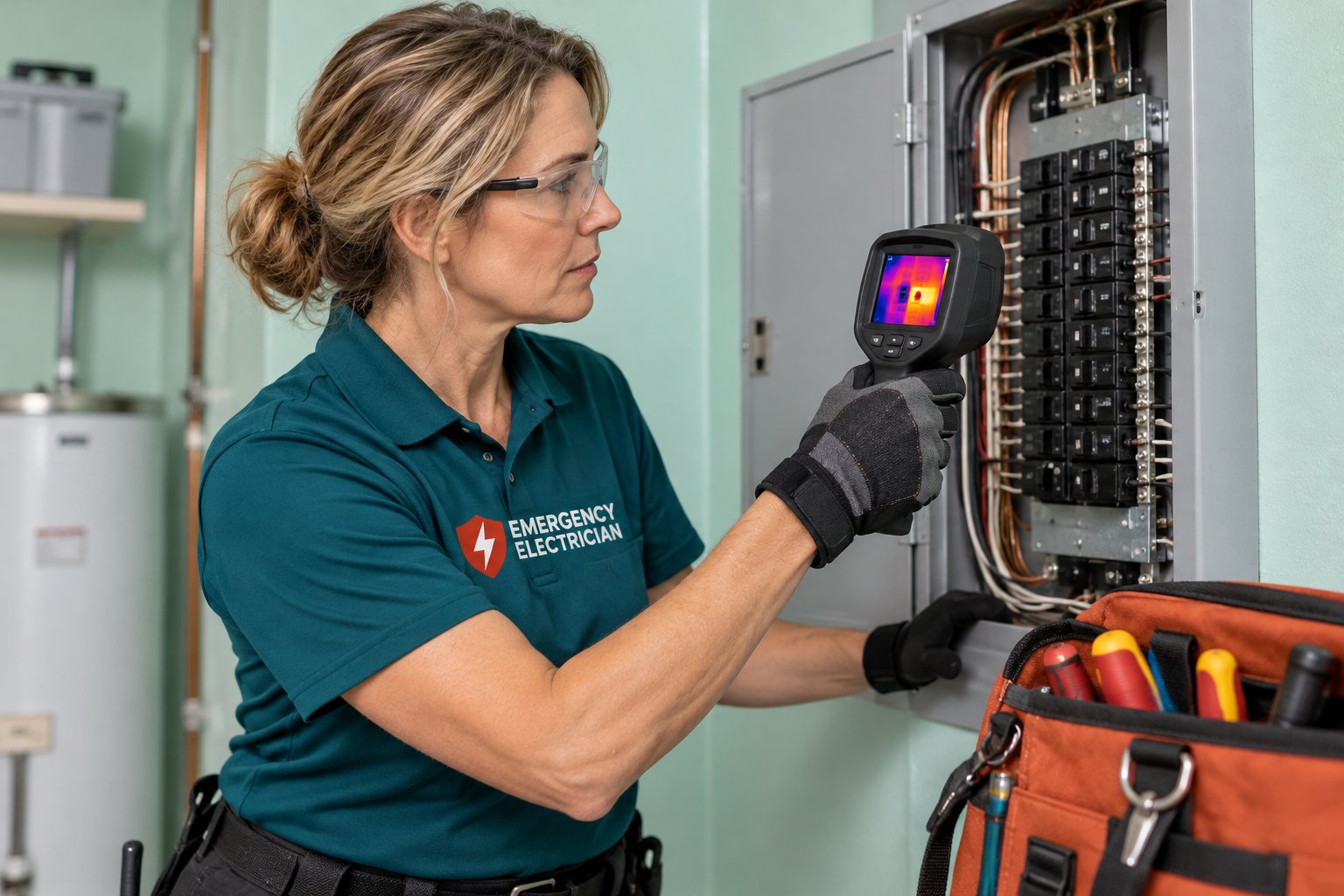
A burned meter base is rarely the whole story. A good technician looks at the full path of power from the service point to the panel. They check the weatherhead and service mast for water entry, the condition of the service entrance cable insulation, the clamps and straps holding the conduit, and the bonding and grounding connections at the base and at the panel.
They also look for signs of heat in the panel. A loose service lug at the meter base can be paired with a loose lug at the main breaker, and heat marks on the main breaker or on the bus bars point to a wider problem. If the panel shows scorching, the job may grow from a base replacement to a panel repair. Our page on urgent panel replacement and the related burned bus bar guide explain when that happens.
Another check is the capacity of the existing equipment. An older base rated for lower amperage may be undersized for today's loads, such as central air conditioning, an electric range, pool equipment and an electric vehicle charger. If the base is being replaced anyway, a technician may raise the question of whether the service should be upgraded at the same time. That is a decision for after the emergency, and our guide on urgent electrical service upgrades discusses it without pressure.
Finally, the technician will note anything that could have caused the failure: a nearby sprinkler spraying the enclosure, a trellis pulling on the cable, or vegetation rubbing the conduit. Fixing those is part of making the repair last.
Permits, inspections and municipal differences
Replacing a meter base is not a casual swap. Most municipalities in Broward County and the cities from Boca Raton to North Miami require a permit for service equipment work, and an inspection before the utility reconnects. The details differ between cities and unincorporated areas. Some offer expedited handling for emergency repairs; others require the permit to be opened first and the inspection to be booked in a normal queue. A technician who works in your city regularly will know how the local building department treats emergency jobs.
After a hurricane, building departments often change their hours and procedures, and the utility is working through a long list of restorations. In those periods, delays are about queues rather than the quality of the repair. It helps to have the property address, the account holder's name and the account number ready when you contact the utility.
Never accept an offer to skip the permit or to put the meter back yourself. An unpermitted base can cause trouble later with insurance claims, property sales and the utility itself, and a meter set without inspection can be pulled again. If the electrician says a permit is required, that is a protection for you. For more on this question, read our guide on whether emergency electrical work needs a permit.
Three realistic scenarios
Scenario one: a single-family home near the coast. The owner notices a brown stain on the meter cover and a faint hot smell after the air conditioner cycles. Nothing is on fire. The right move is to keep people away from that wall, switch off big loads if it is safe to reach the panel, and call the utility and an electrician. The technician finds a loose lug on the load side with corroded bus bars, replaces the base and cleans back the conductors. Power returns after inspection.
Scenario two: a duplex after a storm. A fallen limb pulled the service cable and tilted the enclosure on one unit. Wires are exposed and hanging. This is a 911 call, because of the exposed conductors, followed by the utility. The electrician later replaces the mast, base and service conductors together. Our page on a leaning or bent service mast covers that situation.
Scenario three: a small shop with a multi-meter bank in the back lot. One meter socket sparked when a tenant plugged a large machine in. Other tenants still have power. Here the property manager must coordinate: the utility removes the single meter, the electrician replaces the one socket, and the others stay on. The key is to identify which socket belongs to which tenant before anyone calls, so the right account is handled.
Each scenario ends the same way: the repair is done by a qualified electrician, checked by the inspector and restored by the utility.
What to have ready when you call
Preparation shortens the call and helps the dispatcher route the right help. Before you call, collect the property address and a nearby cross street, since meter bases are often hard to find from the street. Know which side of the building the meter is on, and whether it is a single meter or a bank of several.
Write down what you saw and heard in plain words: scorch marks, melted plastic, a cracked cover, a smell, a buzzing sound, water on the box, a leaning mast. Note whether power is still on in the building, whether anyone was shocked, and whether you called 911. If you have taken photographs from a safe distance, keep them; they help with the repair and with any later insurance conversation, as described in our guide on photographing damage before repairs.
Have the utility account number, the name on the account and, if you rent, the landlord's contact information. If you know the age of the base or any previous repairs, mention it. Tell the dispatcher about people in the home who depend on powered medical equipment, because that affects how quickly temporary power should be discussed. Quotes are given only by phone, and complicated jobs need an on-site visit; there is a service call charge, which is explained before a technician is dispatched. Ask questions about it on the call, and do not hesitate to confirm the scope before work begins.
After the repair: confirming the job is complete
Once power is back, take a few minutes to confirm the job. Walk through the building and check that lights, outlets and large appliances work normally. Look at the new enclosure: the cover should sit flat, the seal should be intact, and the conduit entry should be sealed against rain. Ask the technician to explain what was found and what was replaced, and request the findings in writing so you have a record of the conditions and the work. Our page on getting a written findings report explains what a useful report contains.
If anything about the repair feels unsettled, such as lights that flicker, a warm panel door or a buzzing sound, say so immediately rather than waiting. Those can be signs of a loose connection somewhere else on the service.
Keep the permit number, the inspection sign-off and the technician's notes together with your insurance and property papers. If the damage came from a storm, a vehicle or a fallen tree, the documents may matter for a claim. Over the following weeks, keep an eye on the area around the meter for moisture, discoloration or odor. A properly replaced base should run quietly for a long time.
If you are facing a damaged meter base right now, or you have seen any warning sign described above, call and talk it through with a dispatcher. A short conversation can sort out whether this is a 911 matter, a utility matter or an electrician matter, and what the safe next step is.
Questions people ask
Can I replace a meter base myself?
No. The incoming service conductors stay energized until the utility disconnects them, and no breaker in your home can shut them off. Working inside the enclosure risks severe injury, and the meter seal protects the utility's equipment. Replacing a base also requires a permit and an inspection in most cities. A qualified electrician coordinates the utility disconnect, does the work, and arranges the inspection.
Who removes the meter, the utility or the electrician?
The utility removes and resets the meter, since it owns the meter and controls the service lines. The electrician replaces the customer-owned base and the equipment on the load side. Do not pull the meter yourself or break the seal. In some situations the utility will disconnect at the pole or street side, and the electrician then proves the circuit is dead before touching anything.
Why is there a long wait before power returns?
Because the repair is only part of the chain. After the new base is installed, most municipalities require an inspection, and the utility then has to schedule the reconnect. Those two steps depend on the building department and the utility queue, not on how fast the electrician works. After storms, the queues are longer. Ask the electrician what the local process looks like.
Is a hot or discolored meter always an emergency?
Treat it as urgent. Heat or scorch marks mean something in the enclosure is failing, usually a loose or corroded connection. If you see flames, smoke or sparks, call 911 first. If you see only stains or smell hot plastic, stay clear of the wall and call the utility and an electrician right away. Do not wait for it to get worse.
Will I need to upgrade my service when the base is replaced?
Not necessarily. A base can often be replaced like for like. But if the old equipment was undersized for current loads, or the main panel shows heat damage, the technician may suggest a larger service. That is a separate decision, and you can ask for it to be explained on the phone or at an on-site visit before you agree to anything.
What should I tell the dispatcher about a damaged meter?
Give the address, which wall the meter is on, what you saw or smelled, whether there is fire or exposed wire, and whether anyone is hurt. Mention if the meter is one of several in a bank, if you rent, and if anyone in the home depends on powered medical equipment. Call 911 first for fire or exposed energized wire.
Reading about "Meter Base: What to Know and Do"? Tell us what stopped working and when. We will say what an electrician would check first, and quotes are given by phone when the job can be described.
Related pages
- Service Upgrade: When a failed electrical service leads to an upgrade, how repair comes first, what a technician evaluates, and how the permit and utility steps work.
- Mast Repair: A bent, torn or storm-damaged service mast or weatherhead is a hazard. Learn who disconnects power, who repairs what, and how permits and inspection work.
- Meter Sparking: Sparks or arcing at the electric meter are an emergency. Learn why to call 911 and the utility first, who owns which part and what an electrician does after.
- Disconnect Process: The usual order of events when a service is pulled for repairs in South Florida: who does what, what gets inspected and why power returns when it does.
- Outlet Repair: A dead, warm or heat-damaged outlet needs attention. Learn what is safe to do, how a technician repairs a receptacle, traces the cause and how to prepare.
- Panel Replace: Fire, flood or failure can force a panel swap. See when replacement is needed, how permits, utility disconnect and inspection work, and how to prepare.