
Repair first, upgrade second: the order of an emergency
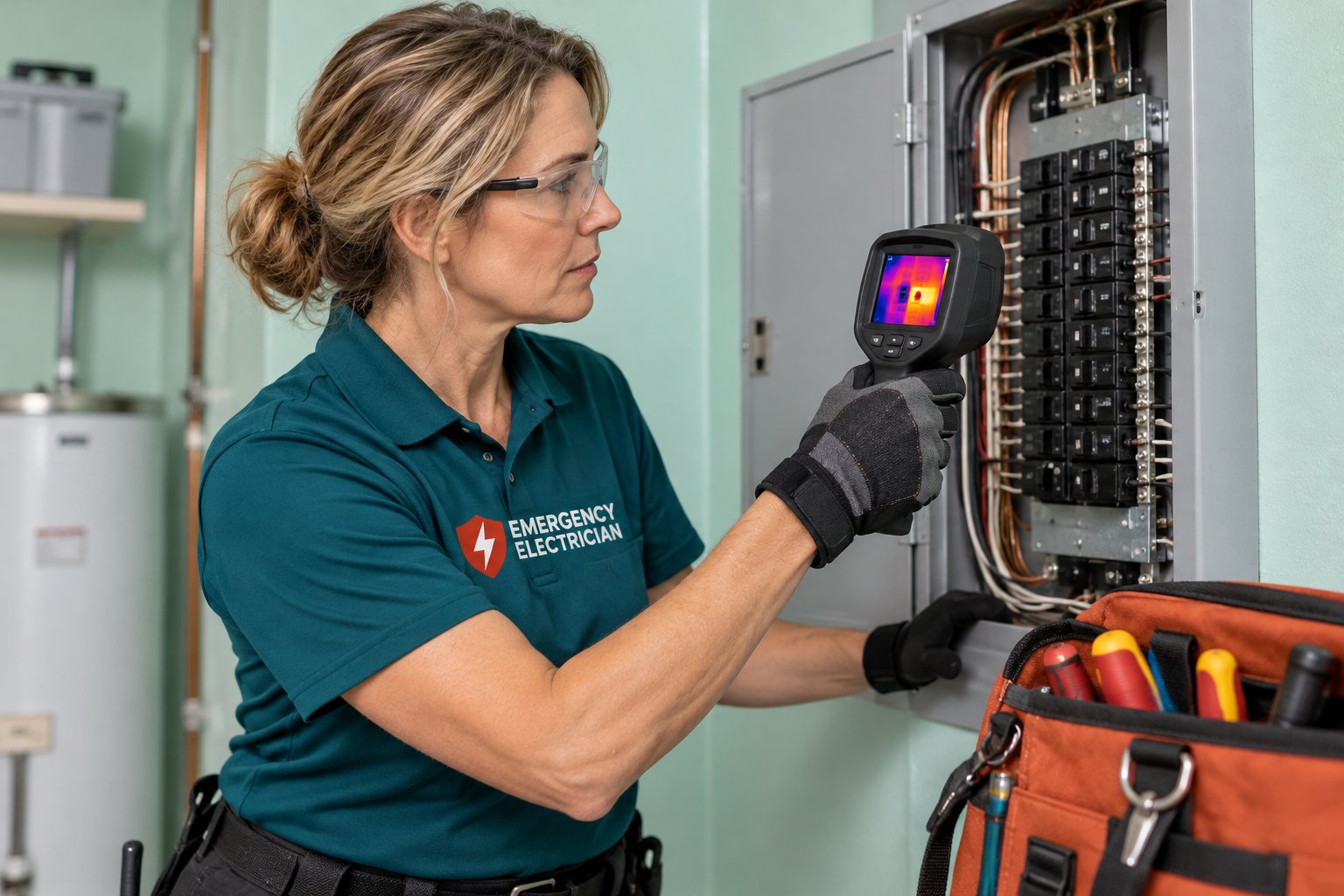
An electrical service is the whole path that brings power into a building: the utility line, the meter, the service conductors, the main disconnect and the main panel. When part of that path fails, the first goal is always the same. Make the scene safe, stop any danger, and restore power to what can be restored safely. If you see fire, heavy smoke, exposed energized wire or someone was shocked, call 911 before anything else, then the utility, then an electrician.
An upgrade enters the conversation only after the immediate hazard is under control. It is a planning decision, not a rescue. A responsible technician will not push you to sign up for a larger service while you are standing in a dark kitchen with a burning smell. They will first stabilize the situation, then explain what they found, and only then raise the question of whether the existing service is still the right size.
That framing matters because panic is a poor basis for a large purchase. If you feel pressured on a call or at the door to upgrade immediately, slow down. Ask what is unsafe right now, what is a repair, and what is an improvement. A good answer separates those three clearly. If the existing equipment can be repaired safely and meets your needs, a repair may be the right outcome, as discussed in our guide on whether to repair or replace after a failure.
What a service upgrade actually includes
People use the phrase service upgrade loosely, so it helps to define it. In most homes it means replacing the main panel with one rated for higher amperage, replacing the main breaker, and often replacing the meter base and the service entrance conductors so they match the new rating. It can also include a new service mast and weatherhead, new grounding electrodes, and new bonding connections at the panel.
The utility is part of the picture. The utility owns the line to the building and the meter, and it may need to change the service drop or the transformer capacity. It must disconnect and reconnect power around the work, and it normally requires that the new equipment pass municipal inspection first. Our page on the disconnect and reconnect process walks through those steps.
An upgrade is not the same as adding circuits. A subpanel or a few new breakers can expand circuits, but they draw from the same service. If the service itself is the limit, more circuits will not help. If you want to know which of these applies to you, a technician needs to look at the actual equipment on site; this is a case where a phone conversation can outline options, but a visit is needed to confirm them.
Failures that often point toward an upgrade
Not every failure suggests an upgrade, but some patterns do. A burned main breaker or bus bar in an older panel often means the equipment has reached the end of its life, and a replacement panel may be the better path. A meter base that has overheated repeatedly can signal loads that exceed what the service was built to carry. A service mast torn off by a storm may be replaced together with a new service while the work is open.
Other signs are quieter. A main breaker that trips when the air conditioner, the oven and the dryer run at the same time suggests the total demand is high compared with the rating. Lights that dim when large appliances start can point to a loose neutral or undersized conductors, which are repair matters first and capacity matters second. Our guide on loose neutral symptoms explains how those differ.
Some panels are simply obsolete. Certain older panel designs have a record of breakers that fail to trip or bus connections that loosen, and technicians are cautious about repairing them. Where parts are no longer made or a design has a poor record, replacement is the safer course. Our page on recalled breaker brand failures covers what that looks like.
A technician will point to the physical evidence: discoloration, pitting on the bus, rust, loose lugs, signs of water, or breakers that cannot be matched to the panel. Evidence, not a sales script, should drive the recommendation.
How a technician evaluates capacity
Sizing a service is a calculation, not a guess. The technician starts by listing what the building actually uses: the air conditioning system or systems, the range, the dryer, the water heater, pool equipment, a well pump if any, an electric vehicle charger, and general lighting and receptacle loads. These are compared against the existing rating using the load calculation method in the adopted electrical standards. The result tells you whether the current service has room.
They also consider what you plan to add. If you are about to install a second air conditioner, a pool, an induction range or a charger, it makes sense to size the service for those now instead of repeating the work later. That is the one area where thinking ahead can save disruption, because an upgrade always means a planned outage and an inspection.
Physical condition matters as much as the numbers. A panel can have the right rating on paper and still be unsafe because of corrosion, double-tapped breakers, burned terminals or poor workmanship from earlier work. The technician looks at the inside of the panel with the cover off, checks torque on the main lugs where safe to do so, and measures voltage under load. They may also test grounding and bonding, and look at the grounding electrode connection.
Quotes for an upgrade are given only by phone after the details are described, and a job of this size needs an on-site visit to confirm the scope. There is a service call charge, which is explained before a technician is sent. Be wary of anyone who offers a firm number for a service change without seeing the equipment.
The upgrade sequence from first call to reconnect
A planned upgrade runs through a clear series of steps. First comes the evaluation and scope, ideally with the scope written down. Second, the permit application goes to the municipal building department, and in many cities the utility is notified of the planned work so it can schedule the disconnect and any changes on its side. Third, a date is set for the outage, which commonly lasts most of a working day, though that depends on the job and on the utility.
On the day, the utility disconnects the service, the electrician removes the old equipment, installs the new meter base, mast, conductors, main panel and grounding, and transfers the branch circuits. Each circuit is checked for correct wire size and breaker rating, and breakers are labeled. The work is then inspected. Only after the inspector approves does the utility reconnect, and then the electrician tests voltage, balance and operation of major loads.
In an emergency where the failed service must be replaced right away, the same sequence applies but the timing compresses. Some jurisdictions allow work to begin with the permit opened after the fact for emergencies, while others do not; your technician will know the local practice. Temporary power may be possible during the wait, as explained on our page about urgent temporary power restoration.
Because the sequence includes parties outside the electrician's control, no honest company will promise an exact reconnect time. Ask what is within their control and what is not, and plan around the uncertainty by having alternatives for refrigeration, medication and cooling.
What an upgrade changes inside the home
For most owners the upgrade is invisible once the work is done, apart from a new panel with fresh labels. But a few things change. The new panel typically has modern breakers, including arc-fault and ground-fault protection where the adopted standards require it for the circuits involved. Some older circuits may need updates to meet those requirements when they are reconnected, and a technician will tell you if so before work begins.
You may also see changes outside. A new meter base and mast are usually larger and cleaner, with a weatherhead sealed against rain. Grounding electrodes, such as ground rods or a connection to a metal water pipe, may be added or corrected. If the old service used a type of conductor that is no longer favored, such as aluminum service conductors with poor terminations, those may be replaced.
Inside, the technician may find issues in the branch wiring while the panel is open, such as spliced wire in the panel enclosure, overloaded neutrals, or circuits with unknown routes. They should tell you what they found and what is required versus optional. Items that are required for the permit to pass are part of the job; optional improvements are your call. Our page on panel repair versus panel replacement explains how those decisions are weighed.
A quiet but important benefit is the labeling. A clearly labeled panel is easier to use in the next emergency, so ask for a legible circuit directory.
Storm-driven upgrades and the permit question
After hurricanes and floods, many owners are forced to replace service equipment at the same time as dozens of others. Building departments and the utility get busy, and rules about rebuilding after storm damage can be stricter than rules for an ordinary repair. If flood water reached the panel or meter base, the equipment generally cannot be dried out and reused; it must be replaced, and the new equipment may need to be mounted above a required height in some flood zones.
Elevation requirements and substantial-damage rules are set by the local building department and the floodplain administrator. A technician who works regularly in your city will know whether they apply to your address, and the building department can confirm. Do not assume a like-for-like swap is allowed if the property was heavily flooded.
Permits are not optional paperwork. They are how the city confirms the work meets safety standards, and the utility generally will not reconnect without an inspection approval on the service equipment. Skipping them can cause problems later with insurance and with selling the property. See our pages on rebuilding after a storm and electrical permits and first steps in a flooded home for more detail.
If you are in a flood zone and your service is being replaced, ask the technician directly whether the new equipment must be elevated, and ask the building department to confirm. Getting that wrong means doing the work twice.
Questions that protect you in an urgent upgrade decision
A short list of questions keeps the decision grounded. Ask what exactly failed and how the technician knows. Ask whether a repair would be safe and lasting, and if not, why. Ask what the existing service rating is and what the new rating would be, and why that size. Ask what is included: the meter base, mast, conductors, grounding, permit handling and inspection scheduling. Ask who handles the utility coordination.
Ask how long the building will be without power, and what part of that depends on the utility and the inspector. Ask what will be found and reported if the panel opens up and shows more problems, and how you will be told before additional work is done. Ask for the work to be described in writing before it starts, and for a findings report afterward.
Also ask about the people doing the work. Verify the contractor's credentials with the state and the local authority, and confirm the permit will be pulled under the contractor's name. Our guide on choosing an electrical contractor in a crisis lists what to verify.
If a company will not answer these questions, or insists on immediate payment or immediate decisions, that is a reason to pause. A real emergency repair does not require you to skip thinking. It requires you to make safe choices, and that is compatible with asking questions.
Rental and condo situations
Who decides about an upgrade depends on who owns the equipment. In a rental house or apartment, the landlord owns and maintains the service, and a tenant has no authority to commission an upgrade. Tenants should report the failure promptly in writing and keep records. Our page on renters and electrical emergencies explains typical responsibilities.
In a condominium, the picture is layered. The association commonly owns the main service, the meter room and the risers, while each owner owns the equipment inside the unit, usually the unit panel and its circuits. A failure in the shared equipment is a matter for the association and its management, and individual owners should not hire their own electrician for common elements without approval. Our page on condo association electrical emergencies covers the process.
In both cases, take photographs, note times, and keep a log of communications. If the failure caused loss of food, medication or damage to electronics, your insurance paperwork will benefit from a clear timeline. A technician can help by writing down what they observed and what they replaced.
For single-family owners, the choice is entirely yours, but the best path still starts with repair, a clear explanation and a written scope.
Living with the decision afterward
After an upgrade, check a few things. Confirm the panel directory is legible and that each breaker is labeled with the area it serves. Ask the technician to show you the main disconnect so everyone in the household knows where to find it. Keep the permit and inspection documents, and any warranty paperwork supplied by the manufacturer of the equipment, with your property records.
Over the next few weeks, watch for anything unusual: warm breakers, buzzing, flicker, burning odors or equipment that behaves strangely. A new installation should be quiet and cool. If anything seems wrong, call right away, since early follow-up is easier than late.
If the failure that started all this came from a storm, consider the next steps for resilience. A whole-house surge device and a generator inlet or transfer arrangement are common additions after a service change, because the panel is already open. Our guide on when to add a surge device or generator explains how to think about them. Do these only if they make sense for your property, not because of pressure.
If your service has just failed, or a technician has told you the equipment is at the end of its life, call and describe what happened. A dispatcher can help you sort the urgent safety work from the planning work, and explain the call charge and the on-site visit before anything is scheduled.
Questions people ask
Is a service upgrade part of every emergency repair?
No. Most emergency repairs restore the existing service safely and nothing more. An upgrade is considered only when the equipment is worn out, damaged beyond reasonable repair, or clearly too small for how the building is used. Even then it is a planning decision made after the hazard is controlled. You are entitled to ask for the repair option to be explained first.
How do I know if my service is too small?
Signs include a main breaker that trips when several large appliances run together, equipment that was added without a capacity check, or a panel that is full with many doubled-up breakers. A technician confirms by calculating the building's actual load against the rated capacity. Dimming lights alone can also point to a loose neutral, so the cause should be tested rather than assumed.
Who contacts the utility for an upgrade?
Usually the electrician coordinates with the utility, but the account holder is often asked to confirm the request or provide account details. The utility removes the meter, may change its own equipment, and restores power after inspection. Ask the electrician who will make each call and what information you need to have ready, so nothing stalls.
Can I get power back the same day?
Sometimes temporary arrangements are possible, but a full service replacement depends on the permit, the inspection and the utility reconnect, which no electrician controls. Plan for the possibility of a longer outage, and arrange for refrigeration, cooling and any medical needs. Ask the dispatcher what is realistic for your city before you commit to a plan.
Do upgrades require a permit?
In nearly all South Florida cities, yes. Replacing a main panel, meter base or service conductors needs a permit and an inspection, and the utility typically will not reconnect without approval. The permit protects you and helps with insurance and resale. If anyone offers to skip it, treat that as a warning sign and ask the building department directly.
What if the technician finds more problems when the panel opens?
It happens, particularly in older buildings. A good technician stops, shows you what was found, explains which items are required for safety or for the permit and which are optional, and agrees on any added work with you before proceeding. Ask for the findings in writing afterward so you have a record of the conditions and the repairs.
If "Urgent Electrical Service Upgrade" matches what is happening, call and describe it plainly: the room, the breaker, any burning smell or tripped circuit. We explain what the repair would involve before a visit is set.
Related pages
- Meter Base Replacement: What to do when a meter base is burned, cracked or pulled loose, who owns which part, and how the disconnect and reconnect sequence works.
- Panel Replace: Fire, flood or failure can force a panel swap. See when replacement is needed, how permits, utility disconnect and inspection work, and how to prepare.
- Repair vs Replace Panel: Inspection findings that push an electrical panel toward repair or replacement, including heat damage, corrosion, and obsolete designs, with no figures given.
- Temporary Power: When a full electrical repair has to wait, isolating the damaged part can keep the rest of the home running. Learn how temporary power is done and its limits.
- Switch Repair: A hot, crackling or dead switch or dimmer can point to an overloaded circuit behind it. Learn what is safe, how repair works and what the technician checks.
- Troubleshooting Visit: A walkthrough of an urgent electrical troubleshooting visit: arrival, safety isolation, testing, findings explained in writing, and how phone quotes work.