
People first: when a warehouse panel problem is a 911 call
In a warehouse, the first concern is the people on the floor. If you see smoke, flames, arcing, or a panel that is glowing or discolored, or smell burning insulation, or hear loud humming, popping, or cracking, call 911 and evacuate the area. Sound the alarm, account for workers, and keep forklifts and trucks away from the building entrance so that responders can get in. Do not send anyone into a room to switch things off if there is any sign of fire or arcing.
If someone has been shocked or burned, call 911 and do not touch them if they may still be in contact with a live conductor. Turn off power only if you can do so safely from a distance, using a switch that is known and accessible. Otherwise wait for responders. A person who has received an electric shock may have injuries that are not obvious, and needs medical attention even if they feel fine.
If there is water on the floor near equipment, a roof leak above a panel, or flooding in the building, keep everyone out of the area. Water and large electrical equipment are a dangerous combination, and warehouses have large open floors where water can spread. Do not wade in to reach a disconnect. Call 911 and the utility, and wait. These steps override production concerns. Equipment and freight can be handled later.
Understanding what failed: main, distribution panel, or a single disconnect
Warehouses have layers of electrical equipment. At the service entrance there is a main disconnect and a meter. From there, power goes to distribution panels or switchgear and then to branch panels, lighting panels, and individual disconnects for large equipment such as dock levelers, compressors, rooftop units, and conveyors. A failure at each level has a different footprint.
If the whole building is dark, the cause may be the utility or the main. If a large section is dark, a distribution panel or a feeder may be the cause. If only one machine is out, its disconnect, breaker, or the equipment itself may be at fault. Describe the footprint to the dispatcher: what is out and what is still working. That description tells the technician where to start.
Many warehouses are leased, and some equipment belongs to the owner while some belongs to the tenant. A building's main switchgear and meters are usually the owner's responsibility, while tenant panels, racks, and equipment connections belong to the tenant. Check the lease. If the problem seems to be in the owner's equipment, notify the property manager immediately. See tenant and landlord power responsibility.
Signs that a panel or disconnect is failing
Large equipment often gives warning before it fails. Look for discolored covers, blistered paint, a smell of hot insulation, a warm or hot enclosure, and buzzing or crackling. Breakers that trip repeatedly, lights that dim when large equipment starts, equipment that runs slowly or stalls, or a disconnect handle that is hot are also signs. Water stains, rust, or corrosion on enclosures show moisture exposure.
Do not open an energized enclosure to look. The hazard is not just shock, but arc flash, which is a violent release of energy that can cause severe burns and injuries at a distance. Qualified technicians use protective equipment and procedures for this work. A manager or operator should observe from the outside only. Take photographs from a safe distance and note what was happening when the problem began.
If you notice signs, reduce the load on the affected equipment if it is safe to do so, and keep people away. Schedule a visit rather than waiting for failure. A planned shutdown at a convenient hour is far less costly than an unplanned one during a busy shift. For ideas on what to monitor, see preventive checks for continuity.
Shutting down safely while you wait
Operations need to make decisions in a few minutes. Start with a controlled shutdown of equipment that could become unsafe or damaged if it restarts unexpectedly. Forklifts and battery chargers, conveyors, dock doors, compressors, and motors should be stopped using their normal controls if they are accessible and safe. If power returns suddenly, equipment that is still switched on may start without warning, which can injure people or damage machinery.
Use your site's lockout and tagout procedures, if you have them, for any work on equipment. These procedures exist because people have been killed when equipment restarted. An electrician will follow their own procedures, and they will need to coordinate with yours. Do not remove another person's lock or tag, and do not bypass safety devices.
Protect inventory where possible. Temperature sensitive freight may need to be moved to a working cooler or kept closed. Do not open dock doors for ventilation if the building has hazardous materials, and follow your emergency plan. Keep a record of what was shut down and when. If part of the building has emergency lighting, check that exits are clear and lit. If not, use flashlights and send workers out in orderly groups.
Coordinating with shift operations
A warehouse never has just one set of needs. The day shift manager wants the dock open, the night shift wants the lights on, and the electrician needs the area clear and de-energized. Settle this early by appointing one person to be the point of contact for the electrician. That person can tell the technician where the equipment is, when shifts change, who must approve shutdowns, and which areas are off limits.
Think about the sequence of a shutdown for repair. A technician may need to de-energize a panel or a section of the building, and that affects everything fed from it. Ask the technician how long they expect the shutdown to last and what is affected. Plan to move people to other tasks, or send them home, if the shutdown will be long. Make sure forklifts are parked and chargers disconnected, if required, before power is shut off.
If the work can be staged, ask whether parts of the building can be restored early. A technician may be able to restore critical lighting, the office, or the dock doors on a temporary basis while permanent repairs are made. Whether this is possible depends on the fault and safety. See temporary fix versus full repair and urgent temporary power restoration.
Three-phase equipment and why it complicates things
Most warehouses run three-phase power for motors, compressors, and larger equipment. Three-phase systems have three energized conductors, and equipment is designed to receive all three in balance. When one is lost or the voltage is unbalanced, motors can overheat or fail, and electronic controls can fault. A panel failure may knock out one phase while others remain energized, which means some equipment appears normal while other equipment struggles.
If a motor hums, runs hot, or will not start, switch it off and do not keep trying. Repeated starts can burn out windings. Lights that work normally while large equipment fails are a clue that a phase may be missing. See three-phase loss of phase problems for more on this.
Do not attempt to test voltages unless you are qualified and equipped. Measuring a three-phase panel involves live parts. A technician will use properly rated meters and procedures. They may also check phase rotation after a repair, because reversed rotation makes motors run backward, which can damage pumps, compressors, and conveyors.
Cooling, refrigeration, and temperature sensitive freight
Many South Florida warehouses hold goods that do not tolerate heat: food, medicine, electronics, cosmetics, and chemicals. An electrical failure can start a clock on that freight. The panel or disconnect that feeds a cooler, a rooftop unit, or a dehumidifier is as important as the dock door. When you list your critical circuits, put the ones serving temperature control at the top.
If a cooling unit has stopped, check whether the building is out of power, whether only that unit has lost power, or whether the unit itself has failed. A unit with power but no function may be a mechanical problem for a refrigeration or air conditioning technician. A unit without power points to a breaker, a disconnect, or a feeder, and calls for an electrician. Do not keep restarting a compressor that has tripped, because repeated attempts can damage it.
Keep doors closed on cold areas to hold temperature. Move product only following your own procedures. Record temperatures if you have monitors. Notify customers and insurers as your contracts require. An electrician cannot judge whether product is safe, but can restore the supply and explain whether the equipment is safe to restart.
Dock doors, lighting, and life-safety systems
Warehouse life-safety systems also depend on electrical power. Emergency lighting and exit signs should operate when normal power fails, fire alarm panels have their own power and battery backup, and sprinkler pumps may be electric. Dock doors may have manual overrides. During a power failure, verify that these systems are working, and report any that are not.
If emergency lighting is dark, if exits are blocked, or if the alarm panel shows a trouble indication, treat these as safety matters. Limit the number of people in the building, keep aisles clear, and call for help. See emergency lighting and exit sign failure. If a sprinkler or fire pump is affected, notify the fire protection contractor and, where required, the fire department.
Forklifts and chargers also matter. Battery charging areas have ventilation and electrical requirements, and a failed charger or a hot connection is a fire risk. If a charger smells hot, make no attempt to move it while energized. Switch it off at the source if you can reach it safely and report it.
What to tell the dispatcher
Be ready with details. State that it is a warehouse or industrial building, what failed, and what is still working. Say whether it is single phase or three-phase equipment, if you know. Say whether the problem began with a bang, a flicker, a storm, a smell, or a load change. Say whether the utility is also out. Note which panel, disconnect, or piece of equipment is involved, and whether it is labeled.
Say who will meet the technician and who has authority to approve work. Say whether the building is leased and who the property manager is. Say what time-sensitive operations are affected, such as shipments or temperature controlled freight, but understand that the dispatcher cannot promise an arrival time. If there is any danger to people, say so first.
Quotes are given by phone. Complicated jobs need an on-site visit before pricing, and there is a service call charge, which the dispatcher explains before sending anyone. Larger repairs may require parts that must be ordered, planned shutdowns, and permits. Be prepared for the possibility that a first visit will make things safe and gather information, and that the full repair will follow. See what to tell the electrician dispatcher.
What the technician will check
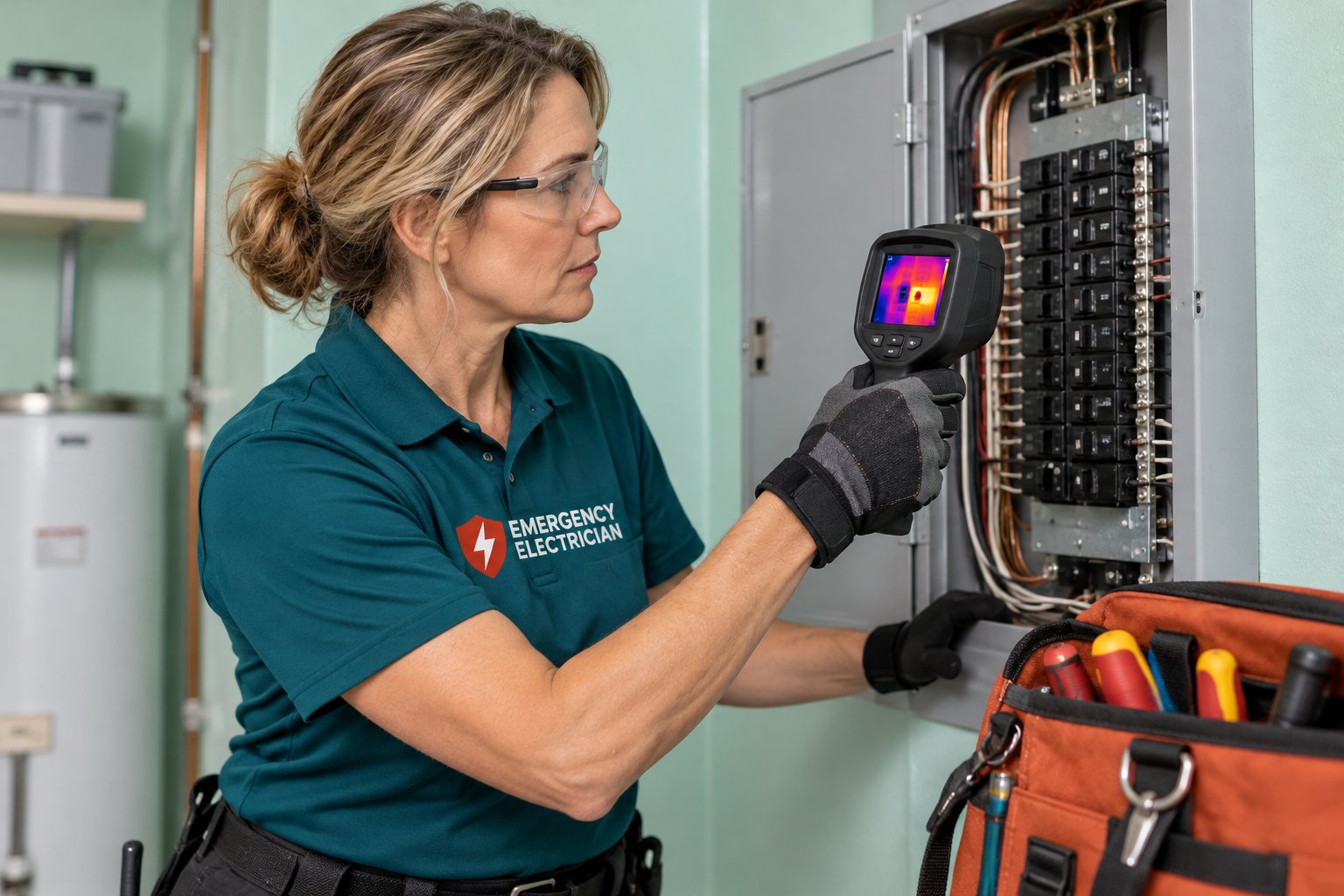
A technician will first review the site's safety, identify the energized equipment, and talk with your contact about what happened. They will inspect the panel or disconnect from the outside, check for heat, discoloration, and damage, and decide how to de-energize the equipment safely. They use lockout and tagout procedures and appropriate protective gear.
With the equipment safe to open, they inspect connections, bus bars, breakers, fuses, and conductors, looking for burned spots, loose lugs, corrosion, and signs of water. They test voltage at appropriate points, check for balance in three-phase systems, and verify grounding. They may take thermal images before shutting down, if the equipment can remain on for that purpose, because loose connections show up as hot spots.
They then recommend repairs. A simple fix, such as replacing a failed breaker or tightening a lug, may be done on the spot, if parts are available. A burned bus, a damaged enclosure, or a failed disconnect may need replacement and a planned outage. Ask what is safe to power up, what is not, and what the next steps are. A written summary helps with your records and with insurance.
Two scenarios from a busy South Florida warehouse
Scenario one: on a hot summer afternoon, a rooftop air handler and a dock compressor start together, and the lights in the back third of the building drop out. The distribution panel serving that area is warm to the touch from across the room, and there is a faint odor of hot insulation. This is the moment to stop work in that zone, keep people away, and call. Afternoon thunderstorms, high humidity, and heavy cooling loads put real stress on connections, and a loose lug that has run warm for weeks can finally fail.
Scenario two: after heavy rain, a disconnect for a loading dock door is dead and the enclosure shows rust streaks at the top where water has run in. Nobody should open it. Moisture inside an enclosure can trip protective devices and corrode terminals, and standing water at the base of the equipment makes the area unsafe. The manager marks off the area, tells dock staff to use another door, and calls for an inspection. The technician finds water in the conduit and a corroded connection, and recommends replacing the enclosure fittings so that rain cannot enter again.
In both cases the useful details for the dispatcher are the same: where the equipment is, what it feeds, what the weather was, what was heard or smelled, and what the operation can do without. In both, the first move was to protect people and keep others from opening equipment, not to restart anything. Those two habits prevent most of the injuries and much of the damage that follow electrical failures in large buildings.
After the event: records, causes, and prevention
Once power is restored, write down what happened and what was found. Keep the electrician's findings, photographs of the failed equipment, and notes on what operations were affected and for how long. These help with insurance, with the property manager, and with planning. See documenting a business outage.
Ask the technician about the cause. Was it a loose connection, an overload, water, age, or a surge? Ask whether similar equipment elsewhere in the building is at risk. Consider a scheduled inspection with thermal imaging, a review of loads before adding new equipment, and a plan for spare parts for critical items. Whether and how often depends on your equipment and environment.
If you are in the middle of an event now, work in order: people and safety, 911 if there is danger, the utility if the whole area is dark, then a call to describe the building. Say what failed, what still works, and what operations are most affected. A calm and specific description is the fastest way to a useful visit.
Questions people ask
Should I keep trying to restart equipment after a panel trips?
No. Repeated restarts can burn motors and worsen a fault. Stop the equipment using normal controls, keep people away from the panel, and note what tripped. If there is smoke, a burning smell, or arcing, evacuate and call 911 first. A technician can find the cause before anything is restarted.
Can my maintenance staff open the panel to look?
Not unless they are qualified, equipped, and following proper procedures. Energized panels carry shock and arc flash hazards that can cause serious injury at a distance. Staff can observe from the outside, take photographs, and note signs of heat or water. Opening and testing is for a technician with protective equipment.
Why does one machine run while others fail?
In a three-phase system, a panel or disconnect problem can lose one phase while others remain energized. Some equipment runs poorly, some stops, and lights may seem normal. Do not keep restarting motors. Describe what works and what does not to the dispatcher. A technician can check phase balance and rotation.
Do I call the utility or an electrician for a warehouse outage?
If the whole area is dark, call the utility first. If only your building or part of it is out, the problem may be in the main, a distribution panel, or a feeder, and an electrician is the right call. If there is smoke or fire, call 911 first. Notify the property manager if you lease.
Can the electrician restore part of the building while repairs continue?
Sometimes. A technician may be able to restore critical lighting or selected equipment through a temporary arrangement while permanent repairs are planned. Whether it is possible and safe depends on the fault and the system. Ask the technician to explain what is safe to power up and what the limits of a temporary fix are.
How is the service call charge handled?
Quotes are given by phone. Complicated jobs need an on-site visit before pricing, and there is a service call charge, explained by the dispatcher before anyone is sent. Have your site contact, access, and a short description of the failure ready so that the visit gathers the information needed for the repair.
About "Warehouse Electrical Panel or Disconnect Failure": call and give us the details, and we will explain what is safe to do while you wait and what the visit would cover. Jobs that cannot be quoted blind need a look on site.
Related pages
- Loss of Phase: One phase dropped in a three-phase business? Learn the warning signs, which motors to shut down, who to tell, and what is checked.
- Business Power Loss: Your business just lost power. Follow a safe first-hour sequence for owners and managers: safety, isolating the cause, informing staff, and documenting.
- Exit Lights: Exit signs dark or emergency lights failing in an occupied building? Learn why it is a life-safety issue, safe first steps, and what a technician will check.
- Temporary Power: When a full electrical repair has to wait, isolating the damaged part can keep the rest of the home running. Learn how temporary power is done and its limits.
- Continuity Checks: Inspection-style electrical planning for businesses: what a continuity check looks at, how to prepare, and why it reduces surprises without promising results.
- Troubleshooting Visit: A walkthrough of an urgent electrical troubleshooting visit: arrival, safety isolation, testing, findings explained in writing, and how phone quotes work.