

Before the visit: triage and the phone call
The visit starts with the call, and the call starts with safety. If there is fire, heavy smoke, someone shocked and hurt, a downed line or flooding around electrical equipment, the first calls are to 911 and the utility. An electrician is not a substitute for emergency responders, and a good dispatcher will tell you to call 911 first when the situation calls for it.
If it is not a life safety situation, the dispatcher will ask a series of questions. What happened? What did you see, hear or smell? Is any breaker tripped? Is the power off in the entire home, part of it, or one room? Is anyone in the home dependent on powered medical equipment? Is the area wet? Has anything been done to the system recently? Your answers shape both the advice you get on the phone and the way the technician prepares.
You will also hear how the visit works. That includes the service call charge, which is explained on the phone before anyone is dispatched. Quotes are given by phone. A job that is more complicated than a straightforward repair needs an on-site visit before a firm quote. You decide whether to go ahead. Nobody should be dispatched to your door without you understanding those terms.
- Fire, heavy smoke, injury, downed lines: 911 and the utility first.
- Describe what you saw, heard and smelled in plain words.
- Mention medical equipment, children, pets and anyone with limited mobility.
- Ask about the service call charge before agreeing to a visit.
What to do while you wait
The waiting period is where a homeowner can help or hurt. The goal is to keep things stable and gather information. If the dispatcher has advised you to switch off a breaker, do so only if you can reach the panel with a dry floor and dry hands, and the panel looks normal. Otherwise stay clear and keep people away from the problem area.
Do not keep resetting breakers, flipping switches to see what happens or poking at outlets. Each test you perform changes the evidence. A breaker that trips once and holds tells a different story than one that has been reset five times. Write down what you noticed and the order in which things happened.
Clear a path to the panel, the meter and the problem area. Move stored items away from the panel door. Make sure the technician can reach the area, and secure pets. If you rent, tell the property manager or landlord that an electrician is coming, and have contact details ready for access to meters, electrical rooms or shared panels. In a condominium, ask the association how to reach the common electrical room.
Arrival: identity, safety and a first conversation
When the technician arrives, the first thing is a conversation. They will ask you to describe what happened in your own words, and they will ask many of the same questions the dispatcher did. This is not repetition. It is verification, because the story you tell at the door is the most reliable clue to what they will find.
You are entitled to confirm who is at your door. Ask for the name of the company and the technician, and check that they match the dispatch details you were given. Do not feel awkward about it. Keep children and pets out of the work area, and show the technician where the panel, the meter and the affected area are.
Before touching anything, the technician makes a quick safety survey. They look for water, heat damage, smoke staining, melted parts and signs of arcing. They check whether anyone should leave the area, and whether the situation calls for a utility disconnect or a fire department check before they begin. If the home is not safe to work in, they will say so and explain why.
Safety isolation: making the work area dead
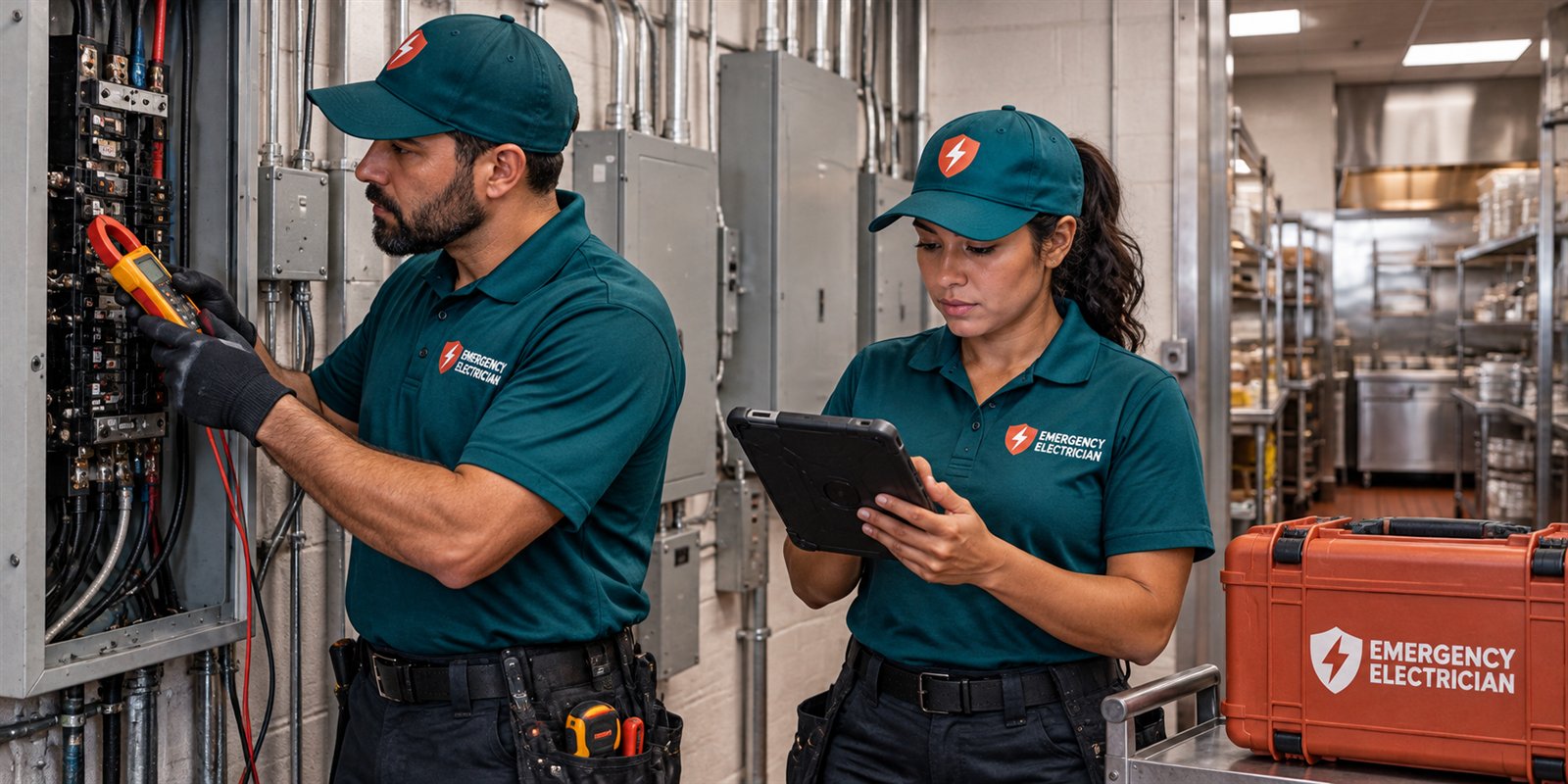
Safety isolation is the step that separates careful work from risky work. The technician identifies which breaker or breakers control the affected circuit, switches them off, and then proves the circuit is dead with a meter. They do not rely on the breaker label, because panel labels in many homes are wrong or missing. They test, confirm and then work.
If the problem is in the panel itself, or on the utility side of the main breaker, isolation is more involved. A panel with a failed main breaker, a burned bus bar or a damaged service cable may need the utility to disconnect the meter. The technician will explain what that involves and how long it may take. Our page on the power company disconnect and reconnect process explains how it works.
For some tests, a circuit has to be live. A qualified technician does those with insulated tools, proper meters and a plan for what to do if something goes wrong. They do not ask you to hold a flashlight near an open panel or stand near the work. If you are asked to step back, do so. It is for your protection.
- Identify the circuit or equipment involved.
- Switch off the breaker or disconnect.
- Prove the circuit dead with a meter, not by label.
- Work on de-energized parts wherever possible.
- Test live only where necessary, with proper tools and distance.
Testing: how the fault is actually found
Troubleshooting is a process of elimination. The technician starts with the symptoms and works toward the fault by testing. They measure voltage at the panel, the receptacles and the equipment to see where the supply stops. They test continuity and resistance on de-energized circuits to find open conductors and shorts. They use insulation testing to find leakage to ground where appropriate.
For intermittent faults, which are the hardest, they may use thermal imaging to see hot spots, or load a circuit and watch for voltage drop. For a breaker that trips, they find out whether it is overcurrent, a short or a ground fault, because each leads to a different part of the system. They may disconnect loads one at a time, and then reconnect them in order, to find the one that triggers the fault.
Throughout, they compare what they find with what the system should look like. Wire sizes against breaker ratings. Connection tightness against standards. Grounding and bonding against the way the home was built. A good technician explains what they are testing and why, if you ask. That is a sign of careful work. Our related pages on short circuit location and ground fault tracing explain two of the most common tests.
Findings: what you should be told
At the end of testing, you should receive a clear explanation. What failed, where, and why. What was found beyond the immediate complaint. Whether the situation is safe to leave as is, whether it needs a temporary measure, or whether it needs a full repair. And what the options are, with the reasoning for each.
You are entitled to see the problem. A good technician will show you the burned terminal, the damaged cable or the failed device, and explain it in plain words. If the fault is in a place you cannot see, such as inside a wall or an attic, they will describe it and explain how they know. Ask questions. Ask them to repeat anything unclear.
You may also ask for the findings in writing. A written findings report is useful for insurance, for a landlord or an association, and for your own records. Our page on getting a written findings report explains what to ask for. If a technician is unwilling to explain what they found, that is a reason to pause.
The quote: how pricing works on this site
Quotes are given by phone. That is a firm rule, and it exists so you hear the terms from a person who can answer questions, not from a flyer. The technician will call the office from your property, describe what they found, and you will hear the quote and the scope of work on the phone before anything is done.
For straightforward repairs, such as replacing a failed breaker or a damaged outlet, the quote can be given quickly. For complicated jobs, such as running new circuits, replacing a panel or repairing a damaged service, an on-site visit is needed first so the scope can be understood. That visit may incur a service call charge, which is explained on the phone before dispatch.
You are never obliged to approve work. If you want a second opinion, you can ask for the findings in writing and consult someone else. If you decide to proceed, the work scope should be clear: what will be done, what is not included, whether a permit is needed and whether the work needs inspection. If a permit and inspection are needed, our page on permits for emergency electrical work explains the usual process.
Temporary restoration versus full repair
Sometimes the best outcome of an urgent visit is not a complete repair. If a circuit is damaged, the technician may isolate the damaged part so the rest of the home can have power while a full repair is scheduled. That is a legitimate step, and it can keep a refrigerator running and a family comfortable. It is not a patch that hides the problem.
The key is honesty about what has and has not been fixed. A technician should tell you which circuits are off and why, what you should not use, and what has to be done before they can be reactivated. Our page on temporary power restoration explains this approach in detail.
If the repair needs parts that must be ordered, a permit that must be filed, or coordination with the utility, a temporary measure may be the only practical outcome of the first visit. In that case, ask for a clear plan: what happens next, who does it, and what needs to be in place for the final repair. Write it down.
Cleanup, testing and sign-off
Before leaving, the technician tests the repair. They energize the circuit, check voltage, test any protective device such as a ground-fault interrupter, and run the affected equipment. They confirm that nothing else was disturbed. They also clean up the work area, close the panel, and replace any covers they removed.
Ask them to walk you through what they did. Where possible, ask them to label the panel if the labels were wrong, and to note any other issues they saw but did not fix. If they recommend further work, ask whether it is urgent, or whether it can be planned. Do not feel pressed to decide on the spot.
Keep your records. Photograph the repair if possible, and keep any replaced parts if the technician agrees, particularly if an insurance claim may follow. Our guides on photographing damage and insurance documents explain what to gather.
Unusual settings: condos, rentals, businesses and medical needs
Not every visit takes place in a single-family home with a panel in the garage. In a condominium, the panel for your unit may be inside, while the feeders, the meter room and the common equipment belong to the association. The technician may need access to a shared electrical room, and a building manager may need to be present. Tell the dispatcher the building type, so the visit is planned around the access you will need.
In a rental, the question of who authorizes the repair matters. A tenant can call about a hazard, but the property owner or manager often needs to approve the work and the cost. Say so on the call, and have the manager's contact details ready. A technician can still make the situation safe, for example by isolating a damaged circuit, while the authorization is arranged.
In a business, the pressure is continuity. A restaurant with a failed walk-in cooler or an office with a dead server room wants a fast answer. The technician will focus on isolating the fault and restoring the most critical loads first, then explain what remains. Medical needs get the same priority. If anyone in the home depends on powered equipment, such as an oxygen concentrator, say so at the start of the call, and have a backup plan with their medical provider, because an electrical repair can take longer than a battery lasts.
Questions worth asking at any urgent visit
A short list of questions helps you stay in control. What caused this? Is it safe to use the affected circuits now? What did you test, and what did you find? What are my options, and what do you recommend? What will it involve, including permits and any utility steps? How will the quote be given and what does it include? What should I watch for in the next few days?
These questions are not a challenge. A good technician is glad to answer them. They also help you tell the difference between a clear explanation and a vague one. If you hear only jargon, ask for plain words. If you hear urgency that does not match what you see, ask why.
If you need an urgent visit, call, describe the situation honestly, and ask the dispatcher to explain the process, including the service call charge. A technician can then work through a calm, methodical sequence, and you will understand every step.
Questions people ask
What should I do while waiting for the electrician?
Keep people away from the problem area, and switch off a breaker only if the dispatcher advises it and the panel is dry and normal. Do not keep resetting breakers or testing outlets. Write down what you saw, heard and smelled, clear a path to the panel and the meter, and secure pets. If anything gets worse, call 911 for fire or injury.
Why does the technician test with a meter instead of trusting the panel labels?
Panel labels are often wrong or missing, particularly in older homes or after renovations. A meter proves whether a circuit is actually dead before work starts, which protects the technician and you. It is a standard safety step, and it also helps identify what really feeds the affected area.
Will the technician give me a price on arrival?
Quotes are given by phone. For a straightforward repair, the technician contacts the office from your property and you hear the quote on the phone before work starts. For complicated jobs, an on-site visit comes first. There is a service call charge, explained on the phone before dispatch.
Can I get the findings in writing?
Yes, you can ask for them. A written findings report describes what was found, where, and what was done or recommended. It is useful for insurance claims, landlords, associations and your own records. Ask for it at the visit so the technician can note the details while they are fresh.
What if I do not want to approve the repair on the spot?
You are never obliged to approve work. You can ask for the findings and the options in writing, and get a second opinion. If the situation is not safe to leave, the technician will explain what should be isolated or switched off in the meantime so you can decide calmly.
Will everything be repaired in one visit?
Often, but not always. Some jobs need parts, permits or utility coordination. In those cases, the technician may restore power to the safe parts of the system and schedule a full repair. They should explain which circuits are off, why, and what the plan is for the final repair.
If "Inside an Urgent Troubleshooting Visit" matches what is happening, call and describe it plainly: the room, the breaker, any burning smell or tripped circuit. We explain what the repair would involve before a visit is set.
Related pages
- Temporary Power: When a full electrical repair has to wait, isolating the damaged part can keep the rest of the home running. Learn how temporary power is done and its limits.
- When They Arrive: The arrival routine for an emergency electrical visit: identification, safety isolation, testing, plain-language findings and what to have ready.
- Written Findings: How to ask an electrician for a plain written summary of what was found, what was done and what remains, and what a useful report contains and avoids.
- Electrician Dispatch: Calling an electrician about a problem? Learn which symptoms, timing details and photos to describe so the right technician and tools are sent the first time.
- Pre-Dispatch Questions: How the service call charge works, how quotes are given by phone, what an on-site visit involves, and questions worth asking before an electrician is sent.
- After-Hours Access: A smooth after-hours electrical visit depends on access. Learn what to arrange with keys, alarms, building managers and gates before the technician arrives.