

Triage: when a short is an emergency
A short circuit releases a lot of energy quickly. Signs include a loud pop, a flash at an outlet or panel, a breaker that snaps off the instant it is turned on, a smell of hot plastic or burned insulation, and lights that die with a bang. If you see flames, smoke, scorched walls or sparks, or if anyone was shocked or burned, call 911 first. Leave the building if there is smoke, and do not return for belongings.
If there is no sign of fire, the situation is still urgent. Do not keep resetting a breaker that trips instantly. Each reset sends fault current through whatever is damaged, which can overheat wire and fixtures inside the wall where you cannot see. Leave the breaker off, and keep it off until a qualified technician has found the cause.
Stay out of any room with water on the floor, and keep away from the affected wall. If a wall feels warm to the touch, treat it as an active hazard. Our page on a wall that is warm to the touch explains why that matters. Keep children and pets out of the area and note exactly what you saw and heard, because the technician will use that to decide where to begin.
What happens electrically in a short
In a healthy circuit, the load, such as a lamp or an appliance, limits current. In a short circuit, a path with almost no resistance appears between conductors, and current rises sharply. The breaker senses this surge and trips, usually within a fraction of a second. That is the system working. The danger is not the trip but what happens before it: an arc at the point of contact can melt copper, burn insulation and ignite nearby material.
Shorts have many causes. A nail or screw driven through a wall can pinch a cable and cut through insulation. A staple can crush a wire. Rodents chew insulation. Heat over years makes insulation brittle and cracks it. Loose connections can arc and burn adjacent conductors. Water causes shorts in fixtures and boxes by creating a path across terminals. Appliances can fail internally and send a short back through their cord.
Not every short is in the wall. In many calls, the fault turns out to be a failed appliance, a bad lamp cord, a damaged fixture, or a switch that has burned out internally. That is good news, since it is easier to fix. But you cannot tell which from looking at a tripped breaker, so testing is how the answer is found, as described below. Our page on tracing a ground fault covers a related type of fault with some of the same tools.
Why you should not hunt for it yourself
It is tempting to open outlets and switches one by one to look for a burn mark. Several risks come with that. First, the circuit might still be energized if you cut the wrong breaker, because many homes have mislabeled panels and shared neutrals, and a wire that looks dead can be live. Second, opening a box on a faulted circuit can expose you to damaged insulation and loose conductors. Third, you can make the damage worse by moving wires that have been compromised, or by reconnecting something that should not be reconnected.
Another trap is to test by resetting. Some people keep flipping the breaker back to see if it holds, or add a larger breaker to stop the nuisance. A larger breaker lets more current flow in the same wire, which raises fire risk. Never install a larger breaker to stop trips. Our guide on what never to do in an electrical emergency lists these actions.
Wall-cutting is also a poor first step. Opening drywall at random is expensive in time and mess, and it often misses the fault because the run of cable may travel through studs and ceilings in ways you cannot predict. Testing allows the technician to narrow the search to a few feet before any cutting. The right instruments make it possible to find a fault in a long hidden run without tearing the house apart.
The method: isolate, measure, narrow
The technician begins by establishing the symptoms. Does the breaker trip immediately when turned on, or only under a load? Which outlets, lights and fixtures are on the circuit? Was there a recent project, such as hanging pictures, installing a ceiling fan or drilling for a cabinet? Was there a storm or a power event? Those answers shape the plan.
Next, all loads are removed. Appliances are unplugged, lamps are removed, and switches are turned off. If the breaker now holds, the fault was in something connected, and the loads are reconnected one at a time to find the culprit. If it still trips, the fault is in the fixed wiring or in a device.
From there, the circuit is isolated and tested with the power off. A multimeter checks for continuity between the hot and neutral, and between each of them and ground. A reading of near zero between hot and neutral on a disconnected run shows a dead short. The technician then splits the circuit at accessible junctions, such as at a switch box or a ceiling fixture, and tests each half. The half that still shows the short contains the fault, and the process repeats until the location is a short section of wire.
This halving approach is methodical and fast. A circuit with ten devices can be narrowed to one or two in just a few steps, and with a tracer or a thermal scan, the final location can often be pinpointed to within a small area of wall.
Tools that locate a hidden fault
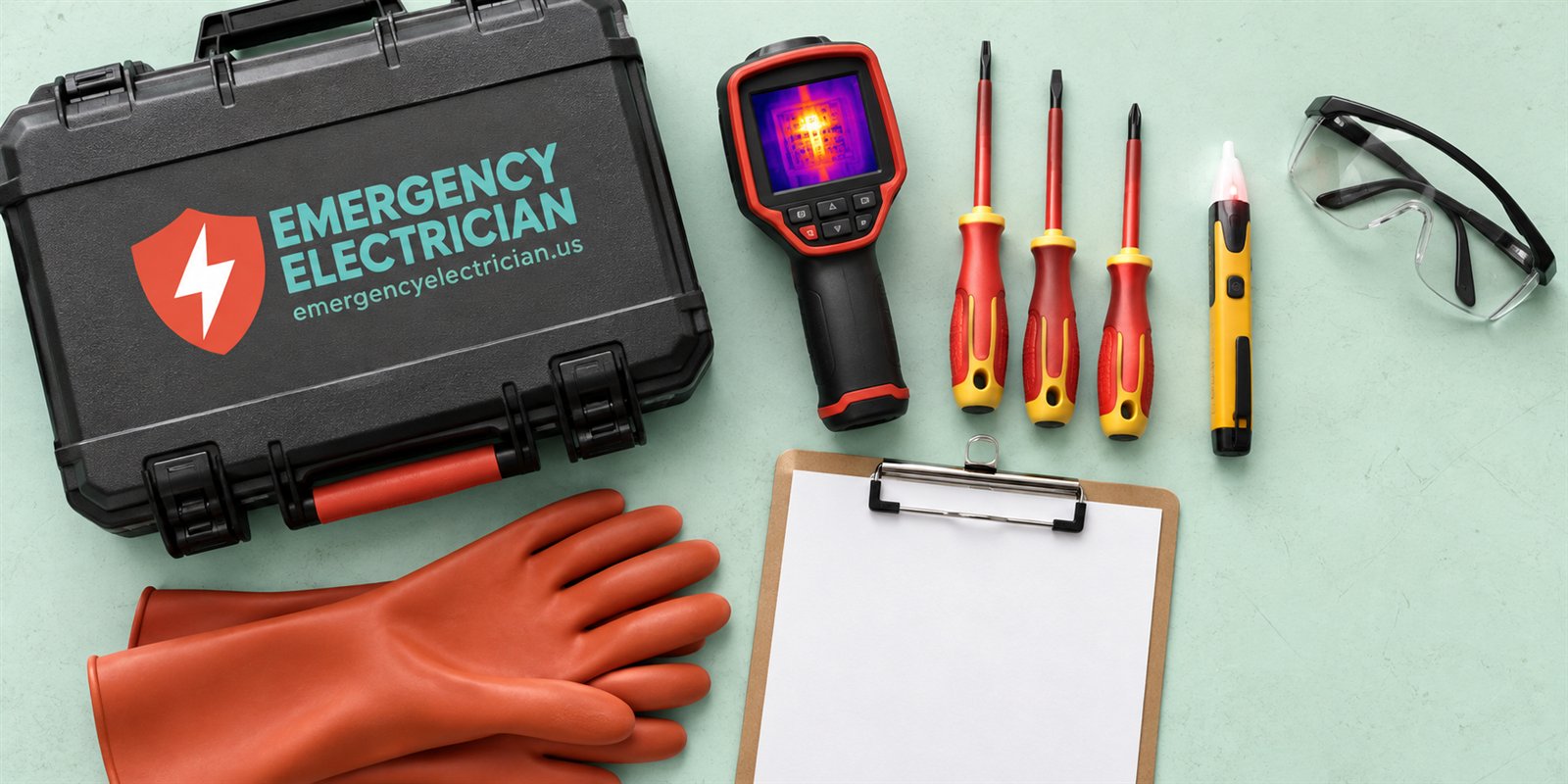
Modern tools reduce guesswork. A circuit tracer sends a signal through the wire and a handheld receiver follows it, so the technician can see the path of a cable behind drywall and find where the signal behaves differently. Some tracers use a pulse that can identify an open or a short along the run.
A thermal imaging camera shows temperature differences on a wall surface. A hot spot may indicate a loose or arcing connection or a damaged cable generating heat under load. It works best when the circuit has been under current recently, and it is a screening tool that must be confirmed with other tests. A stud finder with AC detection, used with care, can also show where cable runs, and some units detect metal nails near a cable.
A time-domain reflectometer, used by some technicians on long runs, measures reflected signals and estimates the distance to a fault. It is not common in residential calls but is valuable for long underground feeders to detached buildings and pool equipment, where digging up the entire run would be costly in time and landscaping. Insulation testers, as in ground fault work, find leakage along a conductor.
A technician combines these tools rather than relying on one. The final step before opening a wall is usually confirming the location by two independent methods. That is the difference between opening a small access hole and removing a whole section of drywall.
Cutting access: how small can the opening be
Once the fault is located, the technician has to reach it. In accessible spaces such as an attic or an open garage ceiling, that may be as simple as lifting insulation. In finished walls, the aim is a small, neat opening, cut so that it can be patched easily. Cutting is done carefully to avoid other wires and pipes.
Sometimes the best access is not at the fault itself. If a cable runs between two boxes, the technician may pull a new cable through the existing path without opening the wall. Where a run can be abandoned and replaced with a new one along an accessible route, such as in an attic or along a baseboard raceway, that may be a better choice than patching an old cable that has aged throughout its length. The technician should explain the options and the tradeoffs before cutting.
Splices inside walls are not acceptable. An approved repair uses a junction box that remains accessible, with a cover plate. That means the opening you see after repair often has a small cover rather than being sealed behind drywall. Our page on repairing damaged wiring properly explains how that works. Drywall patching, painting and finishing are typically separate trades; ask the technician what is included and what is not, so there are no surprises.
If the short was caused by a nail or screw, the technician will check the area for other nail strikes, because the person who drove one often drove several.
Three examples of how it plays out
Example one: a kitchen circuit trips every time it is reset. The technician unplugs everything and the breaker still trips. Testing at the first outlet shows the short is downstream. At the third junction, continuity between hot and neutral disappears. The fault is between the third and fourth boxes. A circuit tracer shows the cable passes behind a newly installed cabinet, and a screw is found through the cable. A short section is replaced in an accessible junction box.
Example two: a bedroom outlet pops and the lights in two rooms go dead. After removing loads, the breaker holds. The technician reconnects devices one by one and finds a window air conditioner with a damaged cord that shorts when the compressor starts. The fixed wiring is fine. The appliance is the problem, and the owner is advised not to use it. Our page on space heaters and window AC circuit safety discusses these loads.
Example three: a detached garage loses power after a storm. The breaker for the feeder trips. The technician tests the underground feeder with an insulation tester and finds a low reading. The fault is at a splice where water entered. The owner has the choice of repairing the splice in an approved junction or replacing the feeder; the technician explains which options fit the soil and the conduit. For this situation, our page on subpanel failure in a detached building adds detail.
Each example shows testing leading to a specific location, and a repair sized to the real problem.
Older homes, newer homes and where shorts tend to start
The age and construction of a building change where a technician looks first. In older South Florida concrete block homes, branch circuits often run through conduit in the slab or in the block cells, and the insulation on older conductors has had decades of heat. A short in these homes is often at a junction where an earlier repair was made, or where a fixture was swapped and the conductors were pinched against the box. In some of the oldest houses, cloth-covered or rubber-covered wire has become brittle, and a short can appear simply because someone moved a fixture and the insulation crumbled.
In newer wood-frame or townhouse construction, the common problem is mechanical. Cable is stapled to studs and passes through drilled holes, and later work such as cabinet installation, shelving, television mounts and picture hanging puts screws and nails close to those runs. Modern drywall screws are long enough to reach a cable behind a thin wall. Standards call for protective plates where a cable passes close to the face of a stud, but older work and later additions do not always have them.
Attics and soffits are another shared source. Heat, insects and rodents attack insulation, and recessed fixtures can run hot enough to damage conductors that touch them. Any renovation project is also a candidate: if the short began soon after a contractor or a handyman worked on a wall, ceiling or outlet, tell the technician, because that timing is one of the strongest clues available.
Knowing the building type does not replace testing, but it helps the technician choose where to begin. It also helps you ask a good question when you call: when was the home built, and has any wall, ceiling or outlet been opened or changed lately.
What a technician will tell you about the rest of the circuit
A repaired short is not the end of the evaluation. When a fault has burned insulation in one place, the technician should check whether heat or arcing affected the conductors on either side of it. Copper that has been heated by a fault can become brittle or discolored for some distance, and insulation farther along the cable may have softened. If the damaged section is short and the rest tests healthy, a local repair in an accessible junction is reasonable. If the damage extends, replacing the run is the safer course.
The technician will also look at the devices on the circuit, such as outlets and switches, for signs that the surge passed through them. Burned terminals, discolored faceplates, and loose connections are common after a hard short. A device that looks fine but has been through a fault can be a hidden weak point, and a technician may recommend replacing the ones that show signs of stress.
Finally, the breaker itself needs a check. A breaker that has interrupted a heavy fault repeatedly can wear. If it fails to trip properly or feels loose, replacing it with an identical, listed breaker is appropriate. This is also the point to verify that the wire size and breaker rating match, which is a frequent problem in older homes where breakers were changed without regard to the conductors. Our page on urgent breaker replacement explains how that choice is made.
Ask for a short written note of what was tested and what was found. It helps if the problem returns, and it helps with any insurance or landlord conversation.
Preparing for the visit and calling for help
Before the technician arrives, keep the affected breaker off, and leave the panel cover on. Write down what happened: the time, the sound, any smells, what was plugged in, any recent drilling or hanging of items on the walls, and any recent leaks. Take photographs of the area if it is safe, without touching anything. Clear access to the panel, and to the rooms on the affected circuit.
When you call, say clearly whether there was a flash, a pop, smoke or a burning smell, and whether any part of the wall or an outlet is hot or discolored. Say whether anyone was shocked. Mention anyone who relies on powered medical equipment. Quotes are given only by phone, and complicated jobs need an on-site visit. There is a service call charge, which is explained on the phone before dispatch. Ask about it when you call.
Our guide on what to tell the electrician dispatcher lists the facts that make the call efficient. A short, accurate description saves time at the property and helps the dispatcher decide whether anything needs to happen before the visit, such as shutting off the main breaker.
After the repair, ask the technician to show you the fault, if it can be shown, and to describe what was done. Ask for the findings in writing, and keep photographs of the repaired area for your records. If the cause was a nail or an animal, ask about steps to prevent a repeat. If you have a tripping circuit now, call and describe what is happening, and the dispatcher will help you decide the safest next step.
Questions people ask
What is the difference between a short circuit and a ground fault?
In a short circuit, a hot conductor touches a neutral or another hot, causing a surge of current. In a ground fault, current leaks to ground, a metal box or water. Both can trip a breaker, but they are found with different tests. A technician uses continuity and insulation tests to tell them apart and locate each.
Is it safe to keep resetting a breaker that trips instantly?
No. An instant trip means a fault, and each reset sends fault current through the damaged wire or device, which can arc and overheat inside a wall where you cannot see it. Leave the breaker off, unplug what you safely can, and have the circuit tested. Call 911 first if there is smoke, burning smell or sparks.
Will the technician have to open my walls?
Not always, and not widely. Testing and tracing tools let a technician narrow the fault to a small area, often accessible from a box, an attic or a garage ceiling. When access is needed, the opening is kept as small as practical. The technician should explain the plan and options before any cutting is done.
Can a short circuit start a fire?
Yes. The arc at the point of contact can melt copper and ignite nearby materials. Breakers are designed to trip quickly to reduce the risk, but damage can already happen. That is why a breaker that trips repeatedly should be treated seriously, kept off and diagnosed instead of reset again and again.
Could the problem be an appliance, not the wiring?
Often, yes. Failed appliances, damaged cords, lamps, fans and window air conditioners cause many short-circuit trips. Technicians remove all loads first and reconnect them one at a time. If the breaker holds with everything unplugged, the fault was in something connected. Keep any suspect appliance unplugged until it is checked or replaced.
What should I do if a wall smells burned but nothing is visible?
Treat it as urgent. A hidden fault may be overheating inside the wall. If the smell is strong, or the wall is warm, discolored or buzzing, leave the area and call 911. If it is faint, turn off the circuit if you know it, keep people away from the wall, and call an electrician for testing.
If "Finding a Short Circuit You Cannot See" matches what is happening, call and describe it plainly: the room, the breaker, any burning smell or tripped circuit. We explain what the repair would involve before a visit is set.
Related pages
- Ground Fault Tracing: How a technician isolates a ground fault with testing rather than guesswork, what trips a breaker or GFCI, and what you can safely do while you wait.
- Wire Repair and Splicing: How damaged wiring from rodents, nails or heat is repaired in approved accessible junctions, why hidden splices are not acceptable, and what to do meanwhile.
- Warm Wall: A warm spot on drywall near an outlet, switch or panel can signal hidden overheating. Learn what else causes it, why it matters and the order to call.
- Burning Smell: A burning smell with no flames is still a warning. Learn how to choose between 911 and an urgent electrician call, and what to do while you wait.
- Medical Office: Power failed in a medical or dental office? Learn the life-safety first steps, what circuits and backup planning cover, and what an electrician can do.
- Server Room Power: Server closet or small office rack lost power or keeps tripping? Learn the safe first steps, what an electrician checks, and what to tell the dispatcher.