

Why a smell with no flames still counts as an emergency
A burning smell is one of the earliest warnings that something electrical is overheating. Plastic insulation, wire jackets, circuit breaker housings, outlet bodies and the dust that collects around them all give off a sharp, acrid odor long before they ignite. By the time flames or visible smoke appear, the fault has often been going for a while. The fact that you cannot see a fire is not proof that one is absent, because wiring runs inside walls, above ceilings and under floors where you cannot look.
That is why the instruction from fire services is simple: if you smell burning and cannot explain it, treat it as a possible fire until proven otherwise. You do not need to be certain before you act. Taking the safe route costs a phone call, while ignoring it can cost a home. This page is about helping you make that call sensibly and not about talking you out of caution.
You also do not need to solve the mystery by yourself. Your job is to notice, protect people, call the right number and describe what you noticed. Finding the source belongs to the fire crew first and a qualified electrician afterward.
First move: get people out of the smell
Before anything else, check on everyone in the home, including children, older relatives and pets. If the smell is strong, if there is any haze in the air, if anyone has a cough or burning eyes, or if the smell is stronger in one part of the house, move everyone outside and stay outside. Leave the door unlocked if you can do so safely, so that responders can get in, and keep your phone with you.
Do not spend time collecting belongings. Do not go back in to look for the source. A smell that is mild in one room can be heavy in the attic or in a closet where a fixture is cooking the insulation. If the smell is faint and no one is in distress, you may still step outside while you decide, because fresh air makes it easier to think and because it keeps you out of a hidden risk.
If you live in a condo or apartment building, tell neighbours, since an electrical fire in a shared wall or a common electrical room does not stay in one unit. Our page on condo electrical room fire risk explains why shared equipment deserves quick attention.
Decide: 911 or urgent electrician
Use a simple rule. Call 911 if there is any visible smoke or haze, any heat you can feel from a wall, outlet, panel or appliance, any flicker of flame, any popping or crackling sound, or a smell that is strong and getting stronger. Call 911 also if you have already tried to find the source and cannot, since a fire crew can use thermal imaging to find heat behind a wall.
An urgent electrician call, without 911, fits when the smell is brief and fading, when it came with a specific event such as a bulb burning out or dust burning off a heater at the first use of the season, and when you have found the source and made it safe. Even then, the electrician call should be made the same day, not postponed. If a fire crew arrives, they may tell you to have an electrician examine the circuit before power is restored, so having a callback plan helps.
When in doubt between the two, call 911. Fire departments would rather check a smell that turns out to be harmless than arrive after a fire has taken hold. Let the dispatcher decide how to classify it.
| What you notice | First call | Why |
|---|---|---|
| Smoke, haze, heat from a wall or panel | 911 | Possible fire in a hidden space |
| Strong smell that is growing | 911 | Heating is continuing |
| Crackling or popping with the smell | 911 | Arcing is likely |
| Brief smell that faded, source unknown | 911 or urgent electrician | Unknown source, ask the dispatcher |
| Brief smell, source found and unplugged | Urgent electrician | Check the circuit and device |
| Smell from a heater at first season use | Electrician if it returns | Dust burn-off may be the cause |
Telling electrical smells from other smells
Many household smells can be mistaken for an electrical problem and the reverse is also true. An electrical overheating smell is often described as sharp, fishy, like hot plastic, like burning hair or like a hot iron. It tends to be chemical and harsh in the nose. Smells that are more likely to have another origin include burnt toast or food in the kitchen, a candle or incense, a fireplace or outdoor smoke drifting in, or a hot motor in a running appliance.
Still, the electrical ones deserve more suspicion because they cannot be confirmed by looking. If your nose says electrical and you cannot identify a food or heater source, take it seriously. Odor strength and place matter. Is it strongest near an outlet, a switch, the panel, a light fixture, a ceiling fan or a large appliance such as the dryer or air handler? Noting where the smell is strongest without putting your face near a device is useful information for the dispatcher.
If the smell started right after you plugged in or turned on a particular device, switch that device off at the control if it is safe to do so and unplug it by the plug only if the plug is cool and the outlet is not sparking. Leave it unplugged, and tell the technician about it. Our page on a hot cord or extension describes how those items overheat.
Common hidden sources technicians find
Because this call comes in so often, technicians have a mental list of likely sources. Failing receptacles and switches are high on that list, because a loose connection heats the plastic body from within. A worn breaker in the panel can also overheat where the wire connects, giving off a smell with no visible sign on the outside. Recessed light fixtures buried in insulation can trap heat and cook the wire jacket. Old ballasts in fluorescent fixtures, transformers for low-voltage lighting and doorbell transformers also smell when they fail.
Appliances are another frequent source. A dryer with lint built up around the heating element, a refrigerator compressor relay, a dishwasher heating element, a microwave and an air handler motor can all produce a burning smell. In those cases the appliance should be switched off at its control and, where safe, at its breaker, and then examined by an appliance or HVAC technician as well as an electrician for the supply wiring.
In South Florida, humidity and salt air add corrosion to the list. Corroded terminals have higher resistance and heat up under load, so an outdoor disconnect, a pool pump circuit or a garage outlet can all be sources. See air handler outdoor disconnect failure for an example outside the house walls.
- Receptacles and switches with loose terminals
- Breakers or panel connections running hot
- Recessed lights surrounded by insulation
- Transformers, ballasts and doorbell power supplies
- Dryer, oven, dishwasher or air handler components
- Corroded outdoor disconnects and pool equipment circuits
- Overloaded extension cords and power strips
What to do while you wait
If you have called 911, follow the dispatcher's instructions. They may ask you to leave the building, to stay on the line, or to meet responders at the door. Do not go back in to check on anything. If you have called an electrician and the smell is faint, stay out of the affected room, keep the area ventilated if it is safe to open a window without walking into the room, and keep everyone away from the suspected equipment.
If you can reach your main breaker safely, with dry hands, dry floor and an undamaged panel, switching it off removes power from most of the house and may stop the heating. Do not do this if the smell is strongest at the panel, if there is any sound of arcing, or if standing at the panel would put you near smoke. Our guide on when it is safe to use the main breaker sets out what to look for.
Do not try to find the source by opening up outlets or panels, and do not use water to cool anything. Do not reset breakers repeatedly. Keep a note on your phone of the time the smell started, where it was strongest, what you were doing and what you changed. These details help the technician and, later, any documentation you may need.
What the fire crew does and what happens next
When a fire crew comes for a burning smell, they usually begin by checking for visible smoke and measuring air for combustion products. They may use a thermal camera to scan walls, ceilings and the panel for hot spots, and they may check the meter and panel. If they find heat, they can cut power at the meter or panel to make the house safe, and they may open a section of wall or ceiling to reach a hot spot.
If they find nothing, they may leave with advice to have the electrical system examined, and some will tell you not to restore power to a circuit until it has been checked. If the utility has to disconnect at the meter, restoring it later involves coordination between the utility and your electrician, as explained in our page on the power company disconnect and reconnect process.
Do not be embarrassed if the call turns out to be a false alarm. Responders see many cases where the cause was dust on a heating element or a failing bulb, and they would rather be called early. For your part, get the name of the officer in charge and ask whether a report number is available, since an insurer may ask for it later.
What the electrician will do after the all clear
Once the fire crew has cleared the building, or if no 911 call was needed, the electrician's visit is about finding and correcting the cause. A qualified technician will start by asking about the smell in detail: when it started, where it was strongest, what had been running and whether anything tripped. They will then inspect the likely points, beginning with the panel, then the circuits near the smell.
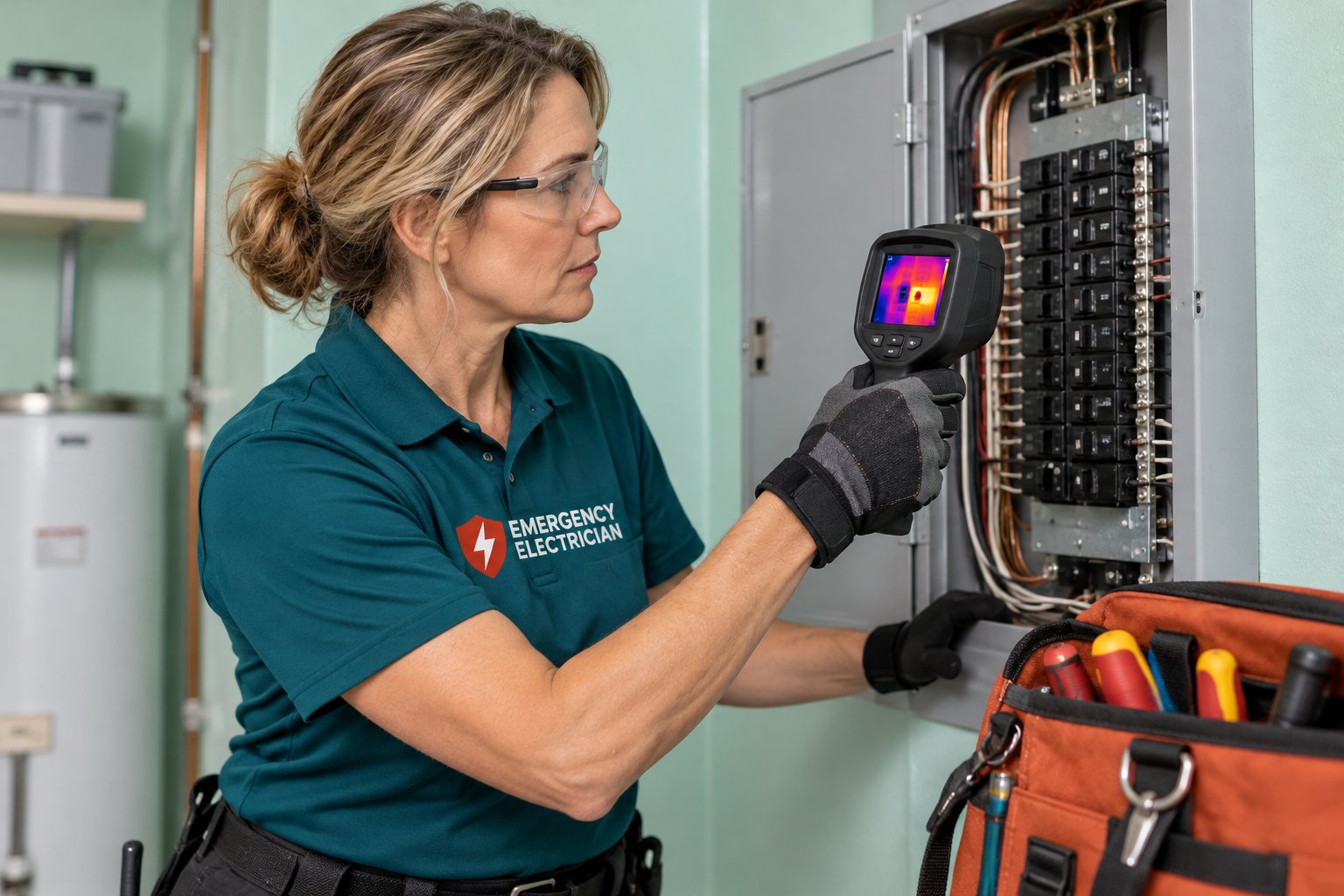
Tools may include a thermal camera, a voltage tester, a clamp meter and a visual inspection of terminals and device bodies. They may remove covers on suspect outlets and switches, look for darkened plastic, discolored copper or loose terminals, and test whether the circuit carries more current than it should. If they find a failed part, they will explain the finding and what is needed to repair it.
Some jobs are quick, such as a receptacle swap. Others involve burned wiring that needs to be cut back and replaced, which may need a permit, or a panel component that has to be replaced. Quotes are given by phone for straightforward work, and complicated jobs need an on-site visit. There is a service call charge, explained on the phone before dispatch.
Heater season, dust and the smell that fades
One common innocent source is dust burning off a heating element the first time a space heater, baseboard heater or furnace is run after a long break. In South Florida that happens less often than in colder places, but it still occurs with portable heaters used on a cool night and with air handler heat strips. The smell is dusty and warm and typically fades within a short time of running the device.
Even then, treat the first use with some attention. Do not leave a heater running unattended while you wait for the smell to pass. Keep it away from curtains and bedding, plug it into a wall outlet directly and not into a power strip, and switch it off if the smell turns chemical, if the cord or plug feels hot or if you hear any popping. Our guide on space heaters and window AC circuit safety goes into the circuit side of this.
If the smell fades and does not return, you can note it and move on, though it is still reasonable to mention it to an electrician at the next routine visit. If it returns, or if it appears with a heater that has a worn cord or a loose plug, switch it off and have it checked.
Records, insurance and the follow-up call
After any burning smell event that led to a call, write down the date, the time, who responded and what they found. If an electrician made a repair, ask for a written note of the finding, even a short one. These records help if there is an insurance question later and help any future technician see the history of the circuit.
If a device or appliance was removed from service, keep it. Do not discard a failed device until the technician has seen it or has told you it is fine to dispose of. Photographs of the area, taken from a safe distance, are also useful. Our guide on photographing damage before repairs explains what to capture.
When you are ready, or if you are standing outside right now with a smell you cannot explain and a decision to make, call and describe what is happening. A person on the phone can help you choose between 911 and an urgent electrician visit and can arrange the next step.
Questions people ask
Should I call 911 for a burning smell if I do not see smoke?
Yes, if the smell is strong, getting stronger, or you cannot find an innocent cause. Wiring burns inside walls where you cannot see it, so the absence of visible smoke does not show that nothing is wrong. Fire crews have thermal cameras and would rather check a smell than arrive late. If the smell was brief and clearly explained, an urgent electrician call may be enough.
What does an electrical burning smell actually smell like?
People describe it as sharp, fishy, like hot plastic, burning hair, or a hot iron. It is usually harsh and chemical and does not smell like food or wood smoke. If the smell is strongest near an outlet, switch, panel, fixture or appliance, that is useful information to give the dispatcher, without putting your face close to the device.
Can I find the source myself before calling anyone?
It is better not to. Opening outlets, touching panels or checking walls by hand puts you near live parts and possible heat. A short look from a safe distance is fine, but do not spend time searching while a fire could be developing. Call the right number and describe what you noticed, then let responders and a qualified electrician locate it.
Is it safe to switch off the main breaker for a burning smell?
It can be, if the panel is dry, easy to reach, undamaged and not the place the smell is coming from. Use one hand, stand to the side and never touch a hot or smoking panel. If the smell is strongest at the panel or you hear arcing, stay away and call 911. The main breaker does not remove power from the utility side.
The smell went away. Do I still need an electrician?
Usually yes, if you could not identify an innocent cause such as food or a heater burning off dust. A smell that fades can come from a fault that is intermittent or load dependent, which can return when something draws more current. A technician can inspect likely points and either find the cause or give you more confidence that it was harmless.
What should I have ready when I call?
Have the address, a callback number, where the smell is strongest, when it began, what was running, and whether any breaker tripped or any device sparked. Say whether anyone has symptoms such as coughing, whether 911 has been called, and whether medical equipment is on affected circuits. A clear description helps the dispatcher choose the right response.
Reading about "Burning Smell and You Cannot Find the Source"? Tell us what stopped working and when. We will say what an electrician would check first, and quotes are given by phone when the job can be described.
Related pages
- Call Order: Electrical trouble, three possible calls. A plain decision order for when to dial 911, when to phone the power company, and when to call an electrician.
- Panel Smoke: Smoke from a breaker panel is a 911 event. Learn what to do while waiting, what the fire crew does, and how the electrician visit follows afterward.
- Warm Outlet: A warm, browned or melted outlet is a heat warning. Learn how to read the damage, what to unplug, when it is a same-day call, and what a technician checks.
- Warm Wall: A warm spot on drywall near an outlet, switch or panel can signal hidden overheating. Learn what else causes it, why it matters and the order to call.
- Panel Buzzing: Some panel hum is normal, but loud buzzing can signal arcing or a loose connection. Learn to sort the sounds and what to tell the dispatcher about them.
- CO and Generator: A carbon monoxide alarm with a generator running is a life-safety emergency. Get out first and call 911. Learn why, and when an electrician call comes later.