
What a breaker is supposed to do
A circuit breaker is a protective switch. It watches the current flowing through a circuit and opens, or trips, when that current stays too high for too long or spikes suddenly in a short circuit. The wire in the wall is sized to carry a certain amount of current safely, and the breaker is chosen to open before the wire overheats.
Most breakers use two mechanisms. A thermal element, usually a bimetal strip, bends as it heats under sustained overload and eventually releases the latch. A magnetic element reacts almost instantly to a large surge, such as a dead short, and snaps the contacts open. Together they cover slow overloads and fast faults.
Because the breaker is a mechanical device with springs, latches and contacts, it can wear out, jam, corrode or fail to meet its original specification. When that happens, the protection you assume is in place may not be. That is why a breaker that fails to trip is a safety issue, not a nuisance.
How a failure to trip shows up
The tricky thing about a breaker that does not trip is that nothing happens at first. There is no alarm. What you notice are the effects of an overloaded or faulted circuit that is still energized: a cord or plug that is hot, a smell of warm plastic, a faint discoloration on an outlet, a light that flickers, or a wall that feels warm.
You might also notice the opposite pattern. A breaker that has to be reset repeatedly may be telling you about a real overload, but a breaker that never trips despite a clearly overloaded circuit may have a worn mechanism. A breaker that feels loose or soft when you move the handle, that will not stay in the off position, or that has a cracked or melted case is also suspect.
If you discover a circuit that is warm to the touch, smells hot, or has been carrying a space heater or similar load for hours while the breaker stayed on, treat it as a possible protective device problem. Switch off the appliance at its own control, unplug it if that is safe and dry, and call. Our page on a hot cord or extension describes related symptoms.
Why a failed breaker is easy to miss
Breakers are rarely tested after installation. They sit in a panel for decades, and most people only interact with them when one trips. A breaker that has gone stiff or whose contacts have fused together will not announce itself.
The failure also tends to be hidden by good luck. If a circuit rarely sees an overload, a stuck breaker may never be called upon. The problem emerges the day something goes wrong: a short in a damaged cord, a power tool that jams, a motor that locks up, a failing appliance. On that day, the wire carries more current than it was meant to, and the breaker that should have opened stays closed.
Dust, humidity and salt air near the coast add to the risk by corroding contacts and linkages. Heat from loose connections inside the panel can also affect nearby breakers. In older homes, breakers that were never exercised may have mechanisms that stick. A technician will often recommend operating breakers during an inspection for that reason, but only when it is safe to interrupt the loads involved.
Brands and models with known issue histories, described generally
Over the decades, regulators and manufacturers have issued notices about certain breaker or panel product lines that were found to have an elevated chance of failing to trip, overheating, or not fitting correctly. These notices are public information and vary by brand, product line and production period. Some led to formal recalls, some to advisories, and some to ongoing debate among electrical professionals.
It is not helpful to list every brand here, and an article cannot confirm whether your particular panel is affected. What helps is the general approach: identify the panel manufacturer and model from the label inside the door, record any date or catalog number, and check the manufacturer's and the Consumer Product Safety Commission's public notices. A technician can read the label and tell you what to look up.
Be wary of two common errors. One is assuming that any older panel is defective, which is not true; many older panels continue to work properly. The other is assuming that a panel without a recall is perfect; age, moisture and loose connections can compromise any brand. The question is the condition of this particular equipment, not its reputation.
Counterfeit and mismatched breakers
A separate concern is breakers that are not what they claim to be. Counterfeit breakers have been reported in the market, sometimes sold online with labels that imitate well-known manufacturers. They may look identical to the genuine product while lacking the internal parts that make a breaker trip reliably.
Mismatched breakers are a related issue. Panels are listed to use specific breaker types, and substituting a breaker of a different brand or series that merely fits physically can result in poor contact on the bus bar or incorrect trip performance. Some substitutions are allowed if the breaker is listed for that panel, but a visual fit alone is not proof.
If you or a prior owner bought breakers from an unfamiliar online seller, or if the breakers in your panel do not match one another, tell the technician. They can check markings, compare the labels and recommend replacements from a reliable supply chain. Do not install a breaker yourself; the connection happens inside an enclosure with live parts.
How a technician tests a breaker
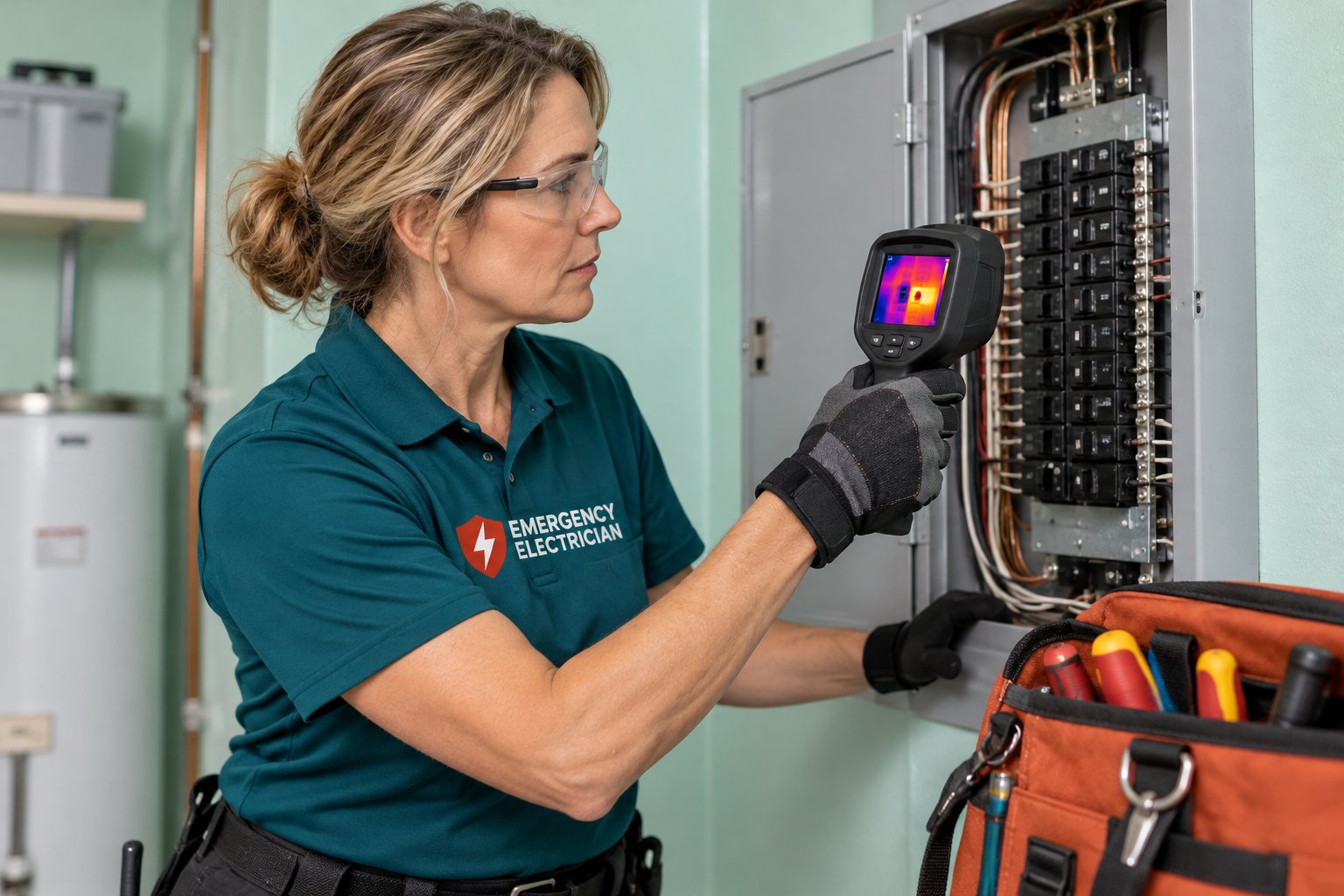
Testing begins with visual and thermal inspection. With the panel cover removed by the technician under controlled conditions, they look for scorched plastic, loose lugs, cracked cases and mismatched types. A thermal camera can reveal a breaker that runs hotter than its neighbors under load without any need to touch it.
Mechanical checks come next. The technician exercises the breaker handle to feel for stiffness, looseness or failure to latch. They may measure voltage drop across the breaker under load, which indicates how much resistance the contacts are adding. High resistance across a breaker is a sign of worn or contaminated contacts.
Performance testing can involve a breaker tester that injects a controlled current and times how long the breaker takes to open. This is typically done with the circuit isolated and the breaker removed or disconnected from loads. Not every call involves this test, but where a failure to trip is suspected it may be the only way to confirm. The technician explains what they are doing and what the findings mean before recommending a replacement.
What you can safely do right now
What you should not do is test the breaker by overloading the circuit on purpose. That is a way to start a fire, not to diagnose a problem. Do not try to trip a breaker by plugging in extra load, and do not open the panel to inspect the breaker yourself.
- Switch off the appliance or device on the suspect circuit at its own control, if you can do so dry and safely
- Unplug nonessential items from the circuit if the plug is cool and the area is dry
- Reduce the number of devices running on that circuit and nearby circuits
- Keep anything flammable away from the panel and from warm outlets or cords
- Photograph the outside of the panel and the label inside the door only if the door opens without exposing live parts, and do not remove the dead front
- Note the date, what was running and what you smelled or saw
Scenarios that bring a failed breaker to light
A homeowner in Miramar plugs a dehumidifier and a space heater into the same bedroom circuit during a cool snap. The wall outlet turns warm, the cord softens, and the breaker never opens. When the technician arrives, the breaker is found to have a stiff handle and high contact resistance. The cord and outlet are replaced along with the breaker, and the load is split across two circuits.
A tenant in a Hollywood duplex notices that a breaker has been in the halfway position for months, neither on nor off. The landlord resets it without inspection. When a window air conditioner is added, the wire in the wall overheats. A halfway handle is a sign that the breaker has tripped internally or is damaged, and it should be examined rather than reset repeatedly.
A garage chest refrigerator circuit in a Davie home draws heavily when the compressor struggles in summer heat. The breaker was installed decades ago and has seen many surges. It stays closed through a sustained overload, and the wire insulation near the panel turns brittle. In each case the visible symptom was heat, and the underlying issue was the protective device.
Why heat and humidity in South Florida matter for breakers
Breakers live in a hot, damp environment here more often than in drier climates. Garages and exterior utility rooms can run hot through the summer, and a breaker that carries a steady load adds its own heat to the enclosure. Higher ambient temperature means a breaker trips at a lower load than the nameplate suggests in some cases, and in others the plastic and springs age faster.
Humidity is the second factor. Moist air condenses on cool metal, and over years that moisture builds corrosion on contact surfaces and linkages. Near the coast, salt in the air accelerates the process. A breaker that has been operating for a long time in those conditions may feel gritty or sticky when the handle moves, or may trip erratically.
Storm seasons add stress. Surges from lightning or restored utility power can force high current through breakers and age their contacts. Hurricane season is a reasonable time to ask a technician to look at the panel, before the heavy-use period begins. Our page on hurricane season electrical readiness lists related checks.
Questions to ask a technician about your breakers
These questions turn a quick visit into a useful record. A good technician welcomes them, and the answers help you decide whether a single replacement is enough. They also help if you later sell the property or file an insurance claim, because they show that the protective equipment was reviewed.
- What brand and series is the panel, and what breakers is it listed to use?
- Are all of the breakers in the panel of the correct type, or are some mismatched?
- Did you see heat marks, loose terminals or damaged wire insulation at any position?
- Which breakers, if any, do you recommend testing or replacing, and why?
- Is the problem limited to one circuit, or does it suggest a broader panel issue?
- Will a permit or inspection be needed for the work you recommend?
- Can you give me a written note of what you found?
Repair and replacement, and when the whole panel is the question
When a single breaker is found defective, replacement with a correct, listed breaker for that panel is the usual repair. The technician tightens the terminals, inspects the bus bar contact point and re-tests the circuit. If the surrounding wire insulation has been overheated, the wire may need to be cut back and re-terminated, or replaced.
When several breakers are suspect, or when the panel's product line has a documented history of problems, replacing the panel can be more sensible than replacing breakers one at a time. A new panel resets the clock on all contacts and removes the question of compatibility. Our page on panel repair versus panel replacement explains how technicians weigh the choice.
For a quick fix on a single circuit, see urgent breaker replacement. For a broader failure, urgent panel replacement describes the path. Both depend on a diagnosis on site, so the dispatcher will usually arrange a visit rather than quote a result over the phone.
What to tell the dispatcher and what to have ready
Describe the symptom in plain terms: the circuit that was warm, the appliance involved, whether the breaker tripped at all, whether you have reset it, and whether you smelled burning. Mention the age of the home, the brand on the panel if you can read it from the door label, and whether any breakers have been replaced recently.
Quotes are given only by phone. A service call charge applies and is explained before dispatch. Because a failed protective device might need testing, a panel inspection and possibly a replacement, the dispatcher may ask to send a technician for an on-site assessment before giving a price for the full work.
If the breaker failure involved heat, a smell or visible damage, say so up front. If anything is burning or smoking, call 911 first. If you are unsure, call and describe what you noticed, and the dispatcher will help you decide the next step.
Questions people ask
How do I know if my breaker is not tripping when it should?
Signs include a cord, outlet or wall that gets warm or smells hot while the breaker stays on, a breaker handle that feels loose or stuck, or a case that is cracked or discolored. Because a stuck breaker may never announce itself, a technician's test is the reliable answer. If you notice heat or smell on a circuit, switch off the load and call.
Is my panel brand dangerous?
It depends on the specific product line, age and condition, not the brand name alone. Some product lines have public notices about issues, while many older panels perform well. The label inside the panel door gives the model information a technician can check against public notices. Do not remove the panel cover yourself to look.
Can I replace a breaker myself if I buy the same type?
No. The breaker clips onto bus bars that stay live even with the main off in many panels, and an incorrect or counterfeit breaker can fail to protect the wire. Replacement should be done by a qualified electrician who confirms the breaker is listed for that panel and checks the terminal and bar for damage.
My breaker is stuck in the middle position. What does that mean?
A handle that rests between on and off usually means the breaker has tripped. Sometimes it also indicates a damaged mechanism. Resetting repeatedly without finding the cause is not advisable, because the problem behind the trip may be an overload or a short. Leave it off, unplug the load and call for a technician to examine it.
Does a breaker that never trips mean my wiring is fine?
Not necessarily. A breaker that never trips could mean your circuits are lightly loaded, or it could mean the breaker will not operate. Wiring problems such as loose connections often produce heat without enough current to trip a standard breaker. A technician can test the breaker and inspect the connections to tell the difference.
How do I get a price for testing or replacing a breaker?
Quotes are given only by phone. A service call charge applies and the dispatcher explains it before anyone is sent. If the issue turns out to be more than a single breaker, such as a damaged bus bar or a panel replacement, an on-site visit is needed before a quote can be given. Have your symptoms and the panel label details ready when you call.
Reading about "A Breaker That Fails to Trip When It Should"? Tell us what stopped working and when. We will say what an electrician would check first, and quotes are given by phone when the job can be described.
Related pages
- Breaker Re-Trips: A breaker that trips again right after you reset it points to a hard fault. Learn why repeated resetting is risky and what to do and tell the electrician.
- Hot Panel: A hot breaker or panel cover can mean a loose connection or overload. Learn what warmth is normal, when to call 911, and what to do before an electrician.
- Burned Bus Bar: Scorch marks, melted plastic or a burned bus bar inside an electrical panel: what it means, why the panel is often replaced and what to do right now.
- Breaker Replace: A bad breaker can leave circuits dead or overheat in the panel. Learn when replacement is urgent, what is inspected beyond the breaker, and why testing follows.
- Reading a Tripped Breaker: What breaker handle positions mean, what a tripped breaker is telling you, and which details to pass along by phone, all without opening the panel.
- Appliance Trips Breaker: A breaker that trips every time the microwave, hair dryer or window unit runs is giving a clue. Learn overload versus fault and when to call an electrician.