
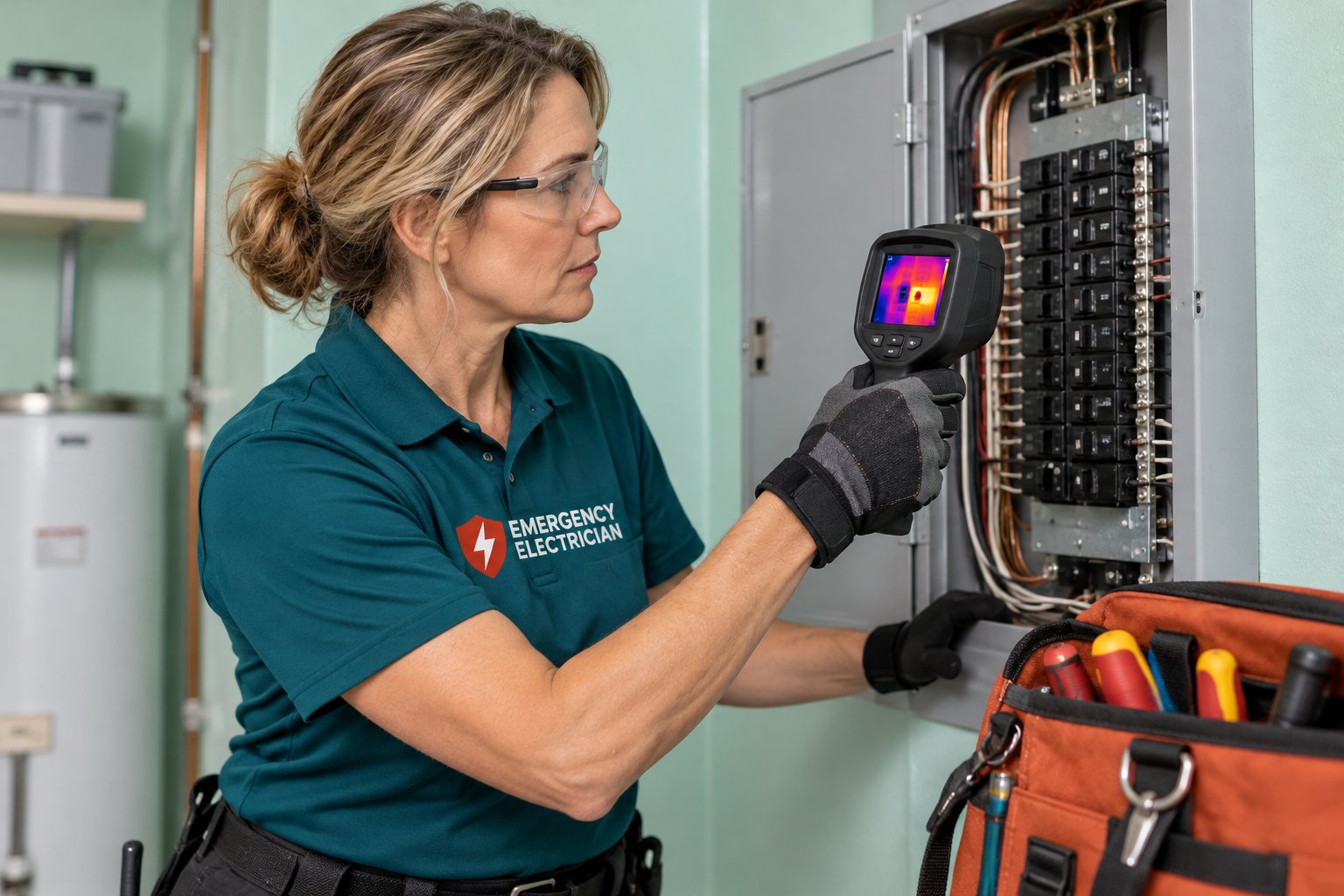
What a breaker is actually doing
A circuit breaker is a switch that opens by itself when a circuit carries more current than it should. It protects the wire in the wall, which can overheat if it carries too much for too long. Inside each breaker there are two basic mechanisms. One responds to sustained overload by heating a small strip of metal until it bends and releases the latch. The other responds to sudden surges, such as a short circuit, with an electromagnet that trips the latch almost instantly.
When a breaker opens, it is not broken. It is working. The handle moves to a position that tells you it has released, and until the cause is dealt with, the breaker will often open again as soon as it is reset. That is the part people find frustrating, and it is also the part that carries information. A breaker that opens again right away is saying the fault is still there.
Reading a tripped breaker is mostly a matter of looking carefully from outside the panel and noting what you see. You do not need to take anything off, touch anything inside, or use any tool. This guide explains what the handles show, what to write down, and what not to do. The guide on mistakes to avoid covers the habits that make a tripping breaker worse.
Looking before touching: is the panel safe to approach?
Before you even read the handles, check the conditions around the panel. If there is smoke, a burning or fishy smell, buzzing or crackling, heat on the door or wall, scorching, or any water on the floor or dripping nearby, do not approach. Stay back, call 911 if there is fire or smoke, and call for electrical help from a safe place.
If everything is dry, quiet and normal, you can open the outer door on panels that have a hinged cover over the breaker handles, which is different from removing the inner cover. Many panels are designed so that the handles can be seen when the outer door is opened, and the live parts remain behind a fixed inner cover. If your panel does not work that way, or if the door is stuck, damaged or corroded, leave it closed.
Do not remove the inner cover, do not reach behind anything, and do not use a tool. If the panel is in a place you cannot safely stand, such as a flooded garage, or if it is outdoors in rain, wait. The guide on when it is safe to use the main breaker sets out the same conditions in more detail.
The three handle positions
Most household breakers have a handle that rests in one of three positions. Knowing them helps you tell the difference between a breaker that has been turned off on purpose and one that has tripped.
On, where the handle is toward the on mark or toward the center of the panel on a typical layout, means the circuit is closed and carrying power. Off, where the handle is clearly toward the off mark, means someone or something switched it off by hand. Tripped is usually a middle position, where the handle sits between on and off, or in the off direction but slightly loose, depending on the brand.
| Handle position | What it usually means | What to do |
|---|---|---|
| Fully on, aligned with its neighbors | Circuit closed; breaker is not tripped | No action unless circuit is dead for another reason |
| Fully off | Switched off by hand or by a past reset | Note which circuit; do not switch back on if you do not know why it was off |
| Middle or loose position | Breaker has tripped | Note the breaker; unplug devices on that circuit before any reset |
| Will not move or feels gritty | Possible failed or damaged breaker | Leave it alone and call |
| Hot to the touch, discolored or scorched | Overheating at the breaker or its connection | Stay back and call; call 911 if smoke or fire |
Why tripped usually sits in the middle
In most household breakers, a trip moves the handle to a middle position so that it can be distinguished from a handle someone has switched off. To turn the breaker back on after a trip, many designs require you to push the handle fully to the off position first, which resets the internal latch, and then to the on position. If you push it straight to on without resetting, it may seem to do nothing.
That detail is why you see people say a breaker will not reset when in fact it needs the full reset motion. It is also why a handle that does not seem to move deserves care. Forcing it can damage the mechanism. If it takes more than a gentle, deliberate push to reset, do not apply more force.
Different brands and types vary. Some show a colored flag, some have a different feel, and double-pole breakers, which control 240-volt circuits for appliances such as a range, dryer or air handler, have two handles tied together. A technician can show you what yours looks like, but from the outside, a handle that sits visibly differently from its neighbors is the one to note.
What the pattern of tripping tells you
One trip, once, with a clear cause such as running a microwave and a toaster at the same moment, is usually an overload. Unplug those, reset once, and normal operation is a sign that you simply asked too much of the circuit. The breaker is not broken, but it does tell you that circuit is working close to its limit.
A breaker that trips again as soon as it is reset, with nothing plugged in, suggests a short or fault in the wiring itself or in a device that is permanently connected. A breaker that trips after a while and only when a certain appliance runs suggests that appliance or its cord is the problem. One that trips only during rain, sprinklers or humid weather suggests moisture in an outdoor outlet, light or junction box.
A breaker that trips at lower and lower loads, runs warm, or has started to trip for no apparent reason may be weakening. A whole group of breakers tripping at the same time after a storm, a surge or a power outage can reflect a utility event, and the page on a tripped main breaker after a storm describes that situation.
What to note for a technician
Information from the outside of the panel is surprisingly useful. A dispatcher or technician can learn a lot from a short list of observations, and it takes only a minute to collect them while you are safely standing at a distance.
Write these down, or say them into your phone, before you start resetting anything. If you can, take a photo of the panel door and labels, and of the handle positions, from a distance and without opening anything inside. The more specific you are, the less time it takes to understand what is going on.
- Which breaker or breakers tripped, and what the label says, including whether the label looks accurate.
- What was running or plugged in on that circuit at the time.
- Whether it happened once, repeatedly, or only under certain conditions such as rain or heavy appliance use.
- Any smell, sound, heat, flicker or visible mark that came with it.
- Whether the whole house or only part of it lost power, and whether neighbors did too.
- What you have already tried, including how many times you reset it.
Resetting once, and when not to
A single careful reset is reasonable under specific conditions. The panel is dry, quiet and normal. You know or suspect the cause, such as an overload, and you have unplugged or switched off the devices on that circuit. You stand to the side, use one dry hand, push the handle firmly to off and then to on in one motion, and watch what happens.
If it holds, plug devices back in one at a time, and notice which one makes it trip again. That device or cord is the suspect. If it trips immediately, or again within a short time, stop. Leave it off and call. The page on a breaker that will not reset explains what a technician will check.
Do not reset when you smell burning, see scorching, hear buzzing, feel heat, or when water may be involved. Do not reset a breaker that has tripped because someone was shocked or because an appliance sparked. Do not reset it repeatedly hoping the problem has gone away. And do not hold the handle on, tape it, or swap it for a larger one. Each of those defeats the protection that is working to keep the wiring from overheating.
Protective types: GFCI, AFCI and combination devices
Some protection lives in the outlet rather than the panel. A GFCI outlet has its own test and reset buttons and trips when it senses current leaking where it should not, such as through water or a person. A GFCI breaker in the panel does the same for the whole circuit. Arc-fault breakers trip when they sense the signature of an arc, and many panels now have devices that combine both functions.
When one of these trips, the cause is often different from a simple overload. A GFCI that will not reset may have moisture or a ground fault on its circuit or may be failing itself. An arc-fault breaker that keeps tripping may be sensing a damaged cord, a loose connection or even a poorly behaved appliance. The guide on what GFCI and AFCI protection actually does explains the differences, and the pages on a GFCI that will not reset and an arc-fault breaker that keeps tripping cover them.
In every case the principle is the same. Trips are information. Resetting once after removing a likely cause is fine. Resetting again and again is not.
When the panel itself looks wrong
Sometimes the breaker is not the story, the panel is. Signs include a rusted or corroded cover, water stains running down from above, a door that is warm, discoloration around a breaker, a smell of hot plastic, a handle that feels loose in its slot, or breakers that are not in line with their neighbors. These are reasons to stop and call, not reasons to look inside.
If you rent, the panel may belong to the building and may be in a shared room. Report what you see to the owner or manager in writing, and ask who is responsible for the repair. The guide on home or rental, which repair is yours explains how responsibility is usually divided.
A technician will check connections, the condition of the bus bars and the breakers, and whether the panel is damaged or aged. Quotes for anything beyond a simple fix come by phone, and larger jobs need an on-site visit, with the service call charge explained before dispatch. If any of the signs above matches what you are looking at, call and describe it, and do not touch the panel while you wait.
Questions people ask
How can I tell if a breaker has tripped without opening the panel?
Look at the handles from outside the inner cover. A tripped handle often sits in a middle position or slightly off line from its neighbors, while on and off handles line up clearly. If you cannot tell, or the panel door is stuck, damaged or wet, do not force anything and call to describe what you see.
Why does my breaker feel like it will not turn back on?
Many breakers must be pushed fully to the off position first to reset the internal latch, and then to on. If it still will not hold, it may be tripping instantly because the fault is still present, or the breaker may have failed. Do not force it or keep trying, leave it off and call.
Is it normal for a breaker to feel warm?
A little warmth under steady load can occur, but a breaker or panel door that feels hot, smells, or looks discolored is not normal. Do not touch it further. Stay back, keep others away, and call. If there is smoke or flames, leave and call 911 first.
Can I just replace a tripping breaker with a bigger one?
No. The breaker size is matched to the wire in the wall, and a larger breaker lets the wire carry more current than it can handle, which can overheat it without tripping. This is a common cause of fires. Leave sizing and replacement to a qualified technician who can check the wiring first.
What should I do if only some outlets lost power?
Check whether a GFCI outlet nearby has tripped, since one can control several outlets. If a breaker has tripped, unplug devices and reset once if the panel is dry and normal. If power does not return, or it trips again, stop and call. Mention which rooms are affected and what was running.
Do breakers wear out?
Yes. Breakers are mechanical devices and can weaken, loosen or fail with age, heat, corrosion and repeated tripping. A breaker that trips at lower loads, runs warm, or will not hold may be failing. A technician can test and replace it. Do not attempt to swap breakers yourself, since it involves live panel parts.
About "Tripped Breaker Handles: What They Mean": call and give us the details, and we will explain what is safe to do while you wait and what the visit would cover. Jobs that cannot be quoted blind need a look on site.
Related pages
- Using the Main Breaker: Plain guidance on when shutting off the main breaker is reasonable, when to stay away from the panel, and who to call first in an electrical emergency.
- Breaker Re-Trips: A breaker that trips again right after you reset it points to a hard fault. Learn why repeated resetting is risky and what to do and tell the electrician.
- GFCI and AFCI Explained: A plain explanation of ground-fault and arc-fault protection, where each is used, what each catches, and the limits that still call for caution.
- Electrician Dispatch: Calling an electrician about a problem? Learn which symptoms, timing details and photos to describe so the right technician and tools are sent the first time.
- Emergency Permits: How urgent electrical repairs still move through permits and inspections in South Florida, what usually needs one, and what to ask before work starts.
- Insurance Documents: Which records to gather after an electrical failure, fire, flood or surge: receipts, photos, technician findings and notes, without claims about coverage.
Circuits that share a breaker and why that confuses people
One breaker rarely serves just one room. Builders often split circuits by convenience, so a single breaker might feed a bedroom outlet, the hallway light and an outlet in the garage. When it trips, the symptoms look unrelated, and people hunt for a problem in the wrong place. A useful habit is to walk through the house and list every outlet, switch and fixture that went dead. The overlap between the dead items usually shows which breaker is involved and sometimes shows where the fault sits. Florida humidity, salt air and summer storms add stress to electrical parts, so conditions that seem minor elsewhere can matter more here.
Older homes and additions can make this harder, since labels may be wrong or missing. Do not trust the printed directory without testing it. With the breaker off, plug a small lamp or a phone charger into a few points and see what does not work. Keep the testing gentle and stop if you smell anything or see scorching. Mark what you learn on a sheet of paper and keep it near the panel for the technician. Keep children and pets away from the area while you wait, and avoid touching anything that feels warm, damp or looks discolored.
Shared circuits also explain why adding a new device sometimes causes a trip. A space heater, a hair dryer or a vacuum can push a circuit over its limit when other items are already drawing power. That is a load issue, not necessarily a wiring defect, but repeated tripping still deserves attention. Describe to the technician exactly what was running at the time, and whether the same trip happens with only one device on. That detail often separates an overloaded circuit from a fault in the wiring. Write down what you noticed, in the order you noticed it, because memory fades quickly once the situation becomes stressful.
What the technician does at the panel, step by step
A visit about a tripped breaker typically begins with questions, then a look at the panel before anything is touched. The technician notes which breakers are off or in the middle position, checks the cover and the surroundings for moisture or damage, and listens for sounds. Only when the panel looks safe to work on does the next step happen. If it does not, the conversation turns to isolating that part and explaining what options exist. Ask for anything you do not understand to be explained in plain words, since you should be comfortable with the plan before work begins.
Next comes testing. The technician identifies which devices and outlets are on the affected circuit and may disconnect loads so that the circuit can be examined with nothing plugged in. Instruments check for faults between conductors and to ground. Where a protective device such as a GFCI or AFCI is involved, the technician tests whether it is behaving properly or tripping because of a genuine fault downstream. This process is methodical and can take time, since the goal is to find the cause rather than simply to make the handle stay up.
Afterward the findings are explained in ordinary language, with the options and what each would involve. You might learn that a single appliance was the culprit, that a connection has loosened, or that a breaker itself has worn out. The scope and any quote are explained before work begins, and you can ask why a step is needed. Keep any notes the technician gives you, since they help if the problem ever returns. Whether you own, rent or manage the property, tell us which applies so we can explain who may need to be involved.