
What the main breaker actually does
The main breaker sits at the top of your electrical panel and controls everything downstream. All of the branch breakers for lights, outlets, the air conditioner, the range and the dryer draw through it. It is sized to protect the service conductors and the panel itself, and it is built to open the circuit when the current through it is too high for too long, or far too high for even an instant.
Because the main sees the combined load of the whole house, it does not trip often. A branch breaker tripping now and then is a nuisance that most people have lived through. A main breaker that trips is a different kind of event. It usually means one of three things: a large fault somewhere downstream, a problem with the main breaker or panel itself, or a problem with the supply coming in.
That is why this page treats a main that will not stay on as a serious sign. It does not necessarily mean disaster, but it does mean that a technician should look before you try again and again. Each reset closes the main into whatever is wrong, and if the fault is a hard short, the current that flows in that instant is large.
The page on reading a tripped breaker explains the positions and feel of breaker handles, which helps when you describe what you see to a dispatcher.
Why a tripping main points to a major fault
Think of the main as being tuned to ignore small problems and respond to large ones. A single circuit with a bad appliance will trip its own breaker first, because that breaker has a lower rating and sits closer to the fault. If the main trips instead, either the fault is large enough to overwhelm a branch breaker, or it sits upstream of the branch breakers, in the bus bars, the main lugs, the service cable or the meter side.
Several situations fit that pattern. A short circuit in the panel itself, such as a burned bus bar, a failed breaker or a loose wire touching metal, can trip the main immediately. Water inside the panel or the meter base can create a path for current. A damaged service cable or mast, hit by a tree or chewed by an animal, can short to ground. A ground fault in a major appliance circuit that bypasses its own breaker can also reach the main.
There is also the possibility that the main breaker itself has failed. Breakers age, and after many heat cycles or after an earlier large fault, internal parts can weaken so that the breaker trips at a lower current than it should, or will not latch at all. A failed main may feel loose, will not hold, or may be warm to the touch.
You cannot tell which of these you have by looking from outside, and you should not try to find out by opening the cover. The point is that the cause may lie upstream of anything you can safely inspect, and that is why this is an urgent call rather than a project for the weekend.
Storms, flooding and why this happens afterward
Storms deserve their own section here for a reason. In South Florida, a main that trips and will not hold often appears during or after a thunderstorm, a hurricane or a flooding event. Lightning strikes and nearby surges can damage breakers, appliances and wiring in ways that show up only when the power returns. Wind can bend a service mast or tear a weatherhead, letting rain run down the conduit into the panel. Flood water, saltwater and wind-driven rain can enter the meter base or the panel and leave behind moisture and corrosion.
When the utility restores power after an outage, the sudden return of voltage and the simultaneous start of many loads can reveal a fault that was hiding. Refrigerators, air conditioners and pool pumps all restart at once, drawing large starting currents. If a connection in the system is already compromised, the main may trip as soon as the load returns.
Debris and tree damage matter too. A branch that struck the service line, or a limb that rubbed on the wires during the storm, can leave a partially damaged cable that works until it is loaded. That is covered on when power returns and breakers trip and in tree on the service line.
If you can see physical damage to the mast, meter, cable or panel, treat that as the first thing to report, and do not touch any of it. For leaning or torn equipment, the page on a bent service mast explains who to call and in what order.
What is safe to try, and what to stop doing
There is a limited and safe set of things you can do. First, check whether this is really a trip. Look at the main breaker handle in the panel. A tripped breaker usually sits in a middle position or in the off position and may feel loose. If you can reach the panel without standing in water, without touching anything damaged, and without smoke, heat or noise present, one careful reset is a reasonable step to see whether it was a one-time event.
To do that, make sure the floor is dry, step to the side of the panel rather than directly in front, turn off every branch breaker first if you can do so one at a time with a dry hand, then switch the main to off fully and back on firmly, and look away from the panel as you do it. Do not hold the handle against resistance. If it does not stay on at once, stop.
Do not keep resetting. A main that trips again the moment you close it has told you what it needs to tell you. Do not tape, wedge, hold or jam a breaker handle. Do not try to replace the breaker yourself, because the lugs on the main side of a panel can remain live even when the main is off, and that is serious.
If there is smoke, a burning smell, a buzzing sound, scorch marks, water in or near the panel, or if the panel door is hot, do not touch it. Leave the area and call. For smoke, flame or someone injured, the first call is to 911.
- Dry floor, no smoke, no heat, no sound: one careful reset is reasonable.
- Stands back from the panel and turns the branch breakers off first.
- Trips again at once: stop and call.
- Never tape, wedge or hold a breaker on.
- Water, smoke, scorching or a hot panel door: leave it alone and call.
Utility side versus customer side
One question comes up often: is the problem the power company's or yours? The answer depends on where the fault sits. In general terms, the utility is responsible for its lines, its transformer and the equipment on its side of the meter, and the homeowner is responsible for the meter base, the service mast and weatherhead, the panel and everything inside. The exact dividing line varies by utility and by installation.
A main that trips can be due to a fault on either side, but the main breaker itself and the panel are on the customer side. If neighbors still have power while you do not, or if the main trips while theirs stays on, the issue is more likely on your side. If the whole block is dark, the utility may be working on a fault or an outage.
If you see a downed wire, sparks at the meter or a pole, or a service line pulled from the house, keep away, call 911 and tell the dispatcher, then report it to the utility. The guide on who fixes what sets out the usual split, and the disconnect and reconnect process explains how utilities approach reconnection after repairs.
In many cases an electrician has to make customer-side repairs, request an inspection where needed, and then coordinate with the utility to reconnect. It helps to know that early, since it can affect how long the process takes.
What to prepare before you call
A few facts make the call efficient. Start with what happened: when the main tripped, whether there was a storm, a flicker, a bang or a surge, and whether it has tripped before. Say whether you have tried a reset, how many times, and what happened each time. Mention any smell, sound or visible damage, including at the meter, the mast or the panel.
Note which devices were running at the time, particularly large ones such as the air conditioner, the range, the dryer, a pool pump or a water heater. If you have a generator or a transfer switch, say so, and say whether it was in use when the main tripped. A mistake in generator connection can cause serious trouble, and you can read more at generator backfeed risk.
Be ready with the address, the access route to the panel, and the name of the utility. Clear the area around the panel and the meter. If it is dark, find a flashlight and keep it handy, and use battery lights rather than candles.
Think about what you need power for. If anyone depends on medical equipment, refrigerated medication or other critical power, say so when you call, and plan an alternative that does not involve improvised wiring or cords from a neighbor. Have phone chargers or a battery pack ready so that you can stay reachable.
What the technician will check on site
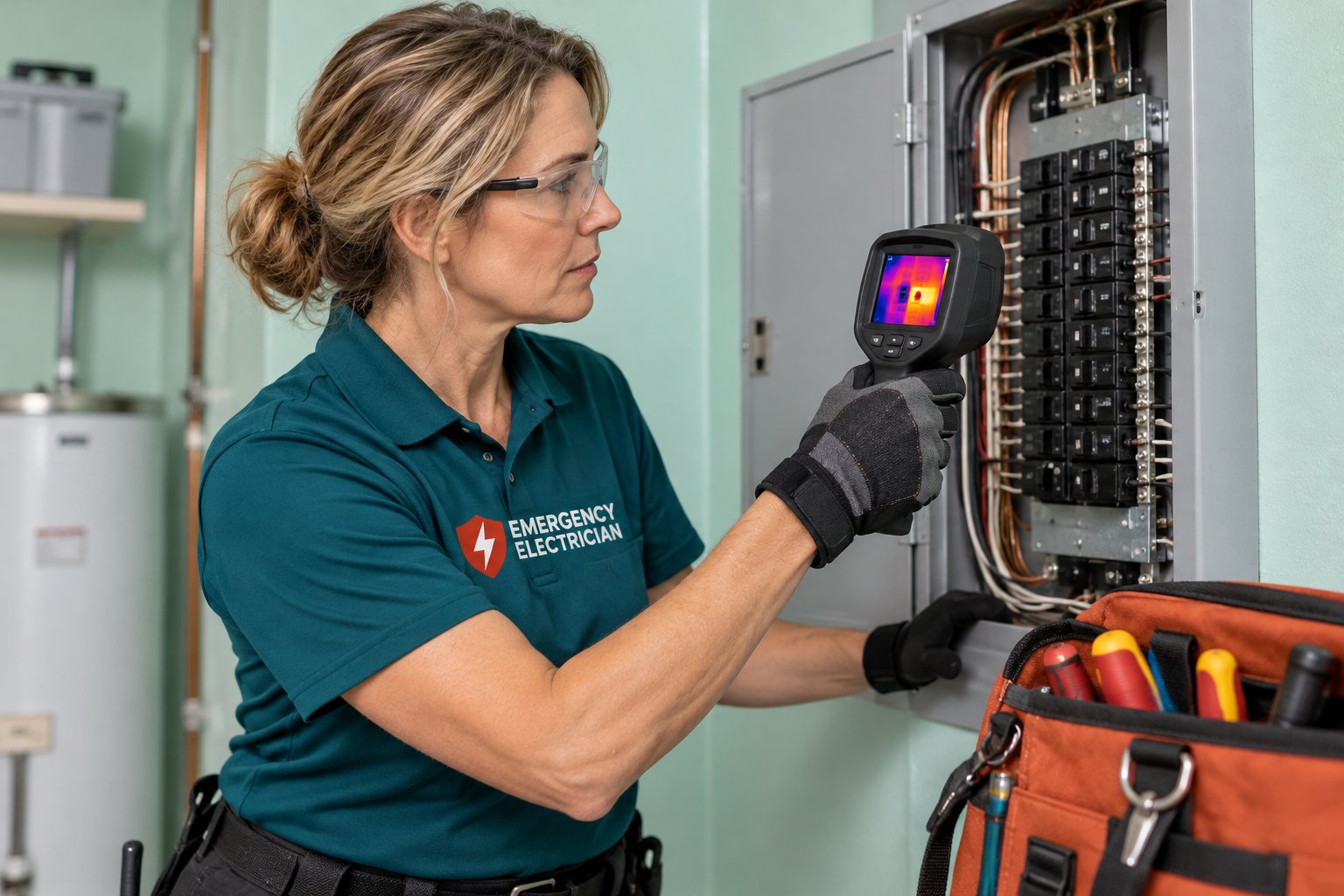
A technician will begin by observing the situation and making it safe. That includes looking at the meter, the mast, the service cable, the panel exterior and the main breaker, noting any visible damage, moisture or heat. Then, with proper protective equipment and instruments, they test the supply, the main breaker and the bus connections.
Common findings include a failed main breaker, burned or pitted bus bars, loose or corroded lugs, a damaged branch breaker that is shorting inside the panel, water intrusion from a leaking weatherhead or conduit, or a large ground fault on a downstream circuit. Sometimes the main is fine and a single circuit is the culprit, in which case the technician isolates circuits one at a time and brings the system back up in stages.
Depending on what is found, the repair can range from replacing a breaker to replacing a panel, repairing a mast or meter base, or tracing a fault in the wiring. Some of these require permits or inspections, and some require the utility to disconnect and reconnect service. The technician will explain the sequence and what is realistic that day.
Related urgent services are described on urgent breaker replacement and urgent panel replacement. Which one applies depends on the findings, not on guesses made before the visit.
Staying safe while the power is off
While you wait, use the time to reduce risk. Leave the main off. Turn off or unplug sensitive electronics so that a sudden return of power does not hit them, and switch off the air conditioner and large appliances at their own breakers so that everything does not start at once when power returns.
Keep the refrigerator and freezer doors shut to preserve food. Use flashlights or battery lanterns. Avoid candles, and if you must use one, never leave it unattended. If you run a generator, keep it outdoors, well away from doors, windows and vents, because exhaust contains carbon monoxide, and never connect it to the house through an outlet or a homemade cable. The guide on generator safety after a hurricane goes into this.
Keep children and pets away from the panel and any damaged equipment. If water is present near the panel, outlets or the meter, do not walk through it. If the area is flooded, the flood response pages explain why the main should stay off until a qualified person has inspected the system.
If you are in a hot house and anyone is struggling with the heat, move them to a cooler place, such as a friend's home, a shelter or a vehicle with the air conditioner on. Heat is a real hazard in South Florida, and comfort should not be traded for risk with the wiring.
Making the call
When the main will not stay on, the most useful step is a phone call to an electrician, ideally with the notes described above in front of you. The dispatcher will ask about safety first: smoke, flame, water, injuries, downed wires. If any of those are present, 911 comes first.
Then the dispatcher will collect the address, a description of the problem and the conditions on site, and will explain how the visit works. There is a service call charge, which is explained on the phone before dispatch. Quotes for repair are given by phone, and complicated jobs need an on-site visit so that the quote matches the real condition of the equipment. You will not be asked to commit to work that no one has seen.
Keep the main off and stay away from the panel until the technician arrives. If anything changes, such as a smell, smoke, heat or noise, call back and say so. If the situation becomes dangerous, leave the building and call 911.
A main breaker that will not stay on is not something to wrestle with alone, and it is not something to ignore. Describe what you see, follow the advice you are given, and call when you are ready.
Questions people ask
Is it safe to keep resetting the main breaker?
No. One careful reset on a dry floor with no smoke, heat or noise is reasonable to see whether it was a one-time event. If it trips again at once, stop. Each reset closes the main into whatever fault is present, and a hard short can release a lot of energy. Leave it off and call an electrician.
Could the problem be the power company's side?
It can be, especially if the whole neighborhood is dark. The utility handles its own lines and equipment up to the meter, while the meter base, mast, panel and wiring inside are typically the owner's side. If neighbors have power and you do not, the cause is more likely on your side. If you see a downed wire or sparking at the pole, call 911.
Why would the main trip only after a storm?
Storms bring lightning surges, wind damage to the mast and weatherhead, water entering the meter or panel, and many appliances restarting at once when power returns. Any of these can expose or create a fault. The breaker is reporting a problem that may have been building, and the restoration of power is when it finally shows.
Can I replace the main breaker myself?
No. The conductors feeding the main stay live even when the main is switched off, and mistakes there can cause severe shock, arcing and fire. Replacing a main breaker or any part of a panel is work for a qualified electrician, often with a permit or inspection. Describe the symptoms to the dispatcher and let the technician make the repair.
What if I depend on medical equipment and the power is off?
Tell the dispatcher when you call so that it can be taken into account, and use your medical provider's backup plan for the device. If anyone is in distress, call 911. Do not improvise by running extension cords from a neighbor or connecting a generator to the house, because those workarounds create new dangers.
How will I know what the repair costs?
Quotes are given only by phone. For complicated jobs, a technician has to see the equipment first so the quote reflects the real fault. There is a service call charge, and it is explained on the phone before anyone is dispatched. If you have questions about how the visit is handled, ask during the call. Call as soon as you are ready to describe the problem.
About "Main Breaker Will Not Stay On": call and give us the details, and we will explain what is safe to do while you wait and what the visit would cover. Jobs that cannot be quoted blind need a look on site.
Related pages
- Breaker Re-Trips: A breaker that trips again right after you reset it points to a hard fault. Learn why repeated resetting is risky and what to do and tell the electrician.
- Seized Main: Main breaker burned, stuck or will not switch off or on: why it happens, why the utility may need to pull the meter and what to do in the meantime.
- Post-Outage Trips: Power returned after the storm but breakers keep tripping. Learn what causes it, what is safe to check, and when to call an electrician for triage.
- Panel Replace: Fire, flood or failure can force a panel swap. See when replacement is needed, how permits, utility disconnect and inspection work, and how to prepare.
- Who Fixes What: Where utility equipment ends and customer equipment begins, in general terms, so you know whether to call the power company, an electrician, or 911 first.
- Small Fire: Small flames at an outlet, cord or appliance still mean get out and call 911. Learn why water is wrong, when an extinguisher is an option and what follows.