
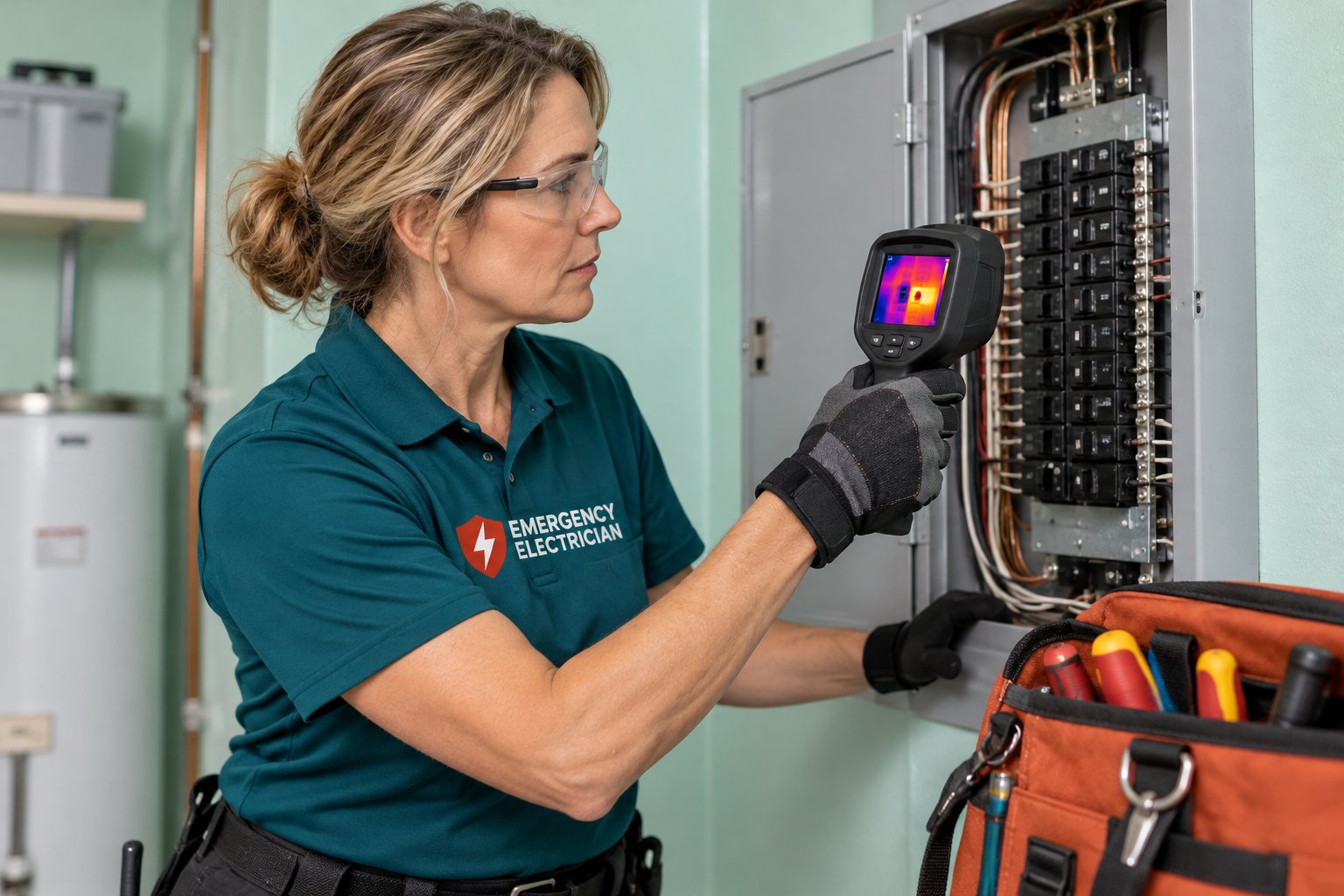
Start with safety, then with the utility
If you smell burning, see smoke, see flames, hear popping from the panel, or someone has been shocked, stop reading and call 911. Get everyone outside, away from standing water, and leave the electrical equipment alone. Do not go back in to check the panel. Fire crews have the training and the tools to make the building safe first, and an electrician can inspect afterward.
If nothing is on fire and nobody is hurt, the next question is whether the problem is yours or the utility's. In much of South Florida the utility is FPL, and in some cities it is a municipal system. If the whole street is flickering, if neighbors report the same trouble, or if lights are dim in some rooms and bright in others, the utility needs to know. A failed neutral on the utility side can cause serious voltage trouble inside every house on that service transformer, and no amount of resetting breakers in your panel will fix it.
If the neighbors are fine and only your house is misbehaving, the fault is most likely on the customer side of the meter. That means your meter socket, your mast, your panel, your branch wiring, or something plugged into it. That is the territory where an electrician is the right call after the safety questions are answered.
- Burning smell, smoke, flames, or a shock: call 911 first.
- Downed or sagging utility wire: stay far back and call 911 and the utility.
- Whole street affected: report it to the utility, not an electrician.
- Only your house affected: the fault is likely on your side of the meter.
Why breakers trip right after power is restored
Restoration is not a gentle event. When a utility re-energizes a feeder after a storm, every circuit in every house on it comes alive at nearly the same moment. Motors in air conditioners, refrigerators, pool pumps and well pumps all try to start together, and any weakness in your wiring gets tested at once. A breaker that tripped right after the lights came back is often reacting to a real fault that was hiding while the power was off.
Water is the most common hidden cause. Wind-driven rain can enter outdoor lights, exterior outlets, attic junction boxes, bathroom exhaust fans, and the top of the service mast. While the circuit was dead, the water did nothing visible. When voltage returns, current finds a path through the damp insulation or the wet connection, the breaker senses the leak or the overload, and it opens. That is the breaker doing exactly what it was built to do.
Surges are the second common cause. A grid that switches on and off can send voltage spikes through the house. Surge damage can leave a device, a power supply, or a section of wiring in a partly failed state that draws too much current. The breaker trips, you reset it, and it trips again, because the failed part is still connected.
Reading the pattern of what tripped
Before you touch anything, notice what happened. Take a photo of the panel with the door open, if the door opens easily and the area is dry. You are looking at which breakers are in the middle or off position and whether any look different from the others. Do not touch the panel if the floor around it is wet, if the panel is rusted or has water marks, or if you feel any tingle from the cabinet.
A single branch breaker that tripped usually points to one circuit with one problem: a wet outdoor outlet, a failed appliance, a damaged cord, or a damp junction box. Several breakers tripping at once is different. It can point to a surge, to a main or a feeder problem, or to a problem in the shared neutral. A main breaker that tripped is the most serious pattern, because the main protects the whole panel and the service conductors feeding it.
Ground fault and arc fault breakers deserve a mention. Many homes have breakers or outlets with test buttons that detect small leaks to ground or dangerous arcing. After a storm these devices are more sensitive to moisture than regular breakers, and a repeated trip from one of them is a real signal that current is leaking somewhere. Resetting it again and again does not help. See the page on arc fault breakers that keep tripping for how that pattern is read.
What is safe for you to do
Some steps are low risk and genuinely useful. Unplug or switch off everything on the circuit that keeps tripping, so the breaker is not fighting against a failed appliance. If an air conditioner, a refrigerator, or a pool pump is on that circuit, note that it is there, because compressors that were running during a surge are a frequent source of the fault.
If you decide to reset a breaker, do it once, firmly, with the load removed, standing to the side of the panel, with dry hands and dry footing. Push the handle fully to off first and then to on. If it trips immediately or within a short time, stop. A breaker that will not hold is not asking to be reset harder. Leave it off and treat that circuit as unavailable.
Do not keep resetting, do not tape a breaker handle, do not swap in a larger breaker, and do not bypass anything. A breaker is the weakest planned link in a circuit so that the wire inside the wall is never the weak link. Defeating it moves the heating from a metal box with a trip mechanism to the cable in your wall or attic. That is how outage-related faults become fires.
- Switch off and unplug what is on the tripping circuit.
- Reset once, with the load removed, standing to the side.
- If it trips again, leave it off and stop troubleshooting.
- Never replace a breaker with a larger one to make the trip stop.
- Keep children and pets away from wet areas and the panel.
What to leave to a professional
Opening the panel cover and touching the bus bars, lugs or conductors exposes you to live parts even when the main is off, because the service conductors above the main are always energized from the utility side. This is not a place for guesswork. If you suspect water in the panel, discoloration, melted insulation, or a loose connection that is warm, leave the cover on and call for help.
The same applies to the meter socket and the mast. Those parts belong to the boundary between the utility and the customer. The utility owns the meter and the lines up to the connection point, and the customer owns the mast and equipment past it. Damage to the customer side must be repaired by an electrician before the utility will reconnect or keep service on. A leaning mast, a cracked weatherhead, or a loose meter socket after a storm is not a do-it-yourself project.
Finally, any circuit that trips with nothing plugged into it is a wiring fault, not an appliance fault. Finding it means testing conductors for insulation breakdown, which takes instruments and training. If the fault is a hidden leak to ground inside a wall, a repeated reset simply feeds energy into the damaged spot.
How an electrician triages this call
A technician usually begins by listening to the story, which is why the answers you give on the phone matter. When did the power go out, how long was it out, did it return all at once, did anything pop or flash at the moment of restoration, which breakers tripped, and which rooms or appliances are affected. That sequence tells the tech where to start before they ever arrive.
On site, the first checks are about safety and incoming voltage. The tech checks the meter and mast for storm damage, measures voltage at the main to see whether the service is stable, and looks for signs of water in the panel. If the incoming voltage is wrong, for example one side of the 240 volt service high and the other low, that points to a neutral or utility-side problem and the technician will explain who needs to correct it.
Then the work moves circuit by circuit. Loads are disconnected, the tripping circuit is isolated, and insulation resistance and ground fault readings narrow down where the leak is. Outdoor devices, attic junction boxes and bathroom fans are common suspects after a storm. The technician will tell you what is found, what can be repaired during the visit, and what may need a second visit for parts or a larger repair. Quotes for larger work are given by phone after the visit findings are explained, and complicated jobs need an on-site visit before a quote is possible.
Common storm scenarios and what they usually mean
Scenario one: a ground fault outlet on the patio will not reset after the storm. Wind-driven rain often reaches weatherproof covers, especially if the in-use cover is cracked or the gasket is old. The moisture creates a tiny path to ground and the device refuses to reset. The fix may be as simple as drying and replacing the outdoor device, but because it shares a circuit with others, a technician should confirm that the wiring behind it is dry and intact.
Scenario two: the main breaker tripped and will not hold. This is more serious than a branch trip, because the main sees everything. Causes range from a failed appliance with a dead short to water in the panel, to a failed main breaker. Do not keep resetting it. Leave it off, keep the house shut down, and call for urgent help while using safe lighting such as flashlights rather than candles.
Scenario three: half the house works and half does not after restoration. That often points to a lost leg or a neutral problem. Some lights are dim, others are very bright, and 240 volt appliances like the range or the air conditioner may not run. Turn off sensitive electronics and large appliances, and call the utility and an electrician, because a neutral fault can damage equipment quickly.
Scenario four: breakers trip only when the air conditioner starts. A compressor or fan motor that was damaged by a surge or by running on low voltage during the restoration can draw high current. The breaker protects the wiring but the equipment may need an HVAC technician as well as an electrician to sort out which part failed.
Damage that shows up later
Not every storm fault announces itself the moment power returns. Water that has soaked into insulation can dry slowly, and a weak spot may fail days later. Corrosion on terminals can raise resistance until a connection heats. Surges can weaken electronics and wiring devices so that they fail after weeks of normal use rather than right away. Pay attention to the first few days after the restoration.
Warning signs include a breaker that trips at a different time of day, warm outlet covers or switch plates, a faint fishy or burning odor around a panel or an outlet, flickering that was not there before, and lights that dim when a large appliance starts. If any of these appear, treat them seriously. A warm outlet is not just a quirk, it is a sign of a loose or overloaded connection.
It is worth writing down what you notice, with dates, so that the technician can see the pattern. Photographs of the panel and of any damaged equipment also help, particularly if you later need to describe the event to an insurance adjuster. See the guide on photographing damage before repairs for what to capture.
Rental, condo and shared-building notes
If you rent, or live in a condominium, the building panel and the meter room may not be yours to touch. In a condominium, the individual unit panel is usually the owner's responsibility, while the meter bank, the riser and the common electrical rooms belong to the association. When a storm trips the whole building or a whole stack of units, the association or the property manager usually needs to be involved, and the utility may be as well.
For tenants, the first step is to tell the landlord or property manager in writing, with photos, and ask who will arrange the electrician. Do not open a locked electrical room or work in common equipment. See the page on tenant and landlord power responsibility for how those duties usually divide.
In older South Florida buildings with aluminum branch wiring, long-lived fuse-style panels, or equipment that has been hit by several storms, the post-outage trip is a good moment to ask for a broader look. A technician can tell you what is urgent and what can wait without pushing a full replacement.
What to have ready when you call
A good phone call speeds everything up. Have your address and a callback number, and say plainly whether anyone is in danger, whether there is any smell or smoke, and whether the neighbors have power. Tell the dispatcher whether the main breaker has tripped, which branch breakers will not hold, and whether any part of the house was wet or flooded.
Mention anything you have already done, such as resetting a breaker or unplugging devices. Do not hide a reset, because it helps the technician know what the equipment has been through. If you have a generator, say whether it was connected to the house and how, because backfeed is a hazard to utility crews as well as to your wiring.
Ask what the service call charge is and how scheduling works before you agree to dispatch. Quotes for repair work are given by phone, and larger jobs need an on-site visit first. When you are ready, call, and the dispatcher will walk through the next steps with you. If at any time the situation changes to smoke, burning, or a shock, hang up and call 911.
Questions people ask
Is it safe to keep resetting a breaker that trips after the power returns?
No. One careful reset with the load removed is reasonable, but a breaker that trips again is reporting a real fault such as water, a failed appliance, or damaged wiring. Repeated resets feed energy into that fault and can heat wiring inside walls. Leave the breaker off, keep the circuit unused, and call an electrician for triage rather than testing it further.
Could the utility be the cause even though only my house is affected?
It is possible, but less likely. Problems on the utility side usually affect several homes on the same transformer. If only your house has trouble, the fault is more often at your meter, mast, panel or branch wiring. If you are unsure, report symptoms such as dim and bright lights to the utility as well, since a neutral failure can look like a house problem.
Why did several breakers trip at the same moment the power came back?
When power is restored, all loads come on at once and a surge can pass through the house. Several simultaneous trips can come from that surge, from a shared neutral problem, or from water affecting multiple circuits. A main breaker trip is especially significant. Turn off sensitive electronics, leave tripped breakers off, and call so a technician can test the service voltage first.
Can wet outdoor outlets cause this after a storm?
Yes, very often. Wind-driven rain can get behind weatherproof covers, into outdoor lights, and into attic junction boxes. While the power was off, nothing happened. When voltage returned, current leaked to ground and the breaker or ground fault device opened. A technician checks that the wiring behind the wet device is dry and intact before repowering the circuit.
Should I open the panel to look for the problem myself?
No. Even with the main off, the incoming service conductors inside the panel stay energized from the utility side, and water, corrosion or loose parts make the area more dangerous. You can safely look at the closed panel, take a photograph of the breaker positions, and report what you see. Leave the cover removal and testing to a qualified electrician.
Do I need to call an electrician or can I wait for things to settle?
If a breaker trips repeatedly, if the main trips, if lights are dim and bright, or if anything smells hot, call promptly. A fault that is hidden today can become a fire or an equipment loss later. If a single breaker tripped once and holds with normal use, monitor it closely and call if the pattern returns. When in doubt, call and describe what you see.
Reading about "Power Returned and Now Breakers Trip"? Tell us what stopped working and when. We will say what an electrician would check first, and quotes are given by phone when the job can be described.
Related pages
- Main Won't Stay On: A main breaker that trips and will not stay on usually signals a major fault, often after a storm. Learn what it means, what to avoid and what to prepare.
- Breaker Re-Trips: A breaker that trips again right after you reset it points to a hard fault. Learn why repeated resetting is risky and what to do and tell the electrician.
- After-Storm Power: What to check before the utility re-energizes your service after a storm, what to leave off, and how to bring a house back online without damage or hazards.
- Reading a Tripped Breaker: What breaker handle positions mean, what a tripped breaker is telling you, and which details to pass along by phone, all without opening the panel.
- Pre-Storm Checklist: A calm, practical electrical checklist for the days before a hurricane: what to check, what to charge, what to leave alone and when to call a professional.
- Medical Power Plan: Plan for powered medical equipment in a long outage: 911 and your provider first, utility notice, safe backup power, and how an electrician can help.