
Triage first: when not to restore anything
If anyone is in danger, call 911 first. That means flames, heavy smoke, a person who has been shocked and is hurt, confused or unresponsive, or someone with chest pain or trouble breathing after contact with electricity. If you smell burning or see smoke, do not approach the panel. Get everyone out and call 911.
If a line is down, sagging, sparking or tangled in debris, stay well back, keep others away and call 911 and the utility. Do not assume a wire is dead because the neighborhood is dark. Restoration can happen suddenly, and a wire that was safe a minute ago may be energized now. Do not touch fences, puddles or vehicles near a line.
If the house took on water, if the panel or meter was wet, or if the service equipment is visibly damaged, do not restore power yourself. Read first electrical steps in a flooded home, and wait for an inspection. This page is for homes that were not flooded and show no obvious damage, where the question is how to handle restoration sensibly.
- Flames, heavy smoke, injury or unresponsive person: 911 first.
- Line down, sagging or sparking: stay back, call 911 and the utility.
- House flooded or panel wet: do not restore, call the utility and an electrician.
- Dry house with no visible damage: follow the steps below.
What actually happens when the utility restores service
Utilities restore power in stages, usually starting with the equipment that serves the most customers and ending with individual streets and homes. Your power may come back briefly, drop out again and return several times as crews switch lines and clear faults. Each of those events can create voltage fluctuations on the lines.
Appliances that were on when the power failed, or were left on, will try to restart when voltage returns. Air conditioners, refrigerators, pumps and heaters all draw a large inrush of current when they start. If many houses do this at once, the load on the local transformer is enormous, which can cause low voltage, flicker and trips. That is why utilities ask customers to restore load gradually.
Voltage spikes and sags during restoration can damage electronics, controls and motors. A compressor that tries to start on low voltage can overheat. A power supply can be hit by a spike. The best protection is to have things switched off or unplugged during the transition, and to bring them back deliberately once power is stable.
Before power returns: the walk-through
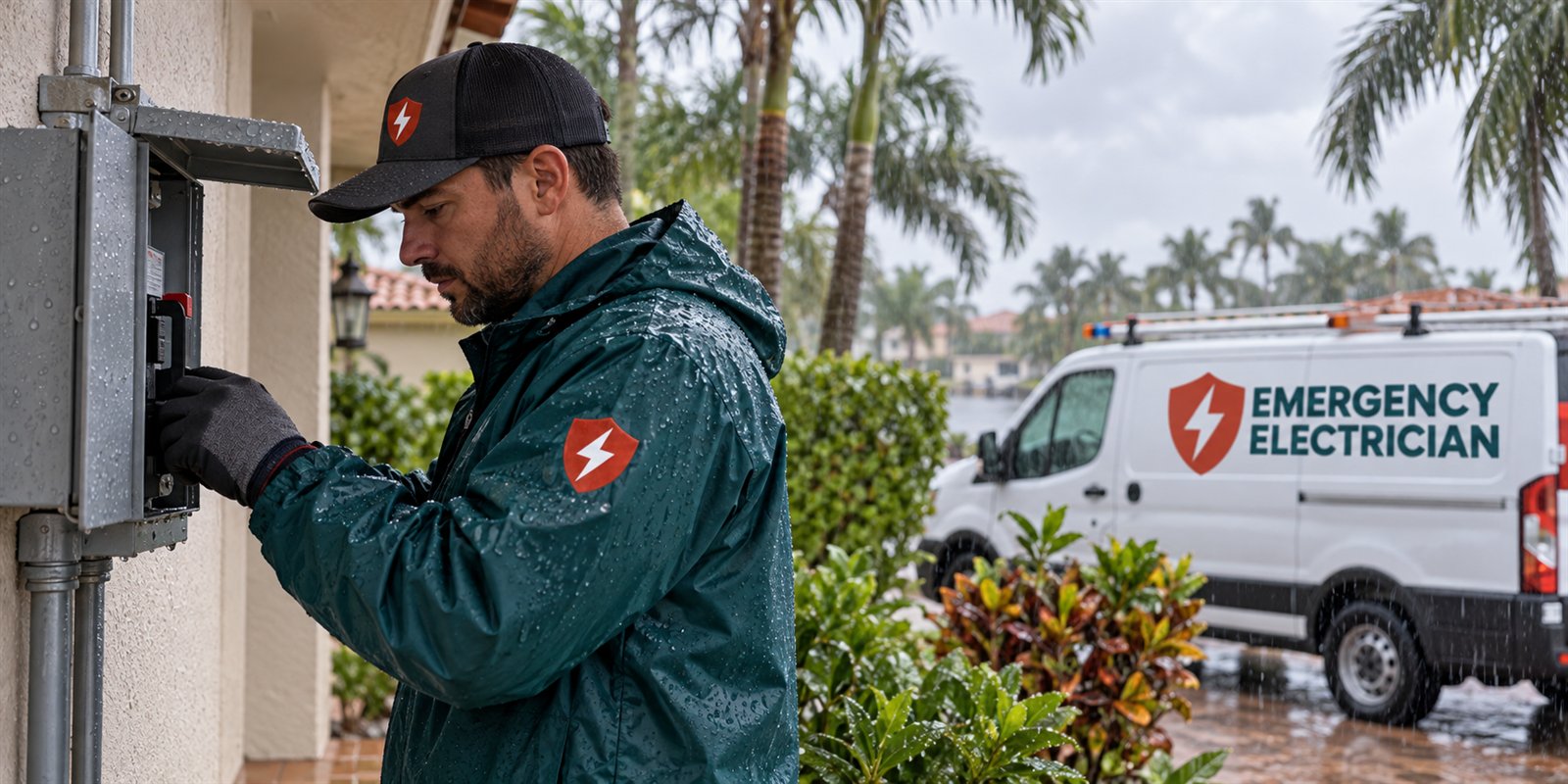
While the power is still off, walk through the house and the yard with a flashlight and look for problems. Outside, check from a safe distance for a leaning service mast, a weatherhead pulled away from the wall, a service cable that sags, a meter base that is cracked or hanging, and any branch or debris on the service line. If you see damage, do not approach it. Call the utility and an electrician.
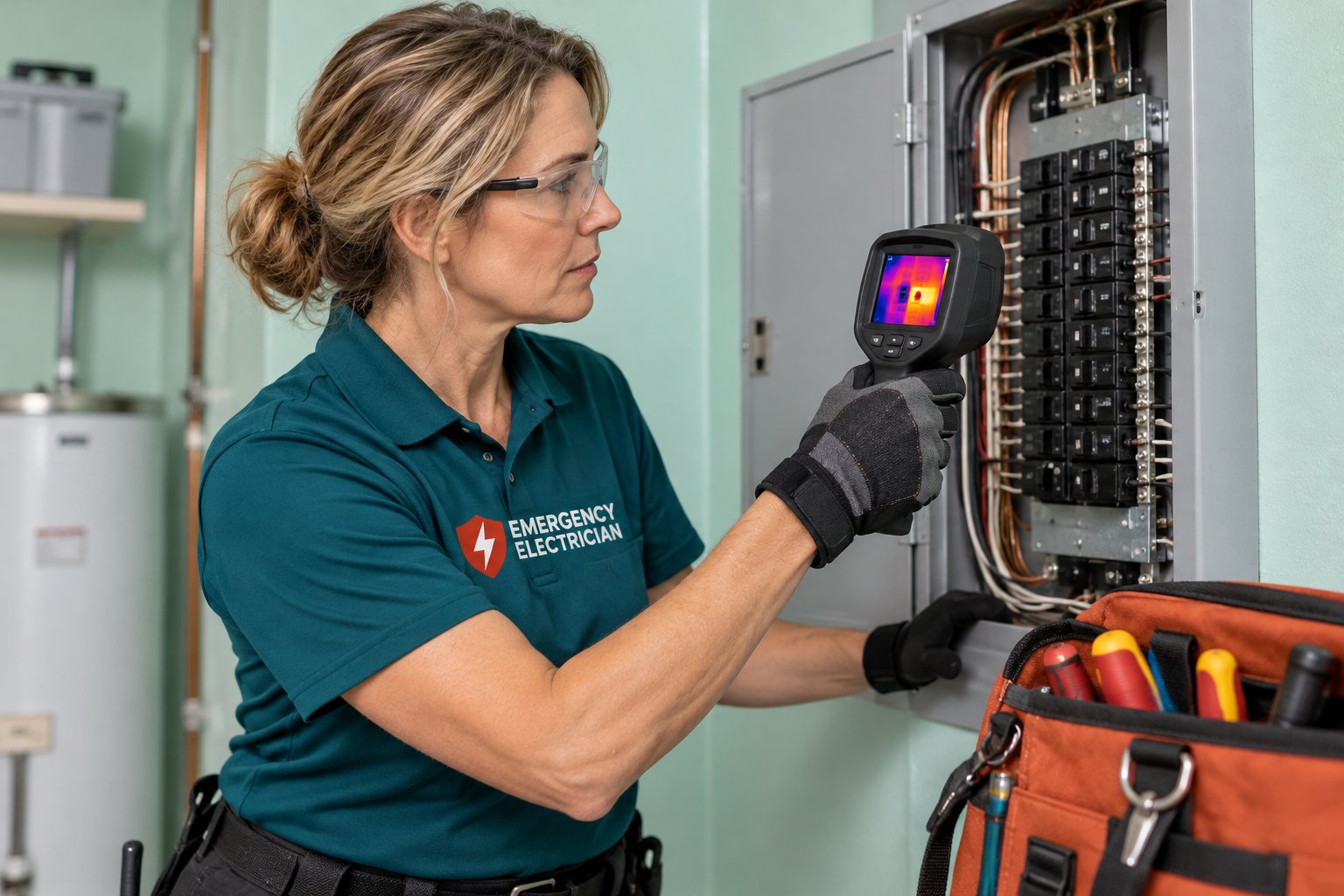
Inside, look at the panel without opening anything beyond the breaker door. Check for water, rust stains, scorch marks, a burning smell or any sign that something was wet. Look at outlets and switches in rooms that had leaks or wind-driven rain. If a ceiling is wet or dripping above a fixture, do not use that light. The page on wet attic and ceiling lights after a storm explains why.
Check appliances and outdoor equipment from the outside. Look for water damage to air conditioning units, pool equipment, garage openers and outdoor outlets. Do not plug in or switch on anything that is wet. Do not disconnect wires or open covers. If you are not sure whether something is safe, leave it off and ask.
Turn things off before the power comes back
If the power is still out, take a few minutes to prepare the house for restoration. Turn off the large loads: the air conditioner, the water heater, the oven, the dryer and the pool pump, at their own breakers or controls. Unplug sensitive electronics, such as televisions, computers, routers and game consoles. Switch off lights except for one lamp that will tell you when power returns.
Some people also turn off the main breaker and bring it back on deliberately after they see that the street is stable. This is a reasonable choice, provided you can reach the panel safely and you follow safe technique. The page on when to shut off the main before a storm explains how to do it and what not to do.
If you have a generator, make sure it is disconnected from the house before utility power returns, or that a transfer switch is in the correct position. A generator that is connected through an improvised cord can backfeed, and when utility power comes back, a collision of sources can damage the generator and the house wiring. Read generator backfeed risk for details.
Bringing the house back in order
When the power returns, wait a few minutes to see whether it stays on. Flicker, short drops and repeat outages are common during restoration. Once it has been steady for a while, begin restoring loads one at a time. If you turned off the main, switch off all the branch breakers, turn on the main and then bring the branch breakers on one by one, starting with lights and small circuits.
Listen and look as you go. A breaker that trips immediately, a buzzing sound, a smell of burning, a light that flickers or a panel that is warm are all signs to stop. Switch off the circuit and do not keep trying it. If there is smoke or a strong burning smell, call 911 first. If the problem is a single circuit, leave it off and call an electrician.
Leave the largest loads for last, and stagger them. Start the refrigerator and freezer early, since food depends on them, and give the compressor a few minutes. Wait before starting the air conditioner, pool pump and water heater, and start them one at a time. Plug electronics back in once things are steady. See what it means when breakers trip as power returns for the symptoms that call for help.
- Check the outside and the panel area for damage, water and burning smells.
- Turn off large loads and unplug sensitive electronics before power returns.
- When power is steady, bring the main on, then branch breakers one at a time.
- Restart the refrigerator first and other large loads one at a time later.
- Stop and call if anything trips, buzzes, smells hot or flickers.
What to leave off until it has been checked
Some things should stay off until a qualified electrician has looked at them. Any circuit that trips immediately on restoration, any outlet or switch that is wet, discolored or warm, any fixture below a wet ceiling, any appliance that was wet and any outdoor equipment that was submerged. Leave them off and mark them.
Do not use extension cords from a neighbor's generator or from a questionable outlet to power part of your house. Do not run cords through windows or doors to a generator in a garage. Do not use a portable heater or a gas stove for warmth in a closed house, because carbon monoxide builds quickly.
If your meter was pulled by the utility for safety, or if a tag was placed on it, do not remove the tag or reconnect the meter. The utility may require an inspection and a release before reconnecting service. The page on the power company disconnect and reconnect process explains how that works, and rebuilding after a storm and electrical permits covers permits.
Generators and the moment of changeover
If you have been running on a generator, switching back to utility power is a moment that needs care. With a transfer switch, you turn off the generator loads, move the switch to the utility position and then shut down the generator, following the manufacturer's instructions. With an interlock on the panel, you follow the specific sequence for your equipment, and you never have both the generator breaker and the main on at once.
Do not turn the generator off while loaded, and do not leave it running unattended in the hope that it will sort itself out. Do not refuel a hot generator. Store fuel safely and keep the generator outdoors and away from windows and doors while it runs. Carbon monoxide has caused many deaths after storms, so every person in the home should know that it is dangerous and silent.
If your generator trips breakers, does not start or does not power the house when expected, that is a job for a qualified electrician, not a project for a flooded garage. The pages on generator safety after a hurricane and generator inlet and transfer switch basics explain the equipment.
Food, medical equipment and appliances
Once power returns, think about food safety. If the power was out for a long period, perishable food in the refrigerator and freezer may not be safe, even though the appliance is running again. Follow current food safety guidance, and when in doubt, discard. Do not rely on appearance or smell.
For medical equipment, restore it first if it can be done safely, and make sure the circuit is stable. If a person depends on powered equipment, call the utility, tell them and ask about priority restoration. The page on extended outages, food and medical power explains planning in more detail.
Check appliances for damage after the power returns. A refrigerator that hums but does not cool, a washer that will not start, an air conditioner that trips a breaker or a water heater that does not heat may have been damaged by a surge. Switch them off, unplug them where appropriate and ask a professional. Keep a list of what failed for insurance purposes.
Neighbors, shared equipment and apartment buildings
Restoration looks different depending on where you live. In a single-family home, your service connects to a transformer shared with a handful of neighbors, and restoration of your street is the utility's job. In a townhome community, an apartment complex or a condominium, shared equipment sits between the utility and your unit, and the association or property manager handles it.
If your building lost power, do not open shared electrical rooms or try to operate disconnects yourself. Wait for building staff and the utility. If your unit stays dark when the hallway lights are back on, check your own panel without forcing anything, and tell management. Do not assume the problem is the utility's, and do not assume it is yours. The page on condo unit power loss and who to call explains the usual sequence.
Neighbors can help each other, but with care. Do not run cords between houses from a generator, and do not share a generator connection that is not set up properly. If a neighbor reports a downed wire, a smell of burning or a transformer that is humming or sparking, keep away and call 911 and the utility.
When to call a professional
Call a qualified electrician if a breaker will not reset, if breakers trip when power returns, if lights flicker or are unusually bright or dim, if outlets are warm or discolored, if there is a burning smell, if the panel buzzes, if the service mast or meter is damaged or if equipment failed after the outage. Call early rather than waiting for the problem to grow.
When you call, describe what you did before power returned, what happened when it came back, which circuits are affected and whether anything smells or sounds wrong. Quotes are given only by phone, and complicated jobs need an on-site visit. There is a service call charge, and it is explained on the phone before dispatch.
After a major storm, demand is high, and not every call can be answered immediately. Tell the dispatcher if anyone depends on powered medical equipment. When you are ready to talk through your situation, call and the dispatcher will walk you through the next safe step. In the meantime, keep the affected circuits off and keep people away from anything that looks damaged.
Questions people ask
Is it safe to leave everything on when power is restored?
It is better not to. Restoration can bring flicker, low voltage and spikes, and large loads such as air conditioners and refrigerators try to start all at once. Turn off big loads and unplug sensitive electronics, then bring things back one at a time once power has been steady for a while.
My breaker trips every time power comes back. What should I do?
Do not keep resetting it. A breaker that trips immediately may point to a fault in wiring or equipment damaged by the storm. Leave it off, unplug what is on that circuit and call an electrician. If there is a burning smell, heat or smoke, call 911 first.
Can I connect a generator to the house with a cord while waiting for the utility?
No. An improvised connection can backfeed into utility lines, endanger line workers and neighbors and overload house wiring. When utility power returns, the two sources can collide. A transfer switch or interlock installed by a qualified electrical contractor is the proper method, and generators must always run outdoors.
The utility pulled my meter. Can I put it back?
No. A pulled meter or a tag on the meter usually means the utility needs an inspection or release before reconnecting. The meter socket holds live conductors, so handling it is dangerous. Call the utility and an electrician, and ask what documents are needed to restore service.
How does pricing work for a post-storm visit?
Quotes are given only by phone. Complicated jobs need an on-site visit before a quote can be given. There is a service call charge, and it is explained on the phone before dispatch so you know the terms up front. Have details ready, such as which circuits are affected and what you saw, heard or smelled.
What should I check outside before power returns?
From a safe distance, look at the service mast, weatherhead, service cable and meter base for leaning, sagging, cracks or pulled fittings, and for debris on the lines. Do not approach or touch anything damaged. Call the utility and an electrician, and photograph the damage for your records.
If "Getting Power Back Safely After a Storm" matches what is happening, call and describe it plainly: the room, the breaker, any burning smell or tripped circuit. We explain what the repair would involve before a visit is set.
Related pages
- Post-Outage Trips: Power returned after the storm but breakers keep tripping. Learn what causes it, what is safe to check, and when to call an electrician for triage.
- Main Off Before Storm: Decision logic for turning off the main breaker before a storm: flood risk, surge risk, medical needs, safe technique and how to re-energize later.
- Generator Safety: Portable generator safety after a hurricane: placement, carbon monoxide, refueling, cords and backfeed, with when to call 911 and when to call an electrician.
- Disconnect Process: The usual order of events when a service is pulled for repairs in South Florida: who does what, what gets inspected and why power returns when it does.
- Surge After Strike: After lightning damage, learn how layered surge protection works in plain language: service entrance, point of use, grounding, and what to ask an electrician.
- Lightning Strike: A lightning strike on your house can leave hidden electrical damage and fire risk. Learn the safe first steps, the fire watch, and what gets inspected.