
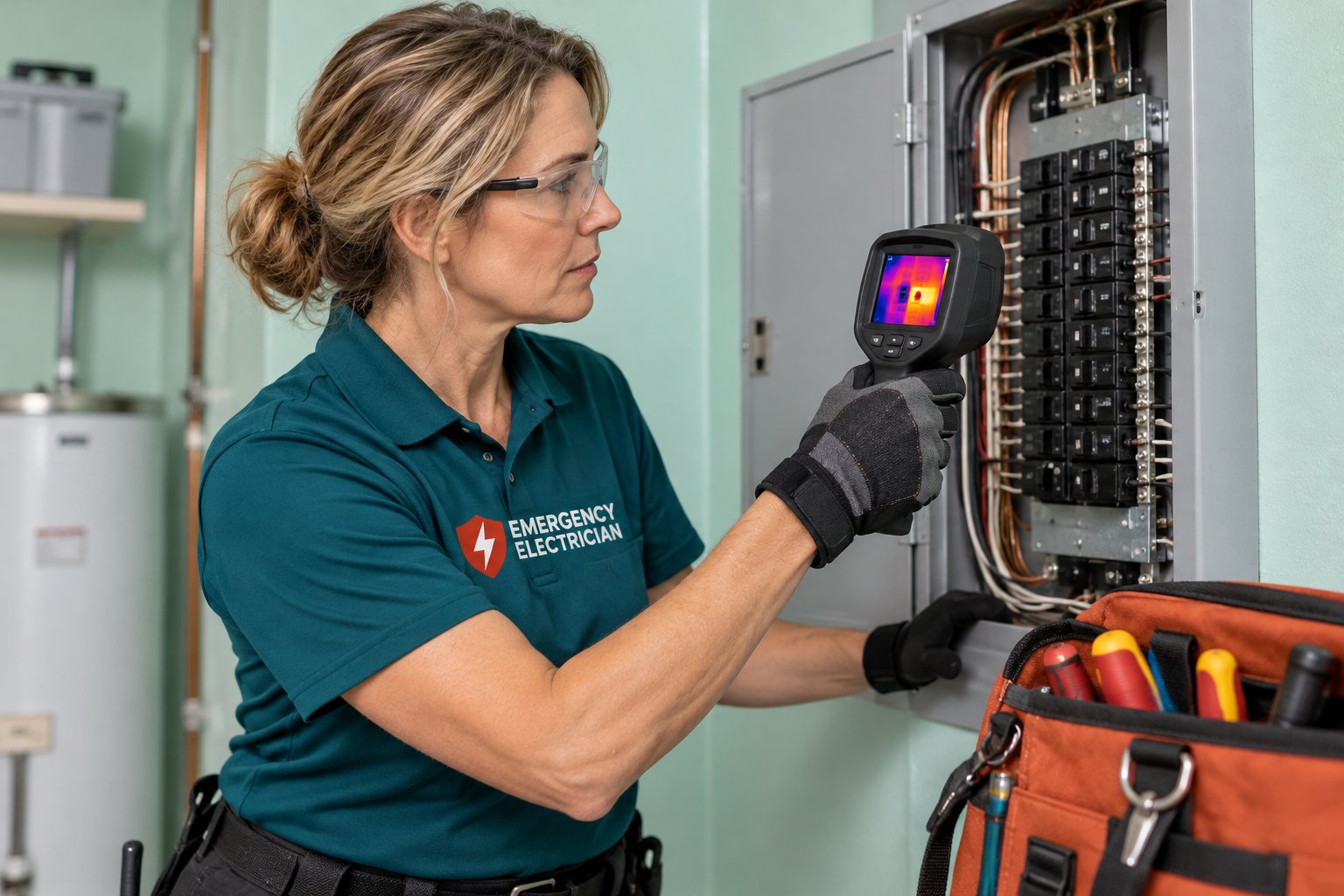
When a breaker problem is a 911 call and when it is urgent repair
Some breaker problems belong to the fire department first. If you see smoke or flames from the panel, smell burning plastic near it, hear loud popping, or find the panel door too hot to touch, call 911, leave the area, and do not try to operate anything. Tell the dispatcher what you see. If the power company is needed to cut service at the meter, the fire department will arrange that. Do not open the panel, and do not hose it.
Other breaker problems are urgent repairs rather than rescues. These include a breaker that will not stay on, a breaker that feels warm, a breaker that buzzes or smells faintly of heat, a breaker that is physically cracked or discolored, a handle that is loose or stuck, or a circuit that stays dead although the breaker looks on. In those cases, the safe move is to leave the circuit off, avoid using it, and call a qualified electrician.
There are also situations that look dramatic but are manageable. A single breaker that tripped once because of an obvious overload, such as a toaster and a kettle on the same circuit, and that resets and stays on is not a replacement job. If a breaker does that repeatedly, however, the trip pattern is telling you that something deserves a closer look. The decision chart on this site, is it an emergency, helps you sort these cases.
Why breakers fail
A breaker is a mechanical device with a spring, a contact, a bimetal strip and a magnetic coil. It is designed to open under overload and short circuit, and to be switched thousands of times. Over years it ages like any other mechanical part. Heat from loaded circuits, vibration, humidity and repeated tripping wear down its internals. A breaker that has tripped under a heavy fault may also be weakened and no longer trip at the right current.
The failures take several forms. A breaker can fail to trip when it should, which is the most dangerous kind. It can trip too easily, which is a nuisance and a sign of wear. It can fail to make contact, leaving the circuit dead although the handle is on. It can overheat at its connection to the busbar or to the wire, which discolors the panel and may melt the plastic. And it can simply fail mechanically, with a handle that will not move.
In South Florida, humidity and salt air add corrosion to the list. Panels in garages, utility closets and outdoor enclosures can pick up moisture that corrodes the stab connection between the breaker and the busbar. A corroded stab creates resistance, resistance creates heat, and heat damages both the breaker and the bus. That is why a breaker replacement is not always just a breaker swap.
What an electrician inspects beyond the breaker
Replacing the breaker without understanding why it failed risks a repeat. A qualified electrician starts by observing the panel, the breaker and the circuit, and by asking what symptoms you saw. They then switch off the main breaker, verify the panel is de-energized where possible, and open the cover. Inside, they look for signs of heat, such as darkened plastic, burn marks on the busbar, melted insulation on wires and a smell of overheated material.
They check that the wire connected to the breaker is the right size for the breaker's rating, that its insulation is intact, and that the terminal screw is tight. They check that the breaker is of the type listed for that panel, because mixing brands or using an unlisted device is a hazard. They look at the busbar contact point, where the breaker clips on, for pitting and corrosion. They check the neutral and ground connections and the general condition of the panel.
They also look at the circuit itself. A breaker that failed because of a persistent overload suggests that the circuit is being asked to do too much. A breaker that failed because of a hidden fault, such as a damaged wire or a failing appliance, means the fault is still there. Without tracing the cause, a new breaker simply trips or, worse, fails to protect. That is why the inspection and testing often matter as much as the part.
- Condition of the busbar and the stab where the breaker connects
- Wire size and insulation condition at the terminal
- Whether the replacement breaker is the correct type for that panel
- Signs of heat, moisture or corrosion elsewhere in the panel
- Load on the circuit and any fault behind a repeated trip
Why the breaker brand and type matter
Breakers are not universal. Each panel is listed to work with specific breaker types, and mixing brands, or using a breaker that merely fits, can create a poor connection or a device that does not trip properly. A mismatched breaker may seat loosely on the busbar, which causes heat and arcing. In the worst case, the panel's listing is voided, and an inspector or an insurer may take issue with it.
Some breakers have added functions. Ground fault breakers protect against leakage current and are used in wet areas such as bathrooms, kitchens, garages and outdoor circuits. Arc fault breakers detect dangerous arcing in the wiring and are used on bedroom and living area circuits. Dual function breakers combine both. Two-pole breakers serve 240-volt loads such as dryers, ranges, water heaters and air conditioners, and they trip both poles together.
If a breaker is part of a product with a known recall or a history of failure, the electrician may recommend replacing others of the same type. Our page about a recalled breaker brand failure goes into this. The key point is that a quality breaker of the right type, correctly installed, is the safe route. Unmatched or poor-quality parts are not worth the risk.
Why testing follows the replacement
After the new breaker is installed, the job is not finished. A responsible electrician tests the result. They confirm that the voltage is correct at the breaker and at the load, that the breaker's handle moves cleanly and holds, and that the connections are tight to the right torque. They check that the circuit works under normal load and that nothing on it trips or heats.
For ground fault and arc fault breakers, they use the built-in test button and, where possible, a tester that confirms the device trips as designed. They may also check neighboring breakers for heat using a thermal imager or a careful touch test after the circuit has run under load. If the circuit serves a major appliance, they may run the appliance to confirm that the load is carried without overheating.
Testing also catches the problem that was not in the breaker. If the new breaker trips under load, the technician knows the original problem was not just a bad breaker, and the work moves from replacement to troubleshooting. If it holds, they have evidence that the repair worked. Either way, you get information rather than hope. Ask the technician to explain what was tested and what the results were.
Temporary operation, and when to avoid it
When a breaker fails late in the evening or over a weekend, people sometimes ask whether they can keep using the circuit until the repair. The honest answer depends on the symptom. A breaker that is simply off or dead can be left off with no risk to anyone, as long as the loads are moved. A breaker that is hot, buzzing, smelling or discolored should not be used, and the circuit should stay off.
Do not tape a breaker handle in the on position, do not wedge a handle, and do not replace a breaker with a larger one to stop trips. A larger breaker lets more current flow than the wire can safely carry, which turns a nuisance into a fire risk. Do not swap a breaker from another circuit to test it. Do not use an extension cord from another room to substitute for a dead circuit unless the cord is rated for the load and is not run under rugs or through doors.
If an essential item such as a refrigerator, medical equipment or a sump pump depends on the dead circuit, tell the dispatcher. They may suggest a short-term way to protect it, and the electrician can often restore the circuit in a way that is safe in the meantime. The goal is to avoid improvising something that causes a bigger problem.
Permits, inspections and panel age
Replacing a single like-for-like breaker is often handled as a minor repair, but local rules vary and some cities want a permit for panel work. The electrician will tell you what applies where you live. If the work involves more than a breaker, such as replacing a busbar, a main breaker or the panel, a permit and inspection are usually part of the job, and the flow is described on our page about emergency panel replacement.
The age and type of the panel also matter. Some older panels have breakers that are hard to find, and some panel families have a history of problems. If the panel has signs of damage or if replacement breakers are not readily available, the electrician may recommend replacing the panel rather than patching it. That conversation takes place on site, with the panel in front of the technician.
If your home is a rental, tell the landlord before authorizing repairs, unless the situation is urgent and unsafe. If you own a condominium unit, check whether the unit panel is yours or the association's, because responsibility differs between buildings. Our page on which repair is yours may help you sort that out.
How the visit usually goes
When the technician arrives, they will ask what happened, look at the panel from the outside, and explain what they plan to do. They will switch off power as needed, which means you lose power to part or all of the home for a while. They then inspect, replace the failing breaker, make any necessary connection repairs, and test the result.
They will tell you what they found, show you the old breaker if there is a visible defect, and describe any other issues they noticed. If they find a problem that goes beyond the breaker, they will explain the options. You decide whether to proceed. A good technician will not push work that is not needed, and will not leave a hazard unmentioned.
After the visit, you may be asked to watch the circuit for a short time and report any trips or warmth. Keep any paperwork, including a note of the breaker type and the work done. If the repair involved a permit, the technician will explain the inspection process. If the same breaker trips again, call back and say so promptly rather than waiting.
Getting ready and what the call involves
When you call, describe the symptoms: which circuit, what it powers, whether the breaker is hot, whether it smells, whether it trips, whether anything sparked, and what you did. Say whether the panel is indoors or outdoors, how old the home is, and whether there are any known problems. If you know the panel brand, say so. Mention any equipment that is time sensitive.
Quotes are given only by phone. A simple breaker replacement can often be described on the call, but if the panel shows heat damage, corrosion or a busbar problem, an on-site visit is needed before a firm figure can be given. A service call charge applies and is explained on the phone before anyone is dispatched. The dispatcher cannot promise an arrival time, but they will tell you how the process works.
Before the visit, clear the area around the panel, label or note which circuits are affected, and keep pets and children away. Protect sensitive electronics by unplugging them, because power will be interrupted. If there is anything unsafe, such as a burning smell, call 911 first. When you are ready to have a qualified electrician look at the breaker and the panel, call and describe what is happening.
- If there is smoke, fire or a strong burning smell at the panel, call 911 and leave.
- Leave the affected breaker off and avoid using that circuit.
- Do not tape, wedge or upsize a breaker to stop it tripping.
- Note which circuit is affected, what it powers, and what you saw and heard.
- Call and describe the situation, including the panel brand if you can see it.
Questions people ask
Can any electrician replace my breaker with a similar one?
A qualified electrician replaces it with a breaker of the correct type, rating and listing for your specific panel. Breakers that merely fit can seat poorly, overheat or fail to trip properly. If your panel brand is hard to match, the technician will explain alternatives, including whether the panel itself should be replaced rather than repaired.
Is it safe to replace a breaker myself?
It is not recommended. Even with the breaker off, the busbar and the main lugs inside the panel remain live, and a mistake can cause a serious shock or arc flash. A qualified electrician is trained to work safely inside a panel, to check the connections and to test the circuit afterward.
Why did my new breaker trip right after it was installed?
A new breaker that trips under load usually means the original problem was not the breaker. A short circuit, a ground fault, an overloaded circuit or a failing appliance may still be present. The technician then moves from replacement to troubleshooting, tracing the circuit to find the fault. That is why testing follows replacement.
Can I use a bigger breaker to stop the tripping?
No. A breaker is sized to protect the wire. A larger breaker allows more current than the wire can carry, so the wire can overheat before the breaker trips, which can start a fire. If a circuit trips because the load is too high, the right fix is to reduce the load or upgrade the circuit properly.
Does breaker replacement need a permit?
Rules differ by city. A like-for-like breaker swap may be treated as a minor repair, while panel work or circuit changes commonly need a permit and inspection. The electrician will explain what applies in your area and handle the process if required. Keep any paperwork for your records.
How is the price given for a breaker job?
Quotes are given only by phone. Simple replacements can often be described on the call, while panels with heat damage, corrosion or busbar problems need an on-site visit before a firm figure can be given. A service call charge applies and is explained on the phone before anyone is dispatched.
If "Breaker Replace: What to Know and Do" matches what is happening, call and describe it plainly: the room, the breaker, any burning smell or tripped circuit. We explain what the repair would involve before a visit is set.
Related pages
- Breaker Re-Trips: A breaker that trips again right after you reset it points to a hard fault. Learn why repeated resetting is risky and what to do and tell the electrician.
- Hot Panel: A hot breaker or panel cover can mean a loose connection or overload. Learn what warmth is normal, when to call 911, and what to do before an electrician.
- Panel Replace: Fire, flood or failure can force a panel swap. See when replacement is needed, how permits, utility disconnect and inspection work, and how to prepare.
- Reading a Tripped Breaker: What breaker handle positions mean, what a tripped breaker is telling you, and which details to pass along by phone, all without opening the panel.
- Failed Breaker: A breaker that did not trip when a circuit overheated or shorted: how technicians test breakers, what failure looks like and why some brands get extra scrutiny.
- Exterior Lighting Repair: Why outdoor and security lights fail in South Florida, how moisture and fixture faults are diagnosed, and what to do safely when lights go out after dark.