
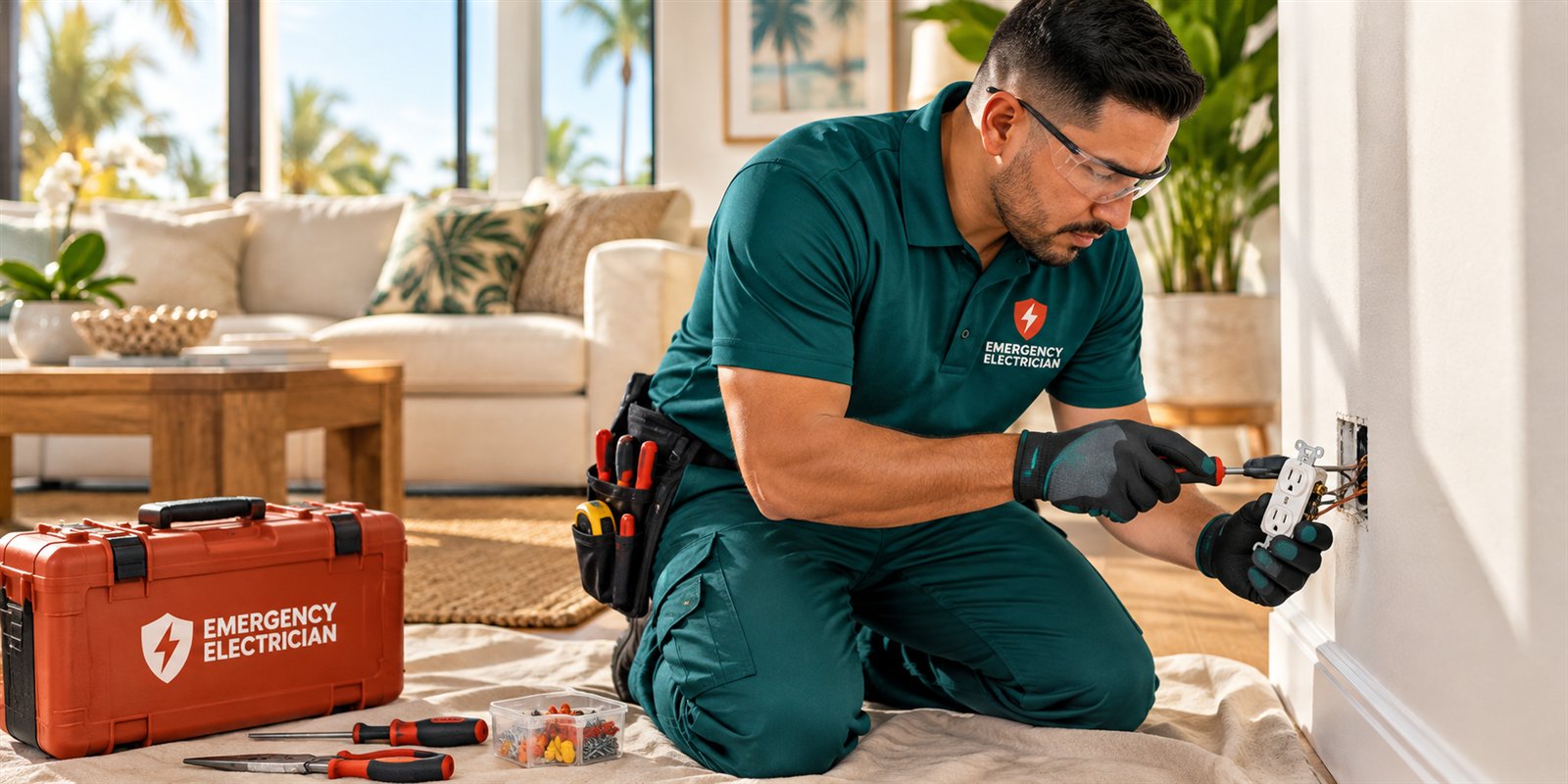
Start at the top: is anyone in danger right now?
The first branch of any electrical decision is the same: is there fire, visible flame, thick smoke, a person who has been shocked and is hurt or unresponsive, or someone who cannot get away from the source? If the answer is yes to any of these, the decision is already made. Call 911, get everyone out of the building, and do not go back in for belongings. Do not touch a person who may still be in contact with live equipment. If it can be done safely from a distance, switching off the main breaker can help, but only if the panel is dry, within easy reach, and not itself the source of smoke or sparks.
This first branch is deliberately blunt because hesitation costs the most here. People often delay calling 911 because they are not sure it counts as an emergency, or because they hope the problem will settle. A rule that serves well is that smoke, flame, and injury always go to 911 first. The fire department can also tell you when it is safe to return, and an electrician can be called afterward to find the cause and restore power safely. For more on what to say to the dispatcher, see what to tell the 911 dispatcher.
Second branch: is the problem on the street side or your side?
If nobody is in immediate danger, the next question is where the problem is. Wires down in the yard or street, a wire hanging from a pole, a transformer that popped or is smoking, or a service cable pulled off the house are utility problems, or at least start as utility problems. Stay well back, keep children and pets away, and call 911 for any downed or arcing wire, then the power company. Do not touch anything a downed wire is touching, including fences, puddles near it, vehicles, and tree limbs.

If the problem seems to be inside your building, such as a dead outlet, a tripped breaker, or a dim light, it is on the customer side. The meter is generally the dividing point, and the guide on utility or electrician: who fixes what explains the boundary in general terms. A quick neighborhood check helps here: if the neighbors are also dark, the cause may be outside the property, and the utility's outage reporting is the right first call. If neighbors have power and you do not, the problem is more likely yours.
Red-level symptoms: call an electrician right away
Some symptoms are not 911 emergencies on their own but should not wait for the next day. A burning or hot-plastic smell with no visible smoke, a breaker or panel door that feels hot, a buzzing or crackling from the panel, an outlet or switch that is warm, discolored, or has a melted plug, and a breaker that trips again as soon as it is reset all indicate that something is overheating or faulting. These are the situations where an electrician should be called now, and where the equipment should be left off in the meantime.
While waiting, do the sensible low-risk things. Stop using the affected outlet or circuit and unplug nearby items only if you can do so without touching anything that is hot, damaged, or wet. Keep people and pets away from the area. If the smell grows, smoke appears, or anything starts to spark, the situation has moved up to the first branch, so call 911. If you want a closer look at the smell question, read if you smell burning: the order of calls.
- Burning or hot-plastic smell, even without visible smoke
- Hot breaker, hot panel door, or warm wall
- Buzzing, crackling, or popping from the panel or an outlet
- Melted, discolored, or scorched outlet, switch, plug, or cord
- A breaker that will not stay reset
Amber-level symptoms: call soon, and stay careful
Amber symptoms suggest a real fault but one that is not actively overheating. Examples include lights that flicker across the whole house, an outlet that stopped working while others are fine, a GFCI that will not reset, a tingle from an appliance, or a single circuit that lost power with no sign of heat. These deserve prompt attention because they can be early warnings. A technician can often explain them quickly, but nothing about them justifies ignoring them for weeks.
The safe course is to avoid using the affected circuit or appliance, keep an eye out for any change toward red-level symptoms, and call to describe what is happening. If a tingle or shock sensation occurs from an appliance, a faucet, or a pipe, treat it seriously, since it can indicate a ground or neutral problem that can be dangerous to the next person who touches the right combination of surfaces. You can read more in our pages on a tingle from an appliance and a GFCI that will not reset.
Green-level symptoms: a visit can wait for the next day
Some problems are genuinely suitable for a next-day or scheduled visit. A single light fixture that does not work, a switch that is stiff, a loose receptacle with no heat or discoloration, a ceiling fan that wobbles, or a dimmer that hums faintly are usually not urgent in themselves. They are worth fixing, but they do not need a technician at night, and treating them as emergencies can crowd out calls from people who really need urgent help.
Waiting safely means that nothing is hot, nothing smells, nothing is sparking, and nothing is wet. If any of those conditions appear, the problem has moved up the scale. A reasonable middle path is to describe the issue by phone, even if you intend to wait, since the dispatcher can tell you whether anything in your description changes the urgency. The guide on emergency call or next-day visit gives a fuller set of criteria for this decision.
A worked example: the dark kitchen
Suppose the kitchen goes dark and the microwave stops mid-cycle. Start at the top: any smoke, smell, or sparks? If yes, leave and call 911. If no, check whether the neighbors have power. If the whole street is dark, it is likely a utility outage, and the right call is the power company's outage line. If only your house is out, check whether the panel shows a tripped breaker, and look at it without opening anything beyond the outer door.
If a single breaker is tripped and nothing smells or looks wrong, that is amber at most. If the breaker is hot to the touch, or tripped again after one reset attempt, it is red. If the kitchen outlets are dead but the breaker is fine, it may be a tripped GFCI elsewhere, such as in a bathroom or garage, which is worth a careful look but not a panic. The point of the example is that one symptom, a dark kitchen, can sit anywhere on the scale depending on what else is true, and the branches help you find your place.
A worked example: the warm outlet
Suppose an outlet feels warm and a space heater has been plugged into it for hours. First, is there any smell of melting plastic or any discoloration? If so, this is red: unplug the heater only if the plug is cool enough to handle safely, and do not use the outlet again. If the plug or outlet has visibly melted, call an electrician now and keep the area clear. If smoke appears at any point, call 911.
If the outlet is only mildly warm and nothing looks damaged, it is amber, but still worth a call, because high-draw devices on shared or older circuits are a common cause of overheated connections. This is also the situation in which the guide on space heaters and window AC circuit safety helps explain why the same appliance can be fine in one room and risky in another. Warmth at an outlet is information, and the technician's job is to find out why.
Circumstances that raise the level automatically
A few circumstances push any symptom up a level. Water is the clearest: any electrical symptom combined with standing water, a leak, flooding, or wet surfaces near the equipment should be treated as more serious, and nobody should step into water to reach a panel or outlet. Medical dependence is another: if someone in the home relies on powered medical equipment, an outage becomes urgent sooner, and the dispatcher should be told so that arrangements can be considered.
Children, pets, and older adults in the home also raise the level, since they are less able to recognize or avoid hazards. Generators raise it too. A generator running indoors or in a garage is a carbon monoxide risk, and a generator connected to the house wiring without proper equipment can backfeed the grid and injure utility workers. For anything involving carbon monoxide symptoms, such as headache, dizziness, or an alarm sounding, leave the building and call 911. For more, see carbon monoxide alarm and generator.
- Any electrical symptom with water present
- Anyone in the home who depends on powered medical equipment
- Young children, pets, or vulnerable adults at risk of contact
- Generators, extension cords, or improvised power connections
- Alarms sounding for smoke or carbon monoxide
The one-page version of the decision
If you only remember one thing, remember the order. Flame, thick smoke, or an injured person means 911 and getting out. A downed or arcing wire, or a damaged service connection, means staying back, calling 911 for the hazard and the utility for the line. A hot, smelly, buzzing, or repeatedly tripping circuit means turning off what you safely can and calling an electrician now. A localized fault with no heat means calling soon and avoiding the circuit. A cosmetic or minor fault with no heat, smell, or water means a scheduled visit.
Each level has a different tone and a different next step, and moving between them is normal. The best habit is to recheck the first questions whenever something changes. A problem that sounded green at dinnertime can turn red at midnight if a smell appears. Treat any change as a reason to go back to the top of the chart, and never hesitate to call 911 when you are unsure whether life or property is in immediate danger.
What to have ready when you call
Whichever level applies, the call goes faster and the technician arrives better prepared if you can describe the situation clearly. Have the address, the type of building, and whether you own, rent, or live in a condo. Describe what you saw, heard, and smelled, when it started, and whether anything has changed. Say which breakers are tripped, whether neighbors have power, and whether anything wet is involved.
Mention anyone in the home who needs powered medical equipment, and any pets or children near the affected area. The dispatcher will explain the service call charge before anyone is sent, and will describe how quotes work by phone and when an on-site visit is needed. When you are ready, call, and the dispatcher will help you place your situation on this scale and decide what happens next. If at any point flames or heavy smoke appear, stop and call 911 first.
Questions people ask
When should I call 911 instead of an electrician?
Call 911 for flames, thick smoke, a person who has been shocked and is hurt, a downed or arcing wire, or any situation where you cannot safely stay in the building. An electrician can be called after the fire department has made the scene safe, to find the cause and restore power.
My lights flickered once. Is that an emergency?
A single flicker during weather is usually not an emergency. Repeated flickering across the whole house, flickering with a buzzing sound, or flickering with a burning smell is more serious and deserves a prompt call. If the smell grows or smoke appears, leave and call 911.
A breaker tripped once and reset fine. Do I need to call?
If the breaker held, nothing felt hot, and nothing smelled, you can usually watch it and call if it happens again. A breaker that trips repeatedly, will not reset, or feels hot is a different matter and should be treated as urgent. Avoid using the affected circuit until it has been checked.
Who should I call if neighbors are dark too?
If a whole area is out, the cause may be on the utility side, so the power company's outage reporting is the right first call. If you see downed wires, sparking, or a smoking transformer, call 911 and stay well back. Call an electrician if power returns to neighbors but not to you.
Is a tingle from an appliance really serious?
It can be. A tingle often signals a grounding or neutral problem that may someday deliver a stronger shock. Stop using the appliance, avoid touching it together with metal pipes or fixtures, and call for an inspection. If anyone received a painful shock or felt unwell afterward, call 911.
Can I wait until morning for a dead outlet?
Often yes, if the outlet is not warm, discolored, smelly, or near water, and the rest of the circuit is behaving normally. Stop using it, keep an eye out for changes, and describe it when you call. Any heat, smell, sparking, or wet conditions raise the urgency right away.
Reading about "Emergency Check: What to Know and Do"? Tell us what stopped working and when. We will say what an electrician would check first, and quotes are given by phone when the job can be described.
Related pages
- Now or Tomorrow: Criteria for deciding whether an electrical problem needs a technician now or can wait safely until tomorrow, with 911 and the utility first if life is at risk.
- 911 Script: Calling 911 about sparks, smoke, a shock or a downed wire? These are the facts that help dispatch most: address, hazard, people at risk and power status.
- Who Fixes What: Where utility equipment ends and customer equipment begins, in general terms, so you know whether to call the power company, an electrician, or 911 first.
- What Never to Do: The instinctive mistakes people make in an electrical emergency, from water on a fire to repeated resets, and what to do instead while you wait for help.
- Emergency Permits: How urgent electrical repairs still move through permits and inspections in South Florida, what usually needs one, and what to ask before work starts.
- Insurance Documents: Which records to gather after an electrical failure, fire, flood or surge: receipts, photos, technician findings and notes, without claims about coverage.
A worked example: the dimming lights during the afternoon storm
Imagine the lights in your living room dim each time the air conditioner starts, and a thunderstorm is passing overhead. Start at the top of the chart: is anyone in danger? If not, ask whether the problem is on the street side or your side. Check whether neighbors also see flickering. If they do, the cause is likely outside your property, and the utility is the first call. If only your home is affected, the problem is on your side of the meter. Whether you own, rent or manage the property, tell us which applies so we can explain who may need to be involved.
Next, look for other signs. Any smell, heat, buzzing or tripped breaker moves you up a level on the chart. If there are none, and the dimming happens only when one large appliance starts, you may be dealing with a load or connection issue that is worth a prompt visit but is not an emergency. Write down which appliance, how often, and whether it started after the storm. Call us to confirm availability and talk through the situation, and the scope and any quote will be explained before work begins.
The lesson of the example is that the same symptom can land at different levels depending on the answers to follow-up questions. Dimming alone is a lower level, while dimming plus a warm panel cover or a sizzling sound is a higher one. When your answers fall between levels, treat the situation as the higher one until a professional tells you otherwise, and call to talk it through. If the situation changes while you wait, such as a new smell, sound or warm surface, treat that as new information and call again.
A worked example: the outlet that stopped working in one room
Suppose a single outlet stops working and nothing else seems affected. Begin by asking whether anything feels warm, smells strange or looks scorched. If so, stop using the outlet, leave whatever was plugged in alone if it is hot, and move to a higher level on the chart. If the outlet simply went dead with no other signs, look at nearby outlets and at the panel for a tripped breaker or a tripped protective outlet elsewhere. Photos taken from a safe distance can help, but never lean in, open a cover or touch wiring just to get a better picture.
A dead outlet with no other symptoms usually sits in the lower levels of the chart. The cause can be as simple as a tripped GFCI in another room, or as involved as a loose connection somewhere upstream. Do not take the outlet apart. Note which devices were plugged in and when it stopped, and whether the problem began after a storm, a renovation or a new appliance. Keep a flashlight or battery lantern nearby rather than a candle, since open flame near a damaged electrical area adds a second hazard.
Compare this with a second version of the story, in which the same outlet has a faint burning smell. Everything changes: the chart sends you to the top level, the circuit should be left off, and a call makes sense right away. Two similar-looking situations, two different responses. Working through the questions in order is what keeps you from either panicking over a minor issue or ignoring a serious one. Small details often turn out to matter most, so include them even when they seem unrelated or awkward to mention.