
Why panels are different from other repairs
A panel is not just another device. Every circuit in the building runs through it, and it holds the protective devices that prevent overloads and faults from becoming fires. When it fails, the effects spread: a single burned connection can stop several circuits, and a damaged bus bar can compromise the whole assembly. Because of that, decisions about panels deserve more care than decisions about a switch or an outlet, and they usually benefit from an on-site inspection rather than a guess.
Panels also age differently from other equipment. They sit in garages, closets, and exterior walls, exposed to heat, humidity, and in coastal South Florida, salt air. They are opened and closed, loaded and reloaded, and added to over the years. A panel that has been quietly working for decades may be fine, or may have developed corrosion and loose connections that are invisible from outside. That is why a repair-or-replace decision has to rest on what a technician finds inside, not on appearances.
Safety first: when to leave the panel alone
If the panel is smoking, if there are sparks, if a burning smell is coming from it, or if the panel door is hot to the touch, treat it as an emergency. Leave the area and call 911. Do not try to open the panel, and do not attempt to switch things on and off to see what happens. If the panel is dry, within easy reach, and showing no sign of heat or arcing, switching off the main breaker can be a reasonable step, but if you are unsure, do not touch it and wait for help.
Never open the inner cover of a panel. Behind the inner cover are live conductors that remain energized even when individual breakers are off, and a mistake can be fatal. This applies even if you are comfortable with household wiring. A panel with water in it, a panel that has been flooded, or a panel in a room with standing water should not be touched, since the combination of water and live parts is a serious shock risk. For more, see smoke from the panel and water in an electrical panel.
Findings that point toward repair
Many panel problems can be repaired. A single failed breaker in an otherwise healthy panel can be replaced with the correct, compatible breaker. A loose neutral or ground connection that has not damaged the surrounding parts can be cleaned and tightened. A damaged cover or trim can be replaced. A section of damaged wiring leading into the panel can be repaired or replaced. In these cases, the evidence is that the problem is local and the rest of the panel is in good shape.
What a technician looks for in these cases is clean copper, firm terminals, intact insulation, an unbent and undamaged bus assembly, and no sign of heat beyond the failed part. The technician also checks that replacement breakers are available and compatible, since panels are designed to work with particular breaker types. If the panel is a design that is still supported, and the failure has a clear, one-time cause, repair is often the proportionate choice. The decision should still be explained to you, and you should be able to ask what was checked.
- A single failed breaker with clean, undamaged surroundings
- A loose connection found and tightened before heat damage occurred
- A damaged panel cover or trim with no internal damage
- A supported panel design with compatible breakers available
- A one-time cause, such as an impact or a single surge, with no repeat risk
Findings that point toward replacement
Replacement becomes the sensible choice when the panel itself has been compromised. Heat damage to bus bars, melted or burned insulation, scorch marks, and discolored terminals are signs that connections have been overheating, and that the metal that carries the current may have been weakened. Corrosion from water or salt air, especially when it has spread through the enclosure, is another. Cracked or distorted plastic parts, breakers that no longer seat firmly, and signs of repeated arcing also point toward replacement.
A third group of findings concerns design. Some older panel designs are obsolete, difficult to find parts for, or the subject of known safety concerns. If breakers for the panel are no longer made, or if the design has a record of failing in particular ways, repairing around it may only delay the inevitable. The guide on recalled breaker brand failures describes how that issue arises. A technician can tell you whether your panel falls into this group, and should be able to show you the evidence.
Heat damage: the finding that changes everything
Of all the findings, heat damage most often shifts a recommendation from repair to replacement. Heat means that somewhere a connection has had too much resistance, a conductor has been overloaded, or an arc has occurred. The visible discoloration is only part of the picture, because heat can anneal copper, soften insulation, and weaken springs inside breakers without leaving much visible trace. Parts that have been through significant heat cannot be trusted to hold their connections over time.
When a technician finds heat damage, a good response is to ask where it is, how far it extends, and what is believed to have caused it. If the damage is limited to one terminal and the surrounding parts are clean, a targeted repair may be possible. If the bus bar itself is damaged, or if several positions show heat, replacement is usually advisable. The guide on a burned panel bus bar provides more detail on what this finding means and why it is taken seriously.
Obsolete designs and what they mean in practice
An obsolete panel is not automatically unsafe, but it carries practical limits. Replacement breakers may be hard to find or no longer made, which makes even small repairs difficult. The design may lack features now expected, such as modern ground-fault and arc-fault protection options, or the space needed for additional circuits. Where a design has a history of problems, such as breakers that fail to trip or connections that loosen, continued use carries risk that a technician may advise against.
In older South Florida homes, it is also common to find panels that have been altered over time, with circuits added, breakers doubled up, or unmatched breakers installed. These alterations may not be visible until the cover is off. A technician can assess whether the panel is still serving its purpose safely, or whether its history of modification makes further repair unwise. For more on older systems, see older home electrical red flags.
Water, salt, and humidity in South Florida panels
Moisture is one of the main enemies of panels in this region. Flooding, wind-driven rain entering through a damaged meter base or mast, a roof leak above a panel, and persistent humidity in garages and exterior closets can all lead to corrosion. Salt air near the coast accelerates the process. Corroded terminals have higher resistance, which creates heat, which accelerates corrosion further, in a cycle that can end in failure.
After flooding or water intrusion, the general guidance is that submerged or wetted panels and breakers should be inspected and often replaced rather than cleaned and reused, since moisture can penetrate parts that cannot be seen or dried. A technician can examine the extent of the exposure and explain what is salvageable. See what floodwater does to wiring and saltwater surge electrical damage for the reasons behind this approach.
The practical side: permits, utility, and timing
Replacing a panel is a larger job than repairing one. It usually involves a permit and an inspection, coordination with the utility for a temporary disconnect and reconnect, and a period without power. Requirements differ from one jurisdiction to another, and a technician can explain what applies to your property. Because of the permit and utility steps, a panel replacement is rarely a single-visit job, and a temporary arrangement may be needed in the meantime.
That is one reason the repair-or-replace decision should be made carefully. If a limited repair can safely restore service while a replacement is planned, that may be the best path. If the panel is too damaged for even a limited repair to be safe, the technician will advise a different plan. The guides on temporary fix versus full repair and permits for emergency electrical work explain more of this.
What a technician checks during a panel inspection
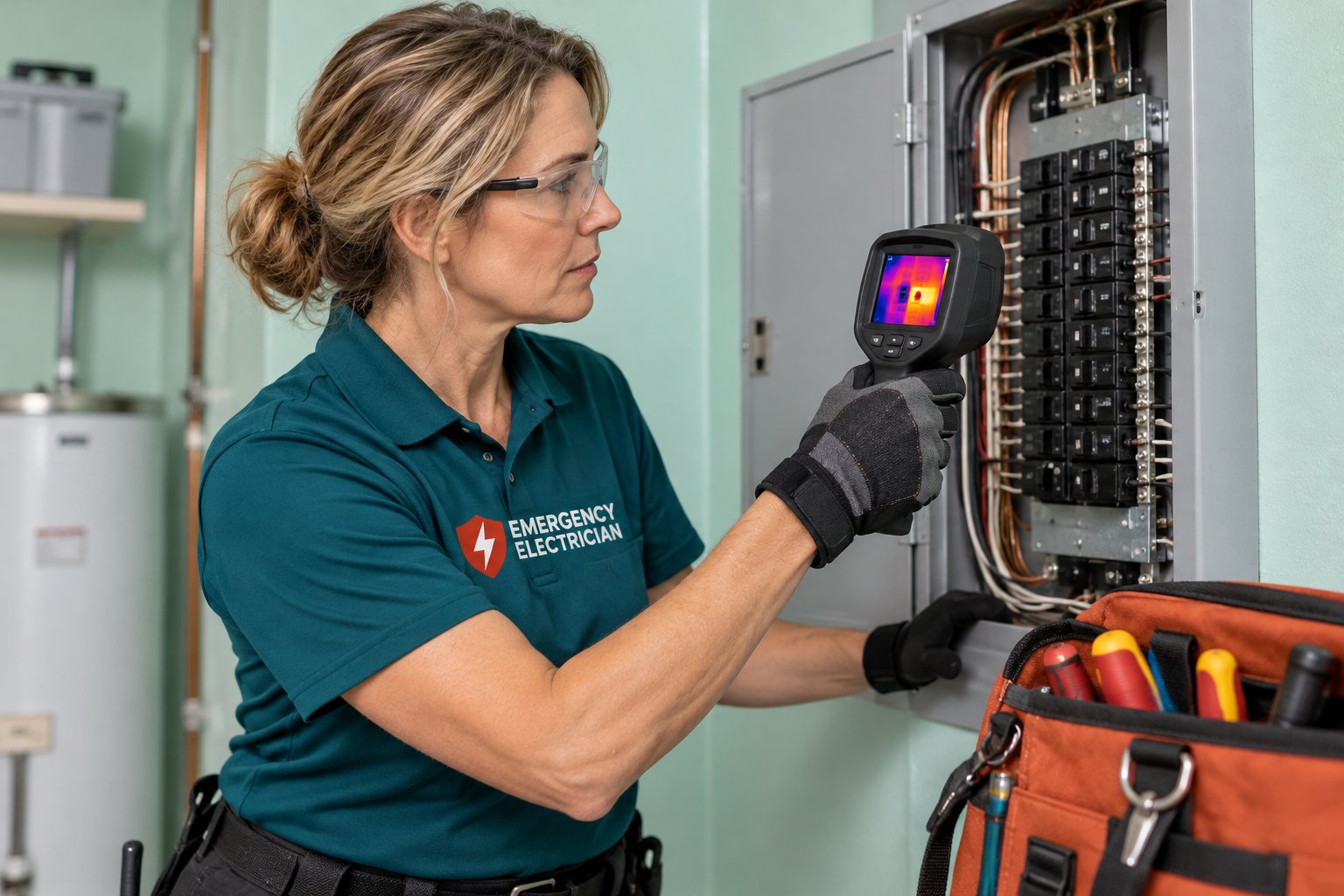
A proper panel inspection follows a sequence. The technician first looks at the outside: the cover, the surrounding wall, signs of water staining, rust, or scorching, and whether the enclosure is mounted firmly and has proper working space around it. With the main power off where it is safe to do so, the inner cover is removed and the inside is examined for discoloration, melted plastic, corrosion, loose or burned conductors, and breakers that do not sit firmly on the bus. Connections are checked for tightness, and conductors are checked for insulation damage near the terminals.
Instruments come next. The technician measures voltage at the main and across the legs, checks for a proper neutral and ground connection, and may test individual circuits for faults. In some cases a thermal camera shows connections that run hot under load, which is one of the best ways to find a loose terminal before it fails. None of this is guesswork, and you are entitled to ask what was checked and what the readings showed. The answers are what turn a recommendation into evidence.
- Condition of the cover, enclosure, and mounting
- Signs of water, rust, salt corrosion, or scorching
- Terminals for tightness, discoloration, and melting
- Bus bars for pitting, warping, or heat marks
- Breaker fit, brand compatibility, and condition
- Neutral and ground connections and measured voltage
A few typical situations, described honestly
Consider a garage panel in a coastal home where the lower breakers show rust bloom and one circuit has been tripping for weeks. The inspection finds corrosion on several terminals and pitting on the bus bar. Here replacement is the likely advice, because the corrosion is spread through the enclosure and repairing one terminal would leave the rest to fail. Compare that with a panel in a dry interior closet where one breaker failed after a surge, and the technician finds clean copper, tight terminals, and an undamaged bus. Replacing that one breaker is a reasonable, proportionate repair.
A third situation is the panel that has a history of added circuits and mismatched breakers, with a few double-tapped positions and unlabeled circuits. Even with no active failure, a technician may advise a closer look at whether the panel can safely carry what it now serves. These examples are illustrations, not predictions about your panel. The decision always comes back to what is found inside, which is why a description by phone can only begin the conversation.
Questions to ask and what to expect on the call
When a panel is involved, useful questions include: what exactly failed, what was found inside, what condition are the bus bars and terminals in, is the design still supported, and what will be different after the repair or replacement. Ask whether protection features will be restored or improved, and what is left unaddressed. Ask for a written description of the findings, which helps with insurance and with future work.
On the phone, the dispatcher will ask about what failed, what you saw and smelled, and how old the panel is if you know. A service call charge applies and is explained before anyone is dispatched. Quotes are given by phone for work that can be described by phone, and a panel replacement needs an on-site visit, since the inspection decides the scope. If there is smoke or heat from the panel, call 911 first. Otherwise, call when you are ready and the technician will inspect and explain the findings.
Questions people ask
Can you tell if my panel needs replacing from a description?
A description helps, but the decision depends on what is inside the panel: bus bars, terminals, insulation, and breaker fit. A technician needs to inspect it. Panel replacement needs an on-site visit before a quote can be given, and the service call charge is explained by phone first.
Is an old panel automatically unsafe?
No. Age is a clue, not a verdict. Some older panels are in sound condition. Others have corrosion, loose connections, or obsolete designs that make repair impractical. A technician's inspection findings should guide the decision, not the date alone.
Can I open the panel to look myself?
You can look at the outside of the panel and note anything unusual, but do not remove the inner cover. Live conductors remain energized behind it even when breakers are off. If the panel is hot, smoking, wet, or smells of burning, stay away and call 911 if there is any smoke.
Does heat damage always mean replacement?
Usually it strongly suggests it, especially if the bus bar or several positions are affected. If the damage is confined to one terminal and the surrounding parts are clean, a targeted repair may be possible. The technician should show you where the damage is and explain the reasoning.
What if my panel was flooded?
Do not touch it or attempt to restore power. Floodwater can enter parts that cannot be seen or dried, so wetted panels and breakers are typically inspected and often replaced. Have the utility and a qualified electrician involved before anything is re-energized.
Will I have power during a panel replacement?
Usually not for part of the job, since the utility often needs to disconnect and reconnect service. A temporary arrangement may be possible in some cases. The technician can describe the sequence for your property, including permit and inspection steps.
About "Panel Repair Versus Panel Replacement": call and give us the details, and we will explain what is safe to do while you wait and what the visit would cover. Jobs that cannot be quoted blind need a look on site.
Related pages
- Fix vs Repair: When isolating a failed circuit is enough for tonight and when a complete repair is required, explained for owners facing a failure and a hard decision.
- Panel Replace: Fire, flood or failure can force a panel swap. See when replacement is needed, how permits, utility disconnect and inspection work, and how to prepare.
- Burned Bus Bar: Scorch marks, melted plastic or a burned bus bar inside an electrical panel: what it means, why the panel is often replaced and what to do right now.
- Repair or Replace: A plain framework for deciding between repairing and replacing failed electrical equipment, based on evidence found on site, not guesses or sales pressure.
- Call Order: Electrical trouble, three possible calls. A plain decision order for when to dial 911, when to phone the power company, and when to call an electrician.
- Emergency Check: A branching guide from symptoms to urgency, showing when to call 911, when to call the utility, when to call an electrician now, and when a visit can wait.
How to compare the options when a technician presents both
When a technician says a panel could be repaired or replaced, ask for the reasoning behind each option. A good explanation points to specific findings, such as corrosion on certain parts, heat marks, loose connections or breakers that no longer fit properly. Ask what repair would address and what it would leave as it is. Repair often fixes a single known problem, while replacement addresses the whole assembly and any hidden issues tied to its age. Whether you own, rent or manage the property, tell us which applies so we can explain who may need to be involved.
Think about how long you plan to stay in the home and what you may add. A household planning a new air conditioner, an electric vehicle charger or a generator connection should consider whether the existing panel can accommodate additions. If the panel is already crowded, a repair may solve today's fault but not tomorrow's needs. Mention your plans during the conversation so the options reflect them. Call us to confirm availability and talk through the situation, and the scope and any quote will be explained before work begins. If the situation changes while you wait, such as a new smell, sound or warm surface, treat that as new information and call again.
Do not feel pushed. Ask what the risks are of choosing the smaller job, and what, if anything, should be monitored afterward. If the technician found heat damage, that changes the discussion, and the case for caution is stronger. If the findings are minor, a repair may be entirely reasonable. The scope and any quote are explained before work begins, and you can take time to decide when no immediate hazard exists. Photos taken from a safe distance can help, but never lean in, open a cover or touch wiring just to get a better picture.