
While you wait: keep everyone safe
The time between the call and the knock on the door is when you can do the most to keep people safe. If there is flame or smoke, nobody should be inside, and 911 comes first. If the situation is a hot panel, a buzzing wall, a warm outlet, a burning smell or a tripped breaker that will not stay on, stay out of the area, keep others away, and do not touch the equipment.
Do not remove covers, do not reset a breaker repeatedly, do not pour water on anything electrical and do not unplug a device that is sparking or hot. If the main breaker is easy to reach, the panel is dry and quiet, and nothing smells hot, one adult may switch it off, as described on the page about when it is safe to use the main breaker. If any of those conditions fail, leave it alone.
Make the home ready for a visit. Clear a path to the panel, the meter and the affected room. Move vehicles that block the driveway or the garage. Put pets in a room or a carrier. Make sure the area is lit and that someone is home to let the technician in. If you rent or live in a condominium, make sure the building manager or the landlord knows the technician is coming, and that they will provide access to any shared rooms. The page on renters and electrical emergencies covers that side.

Information to have ready
A technician works faster and more accurately when you can describe what happened in order. Before the visit, gather a few items and write them down.
Have these ready:
- The address, gate or building access details, and a phone number that will be answered.
- What you saw, heard and smelled, when it started, and which rooms or devices were affected.
- What was running or plugged in at the time, and whether anything was unplugged or added just before.
- Whether a breaker tripped, which one, and whether anyone reset it.
- Whether there was a storm, a flood, a power flicker, a loud bang or work on the property recently.
- Photographs from a safe distance of any scorching, melted plastic, water damage or the panel label.
- The location of the panel and the main breaker, and whether there is a subpanel, a garage panel or a separate meter.
- For rentals and condominiums, the contact for the owner, the manager or the association.
Arrival and identification
When the technician arrives, take a moment before opening the door fully. Look at the vehicle and the uniform, if there are any, and ask for identification. A reputable business expects this and will not be offended. Ask for the technician's name and the business name, and compare them with what the dispatcher told you on the phone. If something does not match, call the number you used to place the request and confirm.
Be wary of anyone who arrives without having been called, who refuses to identify themselves, who pressures you to let them in, or who says they were sent by the utility or the city without any prior notice. A genuine emergency visit is one that you requested. The guide on how to choose an electrical contractor in a crisis and the page on questions to ask before dispatch explain what to confirm before you commit.
You may also wish to verify credentials with the appropriate local authority. In Florida, electrical contracting is regulated, and local authorities maintain records. The technician should be able to tell you who they work for and how to confirm it. Nothing here is a statement about any particular company. It is a habit worth having with any contractor.
The first conversation: safety and the story
The visit usually starts with questions. The technician will want to know what happened, in your words, before touching anything. They will ask whether anyone has been hurt, whether there was any fire, and whether you or anyone else has touched the panel or the equipment. Tell them everything, including things you are not proud of, such as resetting a breaker many times or plugging in a heater. They have heard it before, and the information helps.
They may ask to see the area from a distance first. A careful technician observes before acting: looking for scorching, water, smells, sounds and anything unusual. They may ask you to stay clear of the area while they work, which is for your safety and not a sign that something is wrong.
If the situation looks unsafe on arrival, for example signs of fire in the wall or the presence of water at the panel, the technician may tell you to leave the building, call the fire department or wait for the utility. Follow those instructions. The page on the power company disconnect and reconnect process explains when the utility must be involved.
Safety isolation: making the work area safe
Before any work on a circuit or a panel, a qualified technician makes it safe. That means identifying the circuit, switching off the appropriate breaker or the main, and testing the conductors with an instrument to confirm they are not live. Testing is a critical step, since a label can be wrong and a breaker can fail. In some cases, they will apply a lock or a tag to the breaker so that no one switches it back on while work is under way.
In some situations, the utility has to disconnect power at the meter or the service line, which a homeowner or contractor cannot do alone. If the problem is on the utility side of the meter, such as a damaged service line or a fallen wire, the technician will tell you and may help you contact the utility. The page on who fixes what: the utility or the electrician explains the dividing line.
You will probably be without power in part or all of the home for a time. Ask how long it is likely to last, and what will be unavailable. If someone in the home relies on medical equipment, tell the technician at the start so that the plan takes that into account. Keep the refrigerator closed, and keep phones charged.
Diagnosis: how the technician finds the cause
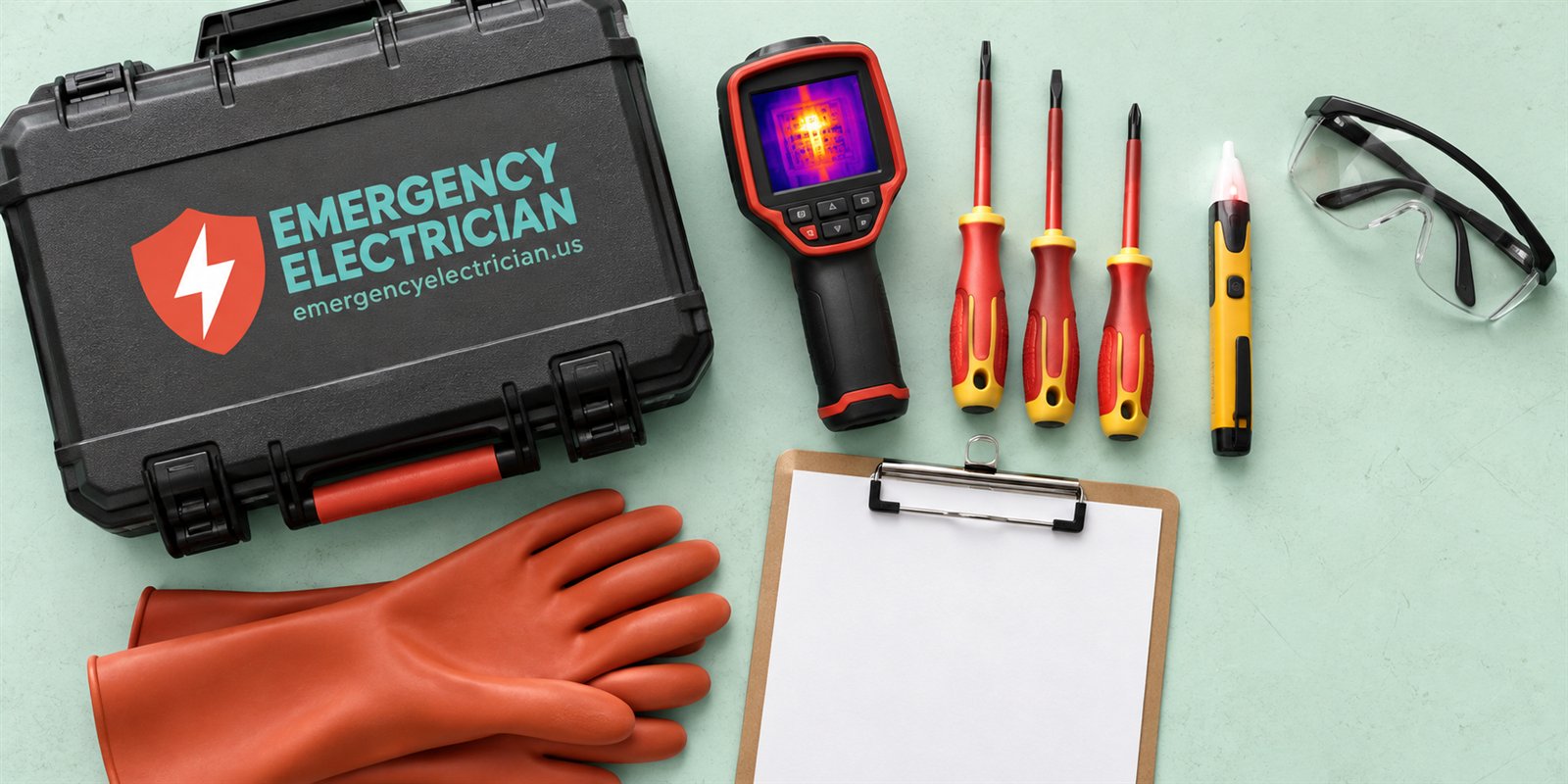
Once the area is safe, the technician starts finding the cause. They will look at the panel, the breakers, the connections and the wiring, often with a flashlight, a voltage tester, a meter and sometimes a thermal camera, which shows heat that the eye cannot see. They will check for loose connections, scorched terminals, damaged insulation, signs of water, overloaded circuits and failed devices.
They may switch circuits off and on one at a time to isolate a fault, unplug devices to see which one causes a trip, and test outlets and ground-fault devices. In a case with several possible causes, they work through them in a logical order, starting with the simplest and the safest. You may see the process take a while. Complicated faults, such as a loose neutral or a ground fault in a wall, can take time to trace. The pages on the urgent troubleshooting visit and urgent ground-fault tracing explain what that involves.
A good technician explains what they are looking for as they go, or after. If you do not understand a term, ask. They may also photograph their findings, which helps with your records and with any insurance claim.
Explanation in plain words
After the diagnosis, the technician should tell you what they found, what it means, what the options are and what each would involve. They should be able to say what failed, why it likely failed and whether it is safe to restore power. They should distinguish between what must be fixed now, what could be fixed soon, and what is a recommendation for the future.
Listen for clear explanations and specific details. You should hear something like: this breaker is worn and not holding, here is the scorched terminal, the circuit can be restored after replacing the breaker, and the panel is otherwise in fair condition. You should be wary of vague or alarming statements without evidence, such as that the whole house must be rewired immediately, with no demonstration of why.
Ask to be shown what they found. Many technicians are glad to show you the scorched terminal, the damaged cable or the failed device. Ask what could have caused it, whether it might happen again, and what you can do to prevent that. The guide on preventing a repeat electrical emergency covers what comes after.
Different visits look different
Not every call looks the same. A visit for a single dead outlet may be short, with testing at the outlet and a replacement. A visit for a burning smell with no visible source may involve a long search, opening several boxes and using a thermal camera. A visit after a storm may begin with checking whether it is safe to restore power at all, since wet equipment cannot simply be switched back on.
A visit to a business may begin with the owner's priorities, such as keeping refrigeration or registers running, and involve temporary arrangements while a permanent repair is planned. A visit to a condominium may require access to an electrical room, and a conversation with the manager or association. A visit to a house with a generator problem may involve checking the transfer arrangement before anything else. The pages on urgent temporary power restoration and after-storm power restoration safety describe two of these.
Whatever the type, the sequence is similar: make safe, find the cause, explain, repair or stabilize, test, and document. If the visit departs from that sequence, ask why.
Quotes, service call charges and consent
Quotes are given by phone. For a simple, well-described problem, the dispatcher can explain the work and the cost on the call. A complicated job needs an on-site visit before anyone can say what it involves. There is a service call charge, and it is explained on the phone before dispatch, so you know it before the technician arrives.
At the visit, the technician will explain the findings and the work needed. You are not obliged to approve repairs on the spot, except where they are needed to make the situation safe. Ask what is required now and what can wait. Ask for the scope of the work in writing, with the details of what will be replaced or repaired. If the work changes from what was discussed, expect to be asked for consent before it goes ahead.
Do not agree to work you do not understand, and do not be pressured. If you need time to consult a landlord, an association or a family member, say so. For permanent repairs after an emergency stabilization, you may wish to take time to think. The page on temporary fix versus full repair explains how to weigh the options.
Permits, inspections and the power company
Some repairs need a permit and an inspection, and some are minor enough that they do not. Replacing a breaker or an outlet may not require one in some places, while a panel replacement, a service upgrade or new circuits usually do. The rules vary by city and county, and a technician working in your area will know the usual practice. Ask what applies to your job.
In an emergency, work to make things safe may happen first, and the permit follows. The page on whether you need a permit for emergency electrical work explains how that works. If an inspection is needed, the work may not be considered complete until it passes, and the utility may require it before reconnecting power after certain repairs, such as a damaged meter base or service mast.
If the utility is involved, the technician may coordinate the timing with you, or you may need to call them. Keep the reference numbers and the names of anyone you speak with. The page on urgent meter base replacement explains a case where several parties are involved.
Testing, restoring power and the final check
Once the repair is done, the technician tests the circuit again. They will check voltage, polarity, grounding and the operation of protective devices where applicable, then restore power in a controlled way, usually by switching the breaker on and observing. They will check that the repaired circuit holds under load, and that nothing else was disturbed.
Expect to be asked to walk through the home with them. They will point out which circuits are back, which are not and why. They may ask you to test a few things, such as pressing the test button on a ground-fault outlet or turning on lights and appliances. This is the time to check that everything you expect is working.
Before the technician leaves, make sure you know three things: what was done, whether anything remains unsafe or unfinished, and what to watch for in the next few days. If something is left off, such as a circuit that is isolated until a part arrives, make sure you know which one, and that you have it in writing. The page on getting a written findings report lists what to ask for.
After the visit: records, follow-up and next steps
Keep the paperwork. A written summary of the findings, a description of the work performed, and any receipts and permit numbers are useful for insurance, for a landlord or an association, and for the next technician. Photograph the repaired area and the label on the panel. Add notes to the household plan about what happened and what you learned.
If you have an insurance claim, give the insurer the written findings and photographs. The page on electrical damage and insurance documents lists what to gather. If the problem affected appliances or electronics, make a list. The page on appliance and electronics damage after an event explains how to describe it.
Watch the repaired circuit for the next few days. If a breaker trips again, a smell returns or an outlet warms, call back and describe what you see. When you are ready to call, or if you want to talk through a symptom before a visit, call, and a dispatcher can explain how the visit will work.
Questions people ask
What identification should I ask the technician for?
Ask for the technician's name and the business name, and compare them with what the dispatcher told you. A reputable business expects this. If anything does not match, call the number you used to request the visit before letting anyone in. You can also verify credentials with your local authority.
Will the power be off during the visit?
Often, at least for the affected circuit and sometimes for the whole home. A technician must make the work area safe and test that it is not live before working. Tell them at the start if anyone relies on medical equipment, and ask how long power is likely to be off and what will be unavailable.
Do I have to approve repairs on the spot?
Only what is needed to make things safe. For the rest, ask what must be done now and what can wait, and ask for the scope in writing. Quotes are given by phone, and a complicated job needs an on-site visit. You can take time to consult a landlord, an association or family.
What should I do if the technician says the whole house needs rewiring?
Ask to be shown the evidence and ask what is urgent. Wiring problems are often local and can be repaired in stages. Ask for the findings in writing, and consider asking for a second opinion if you feel pressured. A clear explanation with specific details is a good sign.
What paperwork should I keep after the visit?
Keep the written findings, a description of the work, any receipts, permit numbers, and your own photographs of the repair and the panel label. These help with insurance, landlords, associations and future technicians. If the technician cannot give written findings on the spot, ask when you will receive them.
Reading about "When They Arrive: What to Know and Do"? Tell us what stopped working and when. We will say what an electrician would check first, and quotes are given by phone when the job can be described.
Related pages
- Pre-Dispatch Questions: How the service call charge works, how quotes are given by phone, what an on-site visit involves, and questions worth asking before an electrician is sent.
- Written Findings: How to ask an electrician for a plain written summary of what was found, what was done and what remains, and what a useful report contains and avoids.
- Prevent Repeat: Follow-up inspections and everyday habits that lower the chance of another electrical emergency in South Florida, without promising outcomes.
- Call Order: Electrical trouble, three possible calls. A plain decision order for when to dial 911, when to phone the power company, and when to call an electrician.
- Emergency Check: A branching guide from symptoms to urgency, showing when to call 911, when to call the utility, when to call an electrician now, and when a visit can wait.
- Mobile Home Electrical: Electrical emergencies in mobile and manufactured homes involve park pedestals, feeder cables and under-home wiring. Learn triage steps and who is responsible.