
How to use this page
This page is general guidance for property owners in Coconut Creek. It is not a record of work done in the city, and it does not describe local streets, utilities or neighborhoods. What it offers is a practical way to think through an electrical problem when you are worried and want to make a sound decision.
Electrical trouble tends to arrive at bad moments: during a storm, in the middle of dinner, or just after you have come home to a smell you cannot place. In those moments it helps to have a simple order of operations in your head. First protect people, then decide who needs to be called, then gather what you have noticed so the conversation is short and useful.
Everything below is written for the person standing in the house, not the person holding the tools. You will not find instructions to open a panel or touch wiring here. Those jobs belong to a trained electrician working on site. What you can do is look, listen, smell, keep people clear and report clearly, and that alone makes a real difference to how the call goes.
Who to call first
The first call depends on what you see. If there is fire, visible flames, heavy smoke, a person who has received a shock, or a wire down across a yard or street, call emergency services first. Do not wait to phone an electrician, and do not try to deal with the hazard yourself. Give the dispatcher your address, what you see, and whether anyone is hurt, and stay on the line if asked.
If the problem is on the utility side, such as a line down outside, a transformer that has failed, or an outage that affects your whole street, the utility company owns that equipment and has to deal with it. The wires from the pole to your meter and the meter itself belong to the utility. An electrician cannot lawfully take over that part of the system, and it is worth knowing the difference before you spend an hour on hold with the wrong party. The page on who fixes what sets this out clearly.
If the trouble is inside your property, such as a panel that smells hot, outlets that spark, a breaker that will not stay on, or a circuit that has died, call an electrician and describe the problem. For homes, condos and townhomes alike, the conversation starts the same way: tell them what is happening, what you can see, and whether anyone is in danger.
- Fire, flames or thick smoke: call emergency services and leave the building.
- Someone shocked or unresponsive near electricity: call emergency services and do not touch them if they may still be in contact with a live source.
- Downed or sagging line outside: stay well back and call the utility and emergency services.
- Smell of burning with no visible source: keep people clear of the area and call an electrician, and call emergency services if the smell grows or smoke appears.
- Dead circuits or a breaker that will not stay on: call an electrician and describe it.
What to observe without touching anything
Observation is the most valuable thing a property owner can offer in the first few minutes. You do not need tools for it. Stand back from the panel, the outlet or the appliance, and use your eyes, ears and nose. Note where the symptom is, whether it is getting worse, and whether anything has changed since you first noticed it.
Look for scorch marks, melted plastic, discolored cover plates, water on or near electrical equipment, and anything that looks swollen or warped. Listen for buzzing, crackling or popping, which can suggest arcing or a loose connection. Notice any smell like hot plastic, fish or something sharp and metallic. Each of these details helps narrow down the cause before anyone arrives, and each is easy to describe over the phone.
Do not poke at the problem to see what happens. Pressing a breaker repeatedly, jiggling a hot plug or wiping a wet panel with a towel can all turn a manageable situation into a dangerous one. If you are unsure whether something is safe to touch, treat it as unsafe. For a longer list of things to avoid, read what never to do in an electrical emergency.
Storm season and the Coconut Creek electrical system
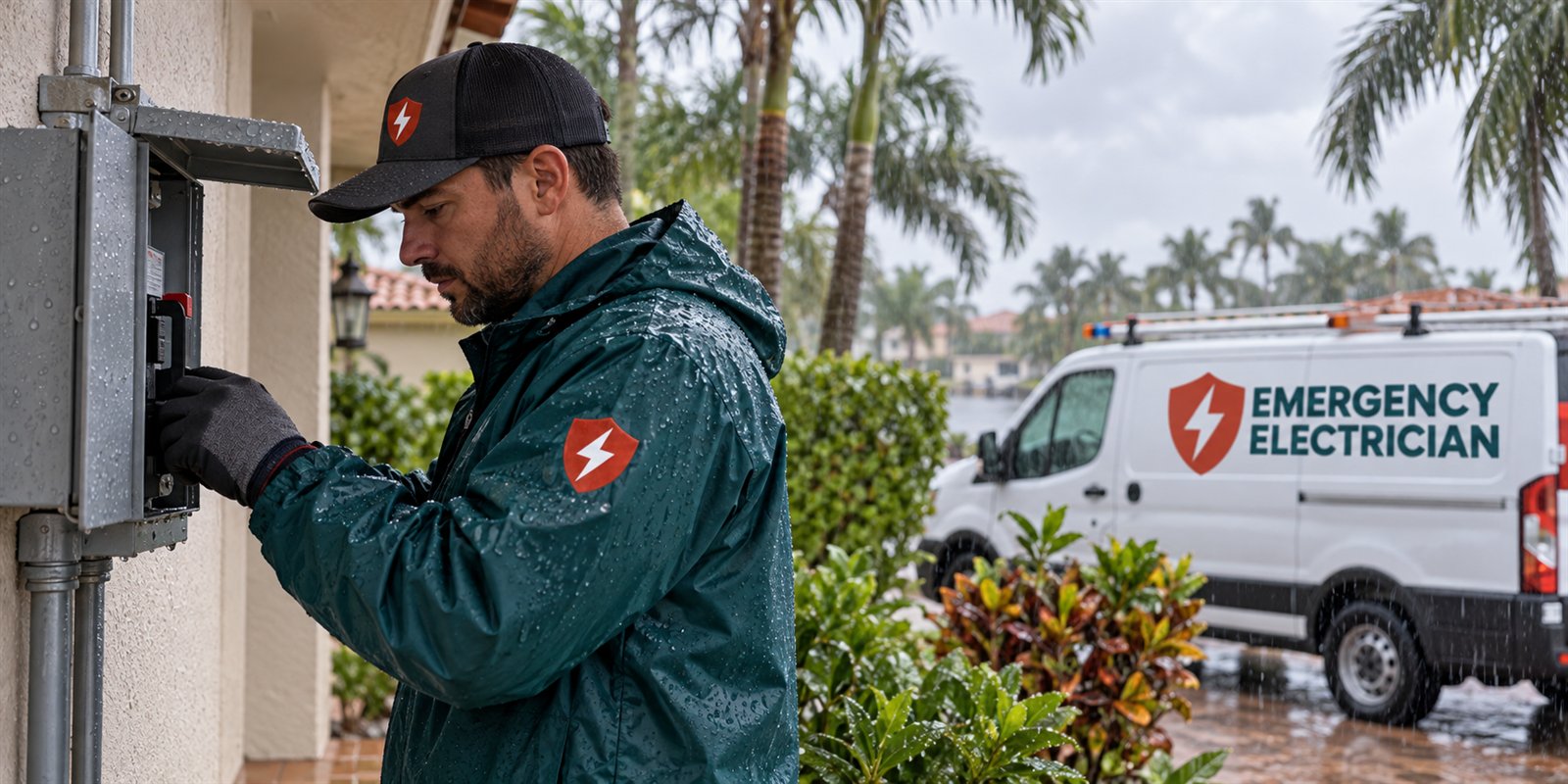
South Florida has a long hurricane and lightning season, and storms are behind a large share of urgent electrical calls. Strong wind can pull service cables and masts, rain can find its way into outdoor equipment, and a lightning strike nearby can send a surge through the wiring of an entire house. Even a storm that passes without obvious damage can leave something weakened that fails days later.
After a storm, the safe approach is to assume that anything outdoors might be damaged. Stay away from lines that are hanging, sagging or touching trees and fences. Do not walk through standing water if there is any chance an outlet, pump or cable is submerged. Our pages on power restoration safety after a storm goes into more detail.
When power returns after an outage, equipment may behave oddly. Breakers can trip as everything starts at once, and a surge on return can damage electronics. If your breaker keeps tripping as power comes back, write down which one and when, so you have something concrete to tell the electrician rather than guessing at the cause.
Heat, humidity and salt air
Warm, damp air is part of life in this part of Florida, and it is hard on electrical equipment. Moisture can creep into outdoor disconnects, exterior receptacles, light fixtures and meter enclosures. Over time it encourages corrosion on terminals and connections, which raises resistance and heat at exactly the point where you want a firm, clean contact.
Properties nearer the coast also deal with salt in the air, which accelerates corrosion on metal parts. You may notice green or white crusting on outdoor fittings, rust streaks around an enclosure, or a switch that feels gritty. These are signs that something deserves a proper look, not a reason to scrub at it yourself. A visit can include checking how well sealed the outdoor equipment is and whether it needs attention.
Air conditioners work hard here as well, and the electrical load they place on a home is significant. Lights that dim when the compressor starts, a breaker that trips on the hottest afternoons, or an outdoor disconnect that looks scorched are all worth reporting. Describing the pattern exactly, including what was running and when, helps the electrician decide where to look first.
Condos, townhomes and associations
Many properties in the area are part of a condo or homeowner association, and that changes who is responsible for what. In a condo, the wiring inside your unit is typically your concern, while shared electrical rooms, common area lighting and building service equipment are usually the association's. Where the line sits depends on your governing documents, so the right move is to ask your association before assuming.
If the outage affects hallways, elevators, gates or shared pumps, report it to management or the board as well as any electrician you call. They may have a preferred contact, rules about who can enter electrical rooms, or access requirements for after hours work. Our page on condo unit power loss walks through the questions to ask.
Townhomes and communities with gated entries add another layer. A failed gate operator or a lighting circuit on community property may not be yours to repair. When in doubt, call the association, describe what you see, and ask who holds responsibility. Knowing the answer early prevents the frustration of a visit to equipment you are not allowed to alter.
Older and newer homes
Homes in the area range from older construction to recent builds, and each presents different electrical questions. Older properties may have panels and wiring that were sized for a lighter load than a modern household places on them. Newer homes tend to have protective devices that older ones lack, and those devices can trip for reasons that are sensitive to small faults in a cord or appliance.
If your house is on the older side, read older home electrical red flags to learn what is worth reporting, such as warm cover plates, flickering that follows the wind, or outlets that no longer hold a plug firmly. None of those are a reason to panic, but each is a reason to schedule an inspection before a small fault becomes an urgent one.
For newer homes, the usual cause of repeated trips is a protective device doing its job. A breaker that detects an arc or a ground fault is telling you something real, even when the cause is a worn cord rather than a house wiring problem. The guide to what GFCI and AFCI protect against explains how these devices think, which makes your description to the electrician much more precise.
What to tell the electrician when you call
A good description is short, specific and in the order things happened. Start with what you noticed and where. Then say what changed, such as a loud noise, a flicker, a smell or a recent storm. Mention whether anyone has been hurt, whether any area is wet, and whether you have turned anything off. If you are unsure about a step, say so rather than guessing.
It also helps to have a few facts ready: whether the problem is one room or the whole property, whether neighbors have power, whether the main breaker has tripped, and whether you rent or own. If you can safely take a photo of the panel door from a distance, or of a scorched outlet cover, that adds useful detail. The guide on what to have ready when you call lists these items in full.
Expect the process to follow a simple pattern. You describe what is happening, the system is inspected on site, the options are explained before work begins, and the finished work and normal operation are reviewed with you. You are welcome to ask questions at each step. If something is unclear, ask for it to be explained until you are comfortable. You can also read what to expect when a technician arrives.
Neighboring cities and wider coverage
Electrical problems do not stop at city lines, and neither does this guidance. If you live near the edge of Coconut Creek, or you manage property in more than one place, the same triage thinking applies. You may find the pages for Margate and Coral Springs helpful for a comparison of how storm and association questions play out nearby.
Each city sets its own building department rules, and permit requirements for electrical work vary from one to the next. If a repair involves a panel, a meter base or a service upgrade, ask your city's building department what applies to your address. A reputable electrician will talk you through whether a permit may be needed, but the city is the authority on the answer. Our guide to permits and emergency electrical work explains the questions to raise.
If you want to browse by symptom rather than location, the main emergencies section lists problems from sparking outlets to panels that buzz. If you are looking for a type of repair, the services section describes urgent work in plain words. Both are meant to help you recognize what you are dealing with before you pick up the phone.
A household routine worth setting up now
The calmest electrical emergencies are the ones a household has already thought about. Sit down with everyone who lives in the home, including older children, and agree on a few simple rules. Everyone should know that fire and shock mean leaving and calling emergency services, that nobody touches a burned or wet outlet, and that one person is responsible for making the follow up call to an electrician.
Choose a meeting spot outside, away from the building and away from any lines. Keep a flashlight where you can find it in the dark, since a power failure often happens at night. Store important numbers on paper as well as in a phone, because a phone battery tends to run low during a long outage. If anyone in the home depends on powered medical equipment, talk to their provider about a plan for outages well before storm season.
Walk around the property once in a while and simply look. Check outdoor receptacles for cracked covers, look at the meter and mast for anything that seems bent, loose or rusted, and notice whether any light fixture has been damp or discolored. You are not testing or repairing anything. You are building a sense of what normal looks like, so that a change stands out right away and you can describe it accurately.
After the immediate danger has passed
Once a problem is under control, take a few minutes to record what happened. Write down the date, what you noticed, what was done and what you were told. If there was damage to property, photograph it before anything is moved. Notes and photos help if you later speak with an insurer, a landlord or an association, and they make it easier to spot a pattern if the problem returns.
Ask for a clear explanation of what was found and what was done. If the cause was a worn component, a loose connection or storm damage, you should know that in plain words. If more work is recommended, ask which parts are urgent and which can be planned. A short written summary of the findings is a reasonable thing to ask for.
Finally, think about prevention. Little things like labeling your panel, knowing where the main breaker is, and keeping a short list of numbers near the door make the next incident easier. Our guide to preventing a repeat electrical emergency offers practical steps that any property owner can take.
Common questions
Is this page a record of work in Coconut Creek?
No. This is general guidance for property owners in Coconut Creek and nearby cities. It does not describe past jobs, local streets or utility details. Its purpose is to help you decide who to call, what to observe safely, and what to say during the call when something electrical goes wrong.
Who should I call if a power line is down outside my home?
Stay well back, keep people and pets away, and call emergency services and the utility company. The lines from the pole to your meter belong to the utility, and a downed line may still be live. Do not approach it, move it, or drive over it, even if it looks dead.
Should I call my condo association before an electrician?
If the problem affects shared areas such as hallways, gates, pumps or an electrical room, tell management or the board. For trouble inside your own unit, you can call an electrician directly, but it is wise to ask your association who is responsible for what and whether any access rules apply.
Do I need a permit for emergency electrical repairs?
Requirements vary by city, and some repairs, such as panel or meter work, may involve a permit. Ask your city's building department what applies to your address, and ask the electrician what they expect. Do not assume a rule from another town applies where you live.
What can I safely do while waiting for help?
Keep people and pets clear of the problem area, avoid touching anything that looks scorched, wet or hot, and note what you see, hear and smell. If you are unsure about something, leave it alone. For fire, smoke, shock or downed lines, call emergency services and move to a safe place outside.
Why do storms cause so many electrical problems here?
Hurricane and lightning season brings strong wind, heavy rain and surges. Wind can damage service cables and masts, rain can enter outdoor equipment, and lightning can send a surge through household wiring. Even when nothing looks wrong afterward, weakened equipment can fail later, so report any odd behavior after a storm.
About "Emergency electrical help for Coconut Creek property owners": call and give us the details, and we will explain what is safe to do while you wait and what the visit would cover. Jobs that cannot be quoted blind need a look on site.