
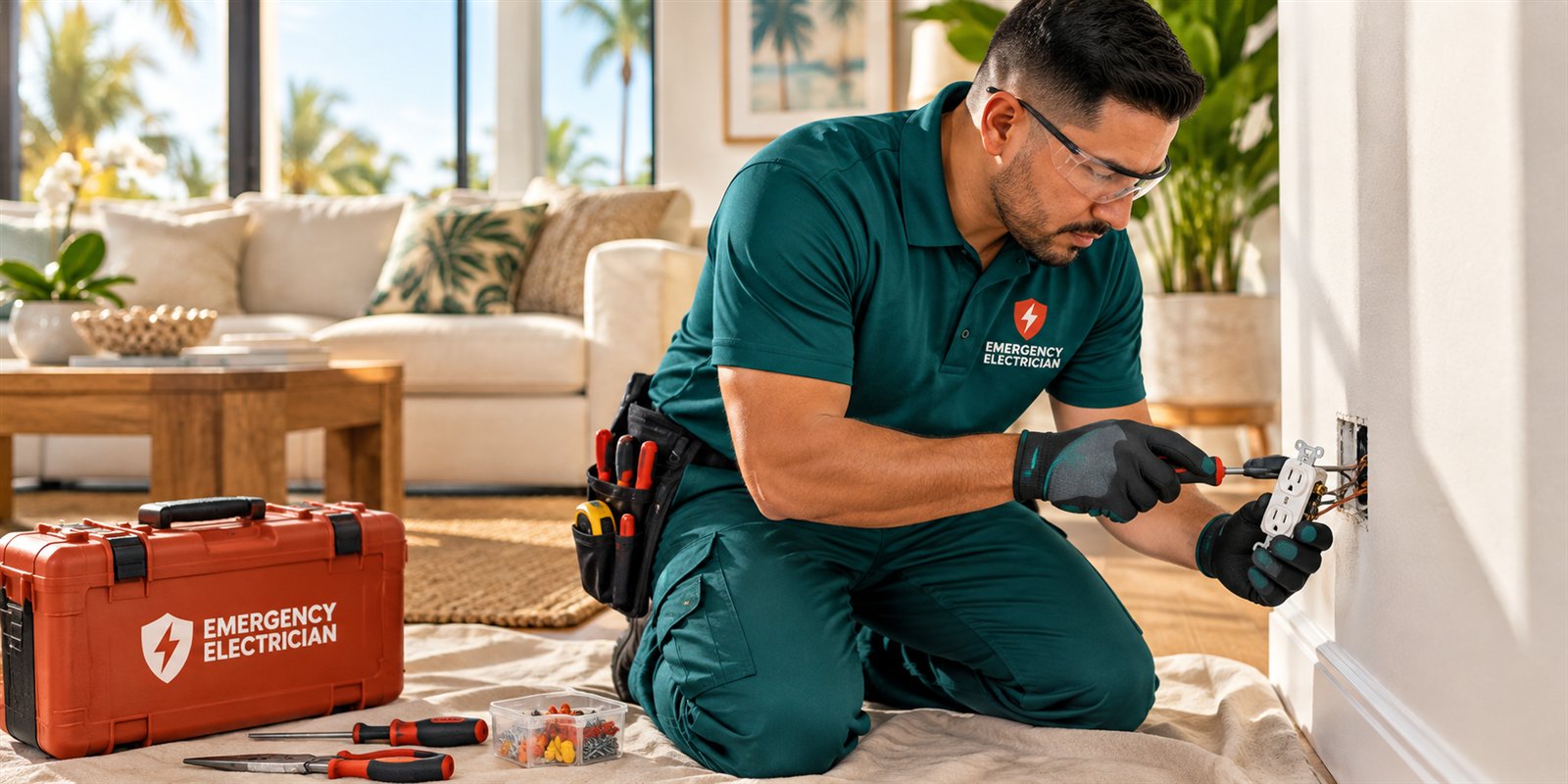
Homes that have been changed many times
Very few homes still have exactly the electrical system they started with. Over the years, owners add a bathroom, enclose a patio, replace an air conditioner, install a pool, upgrade a kitchen, or finish a garage. Each change adds circuits and loads, and each is done by different people with different habits. This page is general guidance for Margate property owners and says nothing about specific streets. It looks at what happens when a house has been layered with changes, and how to respond when that layering produces trouble.
The result is often a system that works but is hard to read. A panel may have breakers that are labeled for rooms that no longer exist. A circuit may feed an unexpected mix of outlets. A subpanel may have been added without a clear record. A connection that was neat when new may have been disturbed during a later project. None of that is unusual, and none of it means the house is unsafe, but it explains why symptoms can be confusing and why a careful inspection matters.
If you have lived in a place a long time, you may remember some of the changes. If you bought it recently, you may know very little. Either way, the useful move is to write down what you know, including who did past work and when, and to hand it to the electrician. Even partial memories help. A line such as "the patio was enclosed some years ago and the lights there have flickered since" can point an inspector in the right direction.
Symptoms that point to layered wiring
Several symptoms commonly show up in homes that have been added to over time. A breaker may trip only when two particular rooms are in use. An outlet may work only when a certain switch is on. A light may dim when a distant appliance starts. A circuit may stay dead after a breaker is reset. These patterns suggest that circuits share more than the owner realizes, or that a splice somewhere is loose.
Another sign is a panel that feels crowded. If breakers are doubled up, if labels are scribbled over, or if the panel door no longer closes comfortably, the system may be near the limit of what it can serve. You can see this by looking at the door and labels without opening anything. Our guide on panel repair versus panel replacement explains how electricians weigh these choices.
Pay attention to anything that changed after recent work. If a problem began soon after a renovation, an appliance swap or a new fixture, say so on the call. Timing is one of the most useful clues. A localized loss, such as power off in one room only, shows why the pattern of what is dead and what is alive matters so much. Two rooms dark on the same wall tell a different story than two rooms dark on opposite sides of the house, and an electrician will ask about exactly that.
- A breaker that trips only when two particular rooms are in use.
- An outlet that works only when a certain switch is on.
- Lights that dim when a distant large appliance starts.
- A circuit that stays dead after a breaker is reset.
- Trouble that began soon after renovation, an appliance swap or new fixtures.
The call order still comes first
Before any of this matters, the call order matters. If there is fire, smoke, a shock, a wire down, or water near electrical equipment, call emergency services first and leave the area. If a line is down or the problem seems to be outside your property, contact the utility too. Only after safety has been handled does the question of the electrician arise. The order protects people and keeps useful help from being wasted on the wrong problem.
If it is not that kind of emergency, but something seems clearly wrong, call an electrician and describe the symptom. Do not try to track the cause yourself by opening panels, swapping breakers, or poking at outlets. Those actions are the work of a qualified professional, and doing them badly can turn a manageable problem into a dangerous one. Our guide on whether it is an emergency, a decision chart can help you decide how urgent the situation is.
Remember that the utility owns its lines and the equipment on its side of your service, and often the meter. Your electrician works on your side. If you are not sure where the boundary is, ask the utility. Our guide on who fixes what between the utility and an electrician explains this division, and it can save a phone call to the wrong party.
Temporary relief versus a full repair
After an electrical failure, there is often a choice between restoring power in a limited way and making a complete repair. Sometimes a limited step is sensible, such as isolating a damaged circuit so the rest of the house can be used while parts are obtained. Other times a limited step simply postpones the real problem. An honest electrician will tell you which is which, and what the limits of a temporary arrangement are.
The risk with temporary arrangements is that they become permanent. A circuit left isolated may be forgotten, then reconnected by someone who does not know why it was isolated. An extension cord used as a workaround may stay in place for months. Make sure any temporary arrangement is explained to you in plain words, ideally in writing, and keep a note of what remains to be done. Our guide on temporary fix versus full repair goes through the decision.
When parts have failed, you may also face the question of repair versus replacement. Replacing a worn component can be more sensible than patching it, especially when the part is old or when failure has occurred more than once. Our guide on whether to repair or replace after a failure helps you frame questions to ask, such as what caused the failure and what else may be affected.
When the same problem keeps coming back
A repeat problem is a clue. If the same breaker trips every few weeks, if the same outlet gets warm again after being replaced, or if the same light flickers again after a bulb change, the first fix probably addressed a symptom and not the cause. Repeat trouble often points to a loose connection upstream, an overloaded circuit, moisture getting in, or a failing component that was not the one replaced.
Keep a simple record of each occurrence. Write down the date, what happened, what the weather and the household were doing, and what was done. Over a few occurrences, a pattern may appear: it happens when it rains, or when the dryer runs, or after the pool pump starts. That kind of note is gold for an electrician, because it narrows the search and reduces repeated visits.
Do not keep resetting, replacing or working around a repeat failure without telling someone. A breaker is designed to protect a circuit, and a breaker that keeps tripping is doing its job. Taking away that protection or forcing it to hold can lead to overheating. Our guide on preventing a repeat electrical emergency explains how to think about cause and not just symptom.
Humidity, heat and everyday wear
Margate has the same hot, humid South Florida climate as its neighbors, and that climate speeds up wear on electrical parts. Heat in attics and garages can age wire insulation and plastic parts. Humidity can corrode terminals and make outdoor boxes damp. Air conditioning systems run for long hours, which keeps their breakers, disconnects and wiring working hard for much of the year.
Wear does not announce itself. It shows up as a receptacle that holds plugs loosely, a switch that feels spongy, a light fixture with a brittle socket, or a cover plate that is discolored. These are quiet signals that a part is tired. Replacing a tired part during a calm visit is far easier than dealing with it after it has failed at a bad moment.
If you notice small signs, you do not have to treat them as emergencies, but you also should not ignore them. Make a list and mention it when an electrician is on site. If a sign is accompanied by heat, a smell, a spark or a sound, treat it as more urgent and keep people away from the spot. An outlet that is warm or discolored is one of the most common early signals, and it deserves a prompt visit.
A good habit is a seasonal walk through the home with a notebook. Touch nothing that looks questionable, but look at cover plates, listen near the panel, and notice smells in the garage and laundry room. Compare what you see with what you noticed the last time. Changes matter more than absolutes, because a system that has been steady for years and suddenly changes is telling you something. Share the notebook with whoever works on the house next, so they do not have to start from nothing.
Storms and the surge question
Storm season brings power flickers, surges and outages, and each leaves its mark. Even when a storm seems to pass without incident, a surge may have shortened the life of electronics and appliance controls. A pattern of equipment failing weeks after a storm is a common story. Protective devices can reduce risk but cannot promise that nothing is damaged.
If your power goes out during a storm, stay away from windows, keep children and pets inside, and avoid wires on the ground or in water. Do not use a generator indoors or in a garage, and do not connect one to the house by improvised means. After the event, when power returns, wait a few minutes before restarting large appliances. Our guide on power returns and breaker trips explains why this is a common time for trouble.
After the storm, look for signs of damage that may not be obvious. Check whether the service mast leans, whether the cable looks pulled, whether the meter is in place, and whether outdoor equipment shows water stains or rust. Take photographs from a safe distance. Our page on a storm damaged meter and mast shows what to look for and why it matters to the utility as well as to an electrician.
Condos, townhomes and association homes
Margate has a mix of housing types, and many residents live in condos, townhomes or communities with associations. If you do, the rules about who may work on what, and who must be informed, come from your association. Some associations require advance notice, some restrict hours, and some require that certain work be done by an approved person. Ask yours before scheduling anything that is not urgent.
If the problem is in a shared area, report it to management and let them arrange the repair. If it is inside your unit, ask what responsibilities fall to you. In an emergency with fire, smoke or shock, call emergency services first regardless of ownership. Keep records of dates, symptoms and contacts, and ask the association whether it needs a written report.
If you rent, report problems to your landlord and keep copies of what you send. Do not try to repair wiring yourself, even if you are handy. Renters have the right to a safe home in most places, but the details differ and the lease has the final word. Our guide on renters and electrical emergencies explains the usual path.
What to say when you call
Begin with the symptom, where it is, and when it began. Say what you saw, heard and smelled. Say whether anyone was hurt, whether emergency services or the utility have been contacted, and whether the problem has happened before. A history of repeats is useful, so mention it. Say whether any renovation, appliance change or storm preceded the trouble.
Tell the electrician what you have done and what you have not. If you reset a breaker once and it tripped again, say so. If you unplugged a cord, say so. If a previous repair was done and the problem returned, say who did it if you know and roughly when. Do not guess at causes. Our guide on what to tell the electrician dispatcher gives a short checklist.
The process is straightforward. You describe what is happening, the system is inspected on site, the options are explained before work begins, and the finished work and normal operation are reviewed with you. Ask questions at each step. If the electrician finds something unrelated to your call, ask whether it is urgent or can wait, and ask for it in writing so you can plan.
Nearby areas and where to read next
Neighboring cities share many of these experiences. If you want to see how the guidance reads elsewhere, the pages for Coral Springs and Pompano Beach are written in a similar spirit. They are general guidance, and they do not claim local history or specific street knowledge.
Building departments set permit requirements by city, and requirements vary by city and by the type of work. When a repair involves a panel, a meter base, a mast or major wiring, ask your city's building department what is required. Ask the utility which equipment it owns. Ask your association which rules apply, and ask your insurer what documents it expects.
To keep learning, browse the emergencies section by symptom. A homeowner who has read a few of those pages will describe a problem more precisely, and that precision shortens visits and clarifies choices. Preparation takes little time, and it turns a confusing home with many past changes into a home you understand a little better each year.
Common questions
Why does my breaker trip only when two rooms are in use?
Two rooms may share a circuit in ways you do not expect, especially in a home that has had additions over the years. Together the loads may exceed what the circuit or breaker can carry, or a loose connection may heat up under load. Note which rooms and appliances are involved and tell an electrician.
Is it all right to leave a circuit turned off after a failure?
Sometimes isolating a circuit is a sensible temporary step, but it should be explained to you and noted so no one reconnects it by mistake. Ask the electrician what was done, why, and what remains. Do not use an extension cord as a long term substitute for a circuit that has been isolated.
The same outlet got warm again after replacement. Why?
A repeat suggests the cause may lie elsewhere, such as a loose connection upstream, an overloaded circuit or a damaged cable. Replacing the visible part may not address it. Stop using that outlet if it is warm, and tell the electrician it has happened before so the investigation goes further.
Should I replace an old panel before it fails?
That depends on its condition, capacity and the work it serves, and only an on site inspection can answer it. Ask an electrician to explain the options in plain terms, and ask your city what permits apply. Warm panels, buzzing, burn marks or repeated trips are reasons to call sooner.
What should I do when power returns after a storm?
Wait a few minutes before restarting large appliances, since a surge of demand can stress equipment. Look and listen for unusual smells or noises. If a breaker trips right away or something smells odd, leave it alone and describe it to an electrician. Do not reset repeatedly.
How much of my home history should I tell the electrician?
Share what you know, including past renovations, appliance changes, storms and earlier repairs. Even partial memories help. Say honestly what you do not know, such as the age of the panel. Timing clues, like when a symptom began, are especially useful to someone deciding where to look first.
About "Emergency electrician guidance for Margate, Florida": call and give us the details, and we will explain what is safe to do while you wait and what the visit would cover. Jobs that cannot be quoted blind need a look on site.
Related pages
- panel repair versus panel replacement
- whether it is an emergency, a decision chart
- who fixes what between the utility and an electrician
- temporary fix versus full repair
- whether to repair or replace after a failure
- preventing a repeat electrical emergency
- power returns and breaker trips
- a storm damaged meter and mast