
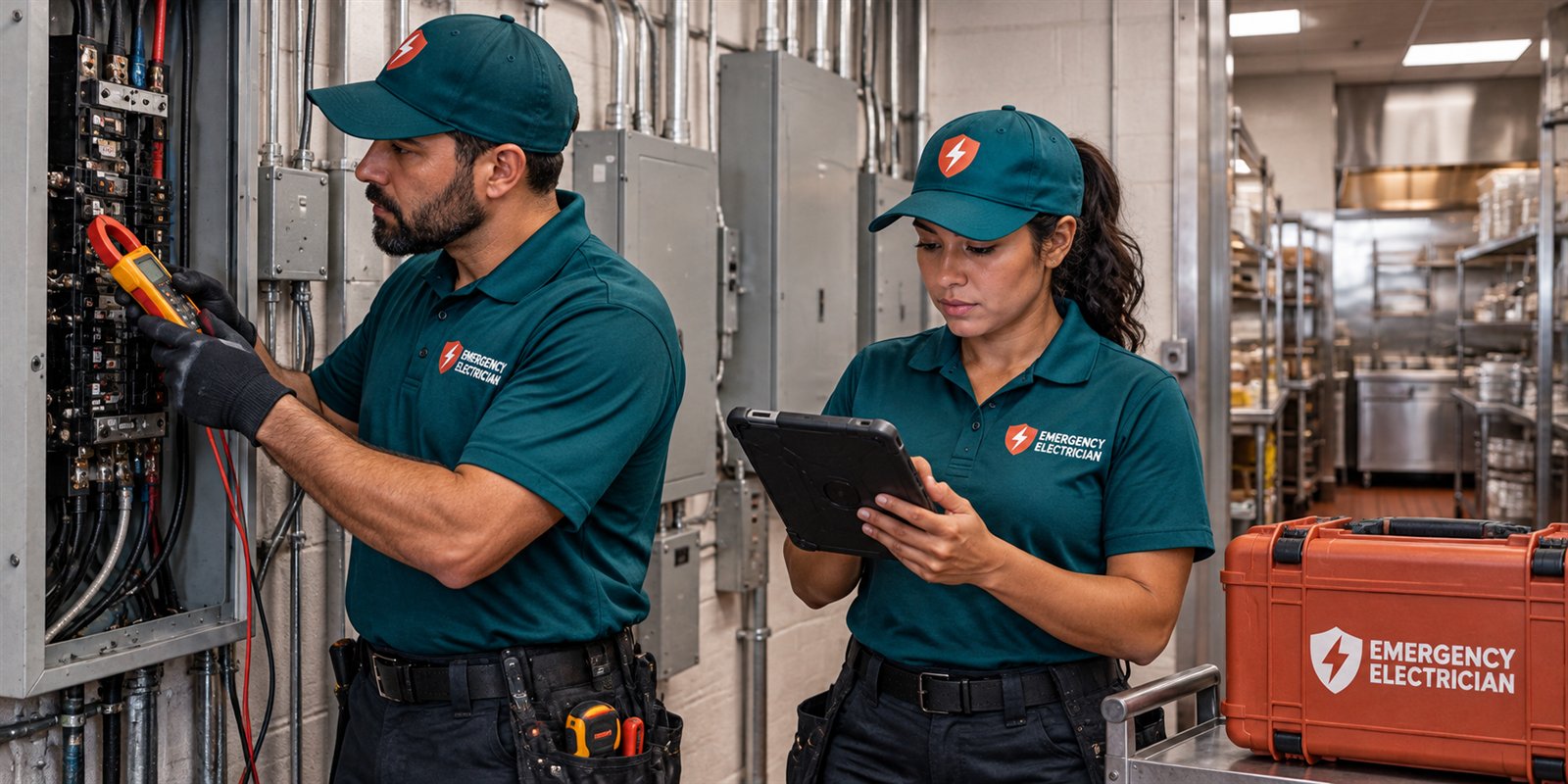
In shared housing, the first question is ownership
When the lights go out in a single family house, the owner of the problem is clear. In an apartment building, condo, townhome group or senior community, it often is not. A dark unit might be caused by something inside the unit, something in a shared electrical room, something on a floor level feed, or something on the utility side. Each of those has a different responsible party, and calling the wrong one costs time. This page is general guidance for Lauderdale Lakes and does not describe any particular building.
The simplest way to sort it out is to look outward from your door. Are the hallway lights on? Do your neighbors have power? Do the elevator and the exterior lights work? If the whole building is dark, the problem is probably in a shared system or on the utility side. If only your unit is dark while the hallway is lit, the problem is more likely inside your unit or on a feeder that serves only you. These observations take a minute and give anyone who helps you a head start.
Remember also that safety does not depend on ownership. If there is fire, smoke, a burning smell you cannot account for, a person who has been shocked, or water near electrical equipment, call emergency services first, and sort out responsibility afterward. The ownership question matters for repairs, not for deciding whether a hazard is real. Do not delay a safety call to wait for a manager to answer.
What is usually yours and what is usually shared
In many multi unit buildings, the wiring, receptacles, switches and fixtures inside a unit, along with the unit panel or breaker box, are the occupant's concern or the owner's. The meter rooms, risers, feeders between floors, hallway lighting, stairwell and emergency lighting, elevators, gates and pool equipment typically belong to the building or association. The exact split depends on the governing documents for each property, and no general rule replaces them.
For renters, the picture is simpler in one way and harder in another. A tenant normally reports electrical problems to the landlord or property manager and does not hire an electrician independently, unless the lease explicitly allows it. The harder part is that reports can go unanswered while a problem continues. Keep written records, including dates, photos and copies of messages. Your lease is the starting point for that conversation, and the notes you keep become the evidence if a repair is delayed. A calm, written, dated report is harder to ignore than a hallway comment.
If you own a unit, ask your association for the documents that describe what you are responsible for, and read the section on electrical systems before you need it. Ask how repairs are reported, who is the emergency contact, and whether work by an outside electrician requires notice or approval. Those answers belong to your association and your building, not to anyone outside. Having them in hand turns a stressful night into a manageable one.
Common area outages and what to notice
A common area outage affects hallways, stairwells, garages, laundry rooms, pool equipment, gates and exterior lights. These systems are shared, and many people notice them at once, which is why it helps to have one person tell management rather than ten. Describe what is out, since when, and whether there is any smell, sound or heat. Note whether emergency lights came on, since that is useful information in itself.
Do not enter an electrical room unless you are authorized and have a reason to be there. Do not open panels, even if the door is unlocked. If a door to a utility room is hot to the touch, if you smell burning near it, or if you hear loud humming or popping, leave the area and call emergency services. Our page on common area outages in condos describes how these problems are usually handled and who needs to know.
A dark stairwell or garage is a safety issue for people, apart from the electrical cause. Use a flashlight and move carefully, and let residents who have trouble with stairs know. If emergency lighting or exit signs fail, report that specifically, because those systems exist to guide people out during an emergency. Our page on emergency lighting and exit sign failure explains why they matter.
Electrical rooms and the risks of shared equipment
Electrical rooms in multi unit buildings hold the meters, disconnects and distribution equipment that serve many households. A fault in that equipment can affect a dozen units or an entire floor, and it can pose a fire risk if it overheats. Those rooms should be kept clear and dry and should not be used for storage. If you notice boxes stacked in front of a panel or a leak above equipment, report it to management.
Signs that something is wrong in a shared room include a hum or buzz that is louder than usual, a hot smell, discolored equipment, a door that feels warm, and breakers that keep tripping. Residents rarely see inside these rooms, so the signs often show up elsewhere, such as flickering lights across several units or appliances that behave oddly at the same time. Mention such patterns to management, who can arrange for a qualified person to inspect the equipment.
Do not try to bridge the gap between your unit and the shared equipment by running extension cords from a neighbor or from a common area outlet. That creates risks of overload, trip hazards and conflict, and it can hide a real problem. Our page on fire risk in condo electrical rooms explains why shared equipment deserves attention and care.
- Report boxes, storage or leaks near electrical rooms to management.
- Mention hums, hot smells or warm doors to the building contact right away.
- Note when several units show the same flicker or outage pattern.
- Never run extension cords between units or from common area outlets.
- Do not open panels or enter electrical rooms unless authorized.
When only your unit is dark
If hallway lights are on and your neighbors have power, but your unit is dark, the cause is probably inside your unit or on its own feed. Look at what still works. If some rooms are dark and others are lit, the pattern points to a circuit or a part of the panel. If everything is dark, the cause may be your unit's main breaker or the feed to it. If lights work but appliances that use two hundred forty volts do not, a partial loss of supply may be involved.
Do not open the unit panel to investigate. Looking at its label and noting whether anything looks different from usual is fine. Listening for buzzing and smelling for hot plastic are fine. If there is a burning smell, a buzzing from the panel or any sign of heat, leave the unit and call emergency services. Our page on condo unit power loss and who to call gives a calm sequence for these situations.
Tell your building contact what you found. Management may know of a repair in progress, a scheduled outage or a failure elsewhere in the building. If they say the problem is inside your unit, ask who may do the work and whether notice is needed. If you are a renter, ask your landlord to arrange for an electrician and tell them what you observed. Keep a note of when you called and whom you spoke with.
Older buildings and aging equipment
Many multi unit buildings in South Florida were built decades ago, and some electrical equipment has simply been in service a long time. Older panels, older wiring methods and older meter stacks can still work, but they may lack protection that newer systems have, and they may be near their capacity as more appliances and electronics are added. Neither age nor appearance proves a system is safe or unsafe, and that is why inspection on site matters.
Residents can notice patterns. Frequent breaker trips, warm cover plates, lights that dim when a large appliance runs, and outlets that no longer hold a plug firmly are all worth mentioning. So is any wiring that looks old, cloth covered or crumbling, or that has been added in unusual ways. Our guide on older home electrical red flags lists signs that deserve attention in any aging property.
Aluminum wiring and certain older breaker or panel types appear in some buildings of certain eras, and they call for knowledgeable inspection. Do not assume you have them or do not. If your management company or association has maintenance records, ask whether any are available. An electrician can often identify what is present during a visit and explain the options before work begins, which gives your building a basis for sensible decisions.
Storms, flooding and shared infrastructure
Storms hit multi unit buildings in specific ways. A flooded garage can affect meter rooms, elevator equipment and electric vehicle chargers. A lightning strike can damage common area systems, fire alarm panels and gate controllers. Wind can pull a service mast or cable and leave a whole building without power. After such events, residents are tempted to check things themselves, but standing water and damaged equipment can be dangerous.
If water has reached any electrical equipment in a garage, ground floor or electrical room, stay away and let the building contact and professionals handle it. Do not wade into water to reach a panel or to check a car charger. Our page on a garage and EV charger after a flood explains what to watch for and why.
Power may return unexpectedly when the utility restores service. Equipment that was damaged can fail or cause a hazard when energized. Ask management to confirm that electrical rooms and affected equipment have been inspected before assuming they are fine. Individual residents can protect their own devices by unplugging sensitive electronics during storms and waiting a few minutes after power returns before turning on large appliances.
Keeping records that help everyone
In shared housing, records carry unusual weight. When a problem affects several households, the person who reports it clearly and early often saves everyone effort. A short note with the date, time, location and symptom is enough. Photographs of damage, taken from a safe position, add value. Keep copies of what you send and what you receive.
If you are a board member or manager, keep a simple log of electrical events in common areas, with dates, symptoms, who was notified and what was done. A log makes patterns visible, such as a gate that fails every time it rains or a hallway circuit that trips weekly. Patterns point to causes, and causes are easier to fix when found early. Our guide on how to keep a home electrical log suggests a format that scales to a building.
Ask the electrician for written findings after an inspection. A short report that says what was checked, what was found and what was done or recommended is useful to the owner, the association and any insurer. Our guide on getting a written findings report explains what a helpful report contains. Records do not fix a problem on their own, but they make the next decision easier and fairer. They also protect the person who reported the problem, because they show that it was raised in good time and described accurately.
What to say when you call
Begin by saying that you live in or manage a multi unit building, and say which kind of ownership applies. Describe the reach of the problem: your unit, several units, a floor, or the whole building. Say what still works. Say what you saw, heard and smelled, when it began, and whether anyone has been hurt. Say whether the building contact, emergency services or the utility have been called.
Mention whether the building has an association, a manager or a landlord, since approvals and access depend on them. Say whether you are an owner, tenant or manager. If access to a shared room is needed, say who holds the key. If you are unsure about anything, say so honestly. Our guide on what to have ready when you call an electrician provides a short list worth keeping handy.
Afterward, the process is straightforward. You describe what is happening, the system is inspected on site, the options are explained before work begins, and the finished work and normal operation are reviewed with you. In a shared building, that final walk through may include the manager or board representative. Ask for plain explanations, and ask which parts of the findings belong to you and which belong to the building.
Nearby areas and where to read next
Shared housing is common across the region, and the same questions apply in nearby cities. If you want to see how the guidance reads elsewhere, the pages for Lauderhill and Sunrise are written in a similar spirit. They are general guidance too, and they do not claim any local history or specific building knowledge.
Permit requirements are set by each city's building department and vary by city and by the type of work. Ask your city when a repair involves a panel, a meter base, a service mast or major wiring. Ask the utility which equipment it owns. Ask your association or landlord which rules apply in your building, and ask your insurer which documents it expects after damage.
For further reading, the services section describes the kinds of urgent work that property owners and managers ask about, and the emergencies section lists problem pages by symptom. Reading a few of them when nothing is wrong makes the next real problem easier to describe. A resident who knows the call order, and a building that has its contacts written down, will handle trouble far more calmly.
Common questions
Who do I call first if my apartment has no power but the hallway does?
If there is smoke, fire, a burning smell or shock, call emergency services first. Otherwise tell your landlord, property manager or association, and describe what still works and what does not. The problem is probably inside your unit or on its feed. An electrician can inspect on site, with the right approvals for your building.
Can a tenant hire an electrician directly?
That depends on the lease and the local rules. Many tenants must report problems to the landlord or manager and let them arrange repairs. In an emergency with fire, smoke or shock, call emergency services first no matter what. Afterward, keep written records and ask your landlord who will arrange the repair.
Why is the whole building dark but the street is lit?
That pattern suggests a problem in the building's own service, meter room or main distribution, though the exact cause needs inspection. Tell building management right away, and avoid entering electrical rooms yourself. If you smell burning or hear loud noises, leave and call emergency services. The utility can tell you which equipment it owns.
What should I do if a stairwell or garage goes dark?
Use a flashlight, move carefully, and tell management. Mention whether emergency lights came on, since failed emergency lighting and exit signs should be reported specifically. Check on neighbors who may need help with stairs. Do not open electrical panels or enter electrical rooms unless you are authorized to do so.
Are extension cords from a neighbor a safe workaround?
No. Running cords between units or from common outlets can overload circuits, create trip hazards and hide a real problem. If your unit has lost power, report it and wait for a proper repair. For medical equipment or other critical needs, tell management and emergency services so that help can be arranged safely.
How do I find out which equipment belongs to the association?
Ask the association or management company for the governing documents and the section that covers electrical systems. The split between unit owner and association responsibility differs from building to building. A written answer from the association is worth more than any general rule, and it helps an electrician plan the visit.
About "Emergency electrician guidance for Lauderdale Lakes, Florida": call and give us the details, and we will explain what is safe to do while you wait and what the visit would cover. Jobs that cannot be quoted blind need a look on site.