
What the bang usually is
Utility equipment can make a loud noise when it fails. A pole-mounted transformer can blow its internal protection or a fuse when it overloads or is hit by a short circuit, producing a bang and sometimes a flash of blue or white light. A tree limb or a palm frond falling across lines can cause a fault. A bird or a squirrel on a connection can cause a short. A vehicle that hits a pole can snap a line and break equipment. A lightning strike nearby can also cause a sharp crack and a failure. Pad-mounted green boxes in underground neighborhoods can fail too, and may smell of burnt oil.
Other sources are on the property side: a failed meter socket, a service mast pulled from the house, or a main breaker that failed under load. These are not as loud as a transformer, but a meter socket failing can produce a pop and a flash. The important point is that you cannot tell the difference from the sound alone, and in every case the safe assumption is that something outside may still be energized or on fire. For that reason, the rules on this page apply whether or not you can see damage.
Immediate safety: stay inside and keep your distance
Do not run outside to look. Look from a window if you can. If you do see a line on the ground, a burning pole, a flash, smoke, a fire at the transformer, or a vehicle in contact with the equipment, treat all of it as live and dangerous. A wire does not need to spark or hum to be energized. Current can travel through the ground, a wet lawn, a metal fence, a puddle or a vehicle, and the area around a fallen line can have dangerous voltage at your feet even though you are not touching the wire.
Keep everyone inside, including children and pets, away from windows and doors near the damage, and keep neighbors back if you can do so by calling to them from a safe place. Do not drive toward the damage, and if you are in a car and a line has fallen on it, stay inside and wait for responders unless there is fire. If you must exit due to fire, jump clear with your feet together and shuffle away without touching the car and the ground at the same time. Our page on a downed wire in your yard or street goes through the full steps.
- Look from a window, not from the yard.
- Treat every wire and pole as live, even if there is no sound or spark.
- Keep children and pets inside and away from the affected side of the house.
- Do not drive toward the damage or move a vehicle that has touched a line.
- Do not approach to check on someone unless emergency services say it is safe.
The call order: 911, then the utility, then an electrician
If there is fire, smoke, a downed wire, or anyone hurt, call 911 first. Describe the location as exactly as you can: street address, the nearest cross street, the pole number if you can read it from a safe distance, and what you saw and heard. Stay on the line if the dispatcher asks, and do not hang up until told.
Second, call the power company's emergency line. Most utilities have a dedicated number for hazards such as downed lines and failed equipment, which is separate from their regular outage reporting. Tell them you heard a bang, give the address and the pole or box location, describe the hazard, and report that your power is out. Third, if the damage appears to be on your own property, such as at the meter, the mast or the panel, or if the utility tells you the problem is on your side, call an electrician. Our page on what to tell the 911 dispatcher can help you organize the call.
- 911 for fire, smoke, downed wires or injuries.
- The utility's emergency line for failed equipment and downed lines.
- An electrician for damage on your side of the meter.
Is it only my house, or the whole street?
Once you are safe, look at the neighborhood. A transformer failure usually affects several homes on one side of the street or around a pole. A failed fuse can affect a short stretch. If every house in sight is dark, that points strongly to the utility. If the neighbors have lights and you do not, the bang may have come from your own service. See our page on whole house dark, neighbors have power for how to tell the difference.
In either case, report your outage even if you assume others have. Utility crews map outages from the calls and the smart meter signals they receive, and a report that includes the sound you heard helps them know it is a hazard and not only an interruption. If you have a smart meter, it may report the outage automatically, but a phone report adds the information about the bang and the location.
Inside the house: protect equipment while power is out
When the power fails after a fault, it can come back suddenly, sometimes with surges or a poorly regulated voltage. Prepare for that. Unplug sensitive electronics: computers, televisions, game systems, modems and chargers. Switch off the air conditioner at the thermostat and consider switching off its breaker, because compressors are damaged by a rapid restart. Leave one light on so you will know when power returns. Keep refrigerator and freezer doors closed.
If the lights, outlets or panel show signs of damage, such as a smell of burning, sounds from the panel, or a hot meter, switch off the main breaker if it is safe and dry. Do not use candles if you smell gas or anything burning outdoors. Use battery lanterns. Avoid running a generator in the garage or near windows because of carbon monoxide, and never connect it to the house with a plug. Our pages on power restoration safety and breaker trips when power returns help you prepare for the moment it comes back.
- Unplug electronics and switch off the air conditioner.
- Leave one lamp on to see when power returns.
- Keep the fridge and freezer closed.
- Use battery lighting, not open flame.
- No generators in garages or connected to outlets.
When the bang was on your own property
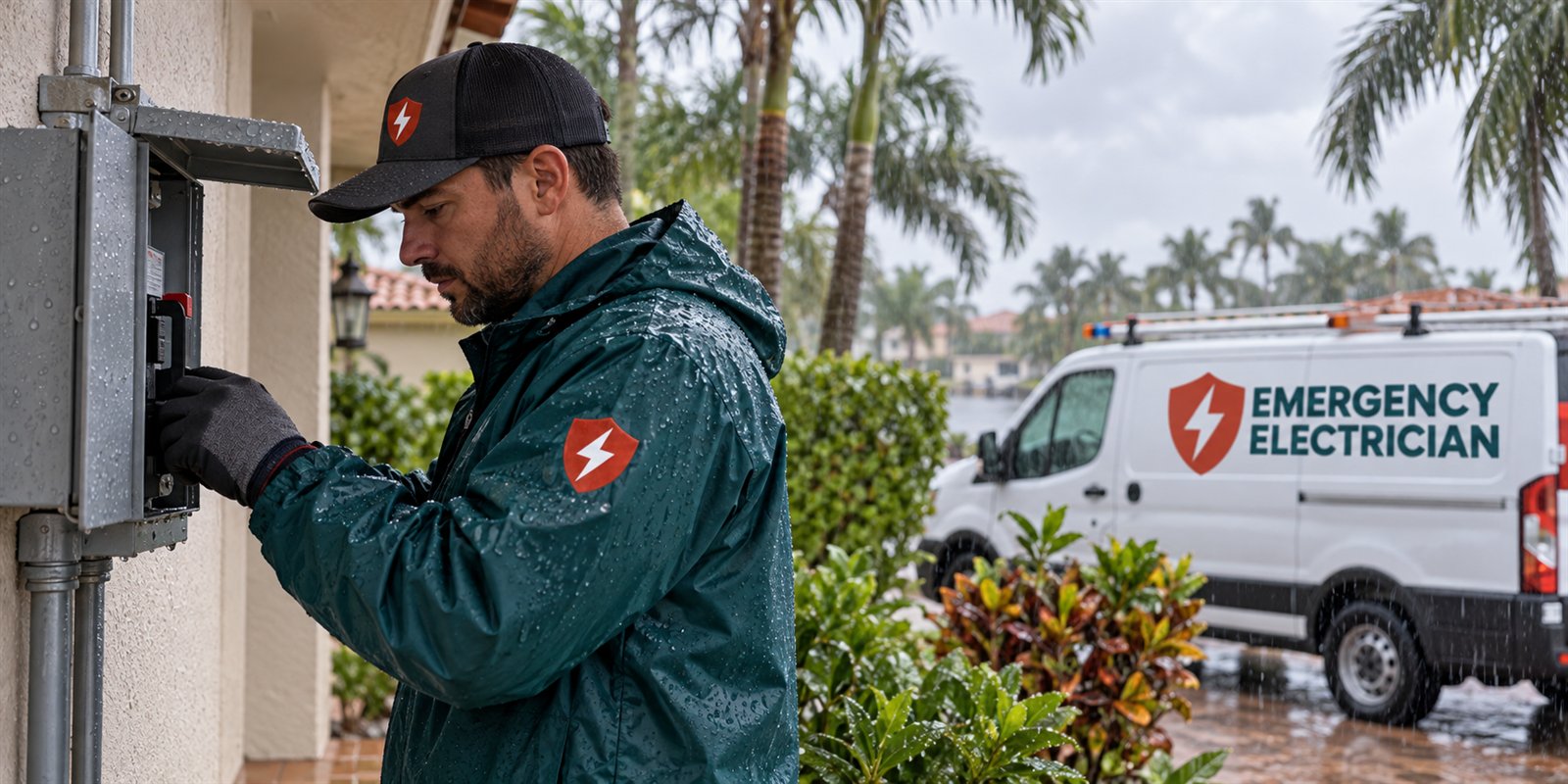
Sometimes the noise comes from the equipment you own. A meter socket that fails can make a sharp pop, burn the plastic around it and leave a scorched smell. A service mast pulled by wind or a falling limb can snap and arc. A main breaker that fails under load can fire a loud crack, and a panel with a bus fault can produce a flash that blackens the cover. If you see scorch marks, melted plastic, a hanging line, a leaning mast, or smoke at the meter or panel, stay back and call 911, then the utility.
The utility may cut power to the line to make it safe, and often will not restore it until a qualified electrician has repaired the damaged equipment and the work has been approved or inspected. That process takes coordination, so call an electrician early. Our pages on meter socket sparking and a leaning or bent service mast describe those cases, and the power company disconnect and reconnect process outlines how restoration usually works.
Condos, townhouses and shared equipment
In condominiums and townhouse communities, equipment may be shared. A pad-mounted transformer may feed several buildings. A meter room may serve a whole stack of units. A bang followed by an outage could mean a failure in the building's main distribution equipment, an electrical room fire, or a utility failure. Report the event to the building manager or association as well as to the utility and 911 where appropriate. Do not enter an electrical room with smoke or a burning smell.
Our pages on condo electrical room fire risk and condo common area outages describe how those emergencies are handled. If you are a tenant, tell your landlord or property manager what you heard and saw. Keep a record of the time, what you observed and whom you called, because it may matter for later repairs and any insurance questions.
Reading the clues you noticed
The details you remember can help the crews and the electrician. A bright blue or white flash with a sharp crack often goes with an arcing fault at a transformer, a fuse or a connection. A low, heavy boom followed by a smell of burnt oil can point to a pad-mounted or pole transformer failure. A crackling or tearing sound followed by a thud may be a limb or palm falling onto lines. A pop at the house followed by a smell of hot plastic points to the meter or panel. Flickering lights for a moment before the outage can mean a fault was trying to clear, which is common when a line is touched by vegetation.
Write these down while they are fresh: the time, the direction of the sound, the color of any flash, whether lights flickered first, and whether the outage covered a street or a single house. Do not walk toward the source to confirm any of it. If a neighbor has a doorbell camera or a security camera that caught the flash, ask them to save the clip. That information supports the utility's investigation and may matter for later insurance or repair discussions.
- Time, direction and character of the sound.
- Color of any flash and whether there was a fire or smoke.
- Whether lights flickered before the outage.
- How many houses are dark and where the dark area starts.
After the power comes back
When power is restored, wait a short while before reconnecting electronics and starting the air conditioner, so that any unstable voltage settles. Check the lights: if they are very bright, very dim or flicker, switch off the main and call, because the fault may not be fully cleared. Check the refrigerator and freezer for temperature, and be cautious about food that may have warmed; follow standard food safety advice and throw out food you are unsure of.
If breakers trip when power returns, do not keep resetting them. A tripped breaker after an outage can point to an overloaded circuit, a fault from damage during the event, or water in the wiring. A technician can check. If you notice damage to appliances, photograph it and keep the items. If any part of your meter, mast or panel was damaged, you will need a repair before the utility reconnects. Call an electrician for an inspection, especially if you smelled burning or saw flashes outside. Our page on photographing the damage before repairs lists what to capture.
- Wait before restarting large loads.
- Switch off the main if lights are very bright, dim or flickering.
- Do not keep resetting a breaker that trips.
- Photograph and keep damaged items for documentation.
What to tell the electrician when you call
Tell the dispatcher what you heard and saw: the time of the bang, a flash or a color, smoke or a burning smell, whether neighbors are dark, what the utility said, whether the meter, mast or panel looks damaged, and what you have done so far. Say whether anyone is in danger and whether anyone depends on powered medical equipment. Give the address and say whether you own or rent.
Remember that the outside of the property may be dangerous when the technician arrives, and the utility may need to make the area safe first. A technician will not work on service equipment until it is de-energized and verified. The call can still be useful before that: it lets the dispatcher plan, and lets you know what to do while you wait. When a loud bang is followed by darkness, the right response is to stay back, make the calls in order, and then call so that a qualified technician can inspect and repair the equipment that belongs to you.
Questions people ask
What should I do first after a loud bang and a power outage?
Stay inside and look from a window. If you see fire, smoke, sparks or a wire on the ground, keep everyone away and call 911. Then call the power company's emergency line. Do not go outside to investigate, because a fallen line can energize the ground and objects around it even when it does not spark.
Is a transformer bang dangerous even if I cannot see anything?
It can be. A failed transformer or fuse may have caused a line to fall or may still be energized and hot. Oil leaks and fire are also possible. Treat the area as dangerous, keep a distance, and report it. Crews decide when the area is safe, not the people nearby.
Should I call the utility or an electrician?
Call 911 if there is fire, smoke or a downed wire. Then call the utility's emergency line for failed equipment. If the damage is at your meter, mast or panel, or the utility says the problem is on your side, call an electrician. Calling the utility first does not delay an electrician later.
My neighbors have power but I do not. Does that change anything?
It suggests the failure may be in the service to your house or your own equipment. The utility still needs to be told, since the bang may have come from their line to your property. An electrician can test your meter socket and main breaker once the area is safe.
Can I turn the main breaker back on when power returns?
If you switched it off, wait until the lights outside or neighbors' power show that service is back, then switch it on and watch the lights. If they are very bright, dim or flickering, switch it off again and call. Switch large loads back on gradually so the system can settle.
How do I document the event for insurance?
Write down the time, what you heard and saw, who you called, and what was damaged. Photograph the damage from a safe distance, keep failed devices, and ask the technician for a written findings report. Our guides on photographing damage and getting a findings report explain what to capture.
If "Loud Bang Outside, Then the Power Went Out" matches what is happening, call and describe it plainly: the room, the breaker, any burning smell or tripped circuit. We explain what the repair would involve before a visit is set.
Related pages
- Downed Wire: A wire on the ground may be live even if it is silent. Learn how to keep a safe distance, call 911 and the utility, and what never to do near a fallen line.
- Only You Dark: Your house has no power but the neighbors do. Learn how to tell a utility fault from a problem on your side of the meter and who to call first.
- 911 Script: Calling 911 about sparks, smoke, a shock or a downed wire? These are the facts that help dispatch most: address, hazard, people at risk and power status.
- Disconnect Process: The usual order of events when a service is pulled for repairs in South Florida: who does what, what gets inspected and why power returns when it does.
- Meter Sparking: Sparks or arcing at the electric meter are an emergency. Learn why to call 911 and the utility first, who owns which part and what an electrician does after.
- Small Fire: Small flames at an outlet, cord or appliance still mean get out and call 911. Learn why water is wrong, when an extinguisher is an option and what follows.