
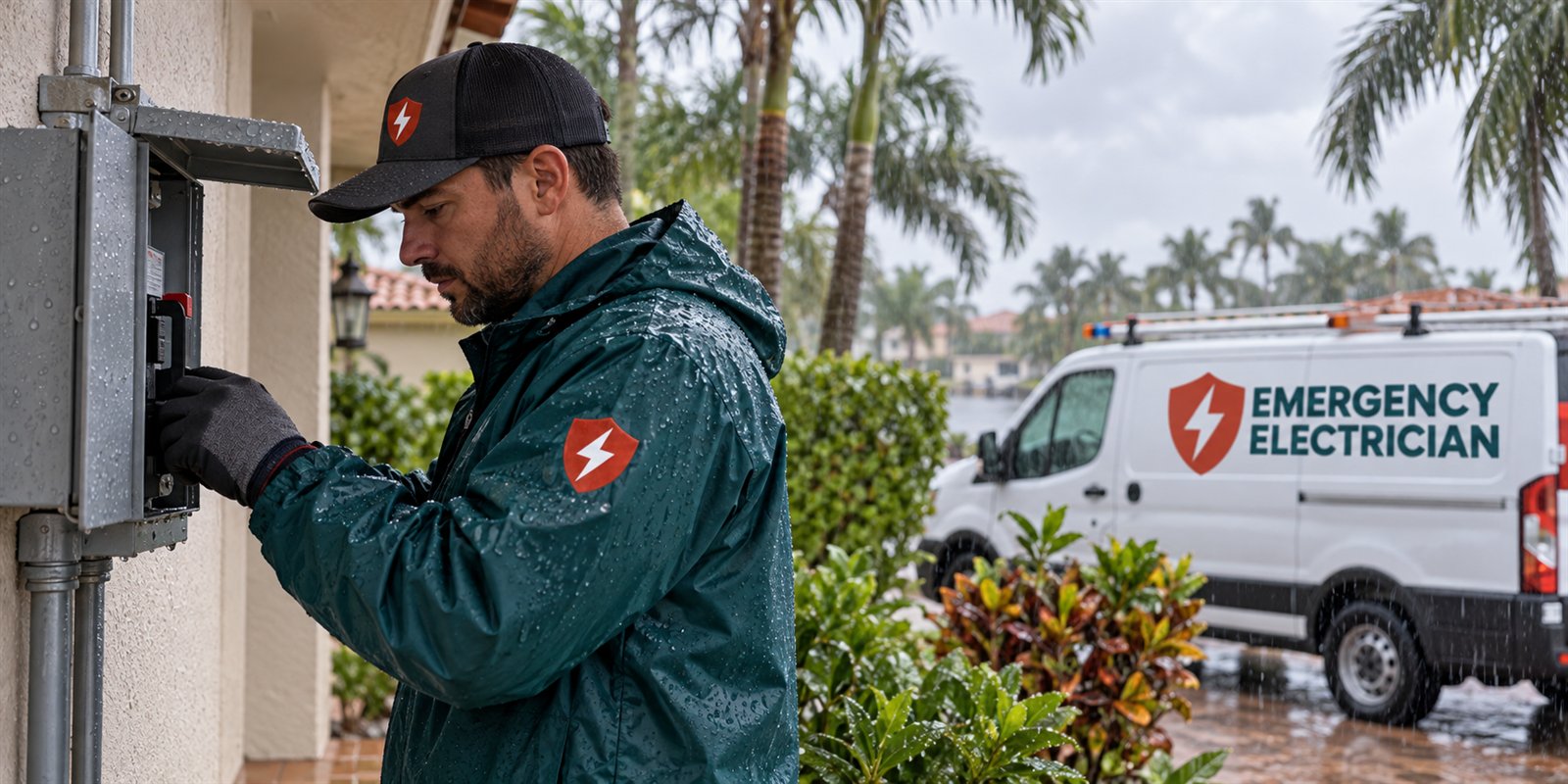
Why it matters that the neighbors still have power
A neighborhood outage points to the utility: a downed line, a failed transformer, a blown fuse on a pole, or a storm that cut a feeder. A single dark house points somewhere else. The fault may be in the service drop that runs from the pole or underground transformer to your meter, in the meter socket, in the service conductors between the meter and your panel, in the main breaker, or in the panel itself. It may also be a simple tripped main breaker or a utility-side problem that affects only your service line, such as a failed connection at the pole.
That split is the whole point of this page. The utility owns and repairs everything up to and including the point where its wires connect to your service equipment, which for most homes means the line to the weatherhead or meter. The property owner owns the equipment from there inward: the mast, the weatherhead, the meter socket in many cases, the main breaker, the panel, and everything inside. Knowing which side the fault is on determines who can and should fix it. Our guide on who fixes what, utility or electrician goes through the boundaries in detail.
Safety first: what to check without touching anything electrical
Start from the outside and with your eyes only. Look at the neighbors on both sides and across the street. Are their lights on, or only a few? Are their air conditioners running? Sometimes a house that appears lit has only emergency lights or a generator running, so listen for a generator hum as well. Then look at your own property. Check the overhead service line from the pole to the roof or mast: is it hanging low, resting on a branch, or visibly burned or broken? Is the weatherhead at the top of the mast leaning, pulled off the house, or showing scorch marks? Is the meter intact, or is there smoke, melted plastic, or a burning smell near it?
If you see a wire on the ground, a line on a tree, sparks, smoke, or burning, stop. Do not walk toward it. Keep everyone away, call 911, and then call the power company's emergency line. Our pages on downed wires and sparking meter sockets cover those cases. If everything outside looks normal, you can move to the checks inside.
- Look at neighboring houses and listen for generators.
- Look at the overhead line, mast, weatherhead and meter from a distance.
- Never touch the meter, the mast or any wire, even if it looks dead.
- If anything outside is damaged, smoking or sparking, call 911 and the utility first.
Checks inside: the main breaker and the panel
Go to the panel only if the floor is dry, you are not touching water, and there is no smell of burning. Open the panel door and look at the main breaker, which is usually the large one at the top, or sometimes in a separate box outside near the meter. In a tripped state, a breaker handle sits in a middle position or at OFF. Do not force a breaker. If the main has tripped, do not reset it repeatedly. One careful reset is a reasonable step only if there is no burning smell, no sound from the panel, and no water; if it trips again right away, leave it off and call. The page on when it is safe to use the main breaker sets out the limits.
You can also notice whether all of the branch breakers are in the normal position. A house with a tripped main will be completely dark, but a house with a tripped sub-main, a failed main, or a lost service can look the same. Do not remove the panel cover. The cover is what keeps the live bus bars out of reach, and taking it off is an electrician's job.
- Confirm the floor is dry and there is no burning smell.
- Look at the main breaker position without removing any cover.
- If it is tripped and there is no sign of fire, one careful reset is reasonable.
- If it will not reset, trips again, buzzes, or feels hot, leave it off.
- Never open the inner panel cover.
Clues that point to the utility side
Several signs suggest that the fault is on the utility's equipment even though the neighbors are lit. Your meter display, if you have a smart meter, may be blank. The line at the weatherhead may be hanging or detached. A loud bang or flash earlier may have come from a service drop or a fuse on the pole feeding only your house or a short stretch of the street. If several homes on the same side of the street are dark but those on the other side have power, they may share a single transformer or lateral. In underground neighborhoods, a failure in the buried cable between the transformer and your meter will leave one house dark while the rest are fine.
In any of these cases, the power company needs to know. Report the outage even if you think someone else already did, and tell them that neighbors have power. That detail changes how they classify the call. If the utility finds that the damage is on the customer side, such as a failed meter socket or a torn mast, they may disconnect the service for safety and ask you to have repairs made by an electrician before they reconnect. Our guide on the power company disconnect and reconnect process explains what that usually looks like.
Clues that point to your side of the meter
Signs that the problem is on your side include: a burning smell near the panel or meter, a scorched or melted meter socket, a main breaker that will not reset or feels hot, a buzzing or crackling sound from the panel, water in the panel or meter base after rain, a mast that has been pulled by a falling branch, or a recent electrical project that was done nearby. If only part of the house lost power, that is a different kind of fault; see our page on a half-house outage.
Another clue is timing. If the lights went out at the moment a large appliance started, or immediately after a flicker, or after you heard a pop from the garage or side of the house, the failure may be in the service equipment. A main breaker that has worn out can fail to carry load, and a connection inside the meter socket or the panel can burn through. These are not repairs you can safely make. They are also the kind of fault the utility will not repair, because the equipment belongs to the property owner.
- Burning, melting, or discoloration at the meter or panel.
- A main breaker that will not stay on or is hot to the touch.
- A leaning mast or a torn weatherhead after wind or a falling limb.
- Water getting into the meter base, mast or panel.
- Dead outlets across the whole house with no outside cause.
Who to call first, and in what order
The order is simple. If there is fire, smoke, a wire down, or a person hurt, call 911 first. If the damage is on the utility's lines or the pole, call the power company's emergency number second. If you see damage at your own meter, mast or panel, or the main breaker will not reset and the neighbors have power, call an electrician. When in doubt, it is acceptable and often wise to call both: the utility can confirm whether power is reaching your meter, and an electrician can confirm whether your equipment is safe to energize.
A utility crew that arrives and finds that power is reaching your meter but your equipment is damaged will usually leave it off and tell you to hire an electrician. If you have already called an electrician in that case, you save time. If the utility finds its own equipment failed, it will repair it without needing you to hire anyone. Neither outcome is a waste. Our page on whether it is an emergency may help you decide how fast to act.
Other reasons only one house goes dark
Not every single-house outage is a service fault. A few other situations look the same at first. A multi-family building may have a failed main disconnect, so a whole unit or a whole condo section loses power while other buildings stay lit. A house on a shared service, such as a duplex with a combined meter bank, can lose power if its own meter has failed. Some homes have a utility service shutoff because of a billing or safety issue. A neighbor's lights may also be on a different phase or feeder, so they stay lit when yours is out even though the cause is a regional event.
Also consider a house with a generator or a transfer switch. If a transfer switch has failed or a generator breaker is open, the house may be dark while the grid is fine. Our pages on the generator that will not power the transfer switch and generator backfeed risk explain why you should never connect a generator to a house through an outlet or an improvised cord.
- Condo and townhouse: check with the association or building manager about shared equipment.
- Duplex and meter banks: confirm whether other units are dark.
- Homes with a transfer switch: check the switch position before assuming a service fault.
- Billing or utility disconnects: check mail and account messages if there is no sign of damage.
Food, medical equipment and comfort while you wait
While you work out who is coming, protect what matters. Keep refrigerator and freezer doors closed so cold air stays in. In South Florida heat, a closed freezer keeps food cold longer than an open one, and a closed fridge buys a few hours. If anyone in the home relies on medical equipment that needs power, such as an oxygen concentrator, a CPAP unit, or a powered mattress, make a plan now: switch to a battery backup if you have one, move to a place with power, or call the equipment supplier or the utility's medical priority program if you are enrolled. If the person is in danger, call 911.
Keep flashlights or battery lanterns handy. Avoid candles when you are also worried about electrical damage; if there is any chance of a gas smell or a burning smell, an open flame adds risk. Do not run a portable generator inside the garage or near windows because of carbon monoxide, and do not plug it into a wall outlet. Our guide on extended outages, food and medical power has a fuller checklist.
What the electrician will check when you call
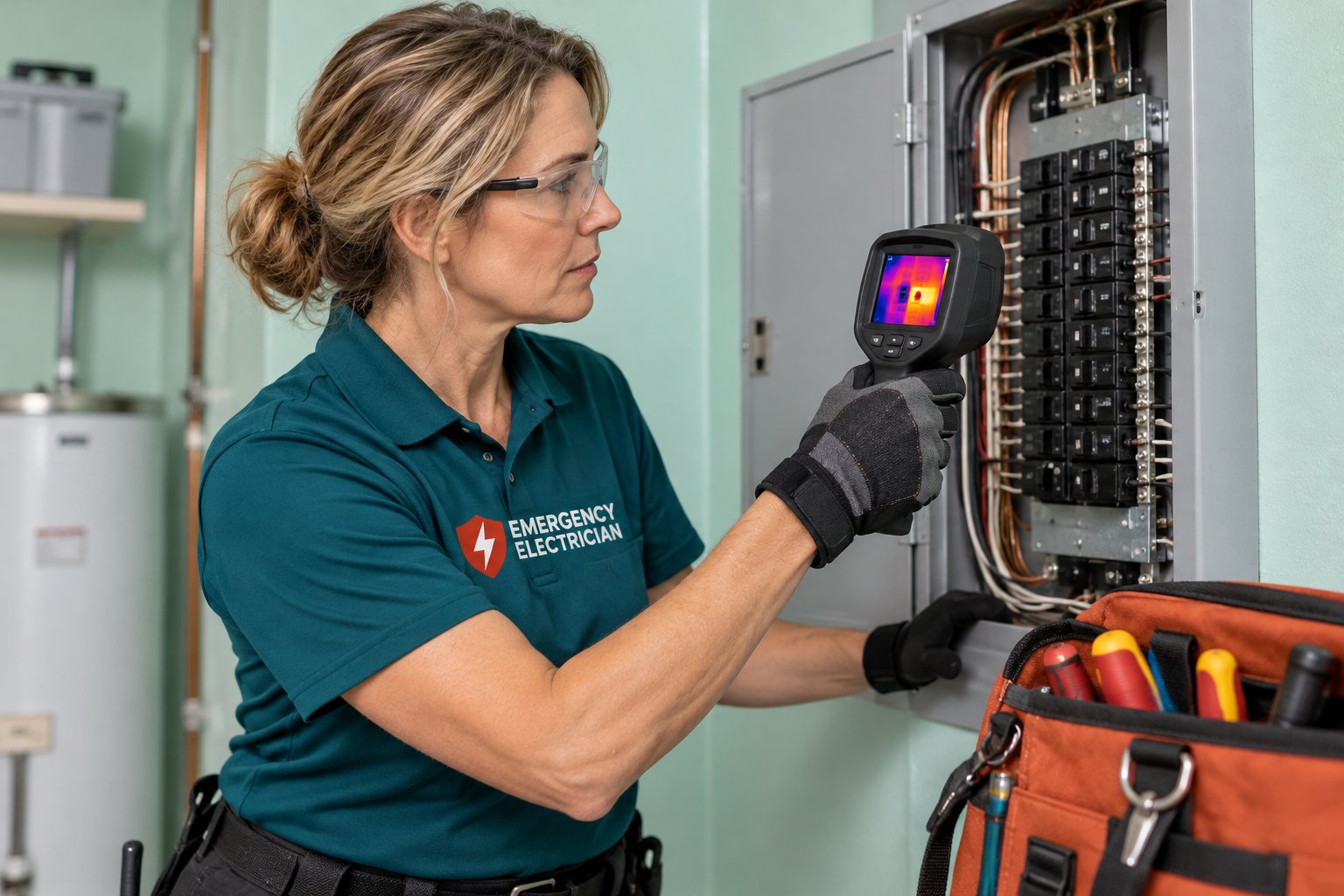
When a technician arrives for a single-house outage, the first step is to verify the voltage at the meter and at the main breaker with proper test equipment. That tells them whether power is arriving at your service equipment. If voltage is missing at the meter, the problem is upstream and the utility is called to restore its side. If voltage is present at the meter but not at the load side of the main, the meter socket, the service conductors or the main breaker is suspect.
The technician then inspects the meter socket for burned contacts and loose lugs, the service conductors for damage or heat, the main breaker for failure or arc damage, and the bus bars in the panel for burn marks. If the panel or meter base is badly damaged, the work may need a permit and coordination with the power company to disconnect and reconnect the service. That coordination is part of the job and your technician can explain it. Our pages on urgent meter base replacement and urgent panel replacement describe those repairs. For smaller faults, a breaker or connection repair and a test of every circuit may be enough.
Larger service repairs usually need an on-site visit before a quote can be given, and quotes are given only by phone. A service call charge applies and is explained on the phone before dispatch.
What to have ready and how to describe it on the phone
The more clearly you describe the situation, the faster the right person can be sent. Say that your house is completely dark while the neighbors have power, whether you have checked the main breaker and what position it was in, whether you saw any damage to the mast, weatherhead or meter, whether you heard a bang or saw a flash, and whether you have called the utility. Give the address and note whether you own or rent. Mention a medical need if there is one.
Keep your phone charged, keep the area around the meter and panel clear so a technician can reach them, and secure pets. If you have an access gate or a locked meter room in a condo, arrange for access. If you have photographs of the meter, mast or panel taken from a safe distance, they help. When in doubt about whether this is a utility problem or an electrical fault on your property, call, describe what you see, and let the dispatcher help you choose the next step.
- Address, building type and whether you own or rent.
- Whether neighbors have power and which side of the street.
- Main breaker position and any smell, sound or heat.
- Any outside damage you can see from a safe distance.
- Whether the power company has been called and what they said.
Questions people ask
If my neighbors have power, is it automatically my problem?
No. The fault may still be on the utility side, such as a failed service line to your house, a blown fuse on the pole, or a buried cable. The way to tell is to check for visible damage and have power at the meter tested. Report the outage to the power company and tell them the neighbors are lit.
Can I reset the main breaker myself?
If the floor is dry and there is no burning smell, sound or heat, one careful reset is generally reasonable. If it trips again, will not stay on, feels hot, or the panel buzzes, leave it off and call. Never remove the inner cover of the panel and never keep forcing a breaker.
Who owns the meter and the line to my house?
The utility owns the line up to its connection point and the meter itself in most cases. The property owner usually owns the mast, weatherhead, meter socket and everything from there inward. Ownership can vary by utility and by building type, so ask the power company if a repair is disputed.
The power company says the problem is on my side. What now?
They may have disconnected service for safety. You will need an electrician to repair the damaged equipment, such as the meter socket, mast or main breaker. Repairs often need a permit, and the utility reconnects after the work is approved or confirmed. Call an electrician and explain what the utility told you.
Is it safe to stay in the house with no power?
Usually yes, if there is no smoke, burning smell, water near electrical equipment, or damage you can see. Keep doors closed on the fridge, use battery lights, and avoid candles. If someone depends on powered medical equipment or the heat is a danger, make other arrangements or call 911 if there is an emergency.
Should I call the utility or an electrician first?
If you see fire, a downed wire or sparks, call 911 and then the utility. If there is no outside damage and your main breaker will not reset, an electrician is the right call. If you are unsure, calling both is reasonable. The utility checks that power reaches your meter, and the electrician checks your equipment.
About "Your House Is Dark but the Neighbors Have Lights": call and give us the details, and we will explain what is safe to do while you wait and what the visit would cover. Jobs that cannot be quoted blind need a look on site.
Related pages
- Who Fixes What: Where utility equipment ends and customer equipment begins, in general terms, so you know whether to call the power company, an electrician, or 911 first.
- Half-House Outage: Half your home lost power while the rest works. Learn why a split outage can mean a lost leg, what you can check safely, and why to call an electrician.
- Meter Base Replacement: What to do when a meter base is burned, cracked or pulled loose, who owns which part, and how the disconnect and reconnect sequence works.
- Disconnect Process: The usual order of events when a service is pulled for repairs in South Florida: who does what, what gets inspected and why power returns when it does.
- Seized Main: Main breaker burned, stuck or will not switch off or on: why it happens, why the utility may need to pull the meter and what to do in the meantime.
- Surge Device Failed: A whole-house surge device with a red light, alarm or burn marks has done its job or failed. Learn what the indicator means and what to do after a big surge.