
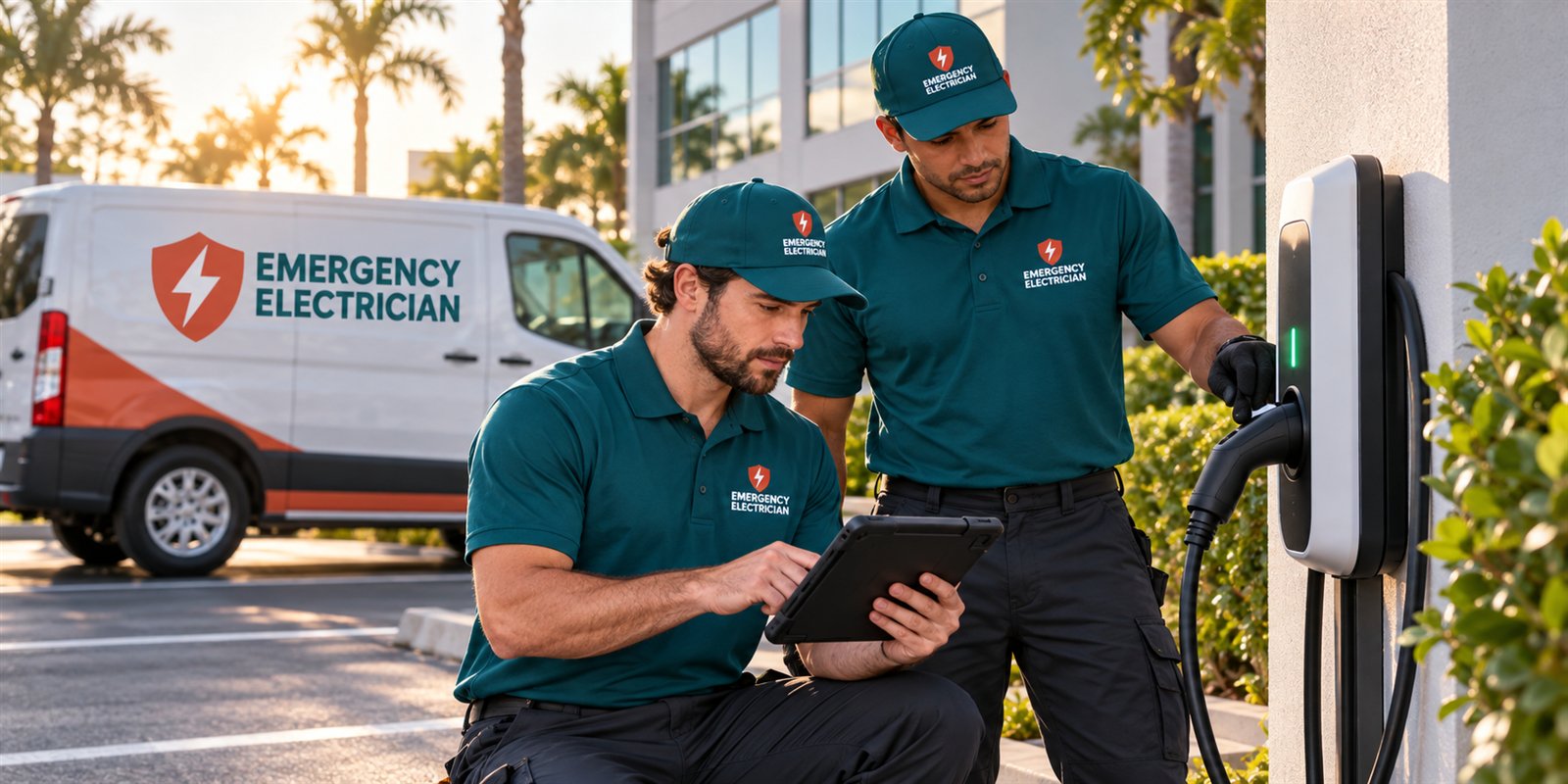
Triage first: stop charging and look for danger
If you see smoke, flames, melted plastic that is still burning, or sparking at the charger, the plug or the outlet, leave the garage, get everyone away from the building, and call 911 from a safe distance. A vehicle battery fire is a distinct hazard, and firefighters need to know that an electric vehicle is involved. Tell the dispatcher it is an electric vehicle charging fire as soon as you speak.
If someone has felt a shock from the charger, the cable, the vehicle or the garage door, and they are in pain, confused, or have any chest symptoms, call 911. Electrical injuries can look minor and still be serious. Do not touch the person if they may still be in contact with a live object. If you can safely switch off the circuit at the panel with a dry hand and a dry floor, do so, but never risk yourself.
If there is no fire and no injury, but the charger is hot, humming, tripping or smelling, the first step is to stop charging. Stopping the session is not the same as making the circuit safe. A charger that has been unplugged from the vehicle can still be energized at the wall. Switching off the dedicated breaker is the clean way to take it out of service.
- Flames, smoke or fire: leave, then 911, and say it is an electric vehicle.
- Shock or burn to a person: 911, do not touch them if still in contact with a live source.
- Heat, smell or tripping with no fire: stop the session and switch off the charger breaker.
- Do not use the charger again until it has been checked.
Why chargers fail differently from other loads
Most household circuits are used lightly and in short bursts. An EV charger is different. It draws a large current for hours without stopping. That sustained load tests every connection in the circuit: the breaker terminals, the wire connections, the receptacle if the charger plugs in, the charging cable and the plug on the vehicle end. A connection that is slightly loose may be fine in a toaster and fail in a charger.
Heat is the enemy. A loose terminal has higher electrical resistance, and resistance converts current into heat. The hotter it gets, the more the metal oxidizes and the worse the contact becomes, a cycle that can end with a melted receptacle or a scorched breaker. In a closed garage in July, with high ambient temperature, there is less margin to start with.
Many chargers come in two forms. A hardwired unit connects directly to a dedicated circuit with no plug. A plug-in unit connects to a heavy-duty receptacle, often the same type used for large appliances. Both can fail, but the failure points differ. Plug-in setups add a plug and a receptacle, which are the most common places for overheating. Hardwired setups concentrate the risk on the terminals inside the unit and at the breaker.
Signs the charger circuit is overheating
The most reliable early sign is warmth. A charger body that feels warm during use can be normal. A plug, receptacle, cover plate, cable or wall that feels hot to the touch is not. If you can see discoloration, browning or melting around the plug, the receptacle or the wiring entry, treat it as serious. Do not keep testing by touch. Heat damage means the connection has already failed to some extent.
Smell is another. A faint plastic or hot-metal smell near the charger, particularly when the vehicle has been charging for an hour or more, deserves attention. So does a crackling or buzzing sound from the wall behind the unit or from the breaker panel. Arcing can sound like frying or popping, and it can occur inside a wall without anything visible from the outside.
Behavior can warn you too. A charger that stops mid-session with a fault light, one that trips its breaker only on warm days or only after a long charge, or one that reduces its charging rate on its own, may be protecting itself against heat. Each of those is a symptom worth reporting, and each is a reason to stop using the charger until it has been checked.
| What you notice | What it may mean | Action |
|---|---|---|
| Plug or receptacle hot | Loose or worn contacts | Stop, breaker off, call |
| Discoloration or melting | Heat damage already occurred | Stop, breaker off, call now |
| Breaker trips after long charge | Overload, heat, failing breaker | Stop, call |
| Charger faults mid-session | Ground fault or thermal protection | Stop, call |
| Buzzing or crackling wall | Possible arcing | Breaker off, call now |
| Smoke or flames | Fire | Leave, call 911 |
Why the charger trips: the usual suspects
Tripping falls into two broad categories. Overcurrent trips happen when the circuit carries more current than its breaker allows for the time involved. Ground-fault trips happen when current leaks to ground through a path it should not take. An EV charger usually includes ground-fault monitoring in the unit itself, and the circuit may also have its own protective device at the panel.
Causes of overcurrent trips include a breaker that is aging and trips early, a circuit that is too small for the charger's setting, other loads sharing the circuit, a loose connection that heats the breaker, and a charger whose current setting is higher than the circuit can support. Causes of ground-fault trips include moisture in the charging cable or inlet, a damaged cable, water in the receptacle, a vehicle-side fault, and a failing charger.
Because the vehicle is part of the circuit, the problem sometimes lives there. A technician can try a different vehicle or a test load to separate a charger fault from a vehicle fault, though the vehicle's own service should handle any fault on the vehicle side. If the charger only trips with one vehicle, that is useful information. If it trips with none connected, the problem is on the wall side.
- Aging or weak breaker that trips early under sustained load.
- Charger current setting higher than the circuit supports.
- Loose terminals at the breaker, the receptacle or inside the charger.
- Moisture in the plug, the cable or the receptacle.
- Damaged cable that was run over or pinched in a car door.
- Charger electronics failing.
Garage conditions in South Florida
Heat, humidity and salt air all shorten the life of electrical connections. A garage that reaches high temperatures in summer leaves little margin for a load that makes its own heat. Humidity condenses on cool metal and creeps into plugs and covers. Homes near the coast see corrosion on terminals and screws sooner than inland homes. A charger installed in an open carport or on an exterior wall takes direct rain and sprinkler spray.
Flooding changes everything. A charger or its wiring that has been wet, even briefly, should be treated as unsafe until a technician has inspected and, where needed, replaced it. Water can leave residues in a connector that cause intermittent faults weeks later. See our page on garage and EV equipment after a flood for what to do if the garage took water.
Cord management matters too. A cable draped across a driveway, pinched under a tire, or kept coiled tight while charging can overheat and damage insulation. Coiled cable holds heat, so unwind it fully while charging. Keep the connector off the ground, and keep the plug-end dry. Most nuisance faults at the vehicle end trace back to dirt, water or a bent pin.
What a technician checks on arrival
The first step is safety isolation. The technician will confirm which breaker feeds the charger, switch it off, and verify with a meter that the circuit is dead before touching anything. Then comes a visual inspection of the charger, the cable, the plug, the receptacle, the wiring entry and the panel. They are looking for heat damage, discoloration, loose terminals, damaged insulation and moisture.
Next comes testing. They check that the wire size matches the breaker and the charger's current setting, and that the breaker is the right type. They measure voltage at the receptacle or the unit's terminals, and, where appropriate, they check the tightness of connections by inspection and by torque. Ground and neutral continuity and insulation integrity are checked to find leakage.
Finally they look at the load. The technician will ask what else is on the circuit, how long the charger runs, what the charger's current setting is and whether the home's main service has enough capacity for it. If the service is already near its limit, a charger can push the whole home to its edge. The honest answer may be that the circuit needs a repair, or that the setup needs a different arrangement. Both are explained plainly. For the service side, see service upgrades.
Repair paths and replacement decisions
If the cause is a worn receptacle or plug, replacing both with heavy-duty parts rated for continuous use may resolve it. If the breaker has failed or weakened, replacing it is the fix, and our page on urgent breaker replacement explains how that works. If the cable or charger is damaged, the unit may need repair or replacement through its maker or installer.
If the charger's current setting exceeds what the circuit can safely supply, the setting can often be lowered to match. That may increase charging time, but it protects the wiring. If the wiring itself is undersized, it has to be replaced, which is more involved work that may need permits and an on-site visit before a quote.
Some problems are bigger than the charger. A loose neutral, a failing panel bus connection or an overloaded service can show up first as charger trouble because the charger is the largest continuous load. If the technician finds evidence of that, they will explain it and recommend the right next step, which may be a panel repair or a service upgrade rather than another charger visit.
Quotes are given by phone after you describe the problem. A complicated job needs an on-site visit first. There is a service call charge, explained on the phone before dispatch.
Do not do these things
It is tempting to keep using the charger because the vehicle needs to be ready in the morning. Do not. A charger that has overheated once will likely do it again, and the damage can be inside the wall. Use public charging, a different vehicle or a ride share for a day or two rather than risk a garage fire with a car inside.
Do not use an extension cord or a multi-outlet strip with an EV charger. Do not swap in a household adapter to make a plug fit. Do not plug a charger into an outlet that is already warm. Do not lower the breaker rating or raise it to stop the tripping, because the breaker is sized to protect the wiring, not to accommodate the load.
Do not open the charger housing, bypass its ground-fault protection or reset it repeatedly. And do not ignore a repeating fault light just because the vehicle eventually charges. A fault that recurs is a signal that something is wrong in the path, and the sooner it is found, the smaller the repair tends to be.
- Do not keep charging a hot or tripping unit.
- Do not use extension cords or adapters with a charger.
- Do not change breaker size to stop tripping.
- Do not open the unit or bypass its protection.
- Do not charge a vehicle in a garage that has flooded.
Preventing a repeat and planning ahead
A well-built charger circuit is dedicated, correctly sized for continuous use, protected by the proper breaker, and installed with permit and inspection where required. If your charger was installed years ago by an installer you cannot identify, it is reasonable to have the circuit checked once, particularly before summer. Ask for the findings in writing so you can show them later to an insurer or a buyer.
Keep the area clear. Do not store cardboard, paint cans, gas cans or other flammables near the charger. Keep the cable off the floor when not in use. Wipe moisture from the connector and cover the plug between sessions. Check the plug and receptacle monthly by looking for color changes. If the charger has an app, pay attention to fault logs.
If you add a second vehicle, a bigger battery or a higher-power charger, treat it as a change to the electrical system. The load grows, and the service, the panel and the circuit may need to change with it. A phone call before the purchase can save an expensive surprise afterward. And if the current charger shows any heat, smell, tripping or discoloration, stop using it and call.
Calling about a charger problem
Have a few facts ready: the charger make if you know it, whether it is hardwired or plugs in, where it is installed, what the breaker is doing, and what you saw or smelled. Tell the dispatcher whether the charger has been switched off at the panel, whether anything looks scorched, and whether the garage or equipment has been wet recently. Mention anyone who felt a tingle.
The dispatcher will ask safety questions first and explain how the visit works. You will hear about the service call charge before anyone is sent out. You decide whether to go ahead. If the charger looks like it is overheating right now, you will be told to keep it off and stay clear.
If your charger is tripping, hot or smelling, stop charging, switch off its breaker if you can reach it safely, and call. A technician can find out whether it is a worn connection, a failing breaker, a damaged cable or a wider service issue, and explain your options before any work begins.
Questions people ask
Is it safe to keep using an EV charger that gets warm?
A charger body that is mildly warm can be normal. A plug, receptacle, cover plate or wall that is hot, discolored or smelling of plastic is not. Stop charging, switch off the breaker if you can reach it safely, and have the circuit inspected before using it again. Heat at a connection tends to get worse, not better.
Why does my charger trip the breaker only after a long session?
Sustained load is the likely reason. A breaker or connection that is aging, loose or slightly undersized can handle short loads but heat up over hours until it trips. Warm weather makes it worse. It can also be a ground fault from moisture. A technician can test the circuit, the breaker and the charger to find out which.
Can I use an extension cord with my charger temporarily?
No. Chargers draw heavy current for hours, and an extension cord or adapter adds resistance and heat at the weakest point. That is a common way to melt a plug. If the charger cannot reach, the circuit or the charger location needs to change, which is installation work for a qualified electrician.
What should I do if my garage flooded and the EV charger got wet?
Do not use it. Switch off its breaker only if you can reach the panel dry and safely, and otherwise call before entering a wet garage. Water can leave residue and corrosion that causes faults later. A technician should inspect the charger, the cable and the wiring, and replace parts that were submerged.
Is a tripping charger a problem with my car or the charger?
It can be either. A technician can often separate the two by testing the wall circuit without the vehicle connected, and by comparing behavior with the vehicle attached. A fault that happens only with one vehicle may be on the vehicle side, which should go to its service department. A fault with no vehicle attached is on the wall side.
How are quotes given for charger circuit repair?
Quotes are given by phone after you describe the problem, and more involved work needs an on-site look first. There is a service call charge, explained on the phone before dispatch. The technician explains the findings and the options in plain terms before any work starts, so you stay in control of the decision.
About "EV Charger Overheating or Tripping": call and give us the details, and we will explain what is safe to do while you wait and what the visit would cover. Jobs that cannot be quoted blind need a look on site.
Related pages
- Breaker Replace: A bad breaker can leave circuits dead or overheat in the panel. Learn when replacement is urgent, what is inspected beyond the breaker, and why testing follows.
- Service Upgrade: When a failed electrical service leads to an upgrade, how repair comes first, what a technician evaluates, and how the permit and utility steps work.
- Garage After Flood: Garages flood first and often hold the panel and EV charger. Learn what is safe to check, what to leave alone, and what an electrical re-check involves.
- Melted Plug: When a plug fuses into an outlet, do not pull it. Learn how to cut power at the breaker, what to report to the dispatcher, and how a technician clears it.
- Warm Outlet: A warm, browned or melted outlet is a heat warning. Learn how to read the damage, what to unplug, when it is a same-day call, and what a technician checks.
- Medical Office: Power failed in a medical or dental office? Learn the life-safety first steps, what circuits and backup planning cover, and what an electrician can do.