
Triage first: who to call in Weston
In any life-threatening electrical situation, call 911 first. That covers visible fire, heavy smoke, a person shocked and hurt, anyone unresponsive and anyone with chest pain, confusion or trouble breathing after contact with electricity. Give the address, say it is an electrical emergency and follow the dispatcher's instructions. In a gated community, say so, and give the entry details responders will need.
If a utility line is down, sagging or sparking, stay far back and keep people and pets away. Call 911 and the power company. Do not touch a fence, a vehicle, a pool enclosure or a puddle near the line. After storms, a line can be energized even when it is silent.
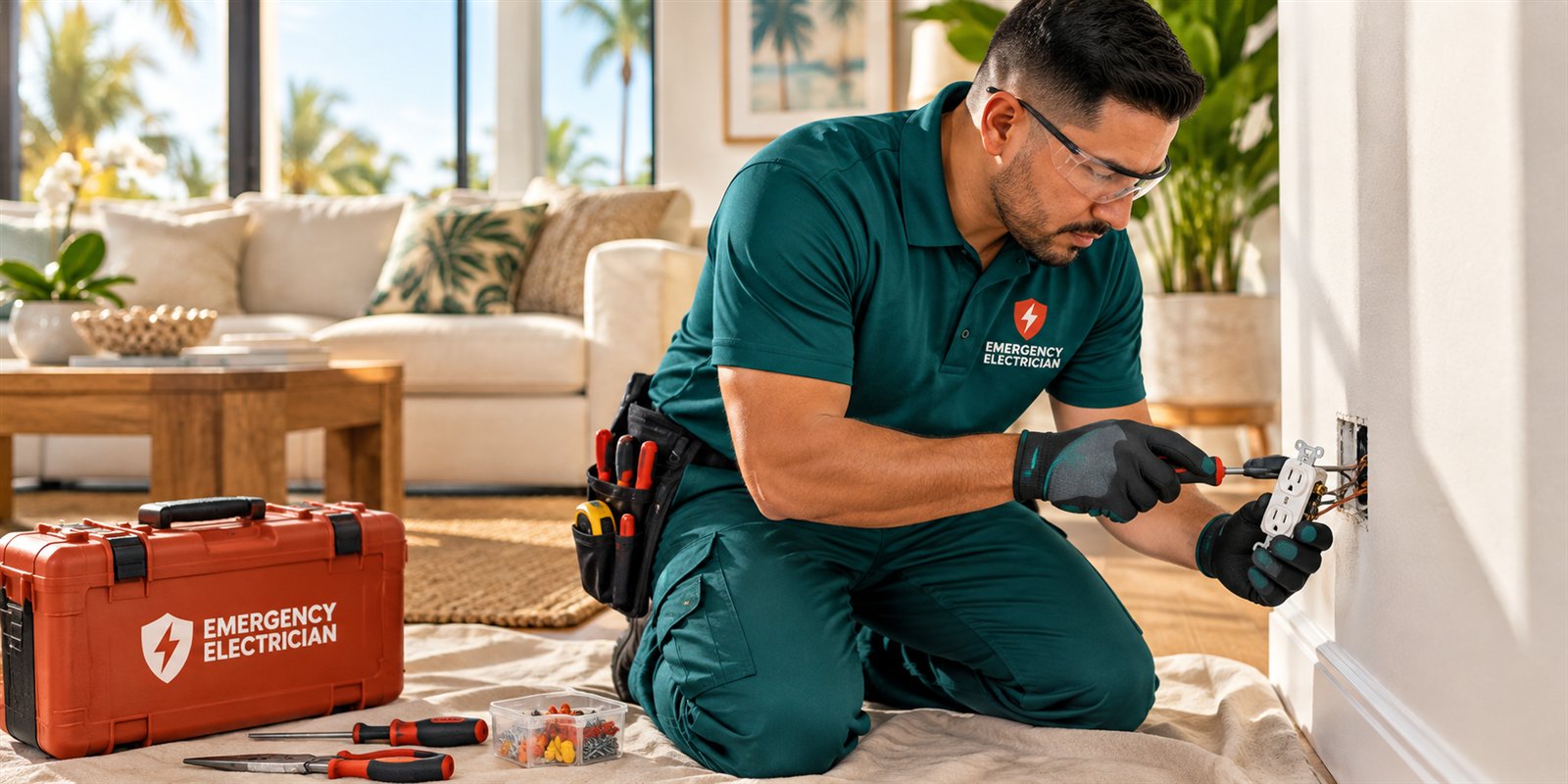
If nobody is in danger but something is clearly wrong, such as a hot or buzzing panel, a burning smell, a breaker that will not reset or part of the house dark, call an emergency electrician. The dispatcher will ask safety questions, explain how the visit works and tell you what to leave alone while you wait. In a large house, it helps to say which wing, floor or panel is involved.
- Fire, heavy smoke, injury or unresponsive person: 911 first.
- Downed or sparking utility line: stay back, call 911 and the power company.
- Smoke, heat or buzzing from any panel: stay clear, 911 if there is smoke, then an emergency electrician.
- One wing, floor or system dead: call an emergency electrician and name the panel involved.
Large homes and the loads they carry
A larger house does not just have more rooms. It has more of everything that draws power: several air conditioning systems, a pool with a pump and a heater, a kitchen with large appliances, a laundry room, a wine or beverage cooler, a home theater, a home office with servers and chargers, security and automation systems, landscape and driveway lighting and an electric vehicle charger or two. Add them up and the electrical service is working hard.
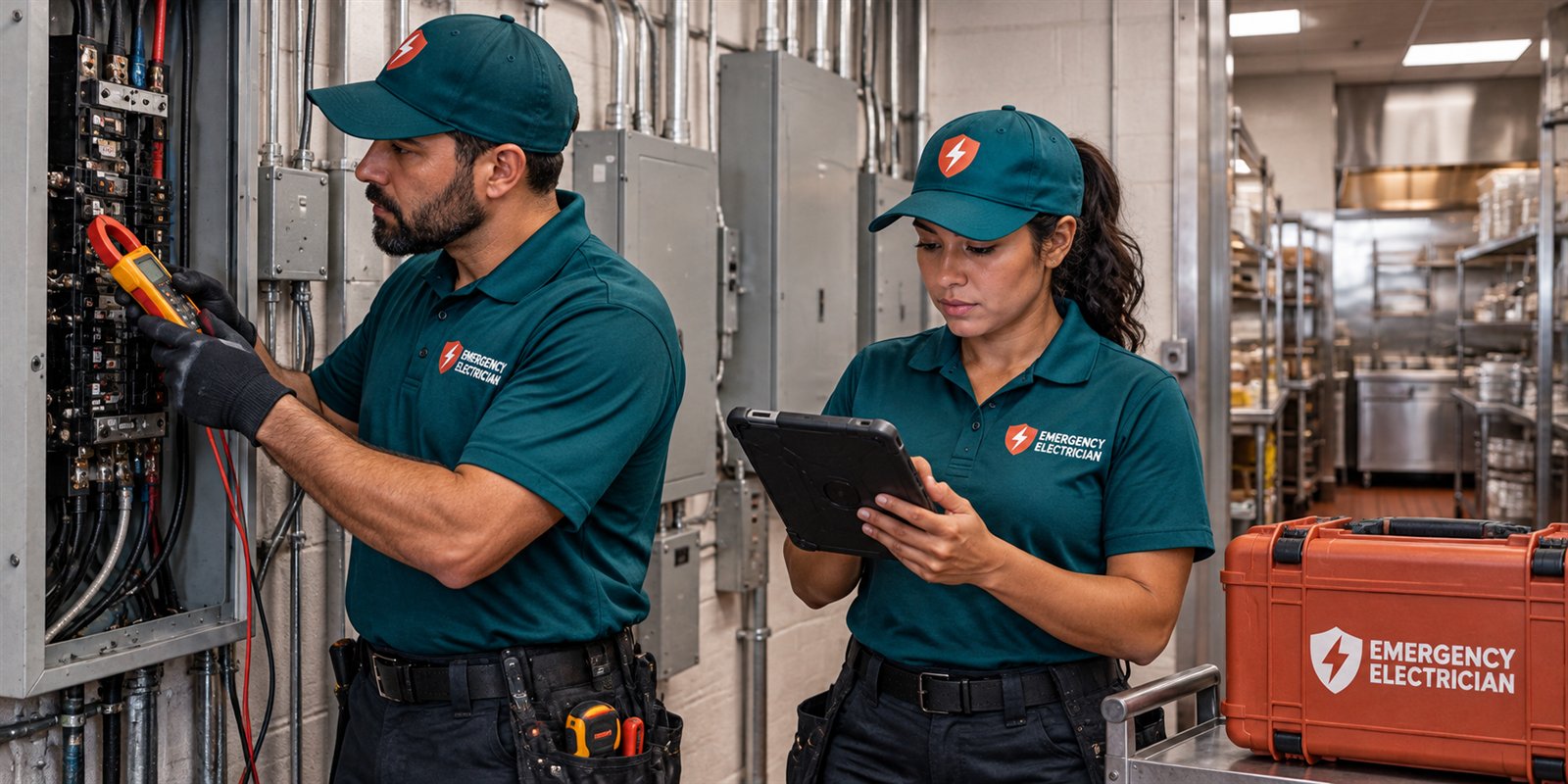
Large homes often have more than one panel: a main panel, one or more subpanels for a wing or a garage and a separate panel for the pool or the outdoor kitchen. That layout is sensible, but it creates more places where a fault can start and more ways for labeling to go wrong. When something fails, the first task is to find which panel feeds it, and that is much harder in a house with panels in several places and handwritten labels that no longer match.
Panel labeling is therefore one of the best preparations a large-home owner can make. Our page on panel labeling before an emergency explains how, and how to find your main breaker covers where to start. Know where every panel is, which is the main and which are subpanels fed from it.
Air conditioning at scale
In a big house, air conditioning is rarely one machine. Several air handlers, each paired with an outdoor unit, serve different zones. Each has its own breaker, disconnect, wiring and controls, and several run at once during a summer afternoon. The combined load is among the largest in the house, and a failure in one system can trip a feeder or leave other systems struggling.
Electrical faults in air conditioning show up as a unit that hums without starting, a breaker that trips when the system calls for cooling, a disconnect that is discolored or warm, a burning smell from an attic air handler or an outdoor unit that is dead. Treat burning smells and scorching as urgent. Set the thermostat to off, avoid opening the disconnect and call. If there is smoke, call 911.
A technician will test the circuit from the breaker to the unit, check connections and see whether the equipment itself is at fault. If the cause is a failed air conditioning component rather than the electrical supply, they will say so, so that you can call the right trade. Our page on air handler and outdoor disconnect failure explains the symptoms.
| Weston large-home situation | Likely electrical cause | First move |
|---|---|---|
| One zone of air conditioning dead | Zone breaker, disconnect or unit fault | Thermostat off, call |
| Pool equipment will not run | Ground fault, failed pump motor or timer | Leave breaker off, call |
| Subpanel in garage or wing dead | Feeder or subpanel breaker fault | Check main, leave off, call |
| Charger or outlet hot to touch | Loose connection or overloaded circuit | Switch off breaker, call |
| Whole house on generator will not transfer | Transfer switch or generator fault | Do not backfeed, call |
Pools, spas and outdoor kitchens
Pools, spas, summer kitchens, fire features and outdoor lighting all rely on electrical systems that are exposed to weather and, in the case of pools, to water. A pool needs equipment that is properly bonded, protected by ground fault devices and wired to avoid current in the water. Over years, connections corrode, seals fail and bonding wires loosen, so protection that once worked may no longer do so.
The risk to people is not abstract. A fault in pool lighting or a pump can place voltage in the water. If anyone feels a tingle or shock in or near a pool or spa, get everyone out immediately and do not go in to help. Call 911 if anyone is hurt. Switch off the pool breaker only if you can reach it dry. Then call an emergency electrician and keep the pool closed until the cause is found.
Outdoor kitchens bring appliances, lights, outlets and sometimes refrigeration into a place that gets rain and spray. Covers that are cracked, outlets that no longer reset and breakers that trip on damp days are all signs of moisture in the system. Our pages on pool equipment tripping power and pool and spa electrical after flood explain the hazards and the next steps.
Whole-house systems: generators, surge devices and automation
Owners of larger homes often invest in whole-house systems: standby generators with transfer switches, surge protective devices at the panel, battery storage, smart panels and home automation. Each adds convenience and resilience, and each adds a set of components that can fail or be misconfigured.
A standby generator that fails to start, that transfers incorrectly or that backfeeds the utility is a safety problem as well as an inconvenience. Our pages on standby generator fails to start, generator will not power transfer and generator backfeed risk go through what can go wrong. If you smell fuel or exhaust, or see smoke, shut it down if you can do so safely and call.
Surge protective devices wear out as they absorb surges. A device with an indicator that has gone dark or changed color is no longer protecting anything. A device that has failed in a storm tells you the house took a hit. Our pages on whole-house surge protector failed and when to add a surge device or generator explain what a technician looks at.
Bigger service equipment, bigger consequences
A large house usually has a large service: a bigger meter base, a larger main breaker, heavier conductors and a panel with many more spaces. The energy available at that equipment is greater than in a small house, and a fault there can do more damage. A loose connection at a large lug can run very hot, and a failed main can leave a house dark and the equipment inside a danger to touch.
Warning signs are the same as in smaller homes but deserve extra respect: a panel or meter base that is warm, a hum or crackle, a smell of hot plastic, scorch marks, discolored lugs or a main breaker that is stiff or will not move. Do not open the panel, do not touch the service equipment and do not keep switching breakers. If there is smoke, call 911 and leave.
Our pages on main breaker failed or seized, meter socket sparking and hot breaker or panel door explain what each can mean. Large equipment repairs usually need a permit and an inspection, and the utility has to disconnect and reconnect the service, so the sequence matters.
Electric vehicles, chargers and garage circuits
Weston garages often hold more than one vehicle, and more owners are installing chargers. A charger is a continuous load that can run for hours, drawing current near the limit of its circuit. That is hard on any weak connection. A loose terminal at the charger, the breaker or a splice will heat under that load, and heat damages insulation, plugs and enclosures.
A charger, a plug or a receptacle that is hot, discolored or smells of hot plastic should be switched off at the breaker and left alone. A charger that trips repeatedly or reports a fault should not be bypassed. If a garage has been flooded, keep out and keep the circuits off until a technician has checked them.
Our pages on urgent EV charger fault and garage and EV after flood explain the typical problems. Remember that a charger added to a panel that was already heavily loaded may need a service upgrade rather than a patch. A technician can explain whether the panel has room for it.
Storms, flooding and long outages in a large house
A large house takes more effort to protect and more time to restore after a storm. Hurricane season brings wind, rain, lightning and outages, and a house with several panels, many circuits and many electronics has a lot of equipment to check. Lightning can damage the air handlers, the automation system and the pool equipment at once. Water can enter a garage, an equipment room or a ground-floor panel.
Before storm season, know where each panel is and how to shut off the main. Photograph the panels, the meter and the major equipment. Know how your generator and your surge devices work. Our before-hurricane electrical checklist and hurricane season electrical readiness explain more.
After a storm, avoid standing water, stay away from downed lines and do not switch on any system that was wet. Surges can arrive when power returns, so switch off or unplug sensitive equipment first and bring things on one at a time. Our page on after-storm power restoration safety explains the careful sequence.
Utility, association or electrician: who fixes what
The power company handles its lines and equipment up to the connection to your building, which usually includes the meter. The owner handles the building-side equipment: the mast or entrance conductors in many arrangements, the meter base, every panel and everything downstream. A homeowner association handles community lighting, entry gates and shared equipment.
If the neighborhood is out, it is a utility matter. If only your house is out, check the main breaker and each panel, then look at the meter. A burned meter base or a damaged mast is generally an owner repair, but the utility has to disconnect and reconnect so the work can be done safely. Our page on utility or electrician, who fixes what sets this out.
Large repairs usually require a permit and an inspection through the city, and the utility may wait for the inspection before reconnecting service. A technician on an emergency call should explain what applies, may make the situation safe first and can arrange the permit and the inspection afterward.
Records, insurance and the written report
In a high-value home, documentation is not a luxury. Photograph the damage before repairs, including the panel, the meter, the failed equipment and any water or scorch marks. Keep the written findings report, the permit and the inspection result. List every damaged item. Insurers generally ask for these, and a clear record speeds the conversation.
Ask the technician to state the cause of the failure in plain terms, and to say what was done and what remains. A report that identifies the cause supports a claim and helps you prevent a repeat. If the cause is unknown, the report should say so and say what was ruled out.
Our guides on photographing damage before repairs, electrical damage and insurance documents and getting a written findings report explain what to gather and what to ask for.
What to tell the dispatcher and how to prepare
Give the dispatcher the address and the gate details. Say what happened, what you saw, heard and smelled and what you did. Say which panel, wing, floor or system is involved. Mention whether the area is wet, whether a breaker has tripped, whether anyone has felt a shock and whether anyone relies on medical equipment. Our page on what to tell the electrician dispatcher offers a short script.
You will be asked safety questions and told how the visit works, including the service call charge, which is explained on the phone before anyone is dispatched. Quotes are given by phone, and more complicated jobs need an on-site visit first. In a large house, expect the technician to spend time tracing circuits before repairing them.
To prepare, label every panel, write down the location of each main and subpanel and keep a flashlight and a charged power bank in a place you can find in the dark. Do not ignore small signs, because a warm outlet or a repeated trip is the earliest warning you get. If something looks, smells or sounds wrong, call.
Questions people ask
Who do I call first for an electrical emergency in Weston?
For fire, heavy smoke, a person shocked and hurt or anyone unresponsive, call 911 first. For a downed or sparking utility line, stay back and call 911 and the power company. For trouble at your property without immediate danger, such as a hot panel, a burning smell or a breaker that will not reset, call an emergency electrician.
Why is it harder to find a fault in a large home?
Large homes often have several panels and subpanels, many circuits and labels that no longer match. A technician has to find which panel feeds the failed system before tracing the fault. Clear labeling and a list of panel locations make the visit faster and the diagnosis more reliable.
One of my air conditioning zones stopped working and its breaker keeps tripping. What now?
Set that zone's thermostat to off and leave the breaker off. Repeated trips can point to a failing component, loose connection or damaged wiring. Do not touch the unit if you see water, scorching or smoke, and call 911 for smoke. Call an emergency electrician and say which zone is involved.
My standby generator did not start during an outage. Is that an electrical emergency?
It is urgent if someone relies on medical equipment or the home is unsafe without power. Do not connect a portable generator to a house outlet or panel, because backfeeding can kill utility workers. Call an electrician, who can check the transfer switch, controls and connections.
Can a charger added to my garage overload the panel?
It can. A charger is a continuous load, and if the panel or the circuit is already heavily used, connections run hot or breakers trip. A technician can check the panel's capacity and the circuit and explain whether it needs repair or an upgrade. A hot plug or outlet should be switched off at once.
How are quotes given for emergency electrical work?
Quotes are given by phone after you describe the problem, and more involved jobs need an on-site visit first. There is a service call charge, explained on the phone before dispatch. The technician explains findings and options in plain terms before any work begins, so you decide at each step.
Reading about "Emergency Electrical Help in Weston"? Tell us what stopped working and when. We will say what an electrician would check first, and quotes are given by phone when the job can be described.
Related pages
- AC Disconnect Burn: A melted or scorched AC disconnect box outside your home is an electrical hazard. See what to do now, who handles which part, and what to tell the dispatcher.
- Standby No-Start: The power went out and your standby generator stayed silent. See what an electrician checks, what a generator technician checks and what you can do safely.
- Pool Equipment Trips: A pool pump, heater or light that keeps tripping the breaker can signal water intrusion or a bonding fault. Learn what to do, who to call and what to tell them.
- Davie: Emergency electrical triage for Davie: rural-style lots, barns, wells and long service runs to detached buildings. Learn who to call first and what to check.
- Miramar: Emergency electrical triage for Miramar: newer suburban builds, open-sky lightning exposure and surge damage. Learn who to call first and what to check.
- Boca Raton: Emergency electrical triage for Boca Raton: high-rise condos, gated communities and homes with extensive landscape and pool lighting. Learn who to call first.