
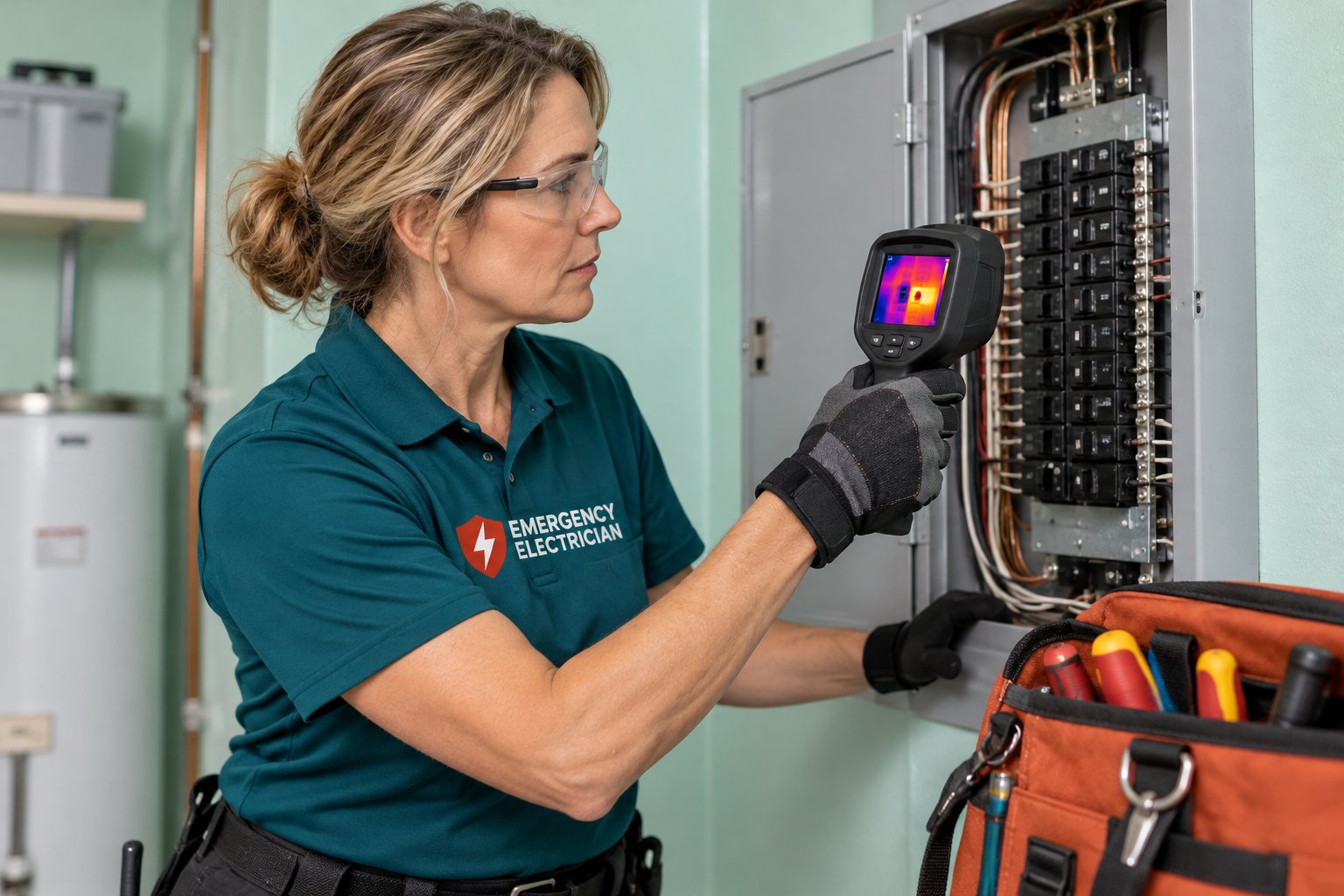
Look, do not open
The aim of this guide is simple: know where your main shutoff is, how to recognize it, and when it is safe to use, without opening anything. A main breaker, or main disconnect, is the large switch that turns off power to the whole panel. In most cases, it can be seen and found without removing any cover. If it requires removing a cover, a panel door that is screwed shut or entering a locked room you do not control, stop and ask a qualified person.
The inside of an electrical panel contains live parts even when the main is off, because the wires that bring power in from the utility remain energized above the main breaker. Never remove the metal cover that hides the wiring. Never poke, test or tighten anything inside. Do not take photographs with the cover off. The hinged door that shows the row of breakers is usually safe to open for reading labels, but if there is any sign of heat, water, rust, burning or damage, do not open it.
If anything about the panel seems wrong, such as a burning smell, buzzing, heat, scorch marks or water, do not touch it. If there is smoke or fire, call 911 first. Otherwise, keep away and call an electrician. A search for the main breaker is for calm moments. It is not a reason to go near a damaged panel in an emergency.
- Look and read, never remove covers or screws.
- Do not open a panel that is hot, wet, rusted, smoking or damaged.
- Do not touch the wires or metal parts inside.
- If a panel smells burnt or buzzes, stay away and call.
Where the main breaker usually is
In a single-family home in South Florida, the main panel is commonly found on an outside wall, near the electric meter, or in the garage, a utility room or a hallway closet. In newer homes, it may be in the garage or on the exterior near the meter. In older homes, it may be inside a closet, a laundry room or even a bedroom wall. Look near where the utility service enters the building. The meter is on the outside wall, and the panel is often directly behind it, inside.
Some properties have more than one panel. A main panel, called the service panel, holds the main breaker. A subpanel, which is fed from the main panel, might be in a garage, a detached building, a pool equipment area or an addition. A subpanel may have its own breaker that disconnects it, but it does not shut off the entire property. Do not assume the first panel you find is the main.
In a property with a meter on the outside and a disconnect switch next to it, the outdoor disconnect may be the main shutoff. It is often a gray box with a handle, mounted near the meter. In some properties, an outdoor disconnect and an indoor panel both exist. Ask an electrician to show you which does what. A technician can label them clearly during a visit.
How to recognize a main breaker
A main breaker is usually the largest breaker in the panel and is located at the top or the bottom, separate from the rows of smaller breakers. It often has a number printed on the handle, which shows its rating in amps. It may be a single large switch or two joined switches. It is often labeled main, main disconnect, or service disconnect.
Other breakers are smaller, arranged in two columns, and each controls a separate circuit. Some of them are wide because they serve 240 volt equipment such as an air conditioner, a range or a dryer. A wide breaker is not necessarily the main. The main is the one that sits apart and is labeled as the master switch for the entire panel. If you are not sure, do not guess by flipping breakers. Ask an electrician to identify it.
Some panels combine the main breaker with a meter, in a meter-main combination, mounted outside. Others have a main lug panel, which has no main breaker, and rely on a separate disconnect elsewhere. This is common in subpanels. If your panel has no obvious main, there may be a disconnect somewhere else, and a technician can help find it. Describe what you see, and consider a photograph of the closed panel to show them.
| What you see | Likely meaning | What to do |
|---|---|---|
| Large breaker, apart from the rest, labeled main | The main breaker | Note its location and leave it alone for now |
| Gray box with a handle near the meter | An outdoor main disconnect | Note it, do not open the box |
| Panel with only small breakers and no main | A main lug or subpanel | Look for a disconnect elsewhere, ask a technician |
| Several panels | A main plus subpanels | Find which panel is fed by the utility |
| Fuse box with pull-out blocks | Older fused service | Do not touch, ask a technician how it should be shut off |
Homes, condos and apartments
In a house, work outward from the meter. Walk around the outside to find where the service enters. Look for the meter and any disconnect near it. Then go inside along the same wall and look for the panel. Check the garage, utility room, and hall closets. Look at the walls rather than behind stored items, and keep that area clear for access.
In a condominium or an apartment, the arrangement is different. Each unit may have its own panel inside the unit, often in a hallway, closet or kitchen. The meters for the units may be grouped in a meter room or on an outside wall, and the main equipment for the building is typically in a locked electrical room that the association or landlord controls. Your unit's panel may have a main breaker for the unit, but not for the building.
Find your unit's panel and note whether it has a main. Ask the association or the manager where the building's main disconnect is and who has the key. Do not enter locked electrical rooms or force a door to look. See condo unit power loss, who to call and renters and electrical emergencies for more on who controls what.
Stores, offices and commercial spaces
In a business, the service equipment may be larger and more complex. A small store may have a single panel in a back room. A larger space may have a main distribution panel, with several subpanels, and perhaps three-phase power. The main disconnect may be a large switch in a dedicated electrical room, or on an outside wall. In a multi-tenant building, your suite panel may be separate from the building's main.
Walk the space, with the manager if possible, and find each panel. Note which one is the main for your suite, and which equipment each serves. Check whether the panels are accessible, with clear space in front, and whether doors are labeled. If a panel is blocked by shelving, stock or equipment, ask for it to be cleared. The panel should be reachable in seconds, not minutes.
If the building has a landlord-controlled main, find out who has the key and how to reach them after hours. Put that number where staff can see it. See arranging after-hours access for an electrical visit and electrical checks that support business continuity.
Mark it, label it, tell people
Once you have found the main, make it easy for anyone to find. Keep the area in front of the panel clear, with nothing stored on or around it. Make sure there is light nearby, and a flashlight within reach. Put a sign or label on the outside of the door or on the wall, if allowed, saying main electrical panel. In a leased space, ask permission before adding signs.
Tell everyone in the household or business where it is, and show them. Children old enough to understand should know not to touch it. Adults who may need to act, such as a spouse, a roommate or an employee, should know where it is and when it is appropriate to use it. Write the location on your emergency list. See a household emergency plan for power loss.
If your panel directory is missing or wrong, ask an electrician to help label it during a visit. Do not try to identify circuits by switching breakers during an emergency. See panel labeling before an emergency. A clear label is a small thing that makes a big difference when someone is trying to find the right switch in the dark.
When it is appropriate to use the main
Shutting off the main removes power from the building's circuits and can reduce risk in some emergencies, such as before a hurricane, in a flood threat, or when a technician asks you to. It does not make the panel safe to open, because the incoming wires remain live. It does not stop a fire already burning in a wall. It is one step among others, and never a replacement for calling 911 when there is fire, smoke or injury.
Use it only if you can reach it safely. Do not go to the panel if you must step in water, if the panel is hot, smoking, sparking or scorched, if you smell burning near it, or if the floor around it is wet. Do not use it with wet hands. Stand to the side, use one hand, and keep your face away. If you are unsure, stay back and call for help.
Be aware of what happens when the main is off. Lights, refrigeration, medical devices, alarms and sump pumps may stop. Plan for these, particularly if someone in your household relies on powered medical equipment. Our guide on when it is safe to use the main breaker explains the decision in detail, and when to shut off the main before a storm covers hurricanes.
- Confirm that the area around the panel is dry and undamaged.
- Check that there is no smoke, heat or burning smell at the panel.
- Stand to the side and use one hand on the large main handle.
- Switch it off firmly and step back.
- Call for help and do not open the panel.
What to leave alone
There are several things you should not do, even with the main off. Do not remove the panel cover. Do not touch the large wires that come into the top of the panel. Do not try to repair a breaker, change a breaker or tighten a connection. Do not spray cleaner or water on the panel. Do not use metal tools near it. Do not pry open a locked electrical room.
Do not bypass or tape a breaker in the on position. Do not reset a breaker that tripped with a burning smell or a bang. Do not keep resetting a breaker that trips. Do not operate the main with wet hands or while standing in water. Do not allow children to play near the panel. Do not store flammable items near it.
If the main breaker itself seems stuck, will not turn off, feels hot, or makes noise, stop and call. A main breaker that fails to open is a serious problem because there may be no other way to shut off power inside the building. In that case, the utility may need to disconnect power at the meter, and you should call 911 if there is fire or smoke. See main breaker failed or seized.
Fuse boxes, outdoor disconnects and unusual setups
Some older homes still have fuse boxes, with screw-in fuses or pull-out blocks. A fuse box can have a main disconnect in the form of a pull-out block, a lever or a separate switch. These are not safe for an untrained person to handle, because the parts can be hot and may be energized. If you have a fuse panel, look but do not touch, and ask an electrician how the system is meant to be shut off, and whether it should be updated.
Some properties have a main disconnect outdoors, especially where there is a detached garage, a pool, a guest house or solar equipment. Others have more than one disconnect serving different parts. Solar systems add their own shutoff switches, and the main breaker does not necessarily make the solar panels safe. If you have solar, battery or a generator, ask the installer where each disconnect is and how they interact.
Mobile homes, boat docks, outbuildings and farm buildings have their own arrangements. If your setup is unusual, take photographs of what you can see from the outside and ask a technician to explain it at the next visit. This is a good use of a continuity check, as described in continuity checks. Do not experiment.
A calm-day checklist
Take ten minutes on a calm day to do the following. Find the meter. Find the panel or panels. Identify the main breaker or disconnect, from the outside. Check that the area around the panel is clear and dry, and that there is light. Note whether the panel door is labeled and whether the directory is readable. Write down the location of the main on your emergency list.
Show the location to everyone in the household or business who may need to know. Put a flashlight and spare batteries near the panel. If you have a medical device that depends on power, write down what to do if the main is switched off. If you rent, tell the landlord if the panel is blocked or if the main is in a locked room that you cannot reach.
Look for warning signs, from the outside: rust, water stains, scorch marks, a buzzing noise, a burnt smell, or a door that will not close. Report them. If you see any, do not touch the panel. Call an electrician and describe what you see. The checklist is a way to prepare, not a reason to open anything.
- Meter found and noted.
- Panel and main identified from the outside.
- Area clear, dry and lit, with a flashlight nearby.
- Everyone who may need to know has been shown.
- Any warning signs reported to an electrician.
Call if you cannot find it or something looks wrong
If you cannot find the main, if there is more than one and you are not sure which is which, or if you see anything that worries you, call and describe what you can see. A technician can identify the main, label it and show you how it works on a visit. This is a sensible use of a visit, and may be combined with a safety check of the panel.
The service call charge is explained on the phone before anyone is dispatched, and quotes for any repair are given by phone, with an on-site look for complicated jobs. If you are in the middle of an emergency, such as smoke, a burning smell, sparks or a wet panel, do not go to the panel. Call 911 first if there is fire, smoke or injury, then call.
A few minutes of looking now can make an emergency simpler later. When you are ready, call and tell us what you found.
Questions people ask
Where is the main breaker usually located?
In many South Florida homes it is in the main panel on an exterior wall near the meter, in the garage, or in a utility room or hall closet. Some properties also have an outdoor disconnect near the meter. In condos and commercial buildings, the building main may be in a locked electrical room. Look and read only, and never remove covers.
How do I tell the main from the other breakers?
The main is usually the largest breaker, set apart from the rest at the top or bottom of the panel, with a higher amp number on the handle and often labeled main. Wide breakers in the rows are usually 240 volt circuits, not the main. If unsure, do not experiment by flipping switches. Ask an electrician to identify it.
Is it safe to open the panel door to find it?
The hinged door that shows the breakers is generally fine to open on a calm day if the panel is dry, cool and undamaged. Never remove the metal cover behind it, and never touch the wires. If there is heat, a burning smell, buzzing, water, rust or scorching, do not open it. Call an electrician.
Does turning off the main make the panel safe to open?
No. The wires that bring power from the utility into the top of the panel stay energized even when the main is off. Only a qualified person should open the inner cover, and only with proper precautions. Switching off the main reduces risk to the circuits but does not make the panel safe to work in.
I rent a condo or apartment. Who controls the main?
Your unit probably has its own panel, sometimes with a unit main, while the building main is usually in a locked room controlled by the association or landlord. Ask who has the key and the after-hours number. Do not force a door or open locked equipment. Tell the manager if your panel is blocked or looks damaged.
What if the main will not turn off?
Stop and stay back. A main that is stuck, hot or noisy is a serious problem. If there is smoke, fire or a burning smell, call 911 first. The utility may need to disconnect power at the meter. Do not force the handle or open the panel. Call an electrician and tell them what you saw and heard.
Reading about "Finding Your Main Breaker Before an Emergency"? Tell us what stopped working and when. We will say what an electrician would check first, and quotes are given by phone when the job can be described.
Related pages
- Using the Main Breaker: Plain guidance on when shutting off the main breaker is reasonable, when to stay away from the panel, and who to call first in an electrical emergency.
- Panel Labeling: Why an accurate circuit directory matters in a crisis, what a good one looks like, and how labels are updated safely without opening the panel yourself.
- Seized Main: Main breaker burned, stuck or will not switch off or on: why it happens, why the utility may need to pull the meter and what to do in the meantime.
- Main Off Before Storm: Decision logic for turning off the main breaker before a storm: flood risk, surge risk, medical needs, safe technique and how to re-energize later.
- Household Plan: Build a simple family plan for electrical trouble: who calls 911, who handles the panel, where to meet outside, and what to tell the dispatcher.
- Emergency Permits: How urgent electrical repairs still move through permits and inspections in South Florida, what usually needs one, and what to ask before work starts.