

Why a single room points to a local cause
A house is wired as a set of branch circuits, each protected by its own breaker and each serving a group of outlets, lights or fixed equipment. A circuit rarely follows the floor plan neatly. One bedroom may share a circuit with the hall, a bathroom outlet, and an outlet in the room next door, while another circuit serves only the ceiling lights. When one room goes dead and the others do not, the likely explanation is that the circuit or the device that feeds that room has stopped delivering power.
That is reassuring in one sense. A whole-house problem often involves the service, the meter or the main breaker, which are larger and more serious. A single-room outage usually involves a branch breaker, a GFCI device, a loose connection at an outlet or switch, or a failed light fixture. All of those are smaller and easier to isolate.
It is not harmless, though. Some of the reasons a room loses power involve heat. A connection that has burned open can leave the wiring dead but hot, or can arc intermittently. A circuit that stopped because of a short may have damaged insulation inside a wall. The goal of this page is to help you sort the quick, safe causes from the ones that need a professional promptly, and to do it without touching anything that could hurt you.
Before anything else, if you see smoke, smell burning or hear sizzling, stop reading and follow the steps in what to do if you smell burning. Call 911 for smoke or fire.
Check for a tripped breaker first
The most common reason a room loses power is a tripped breaker. Go to the panel, which may be in a garage, a hallway, a utility room or outside. If you are unsure where it is, the guide on finding your main breaker and the panel may help. Make sure the floor is dry and you are not standing in water.
Look for a breaker handle that sits in a middle position or in the off position while the others are on. Many breakers move to a middle position when they trip. If the panel has labels, check which circuit is marked for that room, but do not rely on labels entirely, because they are often wrong or out of date.
If you find one tripped breaker and you can do so safely, a single reset is reasonable. Push the handle firmly to the full off position first, then to on. If the breaker holds and the room has power again, make a note of what was running and watch for a repeat. If the breaker trips again right away or soon afterward, leave it off. A repeat trip is a hard stop, and the page on breakers that trip again after reset explains why.
Do not open the panel cover, and do not touch anything inside. If several breakers look unusual, if the panel feels warm, or if there is any sound or smell from it, step back and call.
GFCI devices that sit somewhere else
A GFCI is a protective device that cuts power when it detects current leaking where it should not. It often appears as an outlet with test and reset buttons, found in bathrooms, kitchens, garages and outdoors. A GFCI outlet in one place can feed other outlets downstream, even in a different room. So a dead outlet in a bedroom may be fed by a GFCI in a bathroom, a garage or an outside wall.
If your dead room has outlets that are not working, look in nearby bathrooms, the garage, the kitchen counter and on exterior walls for a GFCI with a tripped reset button. Press the reset button firmly. If it clicks and holds, and the room has power again, that was the cause. If it will not reset, or if it trips again immediately, there may be a fault downstream, moisture in an outdoor box, or a failed device. See a GFCI that will not reset for what that means.
Some circuits also use arc-fault breakers, which trip for a different kind of fault. They can trip because of a damaged cord, a loose plug or a connection that is arcing. If the breaker has a test button and the handle is not obviously tripped, look for an indicator or a small light. The guide on what GFCI and AFCI devices protect against explains the difference.
Do not defeat or bypass these devices. They exist because a leaking current can be lethal in wet areas, and an arc can ignite a wall. A device that trips repeatedly is telling you something that needs to be found, not silenced.
Hidden connections: the cause that matters most
If no breaker is tripped and no GFCI needs resetting, the dead room often has a failed connection somewhere along the circuit. Wiring runs from the panel to the first outlet, then onward from outlet to outlet like links in a chain. If a connection fails at one outlet, everything beyond it goes dead, even though the breaker looks fine.
Connections fail for several reasons. Back-stab terminals, where a wire is pushed into a hole on the back of an outlet rather than wrapped under a screw, can loosen over time and heat up. Wire nuts in junction boxes can come loose with vibration or temperature swings. Aluminum conductors, which are found in some older homes, expand and contract more than copper and can loosen. Corrosion from humidity and salt air, common in South Florida, adds resistance. Rodents and construction can damage the wire itself.
A failed connection can be quiet, or it can be hot. The heat is why a dead room that lacks any obvious cause should not be dismissed. A connection that has burned open may have scorched the box, the insulation or nearby framing. Signs include a faint burnt smell near a wall, a discolored cover plate, a switch or outlet that is warm, or a crackling sound.
You cannot find a hidden connection safely by pulling covers off, because the wires inside may be energized from the other direction. This is the work of a technician with a meter and a plan, and it is why the best response to an unexplained dead room is to leave the circuit alone and call.
What you can observe without touching live parts
There is useful information you can gather safely, which helps the technician and helps you decide how urgent this is. Stand in the doorway and notice what is dead: only outlets, only lights, or both. Notice whether anything in the room is still working, such as a lamp plugged into a different wall, a smoke alarm or a device on battery.
Check the adjacent rooms and hallway. If a neighboring room, a bathroom or a closet also lost power, say so, since that helps map the circuit. Check whether a ceiling fan, a doorbell or an outdoor light is affected. Check whether the issue began with an event: a vacuum, a hair dryer, a space heater, a window air conditioner, a storm or a loud pop.
Look at the outlets and switches without touching them. Are any cover plates brown, warped or marked? Does anything smell hot or like fish or burnt plastic? Is there any sound? Is any outlet visibly loose or cracked? Make a note, and if you can do it safely, a photo from a distance.
Unplug what was in use in the room, if you can do so safely and the outlet shows no heat or damage. This keeps a sudden return of power from starting a load you do not intend to run. Do not move cords to other outlets in the house to keep using them, because that can overload a different circuit. Leave the room's outlets unused until the cause is found.
- What is dead: outlets, lights, or both?
- Are adjacent rooms or hallway outlets affected?
- Did something specific happen first, such as a heater, a vacuum, a pop or a storm?
- Any smell, sound, warmth or discoloration at outlets, switches or fixtures?
- Anything unplugged, tripped or reset already?
Equipment loads that cause room outages
Some single-room outages follow a specific load. A space heater, a window air conditioner, a hair dryer, an iron or a microwave can draw enough current to trip a breaker, especially if several are on one circuit. After a trip, the circuit stays off until reset, and the room goes dark. If this is the cause, the pattern repeats whenever the same loads run together.
Overloads are not the same as faults. An overload is a legitimate trip of a breaker doing its job, and the remedy is to spread the load or give a heavy appliance its own circuit. But a persistent overload can also heat a loose connection or an aging outlet, so a circuit that trips regularly should be examined. The guide on space heater and window AC circuit safety discusses why.
Extension cords and power strips can contribute. A strip that has been overloaded or damaged may have caused a trip and may itself be unsafe. If you used one, set it aside and do not plug it in again until it has been checked.
Also consider whether a recent change set off the outage. Did someone install a new light, swap an outlet, drill into a wall or hang a picture? A nail or screw can damage a cable behind drywall and cause a short or an open circuit. If so, tell the technician exactly where and when, since that narrows the search.
When it is an emergency and when it can wait
Many dead-room situations are not emergencies, but some are. Treat it as urgent and call promptly if you notice any of these: a burning smell or visible discoloration near an outlet, switch or fixture; a buzzing, crackling or sizzling sound; a breaker that trips again immediately; a warm wall or cover plate; water near the circuit, such as after a leak or storm; or any shock or tingle when touching something in that room.
If a person has been shocked, or if there is smoke or flame, call 911 first. For the broader question of how urgent a situation is, the guide on whether it is an emergency and the page on emergency call versus next-day visit can help you decide.
If none of the warning signs are present, the circuit is simply off, the room has no safety concerns and you can live without it for a while, a next-day visit may be reasonable. In that case, keep the circuit's breaker in the off position or leave the loads unplugged, and do not use extension cords from other rooms to compensate.
Medical and food needs can raise the stakes. If a room with a medical device or a refrigerator is dead, tell the dispatcher. A refrigerator in a garage or a pantry dead for many hours is a practical problem, even if the wiring risk is small. Dispatchers can take that into account when they plan the visit.
What the technician does and what to have ready
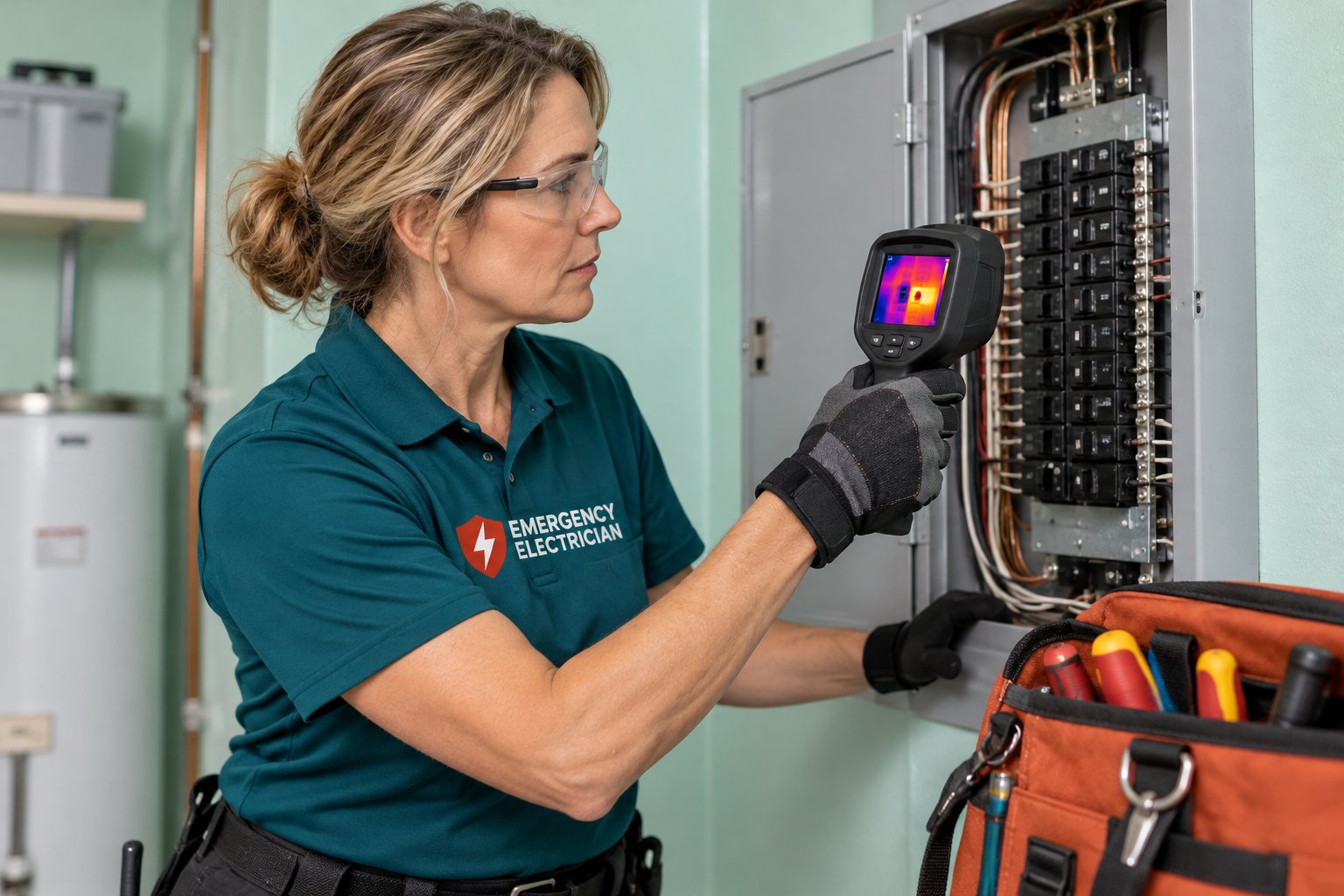
On arrival, a technician will confirm the symptom, check the panel and any GFCI or AFCI devices, and use a meter to find where power stops along the circuit. They test outlets, switches and fixtures in sequence, open boxes with the circuit isolated, and look for burned, loose or corroded connections. They may also test for a short or ground fault on the cable.
Typical findings include a loose back-stabbed outlet, a failed wire nut, a damaged cable, a worn switch, a tripped upstream GFCI, or a breaker that has weakened. The repair may be as simple as remaking a connection or replacing a device, or it may involve replacing a section of cable or correcting a mixed circuit. If a connection has burned, the technician will assess the damage to the box and wall.
To prepare, have the address and access information ready, along with a clear description of what is dead and what happened. Clear the room so the technician can reach outlets and walls. Keep pets and children out. Leave the room's breaker off if you tripped it, or on if it is on and the room is simply dead, and tell the technician what you did.
Quotes are given by phone only. Straightforward repairs may be done at the visit, while more complicated work needs an on-site look first. There is a service call charge, explained on the phone before dispatch. If you are staring at a dark room and are not sure whether it is a quick fix or a hidden problem, call and describe it. A short conversation can sort that out.
Questions people ask
Why is only one room without power when the breaker panel looks normal?
The most likely causes are a GFCI device elsewhere that has tripped, a breaker that tripped but looks nearly normal, or a failed connection at an outlet, switch or junction box that cuts off everything beyond it. Because the cause may be hidden and may involve heat, it is worth having it traced rather than leaving it indefinitely.
Can a GFCI outlet in a bathroom control a bedroom?
Yes. A GFCI feeds the outlets downstream from it on the same circuit, and those outlets can be in other rooms, in the garage or outdoors. If a room has dead outlets, check nearby bathrooms, the kitchen, the garage and exterior walls for a tripped GFCI reset button. If it will not stay reset, a technician should look at it.
Is it safe to plug things into an outlet in another room instead?
Use caution. Moving loads to other circuits can overload them, especially with heaters, air conditioners or power strips. If another outlet is on a healthy circuit and the load is modest, it may be fine, but do not use long extension cords across rooms or doorways. Leave the dead circuit unused until the cause is found.
What if I smell something near an outlet in the dead room?
Treat it as urgent. A burnt smell can mean a connection has overheated or burned open. Do not touch the outlet, keep people away, and call an electrician. If you see smoke or flame, leave the building and call 911. Tell the dispatcher what you smelled and where, and whether any breaker tripped.
Can I check the outlets myself with the cover off?
It is not recommended. Wires in an outlet box may be live from another direction even when the breaker is off, and mistakes can cause shock or fire. A technician has the instruments and procedures to test safely. You can still help by noting what is dead, what happened first, and any smell, sound or discoloration.
How is the visit priced?
Quotes are given only by phone. Complicated jobs need an on-site visit first so the quote reflects what is actually wrong. There is a service call charge, and the dispatcher explains it before anyone is sent. If a repair is simple, it may be completed during the visit. Call and describe the dead room to learn how it would be handled.
About "A Single Room Lost Power Suddenly": call and give us the details, and we will explain what is safe to do while you wait and what the visit would cover. Jobs that cannot be quoted blind need a look on site.
Related pages
- GFCI Won't Reset: A GFCI that will not reset means a fault or a failed device. Learn what safe checks you can do, what to avoid, and how to describe the problem by phone.
- Breaker Re-Trips: A breaker that trips again right after you reset it points to a hard fault. Learn why repeated resetting is risky and what to do and tell the electrician.
- Half-House Outage: Half your home lost power while the rest works. Learn why a split outage can mean a lost leg, what you can check safely, and why to call an electrician.
- GFCI and AFCI Explained: A plain explanation of ground-fault and arc-fault protection, where each is used, what each catches, and the limits that still call for caution.
- Emergency Check: A branching guide from symptoms to urgency, showing when to call 911, when to call the utility, when to call an electrician now, and when a visit can wait.
- Small Fire: Small flames at an outlet, cord or appliance still mean get out and call 911. Learn why water is wrong, when an extinguisher is an option and what follows.