
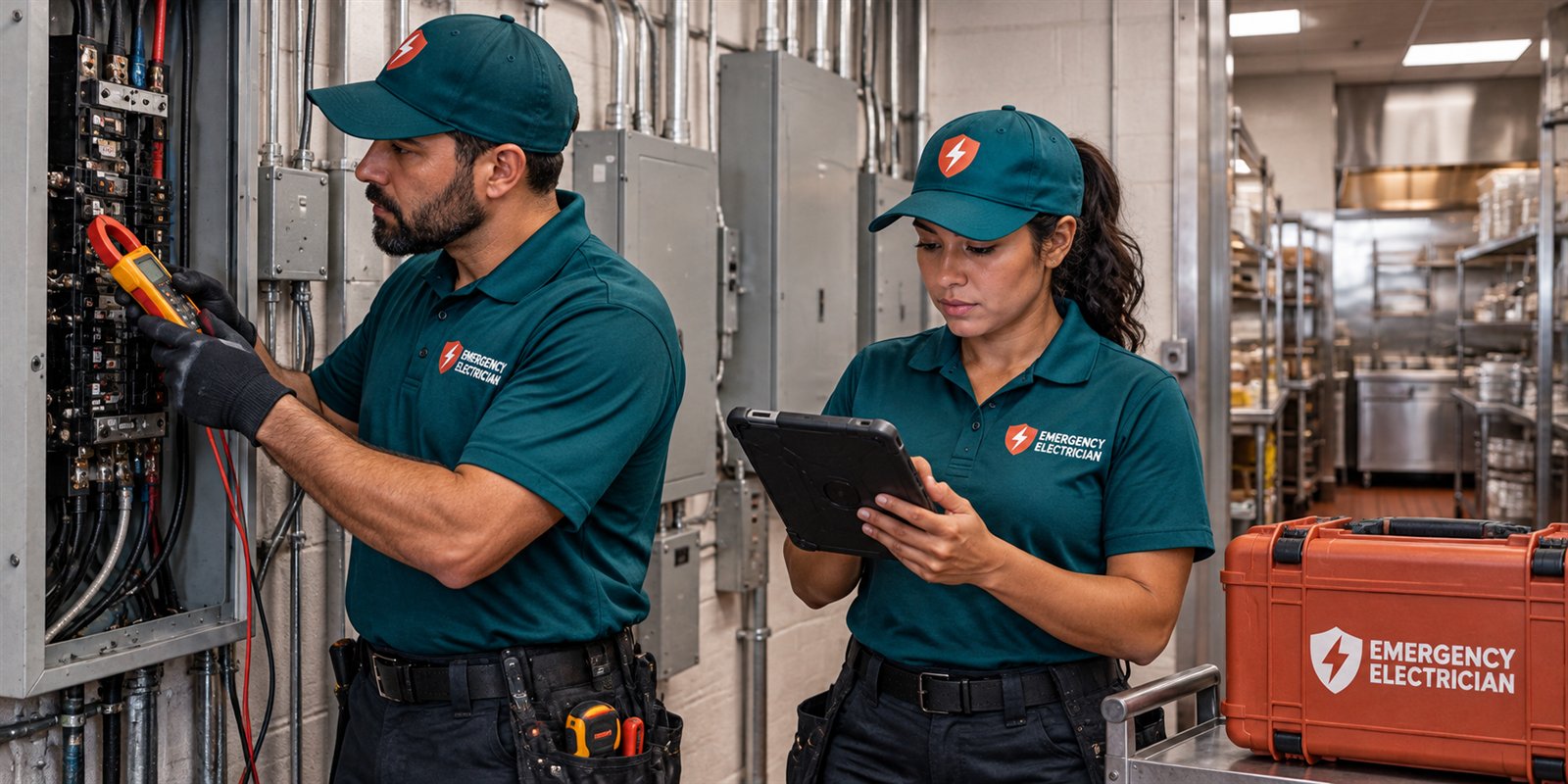
Safety first: kitchens carry fire, gas, and water risks together
If you see flames, smoke, or sparks, smell burning or gas, or someone has been shocked, call 911 and get everyone out. Use the fire suppression system if it is part of your setup and you have been trained to do so, and follow your own emergency plan. Do not return to check equipment. A commercial kitchen concentrates fuel, grease, heat, and electrical load, and an electrical fault there can spread quickly.
If you smell gas, do not touch light switches or electrical equipment, and leave immediately. Call 911 and the gas utility from a safe distance. A power failure can interact with gas equipment, because hood exhaust systems and ignition controls rely on electricity. Gas appliances running without exhaust can fill a kitchen with combustion products. If the hood has stopped, shut down the cooking equipment and ventilate according to your emergency plan.
If nothing is on fire and nobody is hurt, the next question is whether the kitchen is safe to continue operating. In most cases the answer is no. A kitchen that has lost power to its hood, lighting, or refrigeration is in an abnormal state, and you should not run cooking equipment without proper exhaust or in poor visibility on wet, greasy floors. Safe closure of the line is part of the electrical response, not a failure of it.

How a commercial kitchen is wired, in plain terms
A restaurant kitchen is fed by a service that is usually larger than a home's, often three-phase in a commercial building. The service feeds a main distribution panel and one or more sub-panels, which in turn feed circuits for the cooking line, the hood, refrigeration, dish machines, lighting, receptacles, and the front of the house. Each group has its own breakers, and each may be on a different phase. A fault in one place can take down a section while the rest of the kitchen runs.
The hood and exhaust system is often interlocked with the cooking equipment, especially in a setup with a fire suppression system. If the hood fan loses power, the interlock may shut down gas or electric cooking equipment for safety. That can look like a mysterious failure of several appliances at once, when the actual cause is a single tripped breaker or a failed control on the hood circuit.
Refrigeration circuits include the walk-in cooler and freezer, reach-in units, and prep tables. Compressors are heavy motor loads, and they are sensitive to low voltage, lost phases, and rapid power cycling. Dish machines and booster heaters draw high current. Equipment with electronic controls, such as combi ovens, can be damaged by surges when power returns. For the three-phase side, see three-phase loss of phase.
Common causes of kitchen power failure
Overload is a frequent cause. Kitchens add equipment over time, such as another fryer, a bigger oven, or a new dish machine, and the original circuits may be asked to carry more than they were designed for. A hot day, a full house, and every piece of equipment running can push a circuit past its limit. The breaker trips to protect the wiring, and the kitchen goes dark in one section.
Moisture and grease are another cause. Water from cleaning, leaking pipes, and steam finds its way into receptacles, junction boxes, and equipment, and grease can coat wiring and make connections hot. A ground fault device may trip repeatedly because of moisture in a circuit. Loose connections at breakers and terminals heat up under constant load and can fail. See when a GFCI will not reset and a hot breaker or panel door.
Utility and building problems also happen. A failed phase at the service, a loose neutral, or a voltage problem can affect equipment. A storm can cause outages and surges. An old panel can have failed breakers. In a leased space, the landlord's equipment may be involved. Our page on the first-hour checklist for a business power loss describes how to sort out whose problem it is.
Food safety timing: protect the food while you wait
Food safety is a second clock running alongside the electrical problem. Perishable food that sits above safe temperatures for too long becomes a health risk, and the length of time that is acceptable is set by food safety guidance from health authorities, not by the electrician. Know your own procedures, and follow the guidance that applies to your operation. Keep doors on refrigeration closed as much as possible to hold temperature.
Take temperature readings and record them, with times. If you have a thermometer, check the walk-in, the reach-ins, and the prep tables, and write down what you find. If the outage is expected to be long, think about moving high-risk items to working refrigeration, using ice or coolers where appropriate, and arranging for a refrigerated truck or other options. Your records show what happened and support any later decisions about what to keep and what to discard.
The decision to discard food belongs to you and, where relevant, to the health authority. Do not let the pressure to save product push you to serve something that may be unsafe. The electrician's job is to restore safe power as quickly as is safe. For the walk-in specifically, see walk-in cooler electrical failure.
What a manager can safely do in the first minutes
Start with people and the line. Tell the cooks to shut down gas and electric cooking equipment safely, move hot items to a safe place, and keep people clear of wet floors. Switch off equipment so that it does not restart unexpectedly when power returns. Turn off the hood only if that is part of your procedure. Keep walkways clear and use flashlights or battery lanterns for visibility.
Look for the simple things. Check the main panel and sub-panels, if they are dry, accessible, and without burning smells or noise, and see whether a breaker has tripped. Take a photograph before touching anything. If a single breaker has tripped and you can identify an obvious overload, such as several pieces of equipment on one circuit, unplug or switch off the load and reset once. If it trips again, stop.
Leave several things alone. Do not open panels or electrical equipment covers. Do not reset a breaker that keeps tripping. Do not use extension cords to reroute power to refrigeration. Do not hose down equipment that may be energized. Do not try to bypass the hood interlock. The guides on how to read a tripped breaker and what never to do in an electrical emergency explain the reasons.
What a technician checks in a kitchen
A technician starts by confirming the scope: which circuits and equipment are affected, and which phases. They check the service and the main panel for tripped or failed breakers, burned connections, and voltage problems. They measure voltage on each phase and look for imbalance or loss. A lost phase, for example, can leave motors humming but not turning, which can destroy them.
Then the technician traces the affected circuits. For a tripped breaker, they test for overload, short circuits, and ground faults, often by isolating equipment one piece at a time. They inspect receptacles, junction boxes, and disconnects for moisture, grease, heat damage, and loose connections. They look at the hood circuit and any interlocks that tie the exhaust and the cooking equipment together. They check refrigeration circuits and motors, but refrigeration diagnosis may require a refrigeration specialist.
The result is a clear plan. Some problems are repaired on the spot, such as replacing a failed breaker or damaged receptacle. Others need parts or a return visit, or a coordinated visit with an equipment technician. The technician explains what is safe to operate, what should stay off, and what must be fixed before it is used. Our page on temporary fix versus full repair explains how that distinction works.
Equipment that often needs extra attention after an event
Compressors for refrigeration need protection from low voltage and from rapid cycling. After an outage, compressors should not be forced to restart repeatedly. Many units have built-in delays, but a loose connection or a damaged contactor can still cause trouble. If a compressor hums but does not run, turn it off and have it checked.
Electronic controls on modern equipment are vulnerable to surges. A combi oven, a controlled fryer, or a dish machine with a board may need to be tested after power returns. A technician can check supply voltage and wiring, while a specialist for that brand may be needed for internal parts. Surge protection at the panel may reduce risk, as covered in when to add a surge device or generator.
Lighting and receptacles in a wet kitchen need careful treatment. Water-damaged receptacles should be replaced rather than dried. Ground fault protection should be tested. Cords and plugs on equipment should be inspected for damage, because heat and grease wear them out. Our page on extension cords and power strips limits explains why temporary cords are not a solution in a kitchen.
Leased spaces, landlords, and shared equipment
Many restaurants lease their space, and electrical responsibility is divided between tenant and landlord. The landlord often owns the building's service and common equipment, while the tenant owns the equipment inside the space. The lease controls. If the failure is at the service, the meter, or a shared panel, you may need to contact the landlord or property manager.
Be prepared to describe what you see to both the landlord and the electrician. Photographs help. Time stamps help. A clear description of what stopped and when, what else is affected, and what you have done saves time. Our page on tenant and landlord power responsibility goes into the usual division of responsibility.
Shopping centers and strip plazas often have shared electrical rooms and service equipment. If neighboring tenants are also affected, that points to a shared cause. If only your space is out, the problem is likely within your suite. Either way, call early and say so, because it helps determine the right response. If the building needs an after-hours access arrangement, see after-hours access for electrical visits.
Documentation, insurance, and planning ahead
Keep records. Note when the power failed, what equipment stopped, what you observed, temperature readings, and what you did. Take photographs of panels, equipment, and spoiled items before disposal if safe and appropriate. Keep receipts for emergency measures. These records support insurance claims and discussions with the landlord. See documenting a business outage.
Plan ahead. Consider whether your equipment is on appropriate circuits, whether a backup power option makes sense, and whether preventive electrical checks could find problems before service. A thermal scan, a check of connections, and a review of circuit loading are the kinds of steps a technician can discuss. See preventive checks for continuity and backup power for small business.
If your kitchen is dark or partly dark right now, call. Describe what stopped, what still works, whether breakers have tripped, any smells or sounds, and whether refrigeration is affected. Quotes are given only by phone, a commercial kitchen job needs an on-site visit, and there is a service call charge explained on the phone before dispatch. A technician cannot promise an arrival time, but the dispatcher can explain how the visit works and what to do in the meantime.
Questions people ask
Should I keep cooking if only part of the kitchen lost power?
Usually not. A partial failure can mean a lost phase, a failed hood circuit, or a fault that is spreading. Cooking without exhaust, with poor lighting, or on wet greasy floors is risky. Shut down cooking equipment safely, protect the food, and call so the cause can be found before you restart.
Why did several appliances stop at once?
They may share a breaker, a phase, or an interlock. The hood is often tied to the cooking equipment, so a hood circuit failure can shut down appliances that are otherwise fine. A lost phase in a three-phase service can also take out groups of equipment. A technician traces the circuits and tests voltage to find the common cause.
How long can food stay in the walk-in without power?
That depends on the unit, the load, the starting temperature, and how often the door is opened, and food safety guidance from health authorities governs what is safe. Keep doors closed, record temperatures with times, and follow your own procedures. The electrician cannot judge food safety, so decisions about discarding food are yours and the authority's.
Can I reset the breaker repeatedly to get through service?
No. A breaker that trips again after one reset is reporting a real fault, such as overload, a short, or moisture. Forcing it risks overheating wiring and equipment, and in a kitchen with grease, a fire. Unplug or switch off the load, stop resetting, and call for a diagnosis.
Who is responsible, me or my landlord?
It depends on the lease and on where the failure is. Landlords commonly own the building service and shared equipment, while tenants own equipment inside the suite. If neighboring tenants are also out, the cause is probably shared. Read your lease, contact the property manager, and tell the electrician what you know.
How do quotes and the service call charge work?
Quotes are given only by phone. Commercial kitchen failures need an on-site visit, and there is a service call charge that is explained on the phone before dispatch. Call, describe what stopped and what still works, and the dispatcher will explain the process. No arrival time can be promised, so ask what to do while you wait.
If "Restaurant Kitchen: What to Know and Do" matches what is happening, call and describe it plainly: the room, the breaker, any burning smell or tripped circuit. We explain what the repair would involve before a visit is set.
Related pages
- Walk-In Cooler: A walk-in cooler stopped. Learn how electrical faults differ from refrigeration faults, how to protect inventory, and what to tell the dispatcher on the call.
- Business Power Loss: Your business just lost power. Follow a safe first-hour sequence for owners and managers: safety, isolating the cause, informing staff, and documenting.
- Loss of Phase: One phase dropped in a three-phase business? Learn the warning signs, which motors to shut down, who to tell, and what is checked.
- Outage Records: What to record during a business power outage for managers, landlords and insurers: timelines, photos, losses and technician findings, with no coverage claims.
- Retail Outage: When store lights or registers go dark during business hours, panels, lighting circuits and point-of-sale power all matter. See safe steps and what to report.
- Tenant and Landlord: Power out at a leased business space? Learn how responsibility is usually divided between tenant and landlord, and why the lease comes first.
Reopening after repair: a restart sequence for the kitchen
Getting power back is only half the job in a restaurant. Restarting everything at once can trip breakers again, stress motors and overwhelm a freshly repaired circuit. A sensible restart is staged. Equipment that must run to protect food, such as refrigeration and ventilation, comes back first. Cooking appliances follow in groups, with the heaviest loads, like fryers and ovens, brought on one at a time rather than together. Lighting and small equipment fill in last. Having a written order for the staff to follow keeps the process calm and avoids a second failure during the first dinner rush.
While restarting, watch for early warning signs. A breaker that trips again as soon as a particular appliance starts, a hum from a compressor that does not settle, a flicker in the lights when a motor kicks on or a faint warm smell at a plug should stop the process. Switch that item off and keep it off until a technician has looked at it. It is better to serve a shorter menu for an evening than to push a questionable circuit and cause damage that closes the kitchen for longer.
Take notes as the restart goes. Record what came back, in what order, and anything that behaved oddly, along with times if you can. These notes help a technician spot a pattern, such as a particular circuit that always fails when the dishwasher heater and the walk-in compressor run together. Call us if anything repeats after a repair, and describe what you recorded. The more precise the description, the easier it is to explain the likely cause and the scope of any further work before it begins.